Famous Religious Paintings: 12 That Defined Christian Art
The most famous religious paintings run from the Byzantine Christ Pantocrator and Giotto's grieving angels to Leonardo's Last Supper, Michelangelo's Last Judgment and Caravaggio's risen Christ.
For a thousand years, faith was the reason most art existed at all.
For most of Western history the church was the main buyer, so painting served the story: the birth, the supper, the cross, the rising.
I have picked twelve that shaped how the sacred looks, and you can read how their symbols work in what iconography is.
What these pictures were built to do:
Convince. Most were altarpieces or church walls, made to make the invisible feel real to people who could not read.
Instruct. Each scene taught a Bible moment or a saint, in an age long before print.
Move. From Giotto onward, painters aimed straight at the heart, so grief, terror and wonder became the point.
Awe. Gold, scale and light stood in for heaven, and a good picture was meant to stop you at the door.
The stories worth paying for
These go past the caption and into what actually happened:
The Last Supper, detail by detail, the detail hiding at that table
The darker truth about Gauguin, the part of the Tahiti story that never makes the wall label
Vermeer, Woman Holding a Balance, what is actually on those scales
1. Christ Pantocrator, Saint Catherine's Monastery, Sinai (about 550)
A dark bearded Christ raises one hand to bless and holds a jeweled book in the other, staring out with a face that is oddly uneven. Painted in hot wax on a wooden panel around fourteen centuries ago, it is one of the oldest surviving images of Jesus.
Cover half the face at a time and you seem to meet two men, one side calm and merciful, the other stern and severe, an early way of showing Christ as both judge and savior in a single gaze.
The panel survives at all because the remote monastery on Mount Sinai escaped the waves of icon smashing that wiped out almost every Christian image of its age.
2. Giotto, The Lamentation (about 1305)
Mary cradles the dead Christ while angels wheel overhead, doubled up and howling in the sky. Around 1305, on the walls of the Scrovegni Chapel in Padua, Giotto gave holy figures real weight and real grief, and Western painting changed course.
Before him, sacred figures floated flat against gold. Giotto set them on the ground with bodies that turn, backs that hunch and faces that crumple, so a viewer could feel the loss instead of just reading it.
The chapel was paid for by a banker named Enrico Scrovegni, partly to atone for the sin of lending money at interest, which the church still called usury.
3. Jan van Eyck, The Ghent Altarpiece (1432)
Open its wings and a whole Christian universe unfolds across twelve panels, crowned by a lamb bleeding into a golden cup on an altar.
Finished in 1432 by Jan van Eyck and his brother Hubert, this vast polyptych in Ghent is one of the founding works of oil painting itself.
It is also the most stolen artwork in history, targeted in at least a dozen raids over six centuries, carried off by Napoleon and later hidden by the Nazis in an Austrian salt mine.
One lower panel, the Just Judges, was taken in 1934 and has never been found, so the version on view today wears a careful copy in its place.
4. Fra Angelico, The Annunciation (about 1440)
In a plain arched loggia, the angel Gabriel bows to a young Mary and tells her she will bear the son of God. Fra Angelico painted this hushed meeting on a wall at the top of a staircase in the convent of San Marco in Florence, around 1440, for the monks who climbed past it each day.
Very little happens, and that is the point: no crowd, no gold storm of glory, just two figures, a garden and a shaft of light, a calm meant to still a praying mind.
The painter was a Dominican friar who prayed before he worked and was said to weep as he painted the Crucifixion, and the church later named him the blessed patron of artists.
5. Leonardo da Vinci, The Last Supper (1498)
Thirteen men sit along one side of a long table, and at the instant Christ says one of them will betray him, the room erupts into shock. Leonardo finished it on a wall in Milan around 1498, and it is the most famous religious painting in the world.
I unpack its hidden design in the secret of the Last Supper.
Here is the twist most people miss. It is not a true fresco. Leonardo used oil and tempera on dry plaster so he could work slowly, but the method failed, and the picture began flaking within his own lifetime.
It has been dying and being rescued ever since. Bombed in 1943, patched over centuries, scrubbed in a twenty year restoration, what survives is a ghost, and it still draws crowds who book months ahead.
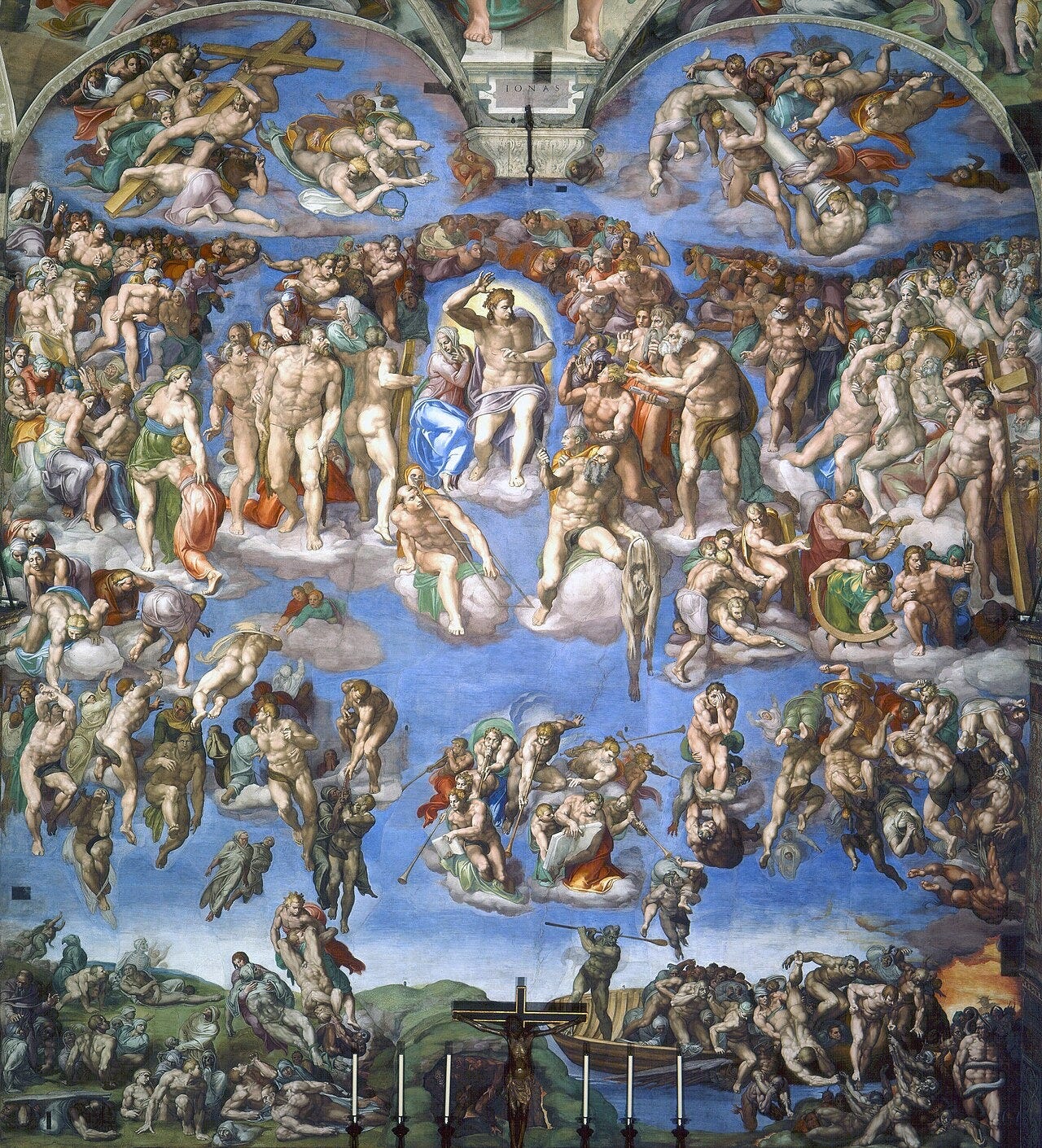
6. Michelangelo, The Last Judgment (1541)
Above the altar of the Sistine Chapel, a young beardless Christ raises his arm and the whole of humanity is dragged up to be saved or hurled down to be damned.
Michelangelo unveiled this storm of more than three hundred bodies in 1541, thirty years after he finished the ceiling above it.
The nudity caused a scandal at once, and soon after his death the church hired a painter to add drapery over the most exposed figures, a man mocked forever after as the breeches maker.
Down among the saved, Saint Bartholomew holds his own peeled skin, and the sagging empty face on it is widely read as Michelangelo's own gloomy self portrait.
7. Raphael, The Transfiguration (1520)
Christ floats in light above a mountain while below, a crowd wrestles with a possessed boy the disciples cannot heal. Raphael was still working on this huge panel when he died suddenly in 1520 at the age of thirty seven, and it was hung above his coffin at the funeral.
He splits the picture in two. Serene glory fills the top, human chaos the bottom, and the gap between them is the whole point, heaven calm and earth desperate for it.
The work was later seized by Napoleon and now hangs in the Vatican, treated as the summit of his short career.
8. Matthias Grunewald, The Isenheim Altarpiece (about 1515)
Christ hangs on the cross with skin that is greenish, torn and studded with sores, the most agonized crucifixion in Western art. Grunewald painted this many paneled altarpiece around 1515 for a hospital run by monks in Isenheim, in what is now eastern France.
The hospital treated a burning skin disease called Saint Anthony's fire, and patients prayed before a Christ who seemed to carry their own symptoms, a God who shared the sickness.
Open the wings, though, and a second scene waits behind the wound, a Resurrection where Christ rises weightless in a blaze of light, so one altar held both the depth of the pain and the promise past it.
9. El Greco, The Burial of the Count of Orgaz (1586)
Saints in gold armor lower a dead nobleman into his tomb while, in the sky above, his soul rises through a crush of angels toward Christ.
El Greco painted this double world for a small church in Toledo in 1586, earth below and heaven above in one towering canvas.
The lower row is a gallery of real faces. El Greco lined up the living gentlemen of Toledo in black, painting his own son and, many think, himself among the mourners.
The flickering, stretched figures up top looked so strange for centuries that some blamed his eyesight, though the distortion was a deliberate Mannerist style all his own.
10. Caravaggio, The Supper at Emmaus (1601)
Two travelers freeze in shock as the stranger sharing their meal blesses the bread and they suddenly know he is the risen Christ.
Caravaggio painted this in 1601, and a hand flies out of the picture toward you while a basket of fruit tips over the table edge.
His Christ is a surprise. Beardless, young and ordinary, lit by a harsh raking tenebrism, he makes the miracle feel like it is happening in a real tavern within arm's reach.
That blunt realism scandalized some clergy and thrilled others, and I trace how he hid meaning in plain sight in the Caravaggio code.
Every detail is loaded. The tipping fruit, the torn bread, the shadow shaped like a fish, all point past the supper to death and faith without a word of text.
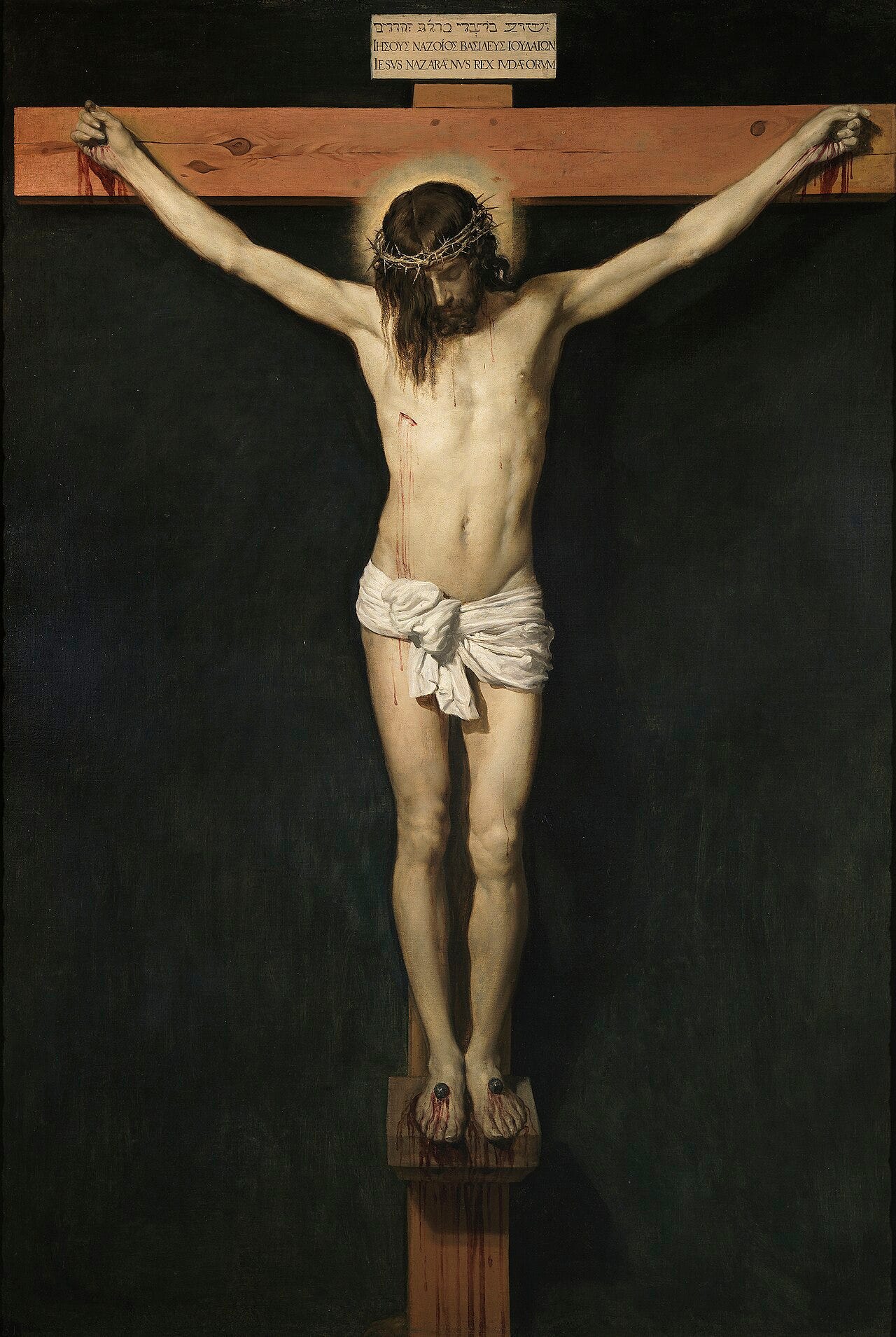
11. Diego Velazquez, Christ Crucified (about 1632)
A single figure hangs alone on a bare cross against pure darkness, head bowed, hair falling across half the face. Velazquez painted this Christ around 1632 with none of the usual crowd or drama, just one body and a great emptiness around it.
The calm is what startles. Where crucifixions usually pile on blood and grief, Velazquez gives near silence, a serene dead Christ closer to private prayer than public show.
It hung quietly for two centuries before the poet Miguel de Unamuno made it famous again in 1920, and it now draws a steady line of visitors at the Prado in Madrid.
12. Rembrandt, The Return of the Prodigal Son (about 1668)
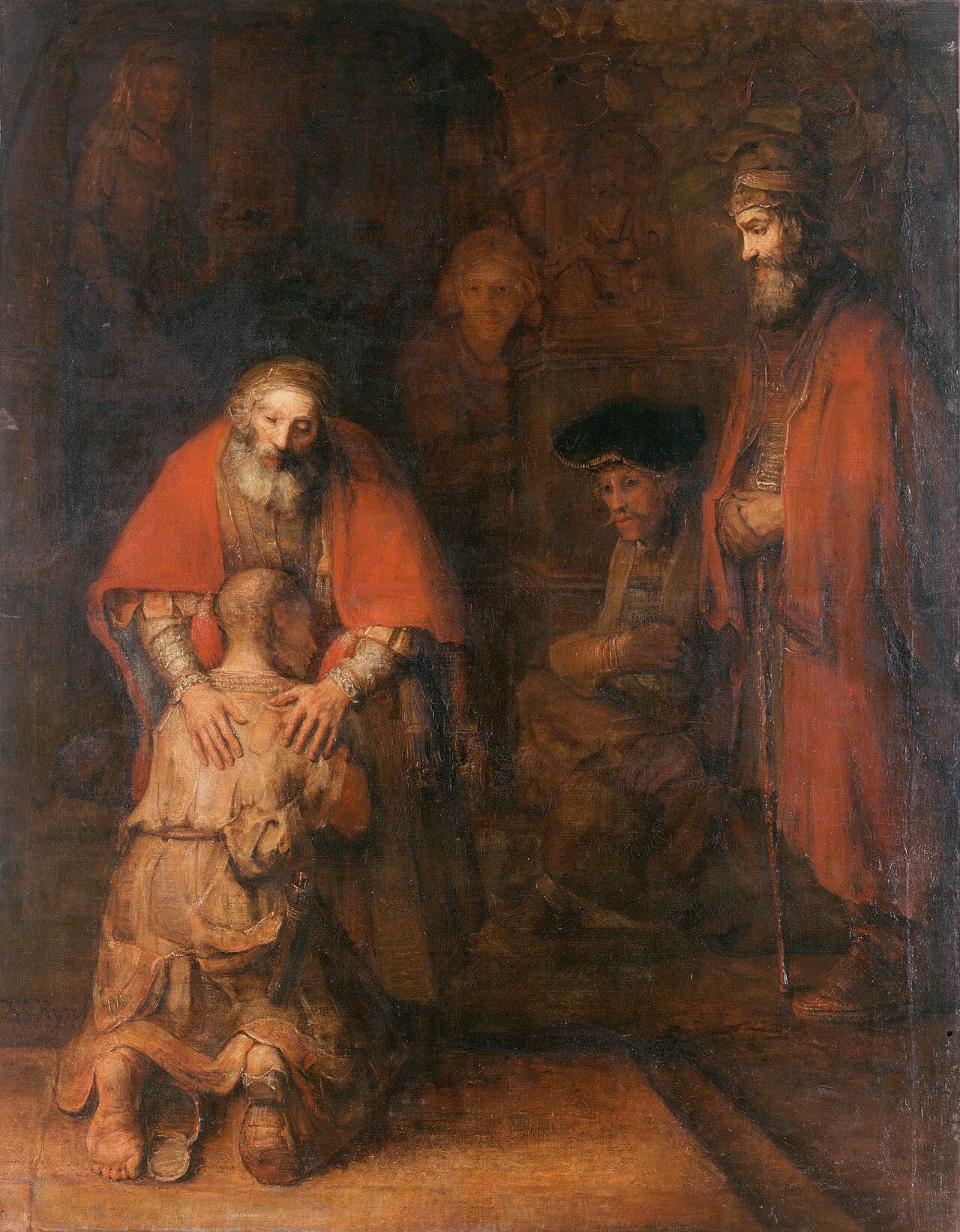
A ragged son kneels and buries his face in his father's chest, and the old man simply lays two worn hands on his back. Rembrandt painted this near the end of his life, around 1668, turning a parable of forgiveness into one of the most tender images ever made.
Many notice that the two hands are not alike, one broad and strong, one slender and soft, as if the father holds his child with both a man's and a woman's touch.
Rembrandt had buried most of his family and lost his fortune by the time he painted it, and the worn tenderness reads like a man who had learned exactly what the story costs.
Where to stand before them
Christ Pantocrator: Saint Catherine's Monastery, Sinai.
Leonardo, The Last Supper: Santa Maria delle Grazie, Milan.
Michelangelo, The Last Judgment: the Sistine Chapel, Vatican.
Raphael, The Transfiguration: the Vatican Museums.
Caravaggio, The Supper at Emmaus: the National Gallery, London.
Velazquez, Christ Crucified: the Prado, Madrid.
Rembrandt, The Return of the Prodigal Son: the Hermitage, Saint Petersburg.
If these sacred scenes drew you in, keep going here:
Inside Monet house at Giverny, room by room, including his own bedroom
The Ambassadors, detail by detail, the object at the bottom that only works from one side
Luncheon of the Boating Party, detail by detail, who everybody at that table actually was
Sacred art, a few honest questions
What is the most famous painting of Jesus? Leonardo's The Last Supper is the most famous, though Warner Sallman's Head of Christ from 1940 is the most reproduced, with an estimated half a billion copies.
What is the oldest painting of Jesus? Among the oldest surviving is the Christ Pantocrator icon at Saint Catherine's Monastery in Sinai, painted around the 500s.
Why is so much old art religious? For a thousand years the church was the main patron, so most painting served the faith, taught its stories and filled its buildings.
What is an altarpiece? A painting, often in hinged panels, set above or behind a church altar, like the Ghent and Isenheim works on this list.
Is The Last Supper a fresco? No. Leonardo used oil and tempera on a dry wall, which is why it started decaying in his own lifetime.
The wall that made you kneel
Line them up and you watch faith learn to feel. A flat golden Christ stares from a desert monastery, then Giotto lets the angels sob, Grunewald lets the wounds fester, Caravaggio drags the miracle down into a tavern, and Rembrandt closes it with two tired hands on a runaway's back.
The most copied of all is none of these. It is Warner Sallman's Head of Christ from 1940, printed in an estimated half a billion copies and hung in homes on every continent, while the pictures that still stop a stranger cold are the ones made five hundred years earlier, for people who could not read the book they illustrated.