
Rembrandt was making his name in Amsterdam at twenty-five, lost his house in the 1650s, and was still painting in his sixties, scratching thick paint with the handle end of a brush. These twelve pictures follow that arc from a teenager's first dated panel to his last years, and in each one he tries something he had not done before.
Cool Stories About Art is a newsletter to learn art the fun way.
Join 200,000+ readers and get:
10 new art stories / month
The entire archive of content (1,000+ articles)
Comment, ask questions, and chat with other readers
A Career in Twelve Stops
Rembrandt's career has clear stages, which is why a life in twelve paintings works. He began as a teenager in Leiden, made his name painting portraits in Amsterdam, went bankrupt in the 1650s, and kept working until he died in 1669.
The list opens with a painting from his teens and ends with the picture the world knows best. Each painting is here for what its story shows about Rembrandt at that moment: a commission, a risk, a failure or a loss.
12. The Stoning of Saint Stephen (1625)
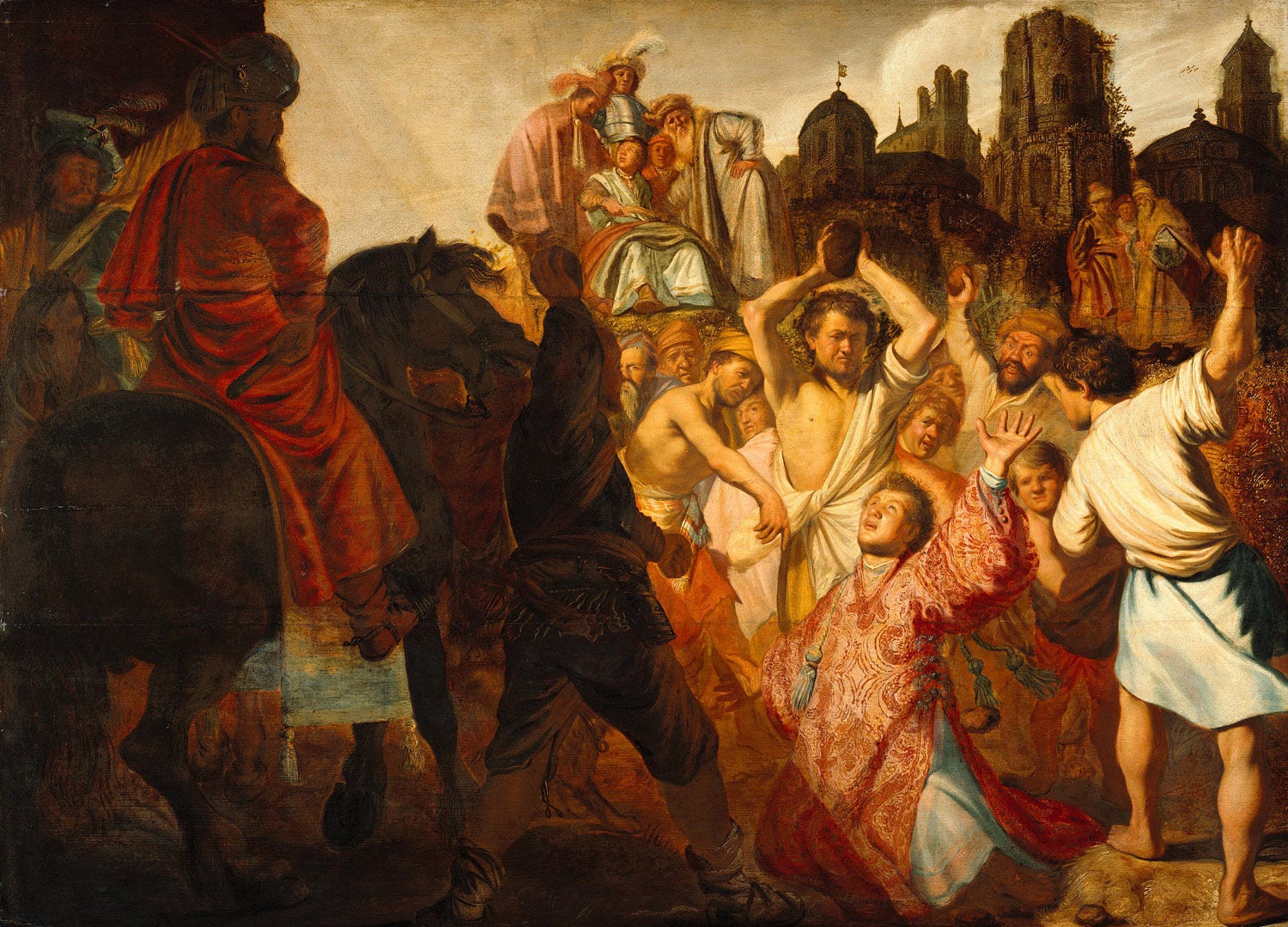
Just above the kneeling saint's head, one face in the crowd is thought to be Rembrandt's own. In The Stoning of Saint Stephen, a young man in crimson kneels with his hands raised while a crowd closes in, and a bare-chested man lifts a stone above his head. The saint is about to die for his faith.
The date is 1625 and the place is Leiden, his hometown. Rembrandt was still a teenager and had only just left the Amsterdam studio of Pieter Lastman, a leading painter of Bible scenes, whose influence is still easy to see.
The panel's own story is the stranger part. The museum in Lyon bought it in 1844 as a Rembrandt, doubts surfaced soon afterward, and they lasted until 1962, when an art historian found a signature with a date on the panel.
That date makes it the earliest dated painting known by Rembrandt, so a picture doubted for more than a century is where his dated work begins.
At a Glance
Artist: Rembrandt van Rijn (1606 to 1669)
Painted: 1625
Medium: Oil on panel
Size: 89 × 123 cm (35 × 48.4 in)
Where to see it: Musée des Beaux-Arts, Lyon
About This Painting
Who was Saint Stephen?
Stephen, a deacon of the early Christian community in Jerusalem, defended his faith before the Jewish council and was stoned to death. He is regarded as the first Christian martyr.
11. The Blinding of Samson (1636)
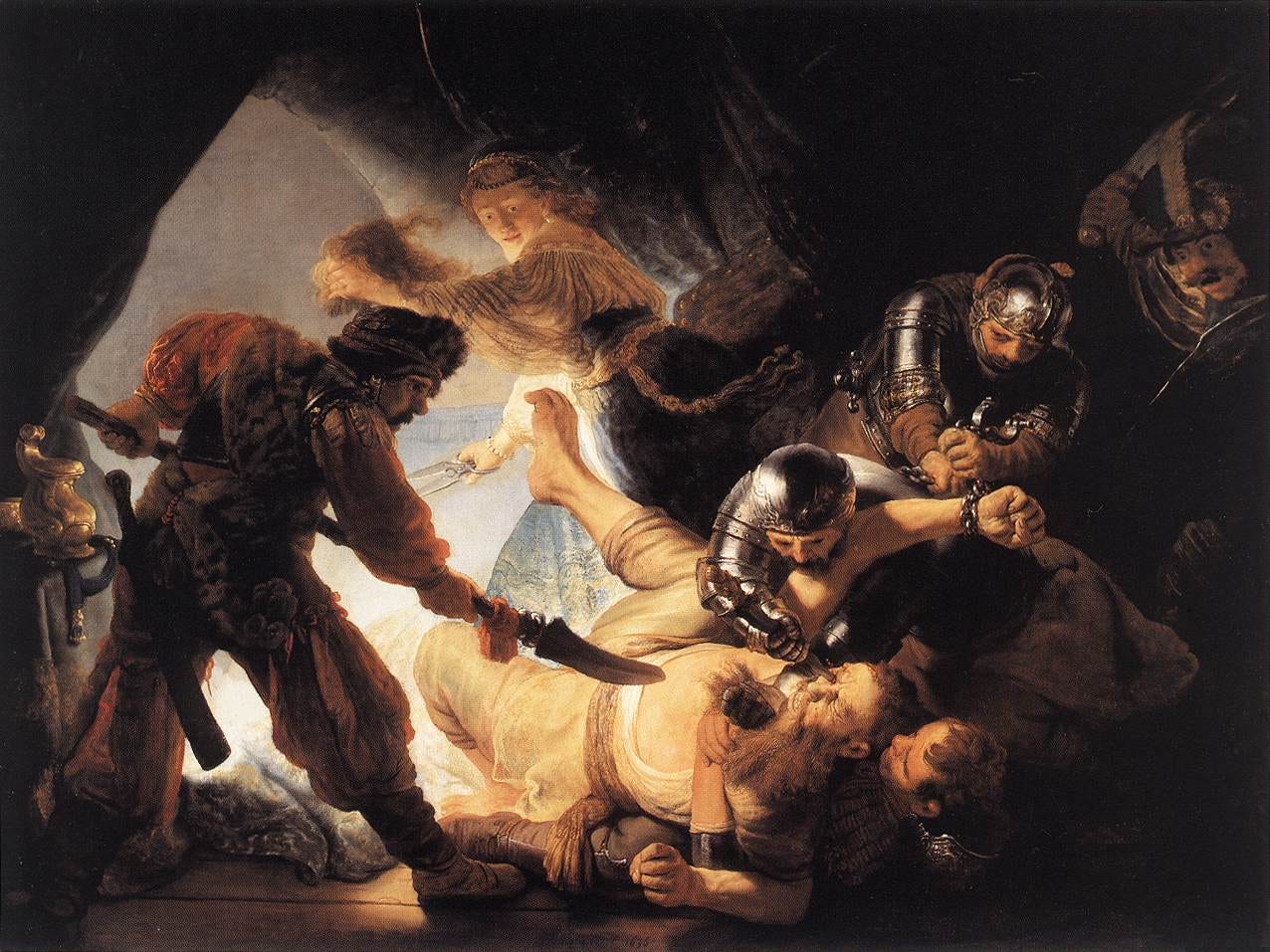
At the left of a dark cave, a woman slips out into the daylight with a pair of scissors in one hand and a lock of hair in the other. Behind her, soldiers pin a man on his back while one of them drives a dagger into his eye. The woman is Delilah and the man is Samson, and in The Blinding of Samson Rembrandt paints what painters in Rubens's tradition left out. They showed the capture. He shows what follows, while it is happening.