
In little more than a century, painters in Florence, Venice, Rome and the trading towns of the Low Countries learned to open a flat wall like a room and to make a painted face look alive. Their pictures are now among the most visited in the world, yet several were first known by other names, and one never reached the man who ordered it.
Cool Stories About Art is a newsletter to learn art the fun way.
Join 200,000+ readers and get:
10 new art stories / month
The entire archive of content (140+ articles)
Comment, ask questions, and chat with other readers
How These Were Chosen
Renaissance painting began in Florence in the early 1400s and spread to Rome, Venice and the Low Countries. Medieval painters often set their saints against flat gold. Renaissance painters put them in deep rooms and open landscapes, and gave them real weight and real faces.
They also brought the myths of Greece and Rome back beside the Bible, and in the North oil paint let artists render cloth, skin and light up close. Men once ranked as craftsmen now worked for popes and princes.
This list holds twelve paintings by twelve painters, from Italy and from northern Europe, across the whole period. I ranked them by how famous they are today and by how much they changed painting, so number 1 is the most famous of all.
12. Giorgione, The Tempest (about 1503 to 1509)
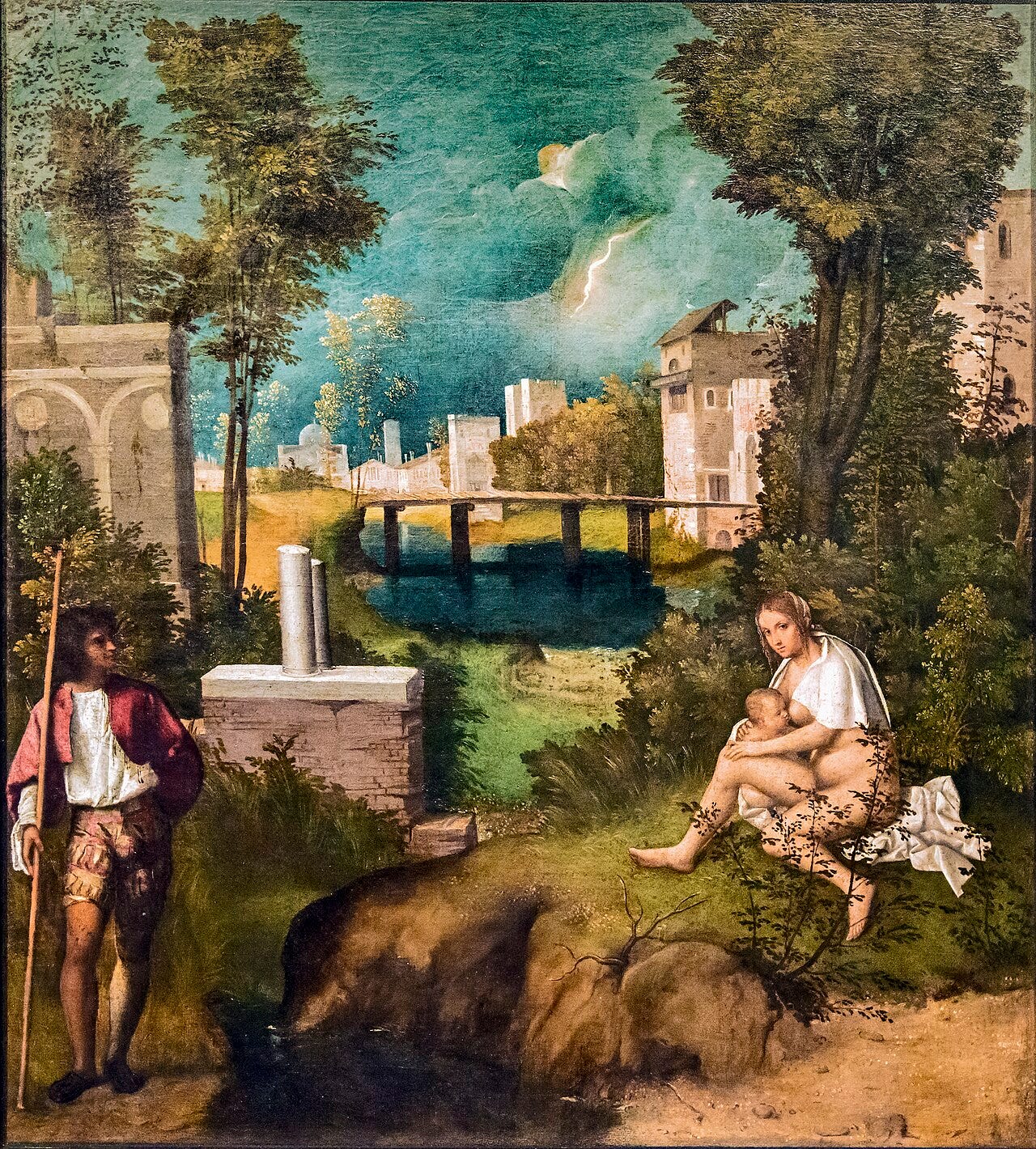
Above the rooftops of a small river town in The Tempest, a thin white bolt of lightning cracks a greenish sky. Below it, on the left bank, a young man leans on a long staff. Across the stream, a woman sits almost naked on the grass, nursing a baby and looking out of the picture. Neither of them turns toward the storm.
The painter is Giorgione, and almost everything about him is uncertain. He spent his whole career in Venice and died there of the plague, probably still young. He painted The Tempest sometime between 1503 and 1509, and so little is known of his life that the count of his surviving pictures runs from fewer than ten to more than thirty.
That uncertainty makes the earliest description of the canvas all the more valuable. In 1530 it hung in the palace of Gabriele Vendramin, a rich Venetian nobleman who had most likely ordered it around 1504.
A patrician named Marcantonio Michiel, who kept notes on the pictures in private Venetian houses, saw it there. He wrote: "The little landscape on canvas with the storm, with the gypsy and soldier, was by the hand of Giorgio da Castelfranco." The landscape and the storm come first in his sentence, and the people only after.
Four centuries later, an X-ray showed that Michiel's order had also been Giorgione's. Taken in 1939, it revealed that the countryside was painted first, and the figures set on top of it once it was finished. Where the young man now stands, Giorgione had first painted a nude woman sitting on the bank, before covering her over.
Since then, the two figures have drawn more than a hundred interpretations, and none has won.
At a Glance
Artist: Giorgione (about 1477 to 1510)
Painted: About 1503 to 1509
Medium: Oil on canvas
Size: 82 × 73 cm (32.3 × 28.7 in)
Where to see it: Gallerie dell'Accademia, Venice
11. Masaccio, The Holy Trinity (about 1425 to 1427)
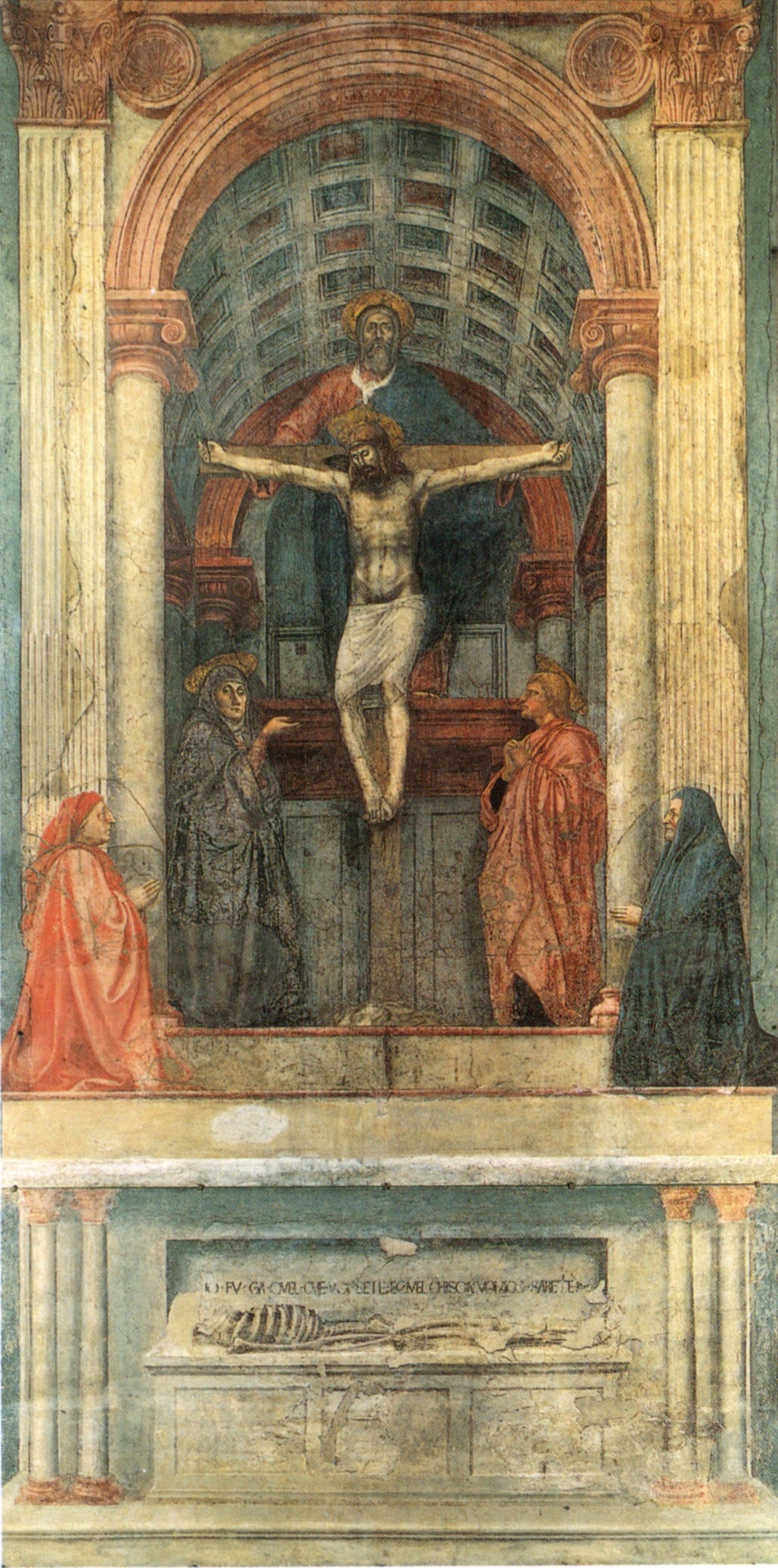
Along the left aisle of Santa Maria Novella, in Florence, a barrel vault seems to open into the stone. Under its coffered ceiling, God the Father holds up the cross of Christ, with Mary and Saint John on either side.
Outside the painted columns kneel a husband and wife, and below them a skeleton lies on a stone tomb. Masaccio painted this Holy Trinity between about 1425 and 1427, and the chapel that seems to run back into the wall is only paint on flat plaster.