
The French painter Pierre-Auguste Renoir painted happy Sundays, sunlit cafés and pink cheeks for fifty years, from a summer on the Seine at 28 to the last large canvas he finished, in the year he died.
He had to fight for them. A critic said his colors looked like rotting flesh, the French state bought nothing from him until he was 51, and in old age his hands stiffened around the brush.
Cool Stories About Art is a newsletter to learn art the fun way.
Join 200,000+ readers and get:
10 new art stories / month
The entire archive of content (140+ articles)
Comment, ask questions, and chat with other readers
Skin, Light and the People He Knew
Renoir painted people more than places. Friends lingering at a long meal, models found in the street, a publisher's wife, an acrobat who later became a painter herself: nearly every canvas he made is filled with someone he knew, caught at leisure.
Around those people, one problem held him for half a century: how to paint skin in light. At first he broke it into patches of color. In his forties he closed it inside a firm outline. In his last years he joined the two, with solid, rounded bodies bathed in warm reds and pinks.
His life ran less smoothly than his pictures. He was broke at the start, mocked in his thirties, in fashion by forty, then in doubt, and ill through his last decades.
12. Study: Torso, Effect of Sunlight (about 1875 to 1876)
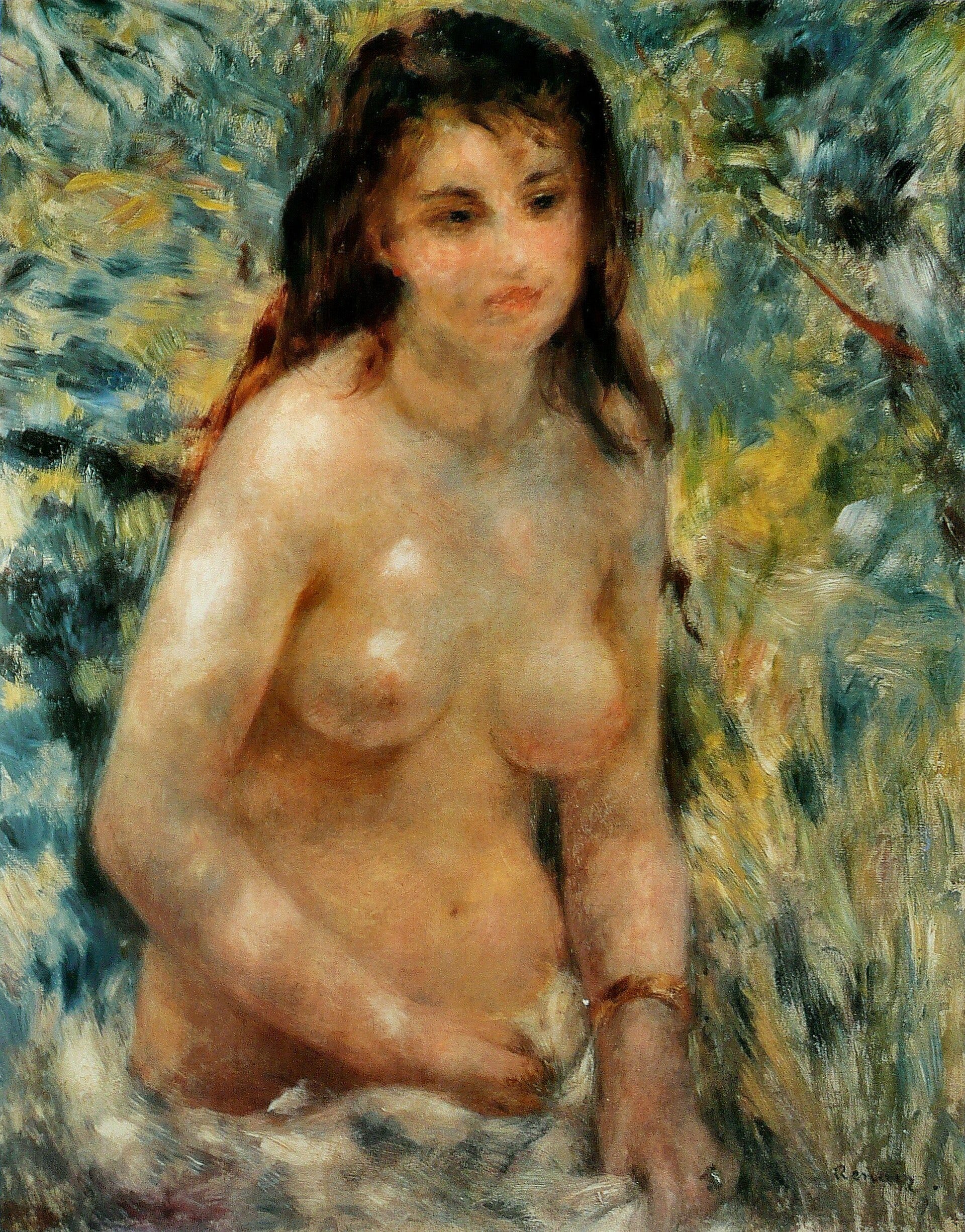
Patches of violet and blue lie across the chest and shoulder of the woman in Study: Torso, Effect of Sunlight, as if someone had scattered colored glass over her skin. They are sunlight, broken up by the leaves above her. Renoir showed the model only from the waist up, against a wall of green, and he meant the canvas as an experiment.
To see what he was testing, it helps to know what a nude was supposed to look like in those years. The nudes that won medals at the official Salon, the great annual exhibition in Paris, had smooth, even skin, shaded from light to dark like polished marble.
Renoir wanted the opposite. He set out to show what happens to a body under trees, where the light arrives in pieces and the shadows pick up the green of the leaves and the blue of the sky.
Renoir, then in his mid-thirties, belonged to a group of young painters who had stopped waiting for the Salon. Its jury had turned down their work too often, so in 1874 they organized an exhibition of their own in Paris.
A critic who mocked a harbor view by Claude Monet there, Impression, Sunrise, called them the Impressionists, and the name stuck. In April 1876 they held a second show, in the gallery of the Paris art dealer Paul Durand-Ruel, and the nude hung there.
That is where Albert Wolff saw it. The most feared critic of the Paris daily Le Figaro, he asked on April 3, 1876, for someone to explain to Monsieur Renoir "that a woman's torso is not a mass of decomposing flesh," and he compared the green and violet spots to the marks on a corpse.
At a Glance
Artist: Pierre-Auguste Renoir (1841 to 1919)
Painted: About 1875 to 1876
Medium: Oil on canvas
Size: 81 x 65 cm (31 7/8 x 25 5/8 in)
Where to see it: Musée d'Orsay, Paris
11. La Grenouillère (1869)
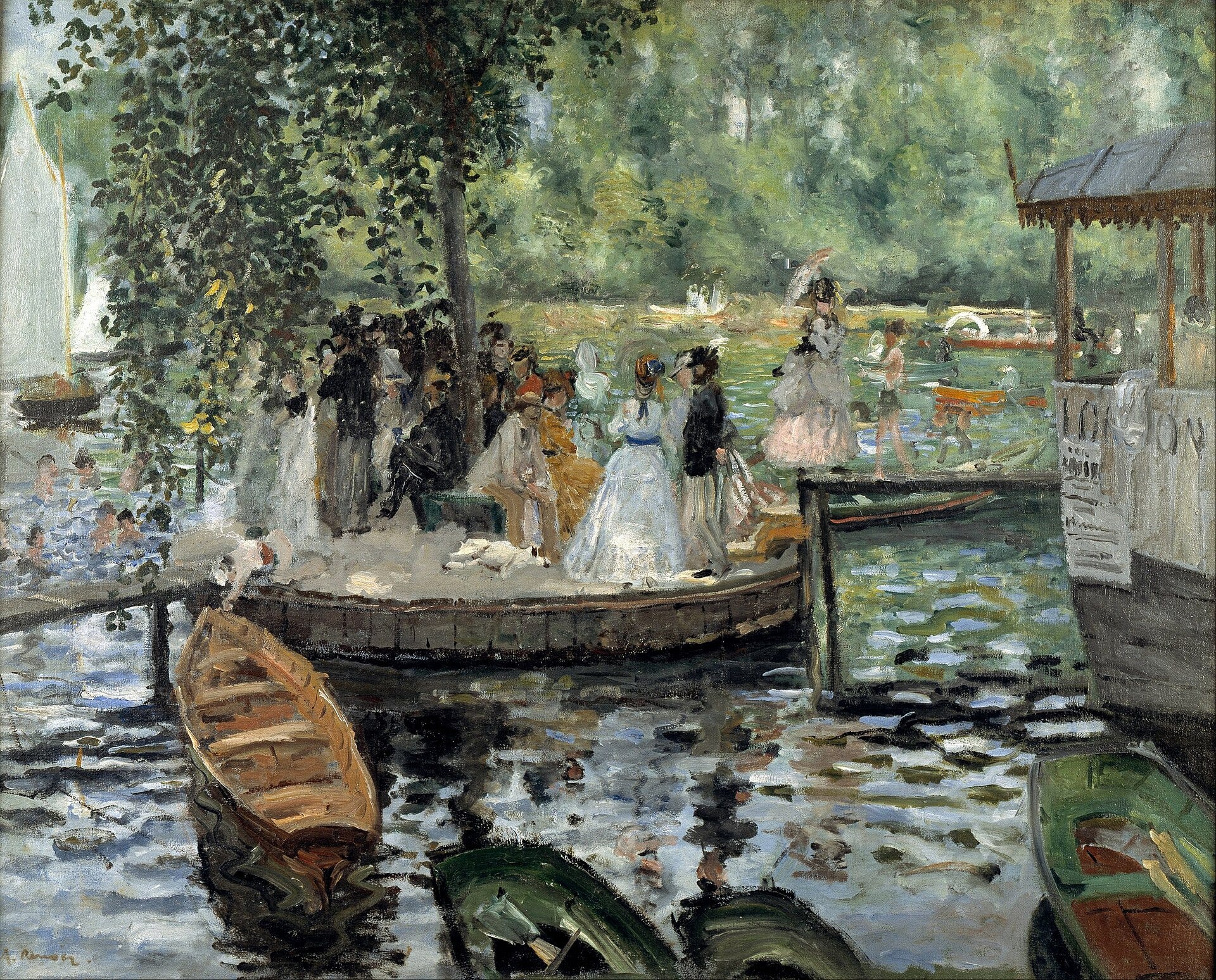
A tiny round island, crowded with people standing around a single tree, floats on the river in La Grenouillère, a bathing place on the Seine west of Paris. Renoir painted it in the summer of 1869, when he was 28 and broke.
He was not alone. His friend Claude Monet, just as poor, had planted his easel next to Renoir's, facing the same island. They were looking at the same water, and they did not see the same thing.