Famous Rococo Paintings: 12 Icons of a Frivolous Age
After the heavy drama of the Baroque, art got light, pretty and a little naughty.
Rococo swept through the palaces of the seventeen hundreds like whipped cream, all pastel color, curling gold, garden trysts and powdered flirtation, made for aristocrats who wanted pleasure, not preaching.
Here are twelve of the most famous Rococo paintings, all now in the public domain. I have gathered the works that turned a whole century of privilege into pure, guilty delight.
Three that reward the time
Three that take a single painting apart, properly:
Twelve famous portraits and the real people, the faces behind the paintings
The Arnolfini Portrait, detail by detail, the mirror, the dog, and the question everyone asks
The secret behind Monet Magpie, one bird in the snow, and why it matters
1. Jean Honore Fragonard, The Swing (1767)
A young woman in a froth of pink silk kicks off her shoe as she swings, while her lover lies hidden in the bushes below, gazing straight up her billowing skirts.
Fragonard packed the whole spirit of Rococo into one cheeky picture, flirtation, secrecy and expensive fun in a lush private garden. An elderly bishop pushes the swing from behind, unaware he is helping the affair along.
Every leaf and ruffle is painted with dizzy, sugary energy. It is the most famous Rococo painting in the world, and the flying shoe has been echoed everywhere since, right down to a wink at it in Disney's Frozen.
2. Antoine Watteau, The Embarkation for Cythera (1717)
Elegant couples drift through a golden evening garden toward a boat that will carry them to Cythera, the mythical island of love.
Watteau invented a whole new kind of painting for this, the fete galante, a dreamy outdoor party of music, courtship and gentle melancholy.
Look closely and the mood is bittersweet, the lovers already half reluctant to leave the enchanted afternoon. He painted it to be admitted to the French Academy, which had no category for such a thing and simply invented one for him.
Watteau was dying of tuberculosis as he painted these carefree scenes, and was gone by thirty six.
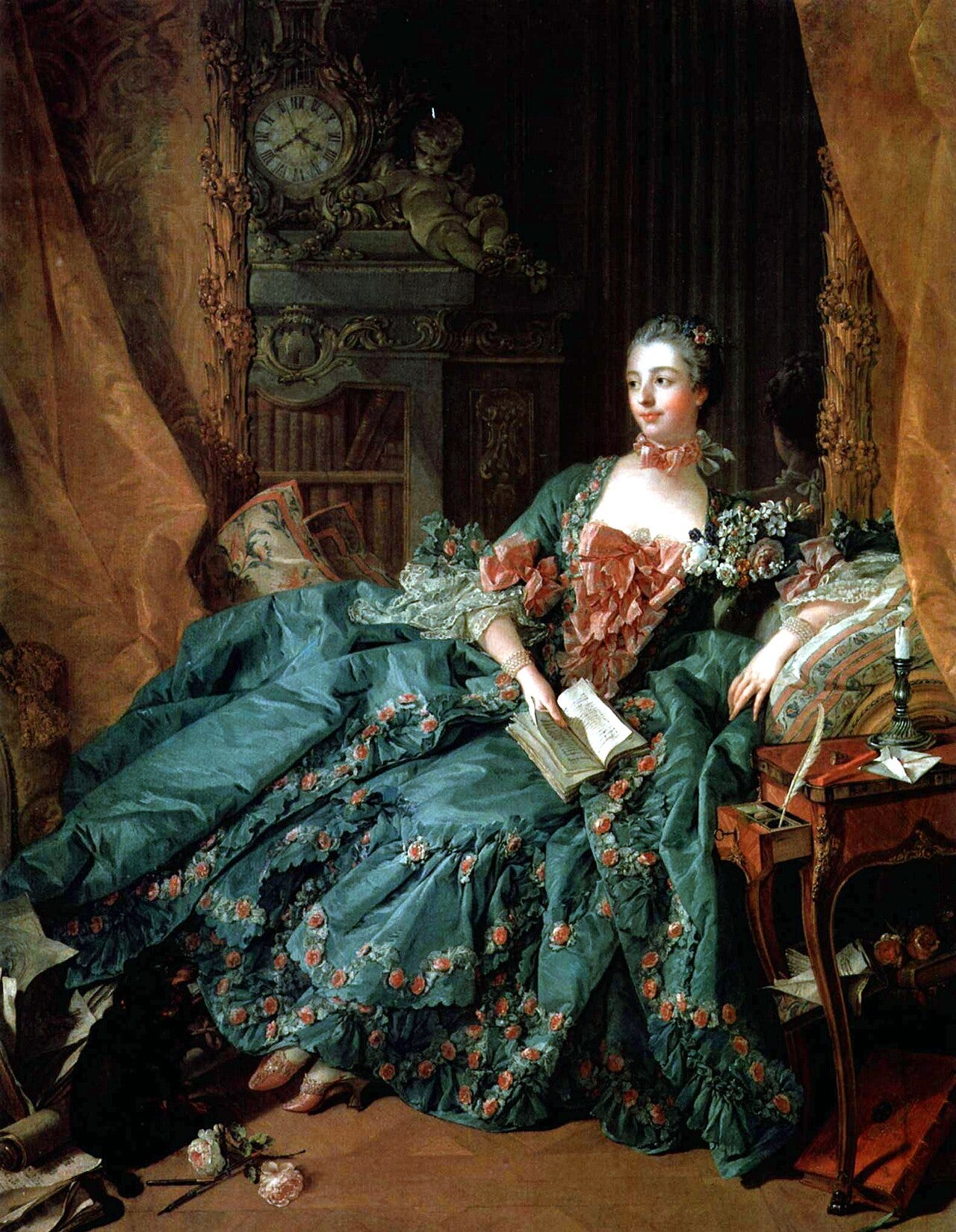
3. Francois Boucher, Madame de Pompadour (1756)
The most powerful woman in France reclines in a sea of green silk, a book in her hand, surrounded by the roses, mirrors and clocks of a life of luxury.
Boucher painted his patron Madame de Pompadour, the mistress of King Louis the Fifteenth, less as a lover than as a woman of taste and learning.
She helped make Boucher the most fashionable painter in France, and Rococo the official style of the court.
The portrait is all soft skin, silver lace and pale rose, the very color scheme of the age. Pompadour steered the taste of a whole nation from her rooms, and even the pink of the Sevres porcelain works was named in her honor.
4. Thomas Gainsborough, The Blue Boy (about 1770)
A young man in a glossy blue satin suit stands with easy confidence against a stormy sky, in the most famous boy in British art. The picture began partly as a challenge, with Gainsborough using cold blue where his rival Joshua Reynolds insisted blue could never carry a whole painting.
The costume is deliberately old fashioned, a tribute to van Dyck a century before. For years nobody knew who the boy was, though he was probably the son of a rich hardware merchant.
In 1921 it was sold to an American railway magnate and left England, and the whole nation lined up to say goodbye.
5. Giambattista Tiepolo, Apollo and the Four Continents (1753)
Above a grand German staircase, Tiepolo painted the largest fresco ceiling in the world, the sun god Apollo rising over figures who stand for the four known continents.
Europe sits in splendor with the arts, while America rides a crocodile and Africa perches on a camel, all beneath a sky of impossible light and space.
Tiepolo was the last great master of the Venetian ceiling, painting heaven as a giddy, sunlit party. He finished the whole enormous vault in about a year, working from scaffolds high in the air.
When a bomb hit the palace in 1945, the great ceiling somehow survived the flames.
6. Jean Baptiste Simeon Chardin, Soap Bubbles (about 1734)
While the court frolicked, one quiet Parisian painted a boy blowing a single soap bubble, and made it unforgettable. Chardin turned away from the pastel frivolity of Rococo and painted ordinary people and humble things, a bubble, a jug, a slice of bread, with grave tenderness.
The bubble is an old symbol, a reminder of how quickly life and beauty burst. He built his surfaces from thick, grainy paint that looks abstract up close and solid from across the room.
Chardin was the still, honest heart of an age of froth, admired centuries later by Cezanne and Matisse.
7. Elisabeth Vigee Le Brun, Self Portrait in a Straw Hat (about 1782)
The most successful woman painter of the century smiles out from under a feathered straw hat, palette in hand, fresh and natural as a spring morning.
She painted it after seeing a Rubens portrait of a woman in a hat, and set out to match its glow using real daylight. She was the favorite portraitist of Queen Marie Antoinette and painted her more than thirty times.
When the French Revolution came she fled in the night and spent twelve years painting the courts of Europe in exile. She left around six hundred portraits and a memoir that still sparkles.
8. Canaletto, The Grand Canal, Venice (about 1730)
Canaletto painted Venice so crisply and so often that his views became the postcards of the eighteenth century, snapped up by rich Englishmen on the Grand Tour.
Here the Grand Canal sweeps into the distance under a wide blue sky, every palace, gondola and reflection set down with cool precision.
He may have used a camera obscura, a lens box that projected the scene onto paper, to get the perspective exactly right.
Most of his best views left Venice for English country houses, where many still hang. He sold so well that his agent shipped whole crates of painted Venice back to London.
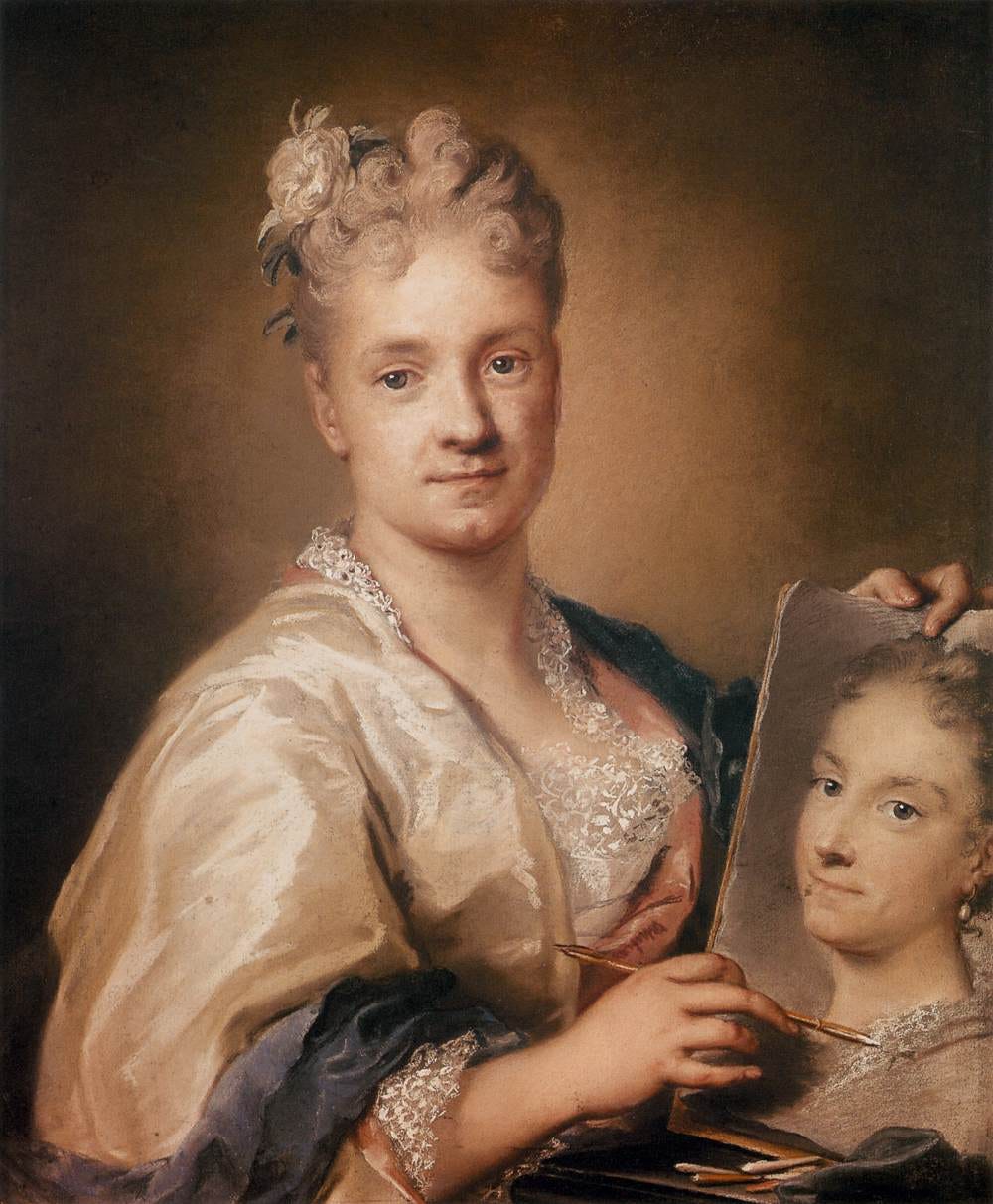
9. Rosalba Carriera, Self Portrait (1715)
Rosalba Carriera made pastel fashionable across Europe and became the most sought after portraitist of her day, courted by kings and popes.
She worked in soft, powdery chalk rather than oil, catching skin, lace and powder with a lightness that suited the age perfectly.
Every grand tourist who reached Venice wanted a Rosalba portrait to carry home. In this self portrait she holds up a small picture of her sister, her own face open and unflinching.
She went blind at the end of her life, unable to see the delicate colors that had made her famous.
10. Antoine Watteau, Pierrot, known as Gilles (about 1719)
A sad clown in a baggy white satin costume stands facing us, arms limp, staring out with a look of helpless, dignified melancholy.
Watteau painted this life size figure of Pierrot, a stock character from the Italian comedy, perhaps as a signboard for a cafe run by a retired actor.
Behind and below him other players laugh and jostle, while the clown stands alone and still, oddly moving. It is strange and modern, a Rococo picture that feels almost sad.
Rediscovered a century after Watteau's death, it was bought for the Louvre in 1869, where its lonely clown still stops people in their tracks.
11. Jean Baptiste Greuze, The Village Bride (1761)
A country family gathers as a father hands a purse of dowry to his daughter's new husband, every face wet with tears of tender feeling.
Greuze made his name with these moralizing family dramas, staged like little theater scenes and packed with virtuous emotion.
The public wept, the philosopher Diderot cheered, and for a moment Greuze was the most talked about painter in Paris. He offered feeling and virtue where Boucher offered pleasure, a first sign that the frivolous age was tiring of itself.
When taste turned to stern Neoclassicism, Greuze was left behind and died forgotten and poor.
12. William Hogarth, Marriage A la Mode (1743)
An English painter looked at all this powdered luxury and set out to mock it, in a savage comic series of six paintings about a doomed society marriage.
Hogarth followed a bored young lord and his merchant's daughter bride from their loveless wedding to disease, adultery, murder and suicide. Every room is stuffed with clues, bad art on the walls, a spot of illness, a lawyer whispering in a corner.
He sold prints of the series so ordinary people could laugh at their betters, and to protect them he helped push the first real copyright law for artists through Parliament.
The six original paintings now hang side by side in the National Gallery in London.
What people ask about Rococo
What is Rococo art? A light, ornate style of the early to mid seventeen hundreds, full of pastel color, curves, gold and scenes of love and leisure.
How is Rococo different from Baroque? Baroque is grand, dark and dramatic; Rococo is smaller, lighter, prettier and more playful.
Who are the most famous Rococo painters? Watteau, Boucher and Fragonard in France, Tiepolo in Italy and Gainsborough in England.
What does the word Rococo mean? It comes from rocaille, the fancy shell and rock work used in garden grottoes, and began as a mocking nickname.
Why did Rococo end? It came to stand for the excess of the aristocracy, and was swept away by stern Neoclassicism and the French Revolution.
If these frothy paintings pulled you in, you will love these too:
Lady with an Ermine, detail by detail, why she is holding that animal
Titian, Sacred and Profane Love, which of the two women is which
The Last Supper, detail by detail, the detail hiding at that table
The last party
Rococo was the art of a world that did not know it was ending. For fifty years the palaces of Europe filled with pink clouds, garden swings and powdered smiles, all paid for by a system about to collapse.
When the Revolution came, this frothy, gorgeous style became a symbol of everything people wanted to tear down. Yet strip away the politics and it is still a delight, the sound of a whole century laughing before the lights went out.