Famous Romantic Paintings: 12 Storms of Emotion
The most famous Romantic paintings threw out cool reason and chased raw feeling, storms and shipwrecks, freedom and nightmares, the terror and glory of nature. Here are twelve of the greatest, all now in the public domain.
Romanticism swept Europe from about 1800 to 1850, a rebellion of the heart against the tidy rules of the age before it. I have gathered the pictures that still hit hardest, from a raft of the dying to a god eating his own son.
What drives them:
The sublime. Nature as something vast, beautiful and ready to kill you.
The feeling. Emotion over reason, the wilder the better.
The politics. Revolution, freedom and real disasters, painted huge.
The dark. Nightmares, madness and horror, dragged into the light.
For anyone who wants more than a caption
The ones I would send you to next:
Was Monet really the first Impressionist, the painting that may have got there first
The secret behind Monet Magpie, one bird in the snow, and why it matters
Lady with an Ermine, detail by detail, why she is holding that animal
1. Caspar David Friedrich, Wanderer above the Sea of Fog (1818)
A lone man in a dark coat stands on a crag, his back to us, gazing over a sea of swirling fog and half drowned peaks. It has become the face of Romanticism itself, a soul alone before the infinite.
Friedrich never shows the man's face, so the view becomes yours.
We do not even know for certain who the figure is, though some think it a memorial to a dead friend. Nothing about the pose is triumphant, whatever the posters suggest, it is closer to melancholy and awe.
It hangs now in the Hamburger Kunsthalle, the most reproduced image German Romanticism ever produced.
2. Theodore Gericault, The Raft of the Medusa (1819)
Survivors pile onto a makeshift raft, some already dead, one waving a rag at a speck of a ship on the horizon. The wreck was real, a French frigate lost in 1816, and its castaways had drifted thirteen days into starvation, murder and cannibalism.
I tell the full grim story in the untold story of the raft.
To paint it, Gericault interviewed survivors, built a model raft, and studied real corpses and severed limbs for the exact color of death.
He was twenty seven, and the huge canvas was an open attack on the government that let it happen. A private disaster became a public scandal that would not fade.
3. Eugene Delacroix, Liberty Leading the People (1830)
A woman carrying the tricolor strides over a barricade of bodies, a musket in one hand, a boy with pistols at her side. She is Liberty herself, half real fighter and half goddess, leading a Paris uprising in July 1830.
Delacroix turned a street revolt into history painting on the grandest scale.
The new king bought the painting, then hid it away for years, afraid it might inspire the next revolt. That face on the barricade would go on to become Marianne, the symbol of France itself.
It hangs in the Louvre now, and the same figure has since appeared on French stamps and banknotes.
4. J.M.W. Turner, The Fighting Temeraire (1839)
A ghostly white warship is towed down the Thames at sunset by a small, dark steam tug belching smoke. The great ship had fought at Trafalgar, and here she is dragged to the breaker's yard to be scrapped.
Turner made her last voyage an elegy for a whole vanishing age.
The pale sailing ship and the grubby little steamer are the old world and the new, met for a moment on the water. Turner refused to sell the picture and kept it to the end of his life.
In 2005 the British public voted it the greatest painting in the country.
5. Francisco Goya, The Third of May 1808 (1814)
On the night of the third of May, 1808, Napoleon's soldiers shot Madrid civilians in reprisal, and Goya painted it as pure horror.
A man in a white shirt throws his arms wide before the firing squad, lit by one harsh lantern, the soldiers faceless as machines.
Few pictures show Goya at his most furious.
The victim's pose, arms flung out with a wound in his hand, deliberately echoes the crucified Christ. Goya gives the viewer no heroes and no glory, only killing in the dark.
Picasso studied it closely before he painted Guernica, the next century's great howl against war.
6. Henry Fuseli, The Nightmare (1781)
A woman sprawls asleep, thrown back over the edge of her bed, while a squat demon crouches on her chest and a horse with blazing eyes pushes through the curtains.
Nothing quite explains it, which is exactly why it burrows into you. Fuseli built the whole picture out of dread and desire.
The title hides a pun, the incubus demon and the ghostly night mare, an old word for a bad dream. It scandalized and thrilled London when it was shown in 1782, and copies sold everywhere.
Centuries later a print of it hung on the wall of Sigmund Freud's study.
7. Caspar David Friedrich, The Sea of Ice (1824)
Great slabs of ice heave up in a frozen sea, and buried in the wreckage lies the crushed stern of a ship, almost too small to notice.
Here is nature as a silent, grinding executioner, indifferent to the men it has killed. Friedrich gave it the bleakest of titles, a wreck of all hope.
The picture was so cold and strange that it found no buyer in his lifetime and was nearly forgotten. There is no rescue and no drama of struggle, only the aftermath of total defeat.
It looks a hundred years ahead of its time, closer to modern art than to 1824.
8. Eugene Delacroix, The Death of Sardanapalus (1827)
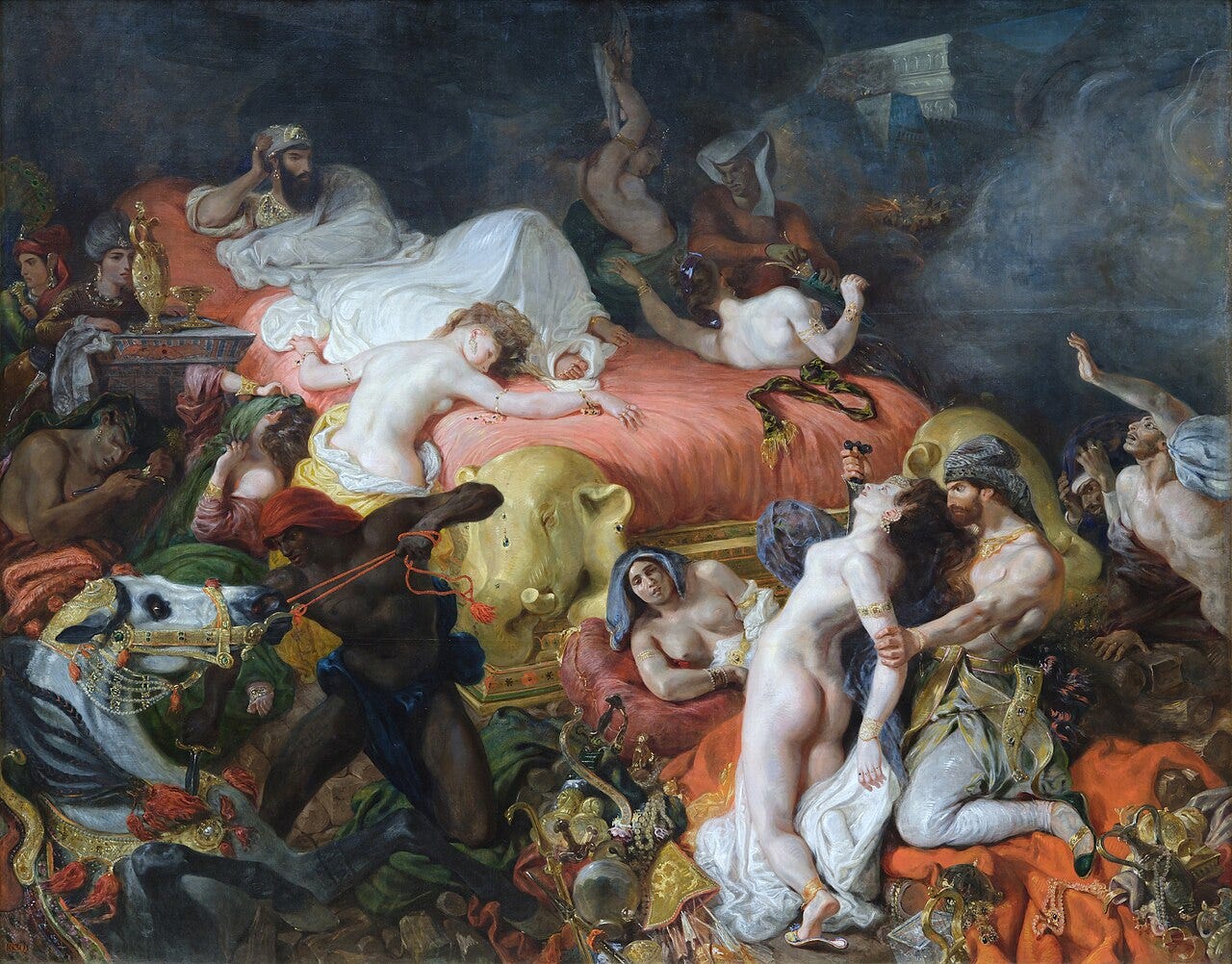
Told his kingdom is lost, an ancient king decides that nothing he owns will outlive him. Delacroix shows Sardanapalus stretched on a vast red bed while his slaves, horses and treasures are slaughtered around him at his command.
He piled the canvas with color, flesh and cruelty until it nearly bursts.
The scene comes from a poem by Lord Byron, the Romantic idol of the age. Critics at the 1827 Salon were appalled by the chaos and the glee, and it hurt his career for years.
Delacroix never sold it, and it reached the Louvre only in 1921, almost a century on.
9. J.M.W. Turner, The Slave Ship (1840)
A blazing orange sea churns with drowning figures, chained hands and legs reaching up among the fish, a ship fleeing a storm beyond.
Turner based it on a real atrocity, a slave ship whose captain threw the sick and dying overboard to claim the insurance.
The beauty of the sunset makes the horror worse.
He showed it in 1840 as Britain argued over the evils of slavery, a painting that forced people to look. The critic John Ruskin was given it by his father and called it Turner's finest work, then admitted he could no longer bear to keep it.
He sold it in the end, and it hangs today in Boston.
10. William Blake, The Ancient of Days (1794)
A bearded god crouches inside a blazing sun and reaches down with a golden compass, measuring the darkness below. This is not the loving creator but Urizen, Blake's figure for cold reason boxing in the infinite.
Blake, poet and printmaker, saw pure logic as a kind of prison.
He printed it himself with his own strange method and colored every copy by hand. It was reportedly his favorite of all his designs, and he worked on a version on his deathbed. The compass that looks divine is really drawing the bars of a cage.
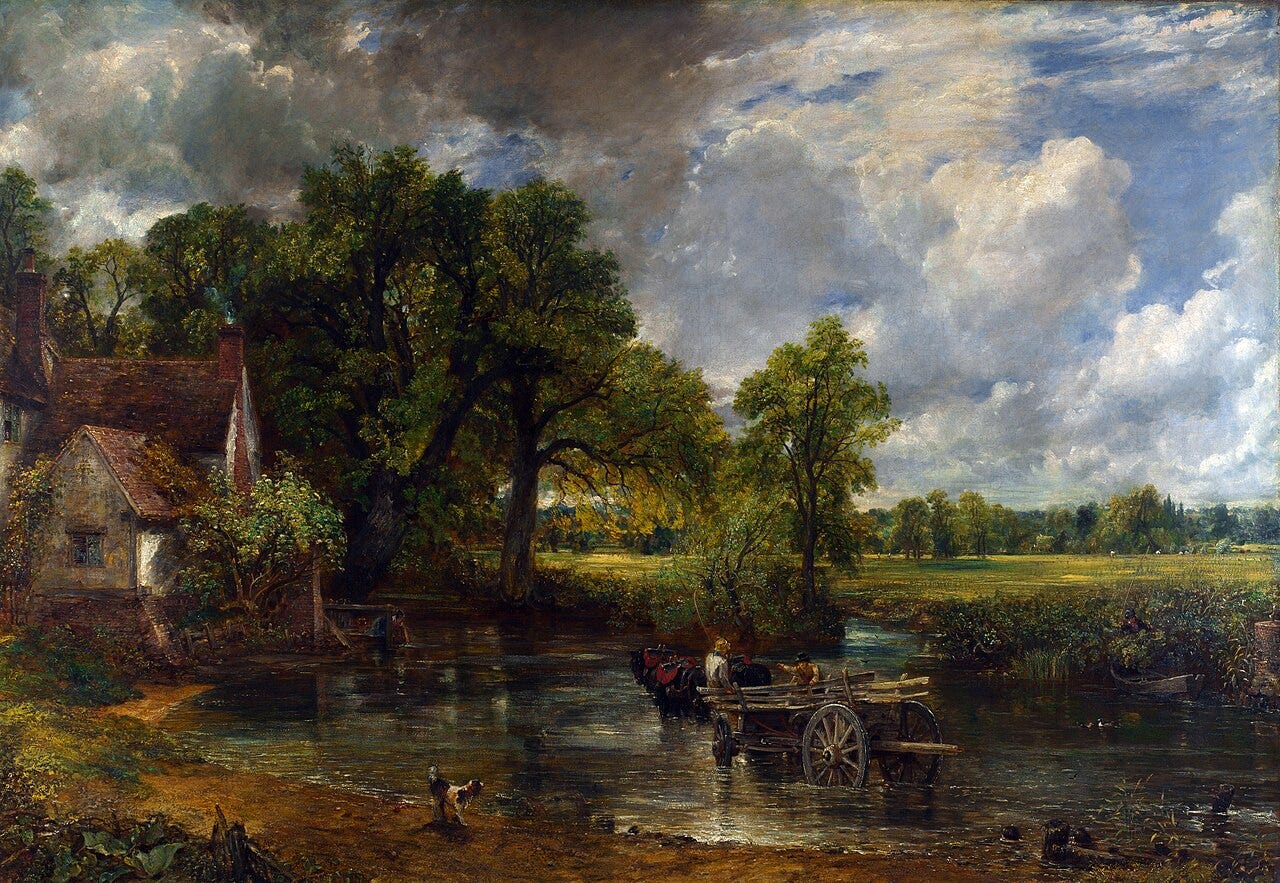
11. John Constable, The Hay Wain (1821)
England shrugged at it, yet this quiet hay cart would go on to shake European painting. Constable shows the cart pausing to cross a shallow river beside a cottage, under a wide English sky full of moving cloud.
That calm was its own rebellion against grand historical subjects.
When the picture hung in Paris in 1824 it won a gold medal and amazed the French. The young Delacroix saw it and repainted parts of his own work after the shock. A quiet hay cart helped push European painting toward Impressionism.
12. Francisco Goya, Saturn Devouring His Son (1823)
Goya never meant anyone to see this one. He painted it straight onto the wall of his own house, a wild eyed giant stuffing a headless body into his mouth, the god Saturn eating his children to stop them overthrowing him. It is madness made visible.
It belongs to the Black Paintings, made in his deaf old age and never meant for any public eye. No commission, no patron, no explanation, just private horror smeared on plaster.
Decades after his death the murals were peeled off the walls and carried to the Prado.
The rooms that hold them
Friedrich, Wanderer above the Sea of Fog and The Sea of Ice: the Hamburger Kunsthalle, Hamburg.
Gericault, Raft of the Medusa, and Delacroix, Liberty Leading the People and Sardanapalus: the Louvre, Paris.
Turner, The Fighting Temeraire: the National Gallery, London.
Turner, The Slave Ship: the Museum of Fine Arts, Boston.
Goya, The Third of May 1808 and Saturn Devouring His Son: the Prado, Madrid.
Constable, The Hay Wain: the National Gallery, London.
If these storms pulled you in, keep going:
The secret behind Hopper Soir Bleu, the clown picture that went wrong
Titian, Sacred and Profane Love, which of the two women is which
The Last Supper, detail by detail, the detail hiding at that table
Romantic paintings, a few quick questions
What is Romanticism in painting? A movement across Europe from about 1800 to 1850 that put emotion, nature and imagination above the calm order of the age before it.
What are the most famous Romantic paintings? Friedrich's Wanderer above the Sea of Fog, Gericault's Raft of the Medusa, Delacroix's Liberty Leading the People and Turner's Fighting Temeraire lead any list.
What is the sublime? The Romantic idea of a beauty so vast and overpowering, like a storm or a mountain, that it fills you with awe and a little terror at once.
Is Goya a Romantic painter? Yes and no. He belonged to no school, but his war scenes and Black Paintings share Romanticism's darkness and force.
Where can I see Romantic paintings? The Louvre, the National Gallery in London, the Prado in Madrid and the Hamburger Kunsthalle all hold major works.
The century that felt everything
Put these together and you feel a whole age changing its mind about what mattered. Reason and order stepped aside, and painters chased storms, revolutions, nightmares and the vastness of the sea.
They wanted art to move you, to frighten you, to make you feel small and alive at once. Two hundred years on, a lone man on a foggy peak is still the first image most people picture when they hear the word Romantic.