
The same flower once belonged to the Virgin Mary and to Venus, to purity and to desire, and a rose in a picture could lean toward either. Over the centuries, painters let those meanings go and looked at the petals themselves. Even the color proved fragile. One bouquet on this page was painted pink and is white today.
Cool Stories About Art is a newsletter to learn art the fun way.
Join 200,000+ readers and get:
10 new art stories / month
The entire archive of content (140+ articles)
Comment, ask questions, and chat with other readers
How These Were Chosen
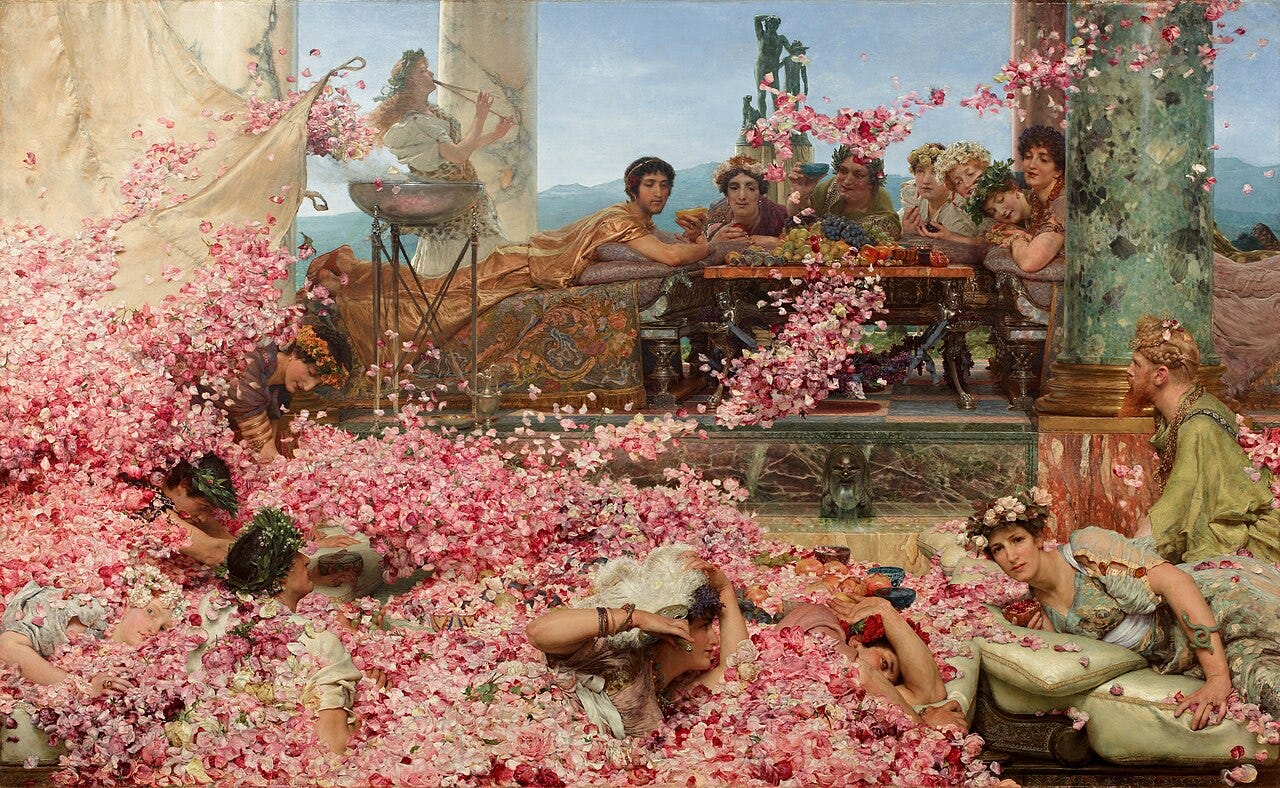
The rose came into painting with its meanings already attached. It was the flower of Venus, the goddess of love, and Renaissance painters still scattered its petals in her lap.
Medieval Christianity gave the same flower to the Virgin Mary, and a white rose came to stand for her purity. Because a cut rose lasts only a few days, it also became an image of beauty that passes, the sense of Robert Herrick's line of 1648, "Gather ye rosebuds while ye may."
Its shape is the other reason painters keep coming back to it, and it is a hard shape to paint. A full rose is dozens of petals curled around one another, each one cupped, each catching the light at a different angle. The outer petals open toward the light, the inner ones sink into shadow, and the color often deepens toward the heart.
Paint every petal and the rose turns into a diagram. Paint only the mass and it becomes a pink blot. The painter has to choose which petals to describe and which to leave as a single stroke, and to choose quickly, before the bloom opens further or drops.
Most of the twelve works below carry the rose in their title. The others earned their place because the roses in them change what the picture says, about a goddess in one case, about the new rank of a royal favorite in the other. Bouquets in which the rose is only one flower among many were left out. The order runs from the least known work to the most famous.
12. Pierre-Joseph Redouté, Rosa pimpinellifolia inermis, for Les Roses (about 1824)
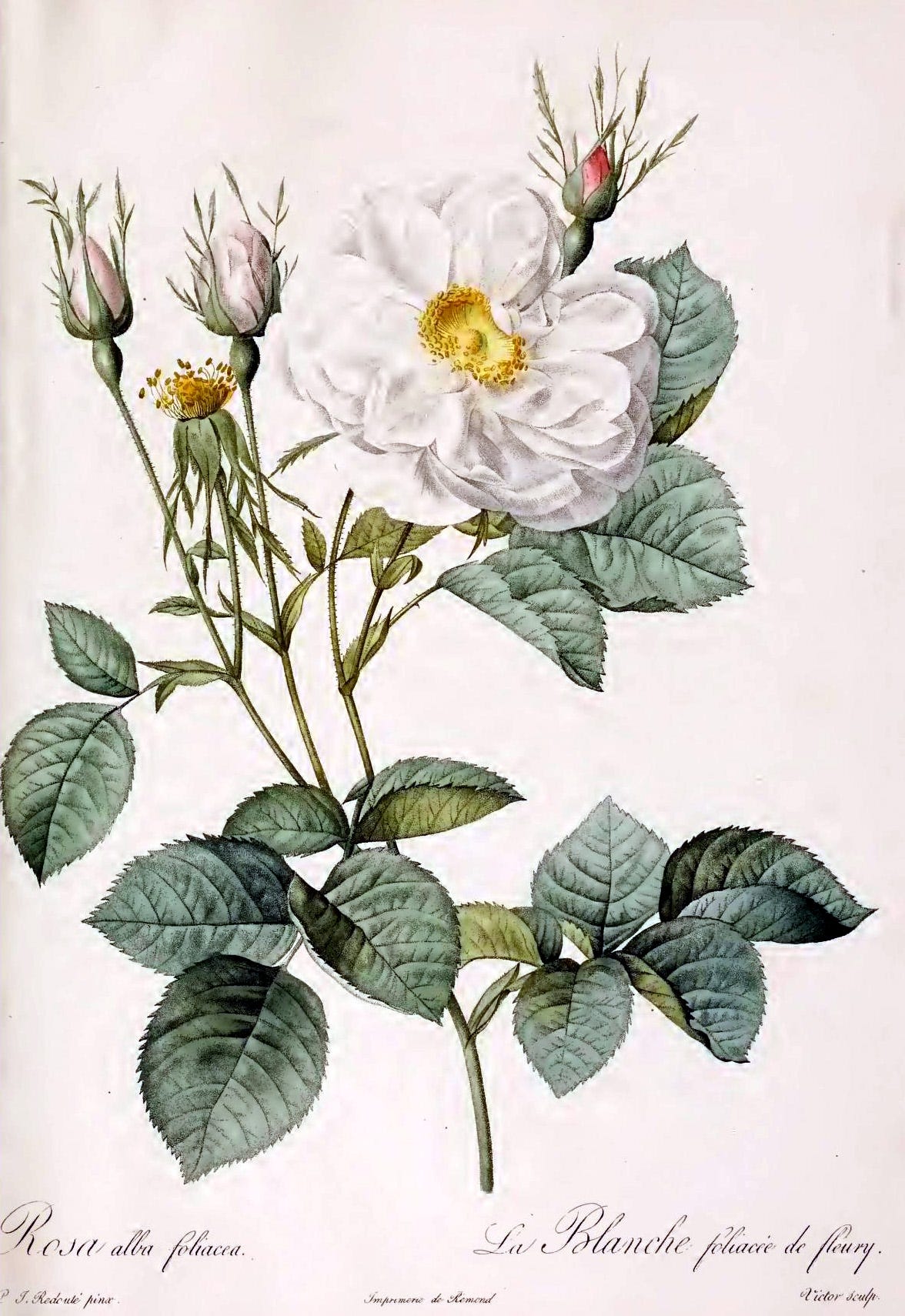
The stems of this wild rose are smooth from top to bottom, without a single prickle. The branch rises across a sheet of vellum, with open flowers that are almost white, five petals around a thick yellow center, and dark, slender buds hanging from the side shoots. Pierre-Joseph Redouté made the watercolor over pencil around 1824, as the model for a plate in his book Les Roses.
That book paired every picture with a text. It came out in parts between 1817 and 1824, about 170 plates in three volumes, and facing each rose stood a description by Claude Antoine Thory, a Paris lawyer who collected roses. Each watercolor became a stipple engraving, an image built from tiny dots instead of lines, printed partly in color and then finished by hand.
Les Roses is usually tied to the Empress Joséphine and her rose garden at Malmaison. She had been Redouté's patron since 1798, and he did paint plants from her garden. But she died in 1814, three years before the first part appeared, and only two plates in the book can be traced with certainty to Malmaison. For the rest, Redouté and Thory searched the rose gardens of Paris.
This rose came from much farther away, from a rock called the Neunerstein in the Vosges mountains, where a botanist found it growing wild. Thory explains that thornless plants sometimes appear among the seedlings of the thorny burnet rose, and thorny ones among the seedlings of the smooth kind. The Latin name on the plate, Rosa pimpinellifolia inermis, records the oddity: inermis means unarmed.
Thory's text also gives the petals a color, from light red to a deeper red, and here the watercolor parts from the description. Redouté painted the open flowers almost white and kept the red for the buds, where a little of it shows through as they begin to open. On the whole sheet, those half-open buds are the only place where the red of Thory's description appears.
At a Glance
Artist: Pierre-Joseph Redouté (1759 to 1840)
Painted: About 1824, for Les Roses (published 1817 to 1824)
Medium: Watercolor over pencil, on vellum
Size: 38.5 × 26.8 cm (15.2 × 10.5 in)
Where to see it: The Morgan Library & Museum, New York
11. Martin Schongauer, The Madonna of the Rose Bower (1473)
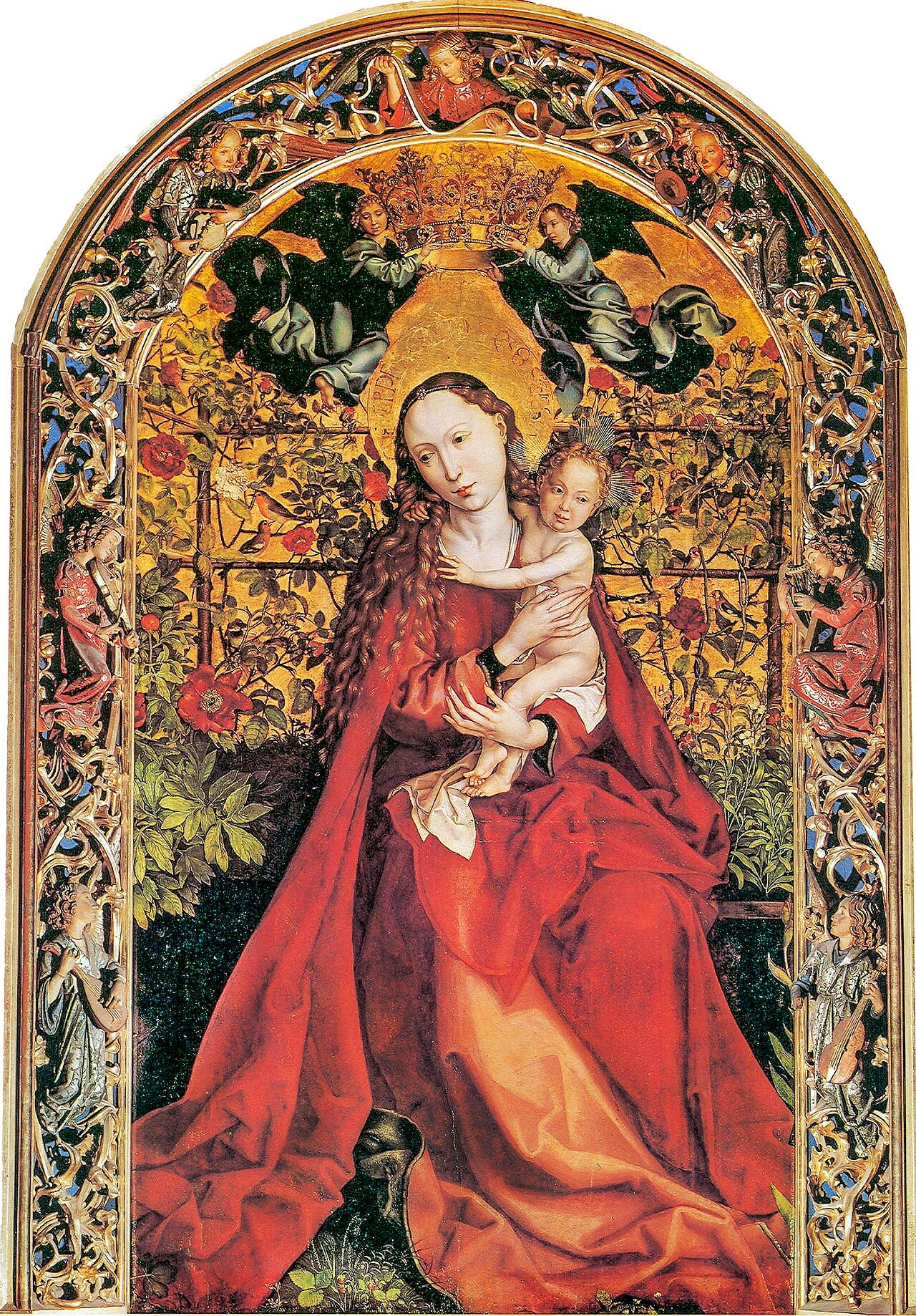
Behind the Virgin's head, against a gold ground, a hedge of roses climbs a trellis. Mary sits below it on a low bench of grass, wrapped in a red cloak that spreads across the lower half of the panel, and the infant Christ on her lap puts an arm around her neck. The hedge holds dozens of red roses, and a single white one, set just beside her halo.