Ruins in Art: 12 Famous Paintings of Decay and Time
Ruins let painters talk about time without saying a word. A broken column, an empty abbey, a fallen empire. From Panini Roman fantasies to Friedrich snowbound abbey and Cole dead city, these twelve works turn decay into a warning and a mood.
Some ruins are real. Piranesi drew the actual wrecks of Rome. Some are invented. Panini and Robert built ruins that never stood. Either way, the message is the same. What looks permanent will fall, and nature will move back in.
The Roman dream: Panini, Piranesi and Ricci sold crumbling antiquity to Grand Tour travelers.
The warning: Cole and Gandy imagined their own great cities lying dead in the future.
The mood: Friedrich, Ruisdael and Constable used ruins to grieve and to think about death.
The trick room: Clerisseau built a whole room to look like a collapsing temple.
If these draw you in, you will also love the untold story behind the Raft of the Medusa, 7 secrets hidden in famous paintings, and the painting that obsessed Hitler.
1. Giovanni Paolo Panini, Ancient Rome
In 1757, Panini painted an imaginary picture gallery. Every wall is hung with views of ancient Roman monuments. Tiny visitors wander among them. The Colosseum, the Pantheon and famous statues all crowd into one room that never existed.
It was a souvenir for a rich tourist. Panini made it for a French patron on the Grand Tour, a painted catalogue of everything he had seen in Rome. He painted a matching version of modern Rome to hang beside it.
The Met keeps Ancient Rome. Its twin, Modern Rome, hangs a few steps away. Together they are one man attempt to fit a whole city onto two walls.
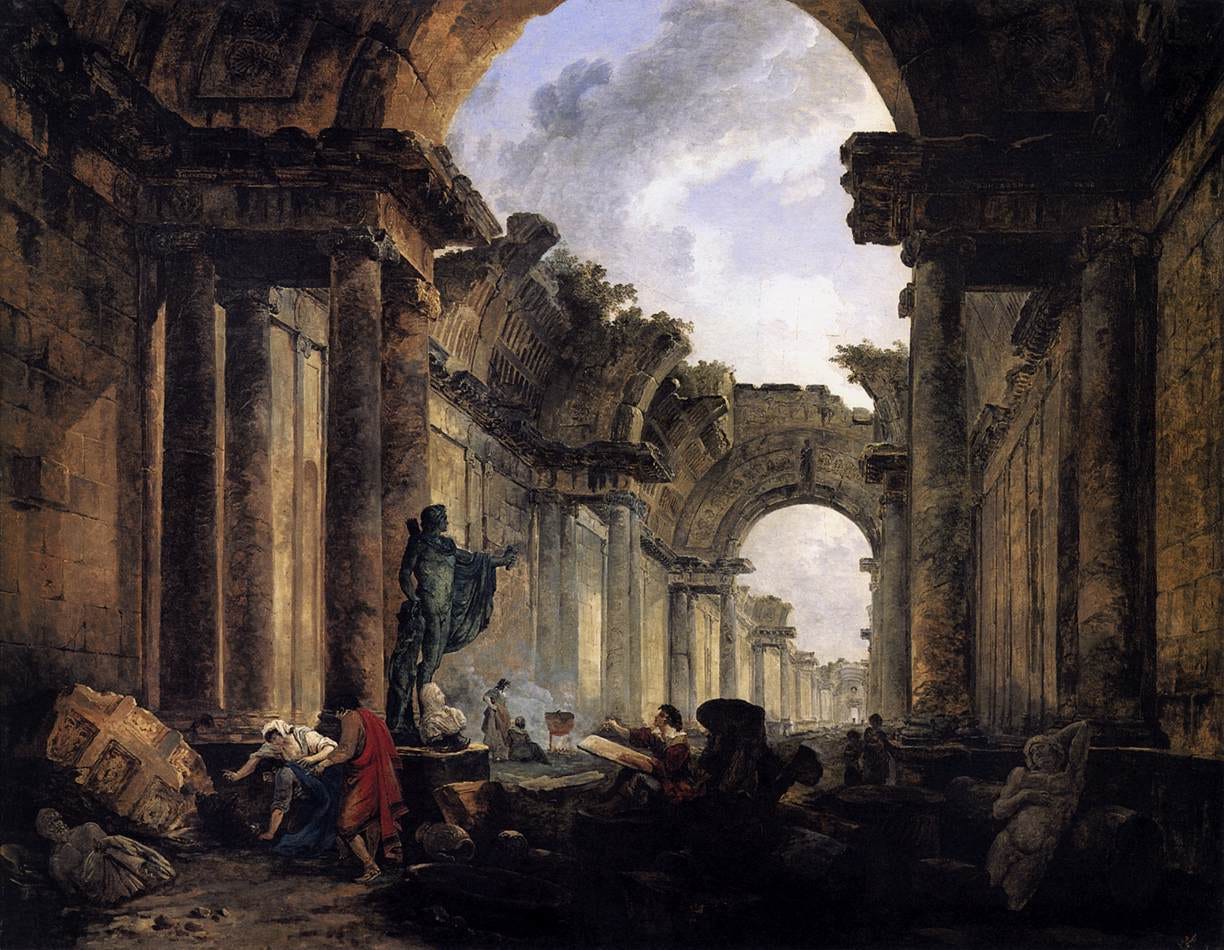
2. Hubert Robert, Imaginary View of the Grande Galerie of the Louvre in Ruins
In 1796, Hubert Robert imagined the Louvre in ruins. The roof of the Grande Galerie has caved in. Weeds grow among the stones. Michelangelo Dying Slave lies broken on the floor while a few people sketch the wreck.
Here is the strange part. Robert was the actual keeper of the king paintings, in charge of turning the Grande Galerie into the museum we know. He painted his own workplace destroyed while he was building it.
He painted a second view of the same gallery whole and full of visitors. He hung the two side by side. The museum still owns both, the dream and the ruin.
3. Caspar David Friedrich, The Abbey in the Oakwood
Friedrich finished this snowbound scene around 1810. A ruined Gothic abbey stands among bare, twisted oaks. A line of monks carries a coffin toward the broken gate. An open grave waits in the snow. Everything is grey and cold.
The ruin is based on a real one, the abbey of Eldena, wrecked in the Thirty Years War. Friedrich stripped away all comfort. There is no ceiling, no warmth in the sky, only death and endurance.
The King of Prussia bought it in 1810, straight from the exhibition. Friedrich had asked for it to hang low, so viewers would feel they were sinking into the grave with the monks.
4. Thomas Cole, The Course of Empire: Desolation
In 1836, Cole finished a series of five paintings tracing a civilization from wilderness to glory to collapse. Desolation is the last. A single broken column rises over a silent bay. A heron nests on top. The city is gone.
Cole painted it as a warning to young America. The empire in the series has no name, but the message is blunt. Every great power grows proud, overreaches and falls back into nature.
His patron Luman Reed died before the series was finished. The five canvases went to the New York Historical Society, where they still hang in a row, from sunrise to ruin.
5. Jacob van Ruisdael, The Jewish Cemetery
Around 1655, Ruisdael painted a real Jewish cemetery near Amsterdam, but he changed the setting. He added a ruined church, a dead tree, storm clouds and a rushing stream. A rainbow breaks through above the tombs.
Every element is a message about time. The stone tombs, the wrecked church and the broken tree all say the same thing. Nothing built or born lasts. The rainbow hints at hope beyond it.
The graves themselves were real and can still be found. Ruisdael went back to them more than once. The Detroit version is the larger and more famous of his two takes.
6. John Constable, Hadleigh Castle
In 1829, Constable painted the ruined towers of Hadleigh Castle above the Thames estuary at dawn. Ships pass in the distance. The sky is torn by wind and light after a storm. The stone is crumbling and empty.
He had sketched the castle years earlier, in 1814. He only painted the big version after his wife Maria died. Many read the picture as his grief, the ruin standing in for his loss.
It is one of his six foot canvases, the huge works he sent to the Royal Academy. The finished painting is now at Yale, its full sized oil sketch across the ocean in London.
7. Giovanni Battista Piranesi, Views of Rome

From 1748 until his death in 1778, Piranesi etched 135 large views of Rome. He drew the Colosseum, the Pantheon and the Arch of Titus half buried, cracked and overgrown, with tiny figures dwarfed beneath them.
He said the ancient ruins were vanishing, scattered through fields and gardens and dwindling day by day. He set out to save them in print before they were gone.
The prints became the souvenir of the Grand Tour. Every English gentleman wanted a Piranesi. His towering, dramatic Rome shaped how the whole world pictured the ancient city.
8. Joseph Gandy, A Bird Eye View of the Bank of England
In 1830, Gandy painted the Bank of England from above, its roofs stripped away. The building looks half constructed and half in ruins at once, its rooms exposed like an ancient site dug from the ground.
The architect was John Soane, who had spent nearly fifty years building the Bank. He asked Gandy to show it as a future ruin on purpose, to picture how grand it would look centuries after his death.
Soane may have been inspired by a cork model of Pompeii he owned. The painting hangs in his own house, now the Sir John Soane Museum, exactly as he wanted his work remembered.
9. Claude Lorrain, Pastoral Landscape: The Roman Campagna
Around 1639, Claude painted the countryside outside Rome bathed in soft evening light. Shepherds rest among the crumbling remains of ancient buildings. A round tower and broken walls sit quietly in the golden haze.
Claude did not paint ruins as horror. He made them peaceful, part of a calm, ideal past. This mix of soft light and antique stone became a whole style copied for two centuries.
English landowners loved it so much they reshaped real gardens to match. They even carried tinted glasses, called Claude glasses, to make the view around them look like one of his paintings.
10. Charles Louis Clerisseau, The Ruin Room
Around 1766, Clerisseau painted an entire room to look like a collapsing temple. In a convent above the Spanish Steps, he covered the walls with fallen columns, a roof open to painted sky and vines creeping through the cracks.
It was a bedroom. The cell belonged to a mathematician monk. Even the furniture played along. The desk looked like a broken sarcophagus, a chunk of cornice served as a table, and a dog slept in a cracked painted vase.
A painted parrot perches on a fake beam. The room still survives in Rome, one of the strangest jokes in the whole cult of ruins, a home built to look like it had already fallen down.
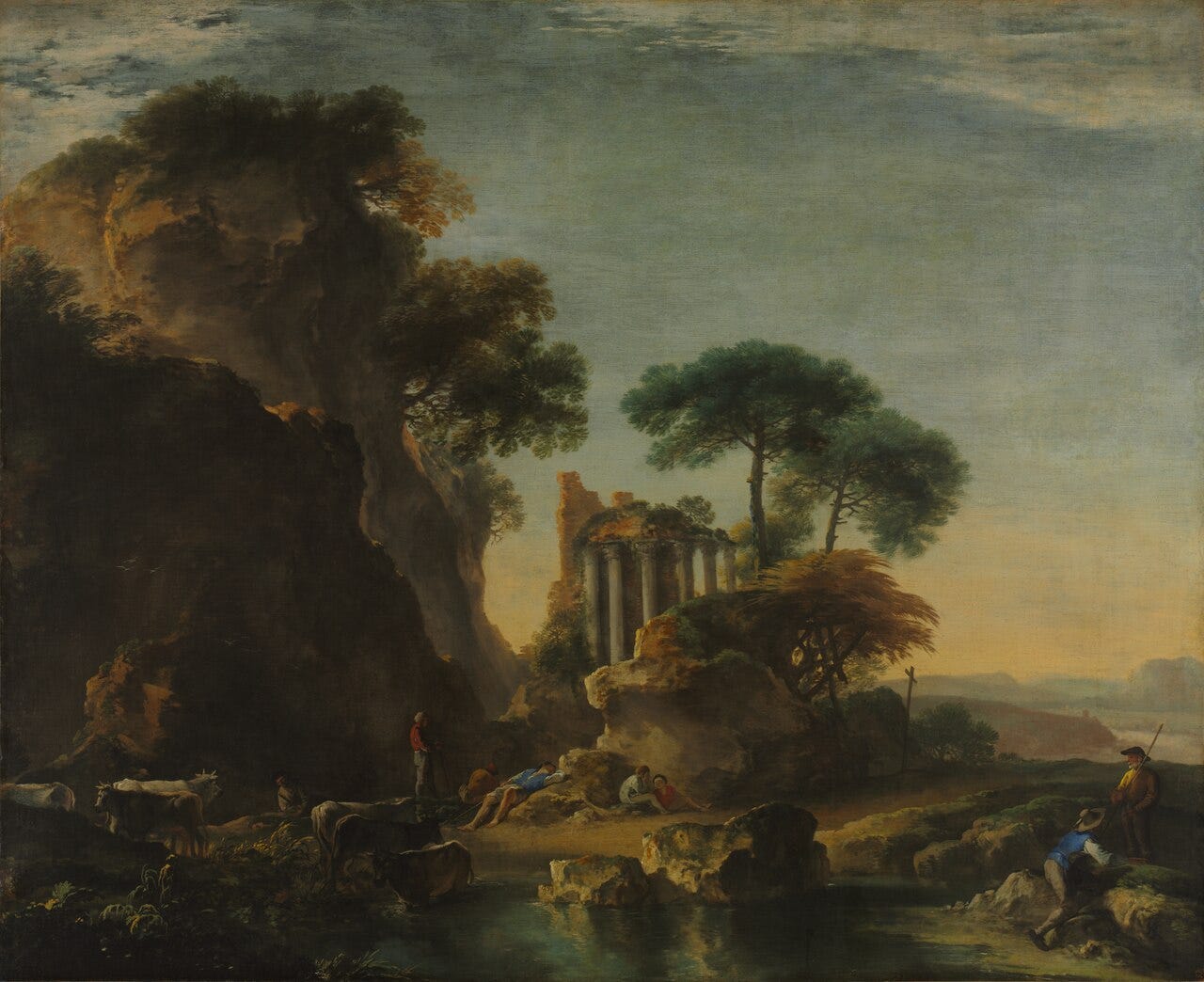
11. Salvator Rosa, Ruins in a Rocky Landscape
Around 1640, Rosa painted classical ruins among wild, dark rocks. Shepherds idle in the foreground while broken arches catch a low, silvery light. The mood is rough and a little threatening, not calm.
Rosa built a reputation on exactly this wildness. Where Claude made ruins soothing, Rosa made them dangerous. He filled his landscapes with bandits, storms and jagged stone, and Romantic painters later worshipped him for it.
He wrote poetry and satire as well, and liked to play the rebel. The Cleveland canvas is an early example of the untamed style that carried his fame long after his death in 1673.
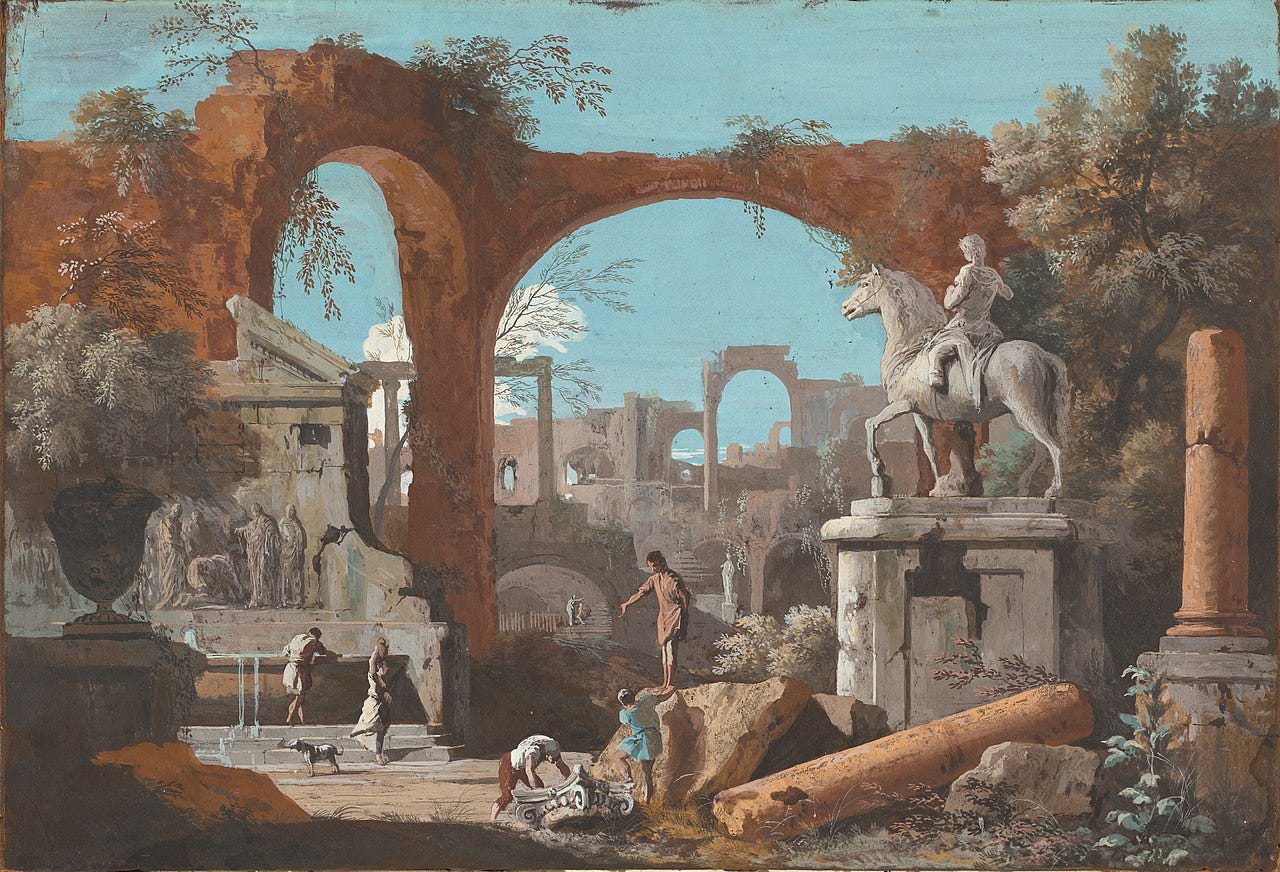
12. Marco Ricci, A Capriccio of Roman Ruins
In the late 1720s, Marco Ricci painted sunlit Roman ruins that never stood together. Red and grey arches, wrapped in green plants, rise against a clear blue sky. A few small figures rest in the shade below.
This kind of invented view had a name, the capriccio, meaning a whim. Painters mixed real monuments with pure fantasy. Ricci often worked in gouache on kidskin leather, an unusual surface for the time.
He helped popularize the ruin capriccio that Panini and Guardi would carry on. Ricci died in 1730, but the fashion he pushed lasted the whole century.
Where to see them
Metropolitan Museum of Art, New York: Giovanni Paolo Panini Ancient Rome and Claude Lorrain Pastoral Landscape.
Louvre, Paris: Hubert Robert Imaginary View of the Grande Galerie of the Louvre in Ruins.
Sir John Soane Museum, London: Joseph Gandy A Bird Eye View of the Bank of England.
New York Historical Society: Thomas Cole The Course of Empire, Desolation.
Alte Nationalgalerie, Berlin: Caspar David Friedrich The Abbey in the Oakwood.
Why a ruin says so much
Many of these are landscape paintings built around a single broken monument, using decay to give a view its whole meaning.
The invented ones are capriccios, where painters mixed real ruins that never stood together, and the darkest belong to Romanticism, where a wreck stood for death and time.
Ruins in art, questions people ask
Why did artists paint ruins? Ruins were a way to talk about time and death. A fallen temple or empty abbey reminded viewers that nothing built by people lasts forever.
What is a capriccio in art? A capriccio is an invented view. The painter combines real ruins and buildings that never actually stood side by side, like Panini or Marco Ricci fantasies.
Which painting shows a real city imagined as a ruin? Two do. Hubert Robert painted the Louvre in ruins in 1796, and Joseph Gandy painted the Bank of England as a future ruin in 1830.
What is Thomas Cole Course of Empire about? It is a five painting story of a civilization rising and falling. The last scene, Desolation, shows the city empty and overgrown, a warning to young America.
Where can I see famous ruins paintings? The Met in New York, the Louvre in Paris and the Sir John Soane Museum in London all hold major examples.
Every ruin is a clock
A ruin is a building telling you the time. Panini and Piranesi drew Rome real wrecks. Robert and Gandy turned the Louvre and the Bank of England into wrecks that had not happened yet. John Soane wanted his life work shown already fallen, so people would picture it lasting for centuries. The joke is that his house survived, ruin painting and all, exactly as he planned.