Famous Russian Paintings: 11 From Icon to Black Square

Famous Russian paintings run from a fifteenth century icon of three angels to a single black square from 1915, and between them they carry five centuries of war, faith, and the empire that painted itself in public.

In 30 seconds:

  • 11 paintings, from Andrei Rublev's Trinity icon (about the 1420s) to Kazimir Malevich's Black Square (1915).

  • Ilya Repin appears twice: Barge Haulers on the Volga and Ivan the Terrible and His Son Ivan.

  • Vasily Surikov appears twice: The Morning of the Streltsy Execution and Boyarynya Morozova.

  • Repin's Ivan the Terrible has been physically attacked twice, once in 1913 and again in 2018.

  • Conservators found an inscription hidden under Malevich's Black Square only in 2015, using X-ray analysis.

What runs through five centuries of Russian painting:

  • The faith. Rublev painted three angels to stand in for a God no icon was allowed to show directly.

  • The empire. Surikov and Repin painted the state's own punishments, from mass executions to a tsar killing his son.

  • The land. Aivazovsky and Levitan painted Russia's water and roads as forces bigger than the people crossing them.

  • The break. Malevich hung a black square in the exact corner where an Orthodox family would hang an icon.


Join 170,000 readers who get the true story behind the paintings. Free.


1. Andrei Rublev, Trinity (about the 1420s)

Andrei Rublev, Trinity, about the 1420s

Three angels sit around a table in a landscape with almost nothing else in it, each one bowing slightly toward the other two.

Rublev painted it as an icon of the Old Testament story where three visitors appear to Abraham at Mamre, read by Orthodox tradition as an image of the Trinity itself.

The icon left the Tretyakov Gallery for a few days in July 2022, on loan to the Trinity Lavra of St Sergius. The museum reported 61 negative changes to its condition afterward. Restorers objected in writing, and in 2023 a presidential decision moved the icon permanently to the Cathedral of Christ the Saviour in Moscow.

2. Karl Bryullov, The Last Day of Pompeii (1830 to 1833)

Karl Bryullov, The Last Day of Pompeii, 1830 to 1833

Buildings collapse and statues topple as the crowd of Pompeii runs through streets lit by the eruption of Vesuvius in 79 AD.

Bryullov researched the site and the eruption for years before painting the canvas in Rome.

Alexander Pushkin wrote a poem about it, and Nikolai Gogol published an essay calling it the bright resurrection of painting. It now hangs at the State Russian Museum in St Petersburg.

3. Ivan Aivazovsky, The Ninth Wave (1850)

Ivan Aivazovsky, The Ninth Wave, 1850

A handful of shipwreck survivors cling to a broken mast at dawn, waiting for the wave sailors believed was always the deadliest of any sequence.

Aivazovsky painted close to 6,000 seascapes in his lifetime, and this is the one still named first.

The sea takes up almost the entire canvas, and the survivors are barely visible against it. It hangs at the State Russian Museum in St Petersburg.

4. Ilya Repin, Barge Haulers on the Volga (1870 to 1873)

Ilya Repin, Barge Haulers on the Volga, 1870 to 1873

Eleven men in torn clothing drag a barge upriver by rope, harnessed to it like animals.

Grand Duke Vladimir Alexandrovich commissioned the painting after seeing Repin's sketches from a trip along the Volga.

It won a bronze medal at the 1873 Vienna International Exhibition. The Grand Duke's collection was nationalized after 1917, which is how the painting reached the Russian Museum.


No lectures, no jargon. Just the stories, free every week.


5. Vasily Surikov, The Morning of the Streltsy Execution (1881)

Vasily Surikov, The Morning of the Streltsy Execution, 1881

Streltsy soldiers wait with candles in Red Square, minutes from execution, while Peter the Great watches on horseback.

The painting shows the aftermath of the Streltsy uprising of 1698, which Peter crushed and then punished with mass public executions.

The Tretyakov Gallery bought the painting the same year it was first shown, 1881.

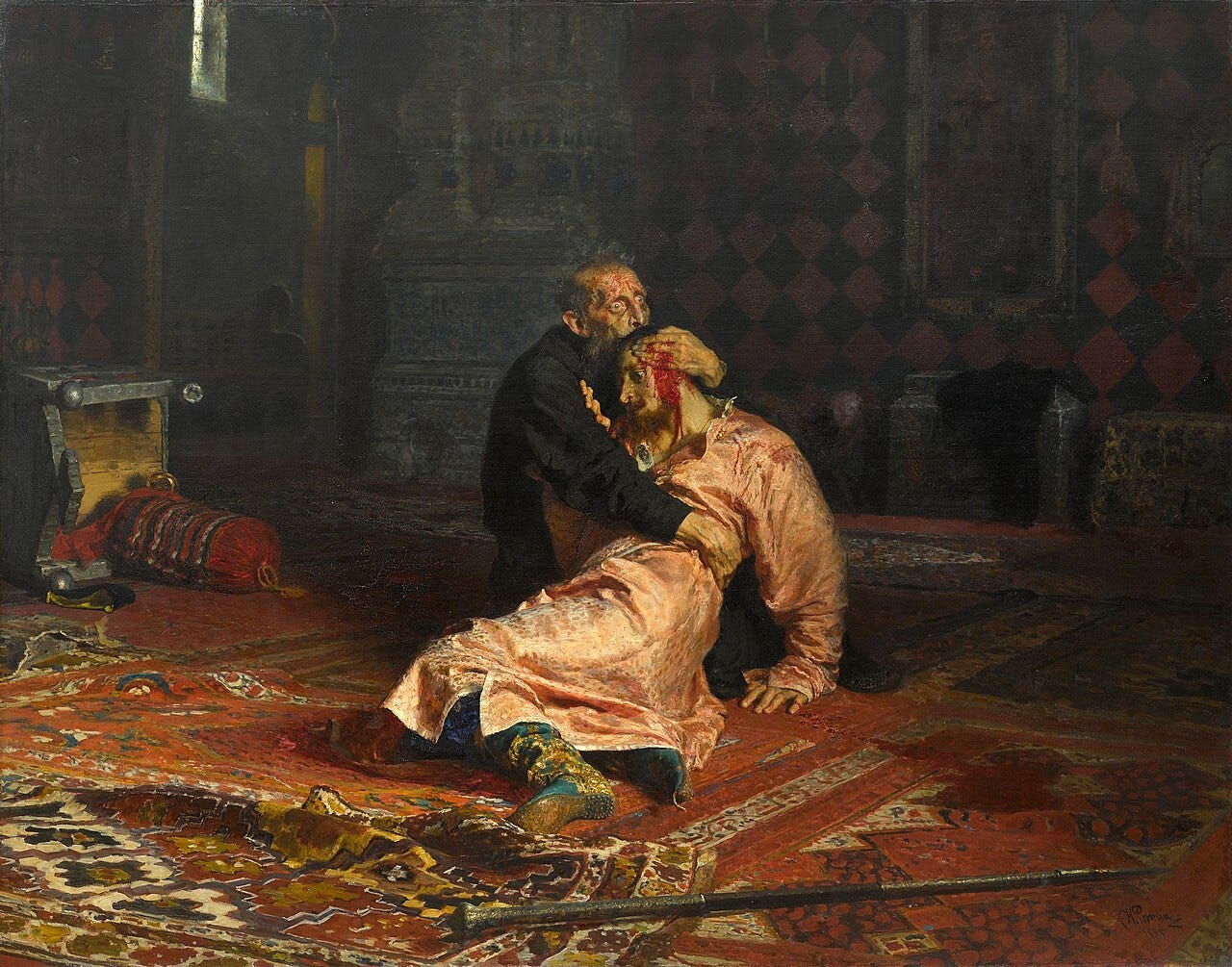
6. Ilya Repin, Ivan the Terrible and His Son Ivan (1883 to 1885)

Ilya Repin, Ivan the Terrible and His Son Ivan, 1883 to 1885

Ivan IV holds his dying son in his arms, blood on both their faces, seconds after striking him with an iron tipped staff.

The painting shows a real event from 16 November 1581. The tsarevich died four days after his father struck him.

The canvas has been attacked twice. A man slashed it with a knife in 1913, and Repin himself helped restore it. In 2018 another man hit it with a metal post, and the painting stayed off view for four years of restoration before returning in 2022.

7. Vasily Surikov, Boyarynya Morozova (1887)

Vasily Surikov, Boyarynya Morozova, 1887

A noblewoman raises two fingers from a sledge as guards drag her through a crowd, the old sign of the cross the state had just outlawed.

The painting shows the real Feodosia Morozova, punished for refusing to accept Patriarch Nikon's reforms to Orthodox ritual.

Pavel Tretyakov bought the painting for 25,000 rubles right off its debut at the 1887 exhibition. It remains one of the largest canvases in his gallery.


Join 170,000 readers who get the true story behind the paintings. Free.


8. Mikhail Vrubel, The Demon Seated (1890)

Mikhail Vrubel, The Demon Seated, 1890

A winged figure sits cross legged among crystalline rocks, his face turned away, closer to sad than frightening.

Vrubel based the figure on Mikhail Lermontov's 1839 poem The Demon, and painted this canvas soon after moving to Moscow in 1889.

Vrubel began suffering severe mental breakdowns from 1896 onward and spent his final years largely in institutions, going blind before his death in 1910.

9. Isaac Levitan, The Vladimirka Road (1892)

Isaac Levitan, The Vladimirka Road, 1892

A dirt road runs straight toward the horizon under a low sky, empty except for a small figure and a distant church.

The road is the real Vladimirka Highway east of Moscow, the route prisoners walked on foot toward exile in Siberia for centuries.

Levitan donated the finished painting to the Tretyakov Gallery himself in March 1894, without waiting to be asked.

10. Viktor Vasnetsov, Bogatyrs (1898)

Viktor Vasnetsov, Bogatyrs, 1898

Three armored riders sit on their horses at the edge of a forest, scanning the horizon for an enemy that never quite arrives.

The three are bogatyrs from Russian epic poetry: Ilya Muromets, Dobrynya Nikitich, and Alyosha Popovich.

Vasnetsov worked on the canvas for close to two decades before finishing it. Pavel Tretyakov bought it directly for his gallery the year it was done.

11. Kazimir Malevich, Black Square (1915)
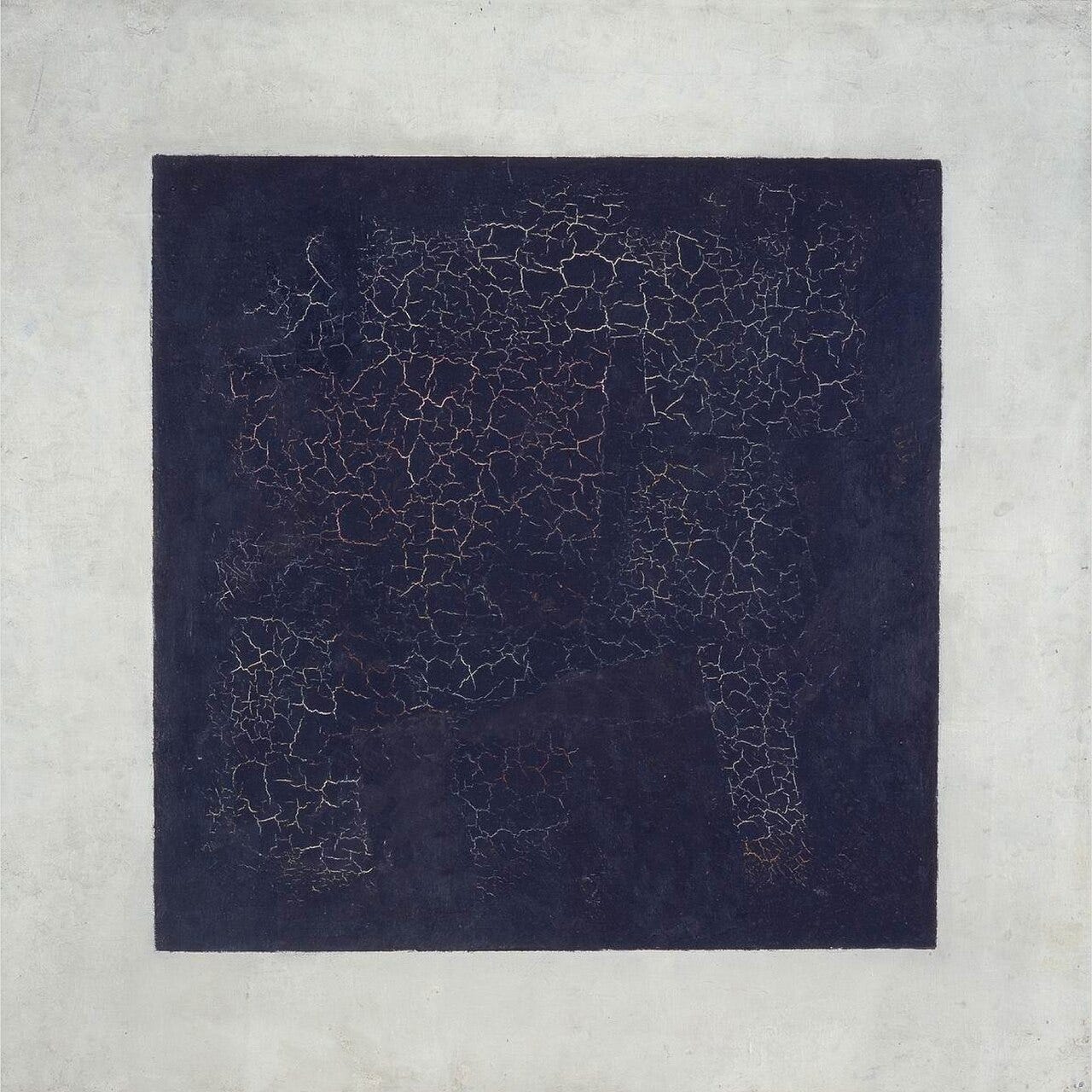
Kazimir Malevich, Black Square, 1915

A black square fills almost the entire canvas, painted flat, with no other shape or color anywhere on it.

Malevich first showed it at the 0,10 exhibition in Petrograd in December 1915, hung high across a corner of the room, the exact spot where an Orthodox family would hang an icon.

In 2015, Tretyakov conservators used X-ray and infrared analysis to find two earlier paintings hidden underneath the black surface, along with a handwritten inscription referencing an 1897 satirical all black painting by the French humorist Alphonse Allais. I go further into what came after this moment in famous abstract paintings.

Where to see them

  • Rublev's Trinity: the Cathedral of Christ the Saviour, Moscow.

  • Bryullov's The Last Day of Pompeii, Aivazovsky's The Ninth Wave, and Repin's Barge Haulers on the Volga: the State Russian Museum, St Petersburg.

  • Surikov's The Morning of the Streltsy Execution and Boyarynya Morozova: the Tretyakov Gallery, Moscow.

  • Repin's Ivan the Terrible and His Son Ivan: the Tretyakov Gallery, Moscow.

  • Vrubel's The Demon Seated, Levitan's The Vladimirka Road, Vasnetsov's Bogatyrs, and Malevich's Black Square: the Tretyakov Gallery, Moscow.


Two new stories a week, straight from real research. Start free.


Short answers, Russian painting

  • What is the most famous Russian painting? Malevich's Black Square is the most argued about, but Repin's Barge Haulers on the Volga and Aivazovsky's The Ninth Wave are the ones most people already know without knowing the artist's name.

  • Who is the greatest Russian painter? Ilya Repin is usually named first, for the range of his work across portraits, history painting, and scenes of ordinary Russian life.

  • Where are most of these paintings kept? Most hang at the Tretyakov Gallery in Moscow or the State Russian Museum in St Petersburg, the two collections built specifically around Russian art.

  • Why does Russian painting return so often to punishment and exile? Painters like Surikov and Levitan worked under censorship that limited direct political comment, so history paintings about past punishments carried present day meaning without naming names.

  • Is Marc Chagall part of this list? No. Chagall's paintings remain under copyright, so I left him out to keep every image here safely public domain.

From an icon corner to a black square

Line up these eleven paintings and Russian art keeps circling back to the same corner of the room, the one where an Orthodox family hung its icon.

Rublev painted three angels for that corner in the fifteenth century. Five centuries later, Malevich hung his black square in that exact spot at an exhibition in Petrograd, in December 1915.

Between them, Russian painters spent a century staring hard at their own state: Peter the Great's executions, Ivan the Terrible's grief, a noblewoman punished for two raised fingers.

Malevich's black square covers two other paintings underneath it, found only in 2015, nearly a century after he painted over them.