Famous Self Portraits: 12 Painters Who Faced Themselves

The most famous self portraits in art history include Durer posing like Christ, Parmigianino warped in a mirror, Rembrandt aging across dozens of canvases, and Van Gogh in swirling blue.

Each is a painter using the cheapest model on earth, the face in the mirror.

Man in a large red turban staring out, van Eyck
Jan van Eyck, Portrait of a Man (Self Portrait), 1433, National Gallery, London.

A self portrait is never only a likeness. It is a painter deciding how they want to be remembered, and often sneaking in a claim about who they are.

I have picked twelve that go past the mirror into something stranger, and if you want the basics first, here is what a self portrait actually is.

Four things a self portrait quietly does:

  • Advertise. Look how well I paint. Many doubled as calling cards for new clients.

  • Argue. A pose borrowed from Christ or from Painting herself is a claim about status.

  • Confess. A face caught old, sick or desperate tells you more than any diary.

  • Save money. The model is free and never complains, which is why poor painters made so many.


Learn art the fun way. Free stories every week, no boring lectures.


If you want the whole picture

These go past the caption and into what actually happened:


1. Jan van Eyck, Man in a Red Turban (1433)

A man in a huge folded red headdress turns and fixes you with a level, knowing stare. Most historians think Jan van Eyck was looking in a mirror, which would make this one of the first true self portraits in Western art.

The frame is signed like a boast. Along the top he painted his personal motto, Als Ich Can, meaning as well as I can, a modest line that was also a pun on his own name.

The eyes give it away. They are slightly reddened and locked in the fixed squint of a man studying his own reflection for hours.

2. Albrecht Durer, Self Portrait at Twenty Eight (1500)

Durer facing forward in a Christ like pose
Albrecht Durer, Self Portrait at Twenty Eight, 1500, Alte Pinakothek, Munich.

Durer stares straight out, symmetrical, one hand raised to his chest, hair falling in perfect waves. This full frontal pose was reserved for images of Christ, and no painter had dared aim it at himself before.

It was a deliberate claim. Durer signed it with the date and a line saying he had painted himself in undying colors, presenting the artist as a maker in the image of the divine maker.

It was close to blasphemy in 1500, and it announced a new idea, the artist as a genius rather than a tradesman.

3. Parmigianino, Self Portrait in a Convex Mirror (1524)

Self portrait warped by a convex mirror, huge hand
Parmigianino, Self Portrait in a Convex Mirror, 1524, Kunsthistorisches Museum, Vienna.

A young face floats at the back of a curved room while a giant hand swells toward you in front. Parmigianino saw himself in a barber's convex mirror and copied the whole warped view, right down to the bulging hand.

He even matched the surface. He had a woodworker cut a half sphere of poplar so the panel itself curved like the mirror, then painted the distortion exactly. He was twenty one.

He carried it to Rome as a demonstration piece. It amazed Pope Clement the Seventh, and it launched his career overnight.

4. Sofonisba Anguissola, Self Portrait at the Easel (about 1556)

Woman painter at her easel painting a Madonna
Sofonisba Anguissola, Self Portrait at the Easel, about 1556.

A soberly dressed young woman looks up from her easel, where she is painting a tender Madonna and child. Sofonisba Anguissola made her point without a word, a woman could be a serious painter, not a curiosity.

The proof piled up. Michelangelo praised her drawings, she became a court painter to the king of Spain, and she trained other women at a time when the profession was closed to them.

She had the last word too. In 1624, nearly blind and in her nineties, she was visited in Palermo by a young Anthony van Dyck, who filled a sketchbook page with her advice on how to light a face.

5. Artemisia Gentileschi, Self Portrait as the Allegory of Painting (1638)

Woman painter mid stroke as the allegory of Painting
Artemisia Gentileschi, Self Portrait as the Allegory of Painting, about 1638, Royal Collection.

Sleeves pushed up, brush lifted, a woman leans into a canvas we cannot see, caught mid stroke. Artemisia Gentileschi painted herself as the very spirit of Painting, an allegorical figure who was always shown as a woman.

It was a clever conceit. Because Painting was always personified as a woman, a female artist could fuse the painter and the muse in a single figure, and Artemisia played it to the hilt.

She was already famous across Europe. King Charles the First of England owned it, and it still hangs in the Royal Collection, a working painter dressed as her own muse.


Join 130,000 readers who get the secrets behind the paintings. Free.


6. Diego Velazquez, Las Meninas (1656)

Velazquez at a large canvas among the royal household
Diego Velazquez, Las Meninas, 1656, Prado, Madrid.

In the greatest hidden self portrait, Velazquez paints himself at work. He stands to the left before a canvas as tall as a door, brush and palette in hand, staring calmly out at us, or at the king and queen he is painting.

It is a puzzle about who is looking at whom. The royal couple appear only as a reflection in a far mirror, which puts us, the viewers, in their place before the easel.

Look at his chest. The red cross of the noble Order of Santiago was added after the painting was done, and the story goes that the king himself ordered it, or even painted it on.


Get the story behind the painting, every week, free.


7. Rembrandt, Self Portrait with Two Circles (about 1665)

Aging Rembrandt with brushes and two wall circles
Rembrandt, Self Portrait with Two Circles, about 1665, Kenwood House, London.

An old painter in a white cap holds his brushes and turns to look, half his face sliding into shadow. Rembrandt painted himself perhaps eighty times across forty years, and this late one, built out of thick chiaroscuro, is among the most searching.

Nobody has explained the two circles. Behind him on the wall are two large arcs, maybe a map, maybe a sign of skill, since drawing a perfect circle freehand was a painter's old party trick.

Taken together the self portraits are a diary in paint. You can watch him go from cocky young star to bankrupt old man who kept looking anyway.

8. Elisabeth Vigee Le Brun, Self Portrait in a Straw Hat (about 1782)

Woman painter smiling in a feathered straw hat
Elisabeth Vigee Le Brun, Self Portrait in a Straw Hat, about 1782, National Gallery, London.

A painter in a feathered straw hat smiles out at us, palette in hand, warm and completely at ease. Vigee Le Brun based the pose on a Rubens painting she had fallen for, and made it her own.

The smile was the risky part. She shows her teeth, which was almost never done in a formal portrait, and some viewers found it improper, even shocking.

She had powerful fans. She was the favorite painter of Marie Antoinette, and when the Revolution came she fled France and painted her way across the courts of Europe.

9. Francisco Goya, Self Portrait with Doctor Arrieta (1820)

Sick Goya held up by his doctor with medicine
Francisco Goya, Self Portrait with Doctor Arrieta, 1820, Minneapolis Institute of Art.

Goya paints himself dying. Gray and limp, he sags back into the arms of his doctor, who gently holds a glass of medicine to his lips as shadowy figures wait behind.

It is a thank you note in oil. Along the bottom Goya wrote that he painted it in gratitude to Doctor Arrieta, who saved his life during a savage illness in 1819 at the age of seventy three.

Few artists have painted their own near death so plainly. It reads like a votive picture, the kind people once left in churches after surviving.

10. Gustave Courbet, The Desperate Man (about 1845)

Wide eyed young man gripping his own hair, Courbet
Gustave Courbet, The Desperate Man, about 1845.

A young man lunges toward you, eyes wide, both hands gripping his own hair as if he has just seen something terrible. It is Courbet himself, in his mid twenties, playing the wild Romantic to the hilt.

He made a whole run of these early self portraits, trying on roles, the lover, the madman, the wounded man. Here he is pure nerve and drama, staring the viewer down.

The wide eyes and thrown back head borrow the look of Baroque saints in ecstasy, turned into plain human panic.

He never sold it. Courbet kept The Desperate Man his entire life, dragging it into exile with him, a picture of the hungry young artist he had been.


Two new stories a week, 130+ secrets unlocked. Start free.


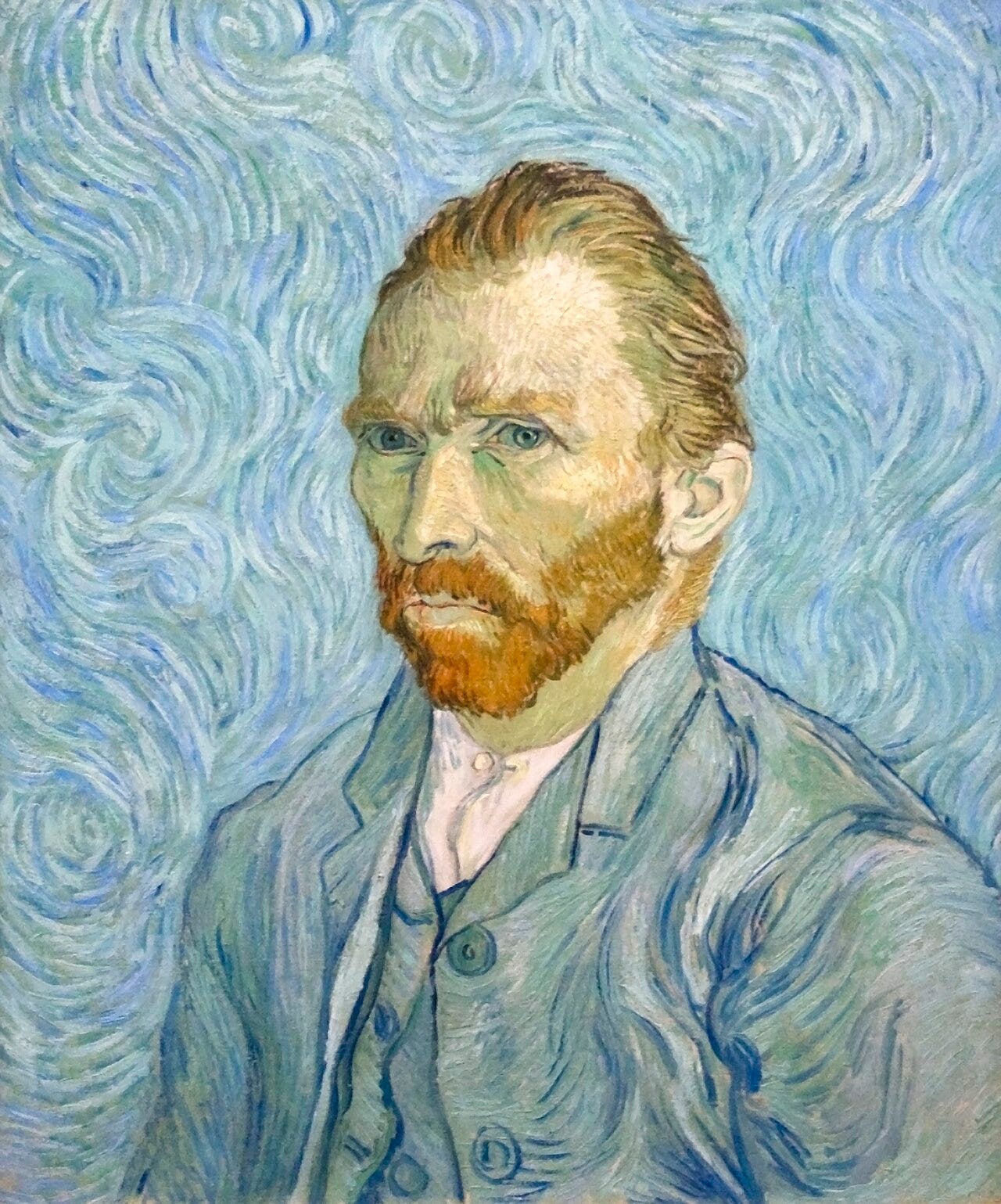
11. Vincent van Gogh, Self Portrait (1889)

Van Gogh against swirling blue, self portrait
Vincent van Gogh, Self Portrait, September 1889, Musee d'Orsay, Paris.

A gaunt man in a suit stands against a wall of swirling pale blue, the same restless current running through his jacket and the air around him. Van Gogh painted this at the asylum in Saint Remy, one year before he died.

He made about thirty five self portraits in only a few years, partly because he could not afford to pay models. His own face was always there, and free. I tell the story of his final months in the last day of Vincent van Gogh.

He sent this one to his brother Theo, telling him his expression had grown calmer, even as the blue behind him churns like water.

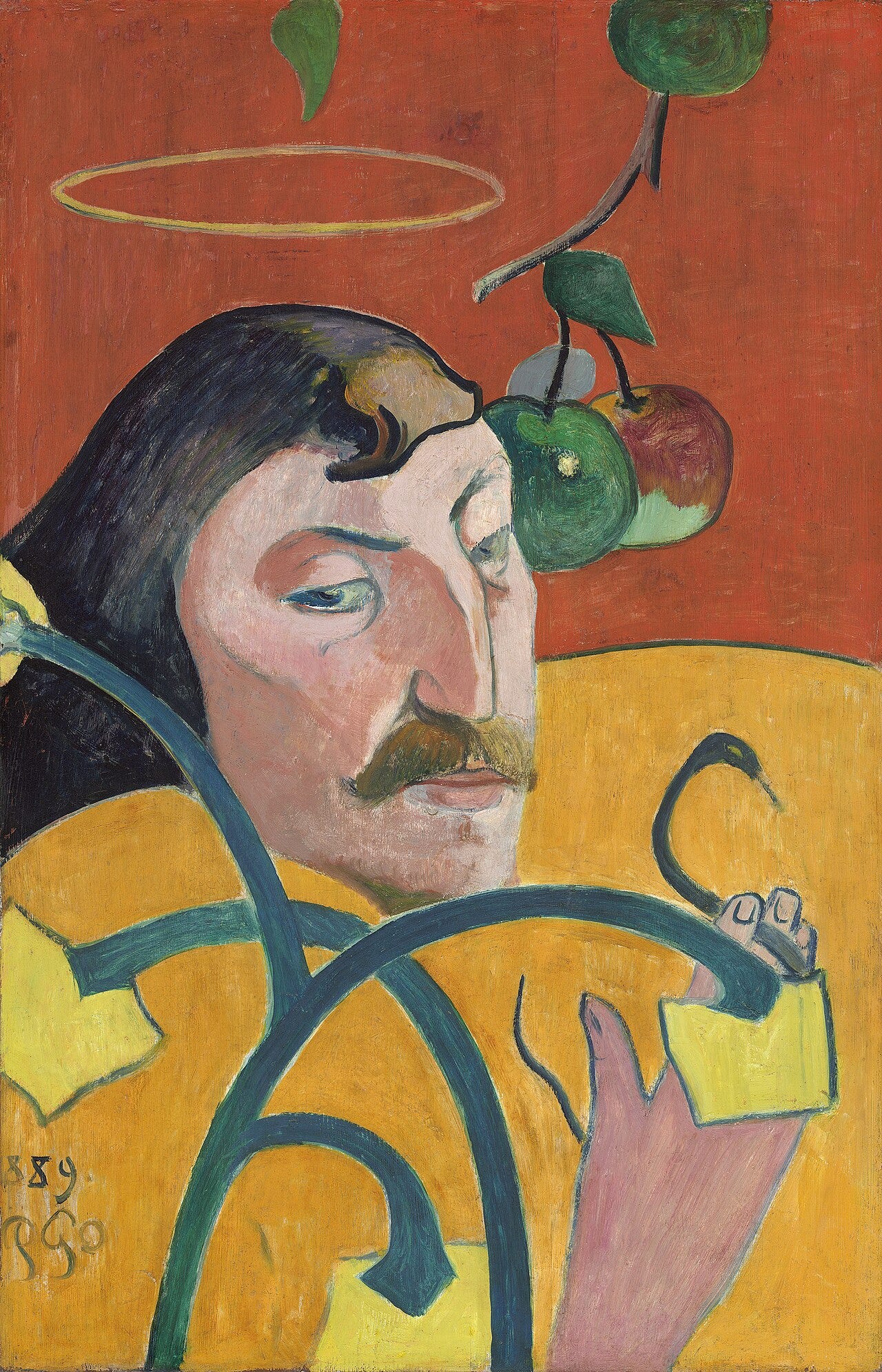
12. Paul Gauguin, Self Portrait with Halo and Snake (1889)

Gauguin with a halo, snake and apples, flat color
Paul Gauguin, Self Portrait with Halo and Snake, 1889, National Gallery of Art, Washington.

Gauguin turns himself into a cartoon of good and evil. A golden halo hovers over his head, a snake dangles from his fingers, and ripe apples float beside him against flat red and yellow.

He is saint and tempter at once, and enjoying it. Gauguin loved to build his own legend, and here he casts himself as both the holy man and the serpent in the garden.

He painted it on a cupboard door in Brittany. The flat, poster like color shows exactly where he was heading, away from Europe and toward the islands of the Pacific.

Where to meet these faces

  • Durer, Self Portrait at Twenty Eight: the Alte Pinakothek, Munich.

  • Parmigianino, Self Portrait in a Convex Mirror: the Kunsthistorisches Museum, Vienna.

  • Velazquez, Las Meninas: the Prado, Madrid.

  • Rembrandt, Self Portrait with Two Circles: Kenwood House, London.

  • Van Gogh, Self Portrait: the Musee d'Orsay, Paris.

Painters worth a longer look

Three of the strongest faces here belong to women the story nearly forgot. Keep going with these:


Questions people ask about self portraits

  • Which artist painted the most self portraits? Rembrandt, with around eighty across paintings, etchings and drawings, a lifelong record of his own aging face.

  • Why did Van Gogh paint so many self portraits? Partly for practice, and partly because he was too poor to hire models. His own face was always available and free.

  • What is the first self portrait? There is no clean first, but Jan van Eyck's Man in a Red Turban of 1433 is one of the earliest widely accepted painted self portraits.

  • Why did Durer paint himself like Jesus? To raise the status of the artist. The frontal, Christ like pose claimed that the painter creates in the image of the divine maker.

  • Did women paint self portraits too? Yes. Sofonisba Anguissola, Artemisia Gentileschi and Elisabeth Vigee Le Brun all used self portraits to prove their skill and win commissions.

The mirror never lies for long

Put them in a row and you get a strange group biography. Durer claims to be almost divine, Parmigianino turns himself into an optical trick, Goya paints his own sickbed, and Van Gogh sends his churning blue face home to reassure his mother.

The tools change over four centuries, and so do the poses, from holy to desperate to ironic. One detail is easy to miss: most of them worked from a single mirror, which flips left and right, so a right handed painter ends up looking left handed, brush in the wrong hand.