Sleep in Art: 12 Famous Paintings of Sleeping Figures
The greatest sleep paintings use rest to say something else. Rousseau put a lion beside a dreaming woman. Fuseli turned sleep into a nightmare with a demon on the chest. Each sleeper below hides a fear, a desire, or a joke worth reading.
Sleep looks calm, but painters rarely let it stay that way. A sleeping body is helpless, exposed, close to death, or lost in a dream nobody else can see. They run from a plague year Venus to a peasant asleep in the noon heat.
The dream one: Rousseau set a lion beside a sleeping woman and no one knows if the lion is real or dreamed.
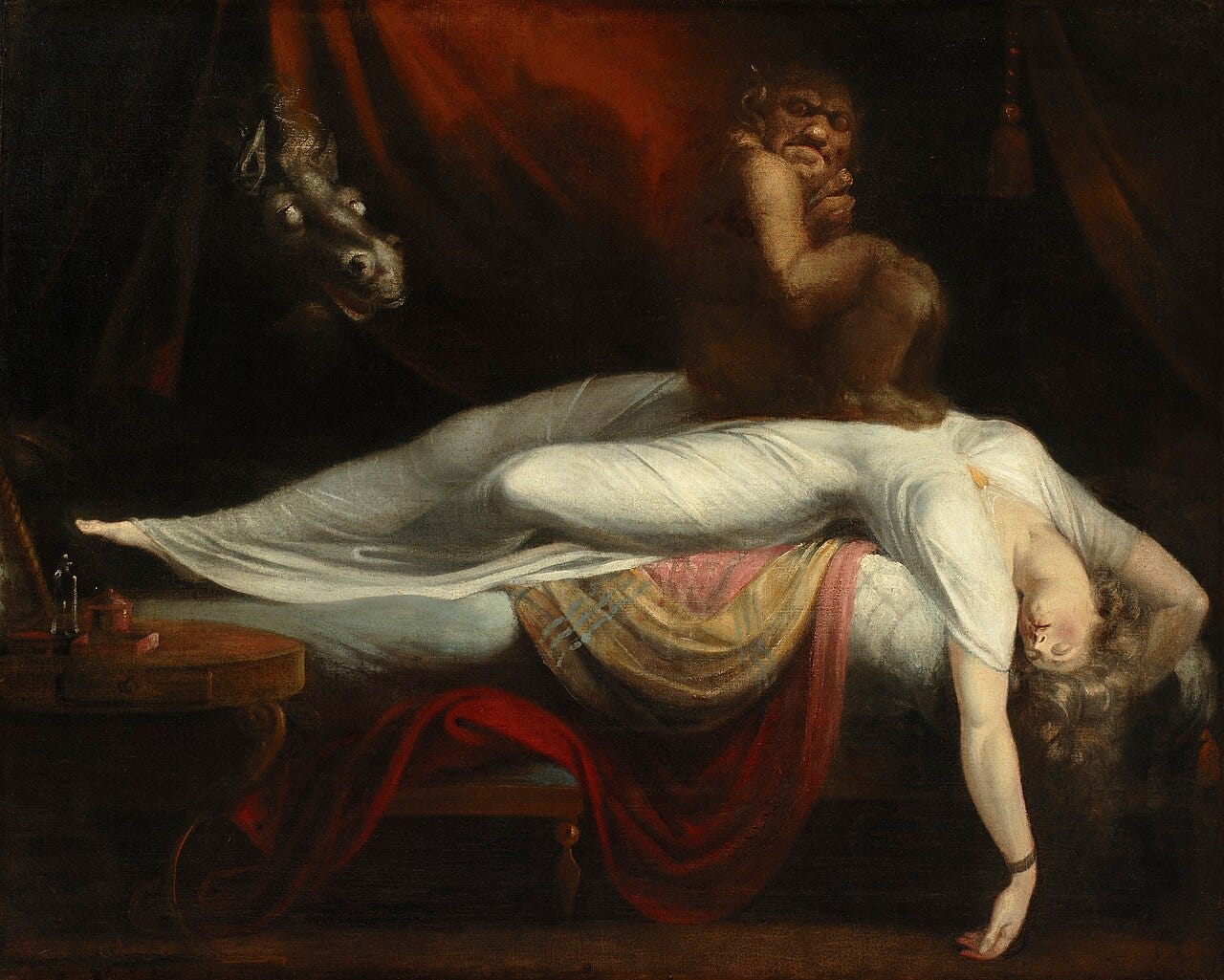
The nightmare one: Fuseli crushed his sleeper under a squatting demon and a wild eyed horse.
The plague one: Giorgione died before finishing his sleeping Venus, and Titian completed it.
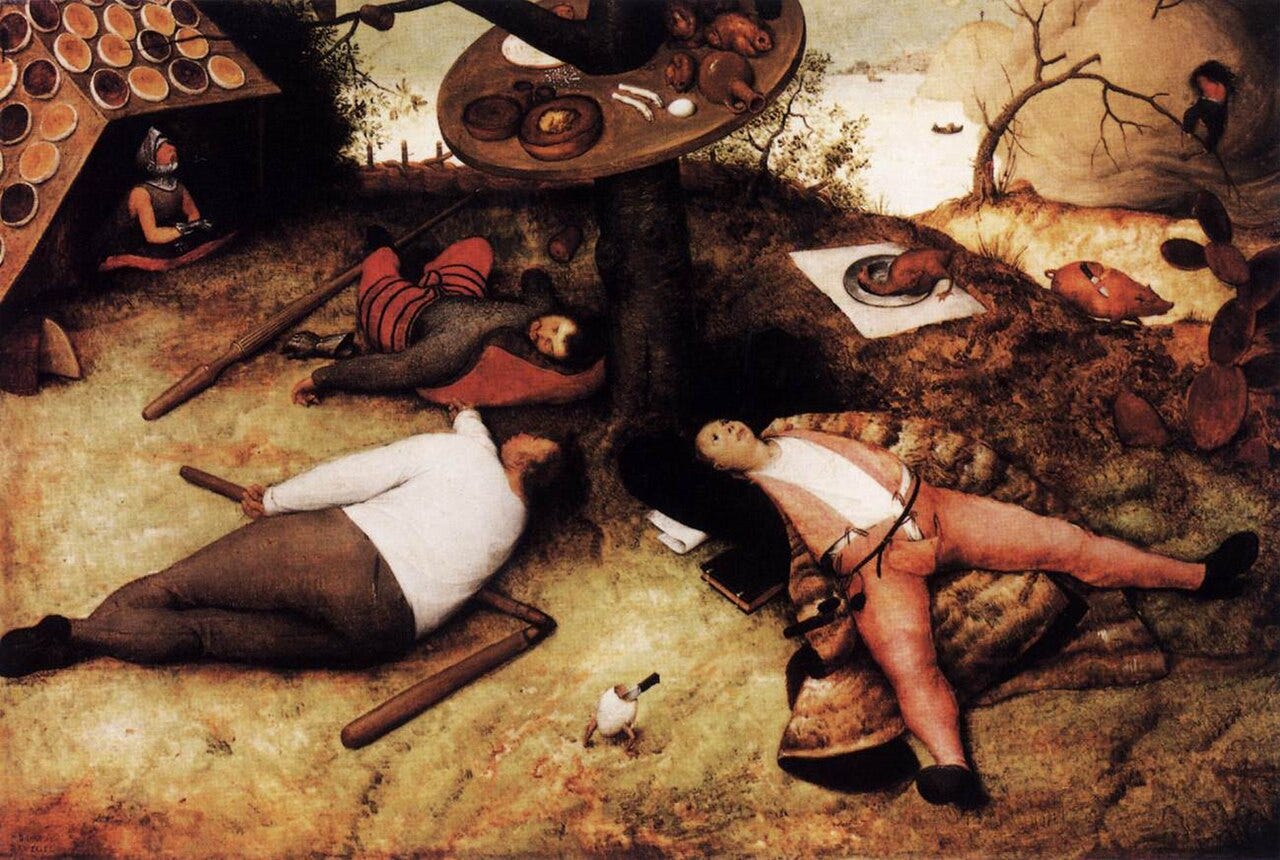
The moral one: Bruegel painted three gluttons asleep in a land of endless food to mock laziness.
If these draw you in, you will also love 7 secrets hidden in famous paintings, is Cezanne the greatest painter of all time, and the story of the woman who made Vincent van Gogh.
1. Henri Rousseau, The Sleeping Gypsy
A woman in a striped robe sleeps in a desert under a full moon. A lion stands over her, sniffing, its tail stiff. Beside her rest a mandolin and a water jar. Rousseau, a self taught painter, built the scene from pure imagination.
The picture feels like a riddle on purpose. Is the lion about to attack, or is it part of her dream? Rousseau offered the canvas to his home town of Laval, which turned it down. It vanished for years.
When the work resurfaced in the 1920s, some experts doubted it was real. It is now one of the most loved paintings at MoMA, and the mystery of the lion has never been solved.
2. Frederic Leighton, Flaming June
A young woman sleeps curled in a deep orange gown, one arm thrown over her head. Leighton, president of Britain Royal Academy, painted her against a bright sea. The folds of cloth twist like flame.
There is a warning in the corner. Top right, a sprig of oleander, a poisonous plant, hints that this sleep touches on death as much as summer heat. Beauty and danger share the frame.
The painting nearly disappeared. In the 1960s it sold cheaply because Victorian art was out of fashion. A collector bought it for the museum in Ponce, where it became the treasure of Puerto Rico.
3. Giorgione, Sleeping Venus
The goddess of love sleeps naked in an open landscape, her body echoing the curve of the hills behind her. Giorgione painted her in Venice, giving Western art its first great reclining nude.
He never finished it. Giorgione died young in a plague outbreak around 1510, and records say Titian completed the landscape and sky. So two of Venice names share one sleeping figure.
The pose set a template that ran for centuries. Titian own Venus of Urbino and Manet Olympia both trace back to this quiet sleeper in Dresden.
4. Henry Fuseli, The Nightmare
A woman lies flung back across a bed, arms trailing to the floor. A small grinning demon squats on her chest. A pale horse with blank eyes pushes through the curtain. Fuseli painted the weight of a bad dream as a body you can see.
The demon is an incubus, the horse a visual pun on the word nightmare. Some scholars think the picture grew from Fuseli unreturned love for a woman named Anna Landolt. He painted a portrait of a woman on the back of the canvas.
The image caused a sensation at the Royal Academy in 1782. Fuseli made several versions, and prints of it hung in homes across Europe, including, it is said, one owned by Sigmund Freud.
5. Caravaggio, Sleeping Cupid
A small boy with wings sleeps on a dark ground, his bow and arrows loose in his hand. Caravaggio painted this Cupid in Malta, while hiding on the island after killing a man in Rome.
This is no soft cherub. The child looks unwell, with a swollen belly and stiff limbs, and doctors have suggested he shows signs of a real illness. Caravaggio painted from a living model, flaws and all, instead of an ideal.
The god of love asleep meant love at rest, a fitting image for a knight who owned it. The canvas has stayed in the Medici collections in Florence for four centuries.
6. Gustave Courbet, The Sleepers
Two women sleep tangled together in a rumpled bed, pearls and a broken necklace scattered on the sheets. Courbet painted the scene in 1866 for a private buyer.
The patron was a wealthy Ottoman diplomat, Khalil Bey, who also owned Courbet most notorious nude. The subject was too frank for public taste, so the picture stayed hidden. Police once listed it in a report on a dealer stock.
For decades almost no one saw it. The city of Paris acquired it in the 1900s, and it now hangs openly at the Petit Palais.
7. Johannes Vermeer, A Girl Asleep
A young woman rests her head on her hand at a table, eyes closed, a glass of wine near her. Behind her an open door leads into an empty room. Vermeer painted her early in his career in Delft.
X rays tell a secret. Vermeer first painted a man in the far doorway and a dog in the middle, then wiped them out, leaving only the sleeper and the silence. The wine hints she may be less asleep than tipsy.
Dutch viewers read idleness as a small sin. The picture reached the Met through the collector Benjamin Altman, and it remains one of Vermeer rare quiet interiors in the United States.
8. Jean Francois Millet, Noonday Rest
Two peasants sleep side by side in the shade of a haystack at midday, their sickles laid aside. Millet drew the scene in pastel and black crayon, catching the dead heat of the harvest hour.
The couple mirrors the tied wheat sheaves next to them, a quiet rhyme between the workers and their work. Millet made it for a Paris patron who paid for the materials and let the artist pick the subject.
Years later, Vincent van Gogh copied this exact composition in oil while in an asylum, turning the sleepers blue and gold. Millet original stays in Boston.
9. Vincent van Gogh, Noon, Rest from Work
Two farm workers doze against a golden haystack, boots off, sickles resting nearby. Van Gogh painted his color version in early 1890, in the asylum at Saint Remy, from a print of Millet design.
He treated Millet like a teacher and copied several of his scenes during his illness, calling it a way to keep painting when he could not go outside. He kept the pose but flooded it with warm yellow and deep blue.
This is one of the last calm images he made. He left the asylum months later and died that July. The canvas now hangs at the Musee d Orsay.
10. Salvador Dali, Sleep
A vast soft head floats above a low landscape, eyes shut, propped up by thin wooden crutches. Dali painted this dream figure in 1937, at the height of his surrealist years.
Dali said sleep was a heavy monster held up by crutches of reality. Take away the props, he warned, and the sleeper falls. The tiny crutches under the eyelids and jaw make the point.
The picture stayed in private hands and rarely tours. It remains one of the clearest images of how the surrealists tried to paint the state of dreaming itself.
11. Pieter Bruegel the Elder, The Land of Cockaigne
Three men lie sprawled asleep around a tree, stuffed with food. A roast bird waddles up ready to be eaten, and a pig runs by with a knife already in its side. Bruegel painted the folk fantasy of a land where no one has to work.
It is a joke with a moral. The three sleepers are a peasant, a soldier and a scholar, all classes made equal by pure laziness. Bruegel used the fairy tale to mock gluttony and sloth.
The land of plenty was a warning, not a dream to chase. The panel entered the Bavarian royal collection and now anchors the Bruegel room in Munich.
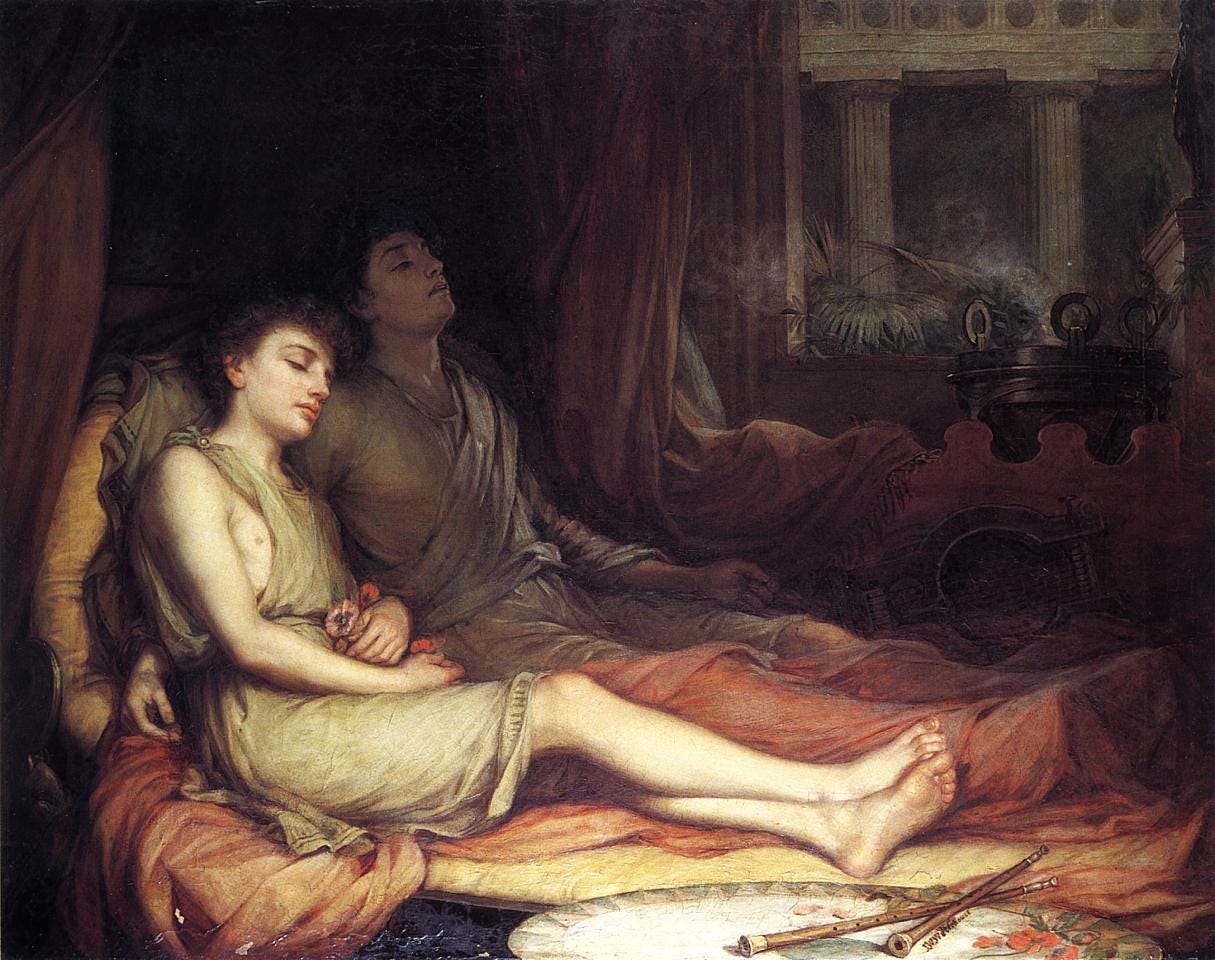
12. John William Waterhouse, Sleep and His Half Brother Death
Two young men lie side by side in a dim room, one asleep, one still. A red poppy rests in the sleeper hand. Waterhouse painted the Greek gods Hypnos, sleep, and Thanatos, death, shown as brothers.
In myth the two are sons of Night, born together, which is why one can barely be told from the other here. Waterhouse painted it soon after his own brother died of tuberculosis, and grief runs under the calm.
This was his debut at the Royal Academy in 1874, painted when he was in his mid twenties. A private collector bought it, and it launched the career of one of Britain great storytellers in paint.
Where to see them
Museum of Modern Art, New York: Henri Rousseau, The Sleeping Gypsy.
Museo de Arte de Ponce, Puerto Rico: Frederic Leighton, Flaming June.
Gemaldegalerie Alte Meister, Dresden: Giorgione, Sleeping Venus.
Metropolitan Museum of Art, New York: Johannes Vermeer, A Girl Asleep.
Musee d Orsay, Paris: Vincent van Gogh, Noon, Rest from Work.
Why sleep is never only rest
Some of these are nudes, where sleep let a painter show a body relaxed and unguarded, from Giorgione Venus onward.
Others are genre scenes of ordinary life, or Surrealist visions that try to paint the dream itself rather than the sleeper.
Sleep in art, questions people ask
What is the most famous painting of a sleeping figure? Henri Rousseau The Sleeping Gypsy, from 1897, shows a woman asleep in a desert with a lion standing over her, and it hangs at MoMA in New York.
What is happening in Fuseli The Nightmare? A sleeping woman is crushed by a small demon called an incubus, while a pale horse looks on. It is a painting of a bad dream, from 1781.
Who painted the Sleeping Venus? Giorgione began it around 1508 to 1510 but died before finishing. Titian is thought to have completed the landscape. It is now in Dresden.
Why did Van Gogh paint sleeping peasants? He copied Jean Francois Millet Noonday Rest while in an asylum in 1890, using Millet as a teacher and adding his own strong yellow and blue.
Where can I see Flaming June? At the Museo de Arte de Ponce in Puerto Rico. It was bought cheaply in the 1960s when Victorian art had fallen out of fashion.
The sleeper that came back from the dead
Flaming June almost never made it. In the 1960s, with Victorian painting out of fashion, the canvas is said to have sat unsold in a London frame shop for a few pounds. The industrialist Luis Ferre bought it for his museum in Puerto Rico, where it now draws visitors from across the world. A sleeping woman, once nearly thrown away, became a national symbol.