Snake Paintings: 12 Famous Serpents in Art History

Snakes coil through art as tempters, monsters, and killers. From the serpent in Eden to Medusa writhing hair and the sea serpents that crushed Laocoon, twelve famous paintings show how one animal came to carry humanity oldest fears.

No creature in art has a worse reputation than the snake. It tempts Eve, poisons kings, and strangles priests. Yet the same coiled shape also stood for healing and eternity in the ancient world.

  • The serpent job: each snake is doing something, whether tempting, killing, or curing.

  • Medusa hair: a severed head of living snakes let painters show horror and beauty at once.

  • The tempter of Eden: Cranach and Michelangelo pictured the snake that ruined paradise.

  • The bite of a queen: Reni reduced Cleopatra fall to one small asp at her breast.

If these draw you in, you will also love 7 secrets hidden in famous paintings, the mafia and the missing Caravaggio, and what the nude means in art.


Learn art the fun way. Free stories every week, no boring lectures.


1. Caravaggio, Medusa

Medusa severed head screaming with snakes for hair on a shield
Caravaggio, Medusa, about 1597. Uffizi, Florence.

Around 1597 Caravaggio painted Medusa severed head on a round wooden shield, her mouth open in a scream, snakes still writhing from her scalp.

The trick is the timing. Caravaggio caught Medusa at the instant of death, still aware of her own beheading, blood spurting from her neck. Many believe he gave her his own face, so the horror stares back at itself.

A cardinal sent the shield to the Medici in 1598, and it was later shown on an armoured mannequin, a real weapon turned into a painting.

2. Peter Paul Rubens, Head of Medusa

Medusa pale head on cold ground with a nest of twisting snakes
Peter Paul Rubens, Head of Medusa, about 1617 to 1618. Kunsthistorisches Museum, Vienna.

Around 1617 Rubens laid Medusa head on cold ground, her skin already pale, while a nest of snakes twists and knots across the rock.

Rubens did not paint the snakes alone. The serpents were done by his friend Frans Snyders, the animal specialist. Small creatures crawl from Medusa blood too, following the old myth that her blood bred vipers.

The picture was made to shock. Owners traditionally kept it covered, drawing the cloth back on a guest for the biggest jolt.

3. Michelangelo, The Fall and Expulsion from the Garden of Eden

A female serpent coiled around the tree handing Eve the fruit
Michelangelo, The Fall and Expulsion from the Garden of Eden, about 1509 to 1510. Sistine Chapel, Vatican City.

On the Sistine ceiling, painted around 1509 to 1510, Michelangelo split one panel in two. On the left Adam and Eve reach for the fruit. On the right an angel drives them out.

The tempter is the surprise. Michelangelo coiled a serpent around the tree but gave it a woman upper body, her tail winding into the branches. This female serpent hands Eve the fruit, blurring the line between snake and seducer.

The whole ceiling holds more than three hundred figures, and Michelangelo painted most of it craning his neck back for four years.

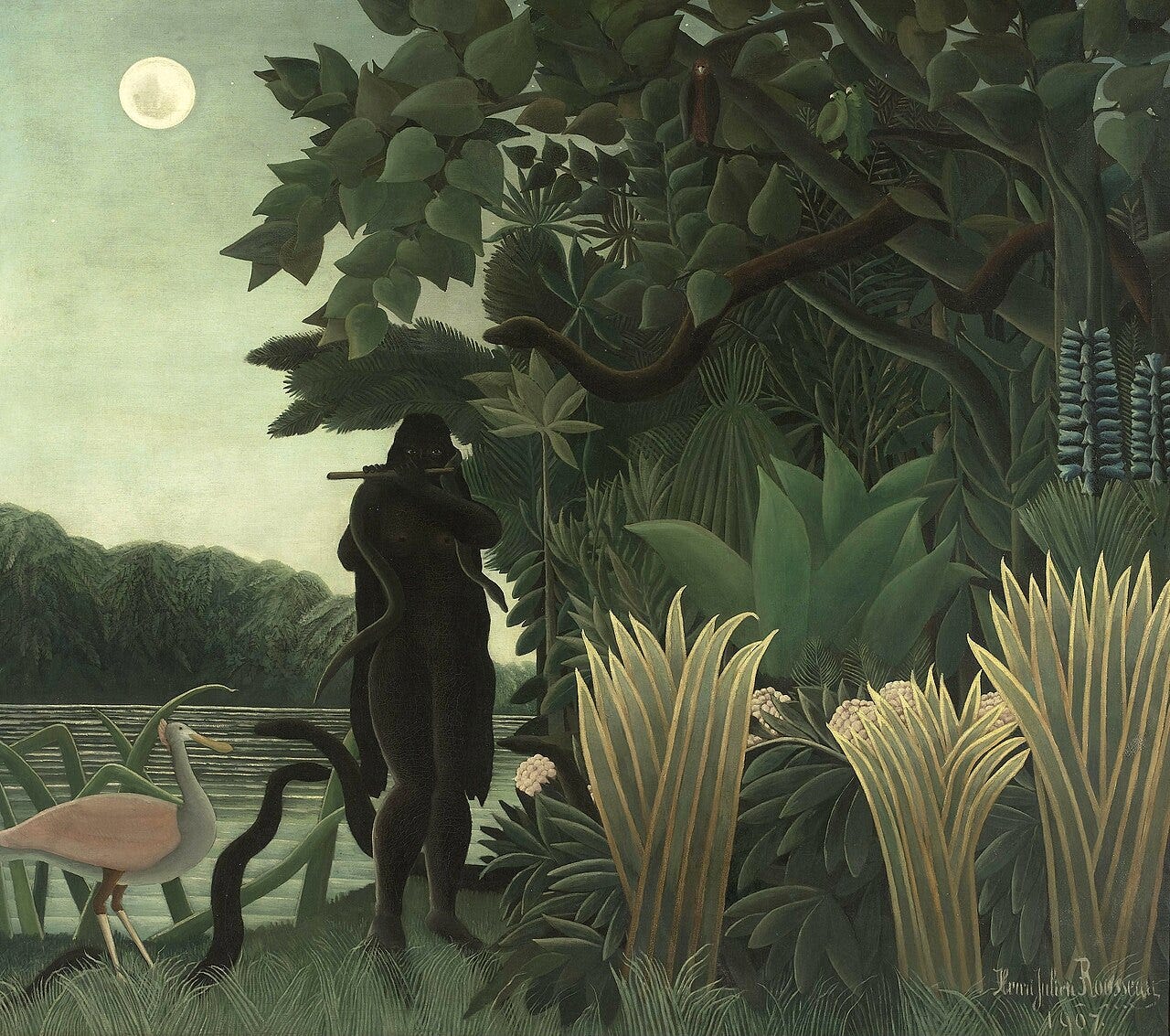
4. Henri Rousseau, The Snake Charmer

A dark figure playing a flute as snakes slide from a moonlit jungle
Henri Rousseau, The Snake Charmer, 1907. Musee d Orsay, Paris.

In 1907 Rousseau painted a dark skinned woman playing a flute at the edge of a moonlit jungle, snakes sliding toward her from the trees, one draped across her shoulders.

Rousseau never left France and never saw a jungle. He built this one from the plants of the Paris botanical gardens and his own imagination. The painting was a commission from the mother of the painter Robert Delaunay.

Rousseau once told Picasso that the two of them were the greatest painters of the age, Picasso in the Egyptian style, himself in the modern.

5. Franz von Stuck, The Sin

A nude woman in darkness with a huge snake wound around her body
Franz von Stuck, The Sin, 1893. Neue Pinakothek, Munich.

Stuck showed The Sin in 1893 at the first Munich Secession exhibition. A nude woman stands in near darkness, a huge snake wound around her body, its head resting by her face.

This is Eve remade as a femme fatale. The snake is both the tempter of Eden and a sign of dangerous desire, and the dark frame Stuck built made it look like an altar. It caused a sensation and made his career overnight.

Stuck was so pleased that he painted the subject again and again. At least twelve versions survive, scattered from Munich to Seattle.

6. John Collier, Lilith

A golden haired nude with a serpent coiled around her body
John Collier, Lilith, 1887. Atkinson Art Gallery, Southport.

In 1887 Collier painted Lilith as a golden haired nude in a dark wood, a huge serpent coiled around her legs and torso, its head cradled against her cheek.

Lilith is not in the main text of the Bible. Folklore made her Adam first wife, who refused to obey him and became a demon. Collier took his cue from Dante Gabriel Rossetti poem, painting her not in fear of the snake but in love with it.

The canvas stands almost two metres tall, so Lilith and her serpent loom larger than life over anyone who walks up to it.

7. El Greco, Laocoon

A priest and his sons attacked by sea serpents under a stormy Toledo
El Greco, Laocoon, about 1610 to 1614. National Gallery of Art, Washington.

Near the end of his life, around 1610 to 1614, El Greco painted the Trojan priest Laocoon and his sons attacked by sea serpents, their bodies stretched and twisting against a stormy view of Toledo.

The myth is a warning ignored. Laocoon told Troy not to trust the wooden horse, and the gods sent serpents to strangle him and his sons. El Greco set the scene not in Troy but under the skyline of his adopted Spanish city.

This is the only surviving painting on a classical subject by El Greco, a Greek who spent his whole career painting saints in Spain.

8. Lucas Cranach the Elder, Adam and Eve

Adam and Eve under the tree with a serpent coiled in the branches
Lucas Cranach the Elder, Adam and Eve, 1526. Courtauld Gallery, London.

Cranach signed and dated this Adam and Eve in 1526. The pair stand under the Tree of Knowledge, a serpent coiled in the branches above Eve, a calm lion and lamb at their feet.

The snake here does double duty. It is the tempter of Genesis, but Cranach also placed near it his personal emblem, a small winged serpent that he used as a signature. So the serpent is both the Devil and the artist own mark.

Cranach and his workshop turned out more than fifty versions of Adam and Eve, an early case of a painter mass producing a hit.


Join 130,000 readers who get the secrets behind the paintings. Free.


9. Guido Reni, Cleopatra with the Asp

Cleopatra pressing a small asp to her breast, eyes upturned
Guido Reni, Cleopatra with the Asp, about 1628. Royal Collection, Windsor Castle.

Around 1628 Reni painted Cleopatra in her final moment, half undressed, eyes turned upward, pressing a small asp to her breast.

The snake is the whole story. Instead of a battle or a throne, Reni reduced Cleopatra fall to one quiet, deadly gesture. The Egyptian queen chose the bite of an asp over capture by Rome.

Reni returned to Cleopatra several times, and versions of his dying queen hang from Windsor to Florence.

10. Nicolas Poussin, Landscape with a Man Killed by a Snake

A calm landscape hiding a man wrapped by a huge snake in front
Nicolas Poussin, Landscape with a Man Killed by a Snake, 1648. National Gallery, London.

In 1648 Poussin painted a calm green landscape hiding a horror. In the foreground a man lies dead, wrapped by a huge snake. A second man flees in terror, a woman on the path senses only his fear.

The genius is the chain of reactions. Each figure sees only part of what happened, fear rippling out across the scene from the one man who saw the snake. Poussin may have drawn on a real snake infested area near Fondi, south of Rome.

The colours have darkened badly over the centuries, so the painting looks far gloomier today than Poussin ever intended.

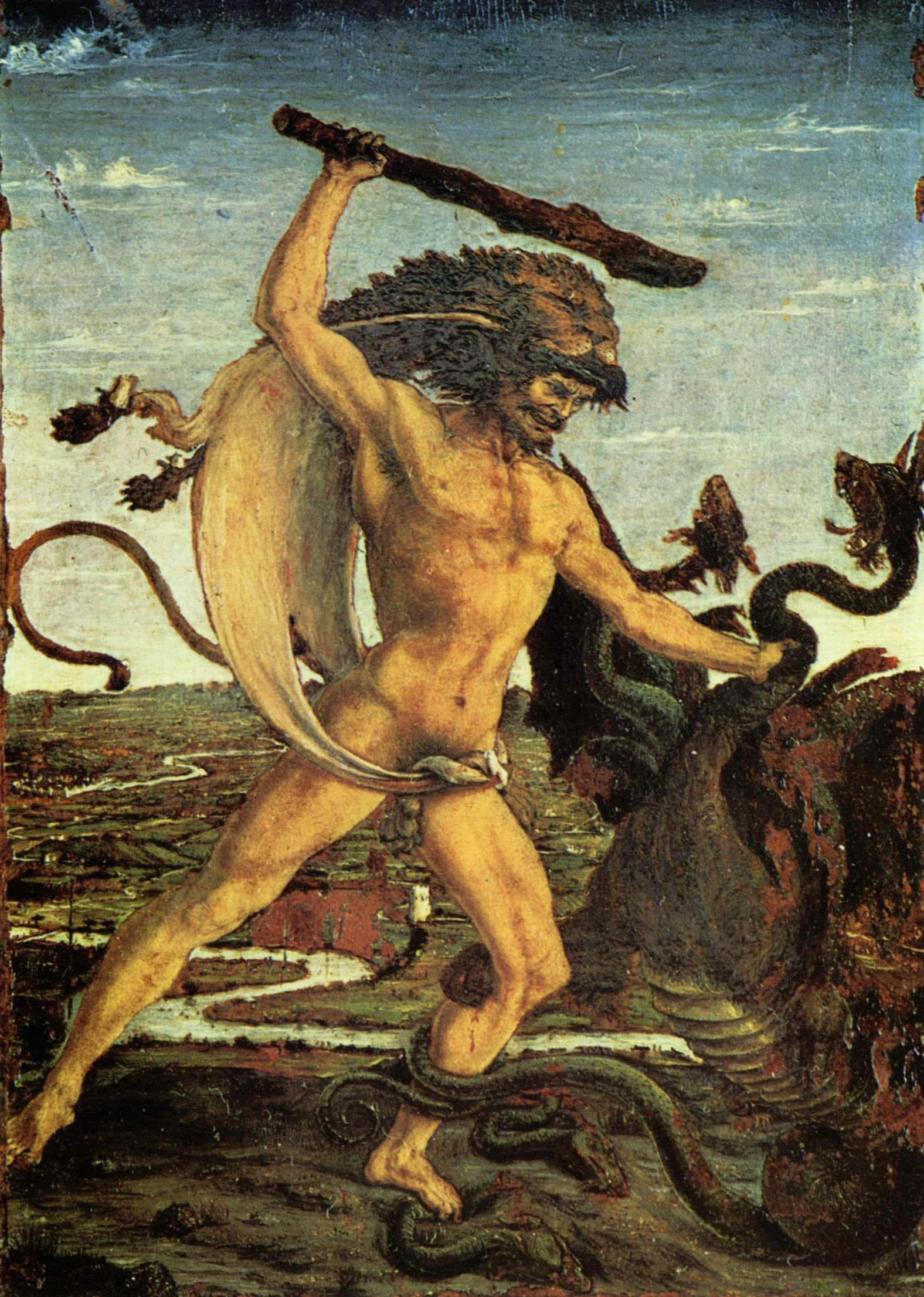
11. Antonio del Pollaiuolo, Hercules and the Hydra

Hercules swinging a club at a many headed serpent in a swamp
Antonio del Pollaiuolo, Hercules and the Hydra, about 1475. Uffizi, Florence.

Around 1475 Pollaiuolo painted Hercules swinging his club at the Hydra, a many headed serpent whose necks writhe up from the swamp. The panel is tiny, barely larger than a hand.

This small version copies one of three huge Hercules canvases Pollaiuolo painted for the Medici palace, each about three and a half metres across. The giant originals are lost, so this miniature is our best record of them.

The two Uffizi panels vanished in the Second World War and were only recovered in 1975.

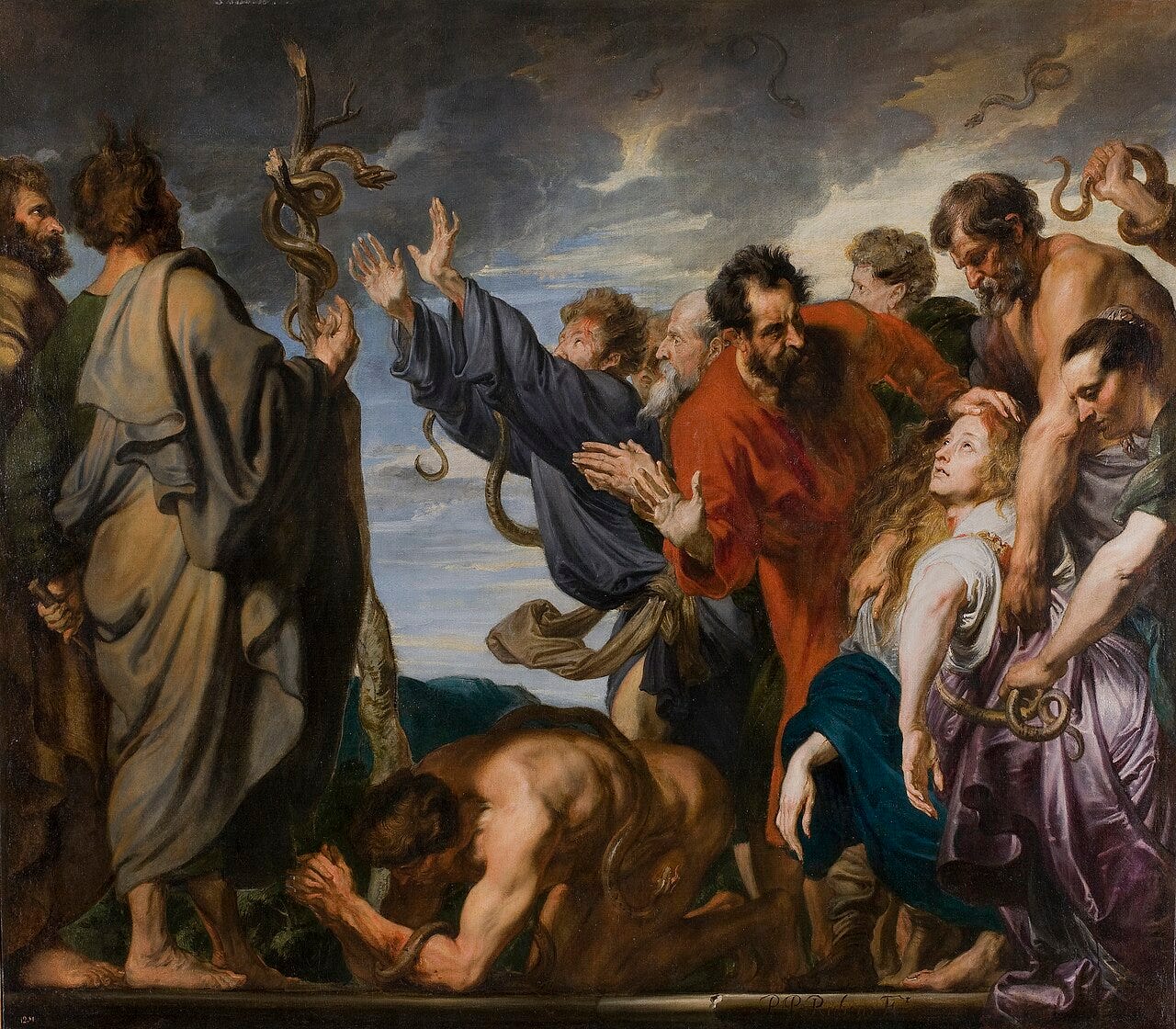
12. Anthony van Dyck, The Brazen Serpent

Israelites bitten by snakes as Moses points to a bronze serpent on a pole
Anthony van Dyck, The Brazen Serpent, about 1618 to 1620. Museo del Prado, Madrid.

Around 1618 the young van Dyck painted the Israelites in the desert, bodies twisting as snakes bite them, while Moses points to a bronze serpent raised on a pole.

The story comes from the Book of Numbers. God sends snakes to punish the people, then tells Moses to raise a bronze serpent so that anyone who looks at it is healed. Christian writers read that raised serpent as a foreshadow of the crucifixion.

Van Dyck was barely twenty when he painted this, already working in Rubens shadow and about to outgrow it.

Where to see them

  • Uffizi, Florence: Caravaggio Medusa and Pollaiuolo Hercules and the Hydra.

  • Kunsthistorisches Museum, Vienna: Rubens Head of Medusa.

  • Sistine Chapel, Vatican City: Michelangelo The Fall and Expulsion.

  • Musee d Orsay, Paris: Rousseau The Snake Charmer.

  • Museo del Prado, Madrid: van Dyck The Brazen Serpent.

What the serpent really carries

In sacred art the snake belongs to iconography, the tempter of Eden or the healing serpent of Moses, a fixed sign read by every viewer.

In later Symbolist works it became the femme fatale coiled around a nude, desire and danger in one shape.

Snakes in art, questions people ask

  • What does a snake symbolize in art? Most often temptation and evil, from the serpent in Eden. It can also mean healing, from the staff of Asclepius, or eternity and wisdom, depending on the culture.

  • Why is Medusa painted so often? Her head, with living snakes for hair and a gaze that turned men to stone, let painters show horror and beauty at once. Caravaggio and Rubens both painted her severed head.

  • Is the serpent in Eden actually a snake in the Bible? Genesis calls it a serpent but never names it Satan. That link came later. Artists like Cranach and Michelangelo pictured it as a snake, sometimes with a human face.

  • What is the most famous snake painting? Michelangelo Fall and Expulsion on the Sistine ceiling is probably the most seen, with Caravaggio Medusa and Rousseau Snake Charmer close behind.

  • Why did Michelangelo give the serpent a woman body? He followed a medieval tradition that showed the tempter with a human upper body, often female, to stress the seduction in the Fall.

From the Devil tool to the doctor badge

The same coiled snake that damns Eve in Cranach panel still marks the medicine you buy today. Wound around the staff of Asclepius, it hangs on pharmacy signs and ambulances across the world, the oldest villain in art quietly recast as a sign of healing.


Two new stories a week, 130 secrets unlocked. Start free.