
For two centuries, much of the finest Spanish art stayed inside royal palaces, churches and monasteries, and some of it reached the rest of Europe only when French soldiers carried canvases north during the Napoleonic wars. In the twentieth century the traffic ran the other way. Spanish artists left for Paris and New York, and changed what a work of art could be made of.
Cool Stories About Art is a newsletter to learn art the fun way.
Join 200,000+ readers and get:
10 new art stories / month
The entire archive of content (1,000+ articles)
Comment, ask questions, and chat with other readers
Church, Crown and the Road to Paris
For most of its history, Spanish art served two patrons, the Church and the Crown, and each wanted something precise. The Church wanted images that moved people to prayer: statues of saints painted to look alive, scenes of suffering a believer could not turn away from. The Crown wanted portraits of the royal family, and for generations it gathered Italian paintings, Titian's above all.
The French occupation of the early 1800s and the wars that followed shook that world. By 1900, many Spanish artists who wanted to change art went to Paris.
Three painters from three different centuries usually compete for the title of greatest Spanish artist, and all three are here. Every artist on this page was born in Spain or did a life's work there, and left art different from the way it was before.
Two of the twelve are women whom most lists leave out. To me, the story is incomplete without them.
12. Luisa Roldán (1652 to 1706)
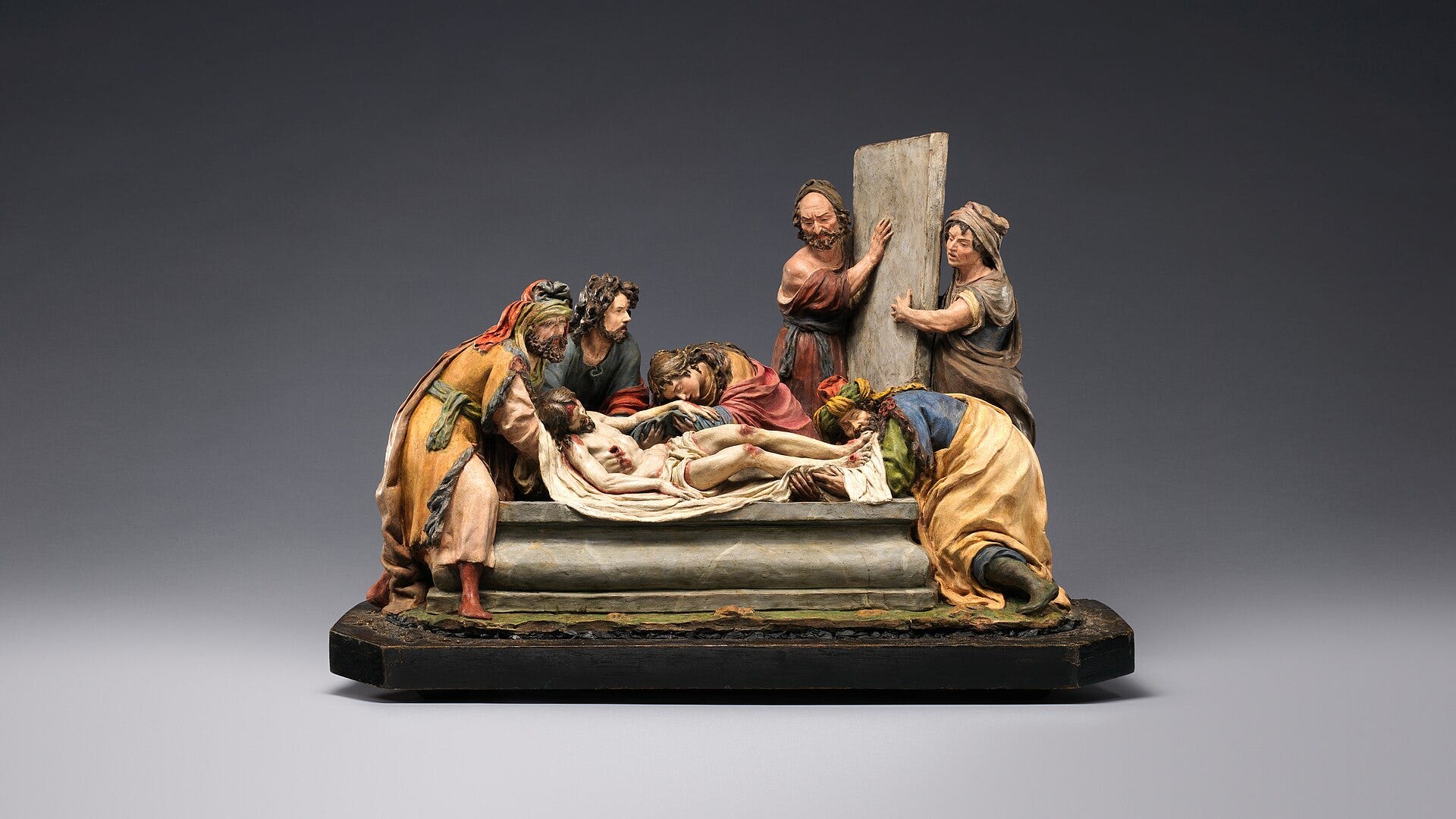
Around an open tomb, small clay figures painted in bright colors lower the pale body of Christ into the grave. The group is small, made to be seen up close, like a painting.
Its maker had started far from such delicate work. In Seville, where Luisa Roldán was born in 1652, sculpture was a man's trade. Workshops run by men turned out life-size saints in painted wood for altarpieces and processions. She learned in the busiest, her father's, and even after her marriage the contracts for her work were drawn up in her husband's name.
Madrid gave her a name of her own. She moved there in 1689, and in 1692 King Charles II made her Escultora de Cámara, sculptor to the royal chamber, the first woman to hold that post in Spain. At court she left wood for terracotta, a material more common in Italy than in Spain, and shaped small groups of figures for the palace.
The Entombment came from that second career, modeled over the winter of 1700 to 1701 as her gift to Philip V, the first Bourbon king, who renewed her title.
The title brought prestige and very little money, and her letters asking the king and queen for lodging and clothes survive. Five days before her death, in January 1706, she declared in her will that she lived in extreme poverty and asked for charity to pay for her burial. That same year in Rome, the Academy of Saint Luke received her as a member of merit.
At a Glance
Born: 1652, Seville
Died: 1706, Madrid
Nationality: Spanish
Known for: Life-size painted wooden saints and small painted terracotta groups, as sculptor to the Spanish court
Where to see the work: The Metropolitan Museum of Art, New York, the Getty Center, Los Angeles, and the Museo del Prado, Madrid
11. Maruja Mallo (1902 to 1995)
One afternoon in the 1920s, four young people walked into the Puerta del Sol, the central square of Madrid, and took off their hats in front of everyone. In those years, going bareheaded in public was enough to cause a scandal. Passersby shouted insults, and some attacked them. Among the four were the poet Federico García Lorca and a young woman from Galicia who had come to the capital to study painting.