Famous Spanish Paintings: 12 From El Greco to Sorolla

The most famous Spanish paintings are darker and fiercer than most, from El Greco's stretched saints and Velazquez's princess to Goya's firing squad and Sorolla's blazing beaches. Spain gave art some of its most intense and unflinching pictures.

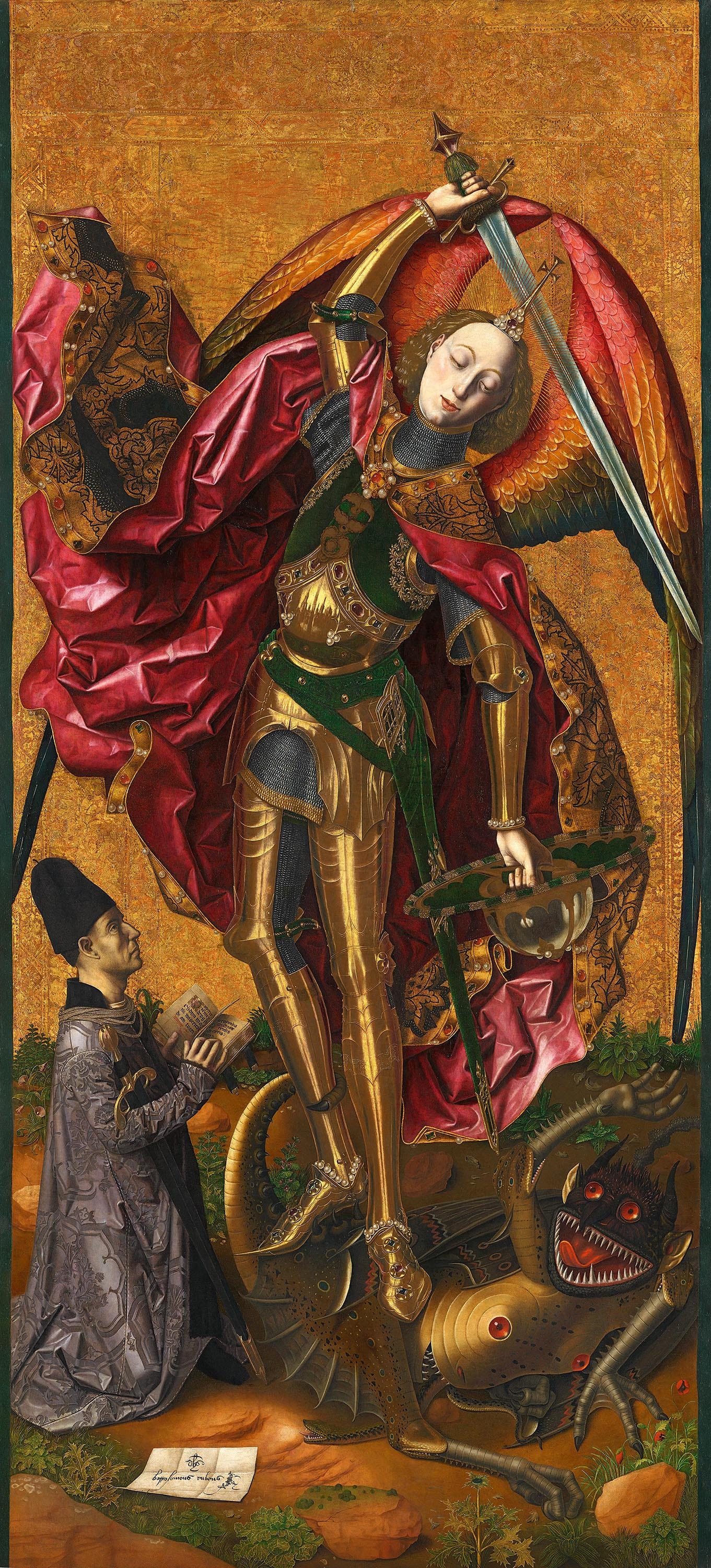
Bermejo Saint Michael gold armor
Bartolome Bermejo, Saint Michael Triumphs over the Devil, 1468, National Gallery, London

Spanish painting kneels before God, stares poverty in the face, and refuses to prettify a king. I have picked twelve that run from medieval gold to the pure sun of 1900, and together they show a voice unlike any other in Europe.

What makes Spanish painting so intense:

  • The faith. Centuries of deep Catholic feeling filled the canvases with saints, martyrs and visions.

  • The dark. Spanish painters loved deep shadow pierced by a single hard light, a style called tenebrism.

  • The truth. From beggars to kings, they painted people exactly as they were, warts and all.

  • The light. By 1900 Sorolla flooded that whole tradition with pure Mediterranean sun.


Learn art the fun way. Free stories every week, no boring lectures.


If you have twenty minutes

Three that changed how I look at a picture:


1. Bartolome Bermejo, Saint Michael Triumphs over the Devil (1468)

Spanish painting begins in gold. In 1468 Bartolome Bermejo painted Saint Michael in shining armor standing over a nightmarish devil, every surface gleaming with real gold and jewel bright color.

Bermejo was one of the first great Spanish painters, working when Spain was still a patchwork of kingdoms. His armor is polished to a mirror that reflects a tiny city, an early sign of the sharp Spanish eye for hard, exact detail.

2. El Greco, The Disrobing of Christ (1579)

El Greco Disrobing red robe
El Greco, The Disrobing of Christ, 1579, Toledo Cathedral

When El Greco arrived in Toledo from Greece by way of Venice, he painted Christ in a robe of burning red, hemmed in by a jeering crowd.

He finished The Disrobing of Christ in 1579, and the church that hired him was so startled it took him to court over the price and the strange design.

He stretched his figures tall and lit them like flames, a style that looked bizarre for centuries. Only around 1900 did modern painters see him as a genius born three hundred years too early.

3. El Greco, The Burial of the Count of Orgaz (1586)

El Greco Burial Count Orgaz
El Greco, The Burial of the Count of Orgaz, 1586, Santo Tome, Toledo

Saints in gold armor lower a dead nobleman into his tomb while, above, his soul rises through a storm of angels toward Christ. El Greco painted The Burial of the Count of Orgaz in 1586 for a small Toledo church, earth below and heaven above in one towering canvas.

The row of mourners is a gallery of real Toledo faces, including his own son and, many believe, the painter himself. It is the great meeting point of Spanish faith and Spanish portraiture.

4. Diego Velazquez, The Surrender of Breda (1635)

Velazquez Surrender of Breda lances
Diego Velazquez, The Surrender of Breda, 1635, Prado, Madrid

Most battle paintings gloat over the winners, yet this 1635 canvas by Diego Velazquez is about mercy. The Spanish victor gently stops the beaten Dutch commander from kneeling, laying a hand on his shoulder.

Velazquez served as court painter to the King of Spain and made even propaganda feel human. The forest of upright lances behind the figures gives the picture its Spanish nickname, Las Lanzas, the Lances.

5. Francisco de Zurbaran, Agnus Dei (about 1635)

Zurbaran Agnus Dei lamb
Francisco de Zurbaran, Agnus Dei, about 1635, Prado, Madrid

A single lamb lies bound on a stone slab against pure black, and that is the whole picture. This Agnus Dei, made by Francisco de Zurbaran around 1635, is a real sheep that is also the Lamb of God, bound and waiting to be sacrificed.

Zurbaran was the painter of Spanish monks and quiet faith, dropping his subjects into deep shadow pierced by one clear light, a style called tenebrism. Nothing else is needed, and nothing else intrudes.

6. Jusepe de Ribera, The Clubfoot (1642)

Ribera Clubfoot boy crutch
Jusepe de Ribera, The Clubfoot, 1642, Louvre, Paris

Ribera gave a poor, disabled boy the full dignity of a royal portrait. In 1642 he painted The Clubfoot, a grinning street child with a twisted leg, standing tall against a bright sky with his crutch over his shoulder.

A Spaniard working in Naples, Ribera loved rough, honest skin and hard light. The boy holds a note begging for charity, so the picture quietly asks the wealthy viewer for kindness while refusing to make him pitiful.

7. Bartolome Esteban Murillo, The Young Beggar (about 1650)

Murillo young beggar sunlight
Bartolome Esteban Murillo, The Young Beggar, about 1645, Louvre, Paris

A ragged boy sits alone in a shaft of sunlight, picking through his clothes, lost in his own small world. Around 1650 Bartolome Esteban Murillo gave a Seville street child the tenderness usually saved for saints, in a picture called The Young Beggar.

Murillo made his name with sweet, glowing religious pictures, but here he turned the same warm light on real poverty. It became one of the first great paintings to make an ordinary poor child its only subject.


130,000 people read this every week. Joining them costs nothing.


8. Diego Velazquez, Las Meninas (1656)

Velazquez Las Meninas Infanta
Diego Velazquez, Las Meninas, 1656, Prado, Madrid

A little blonde princess stands at the center of a busy studio, ringed by her maids, a dog and the painter himself at a huge canvas. Painted in 1656, Las Meninas has kept viewers arguing ever since about who its real subject is.

In the mirror at the back glimmer the king and queen, as if they stand exactly where you do. Many call it the finest picture in the Prado, and some call it the finest painting anywhere.

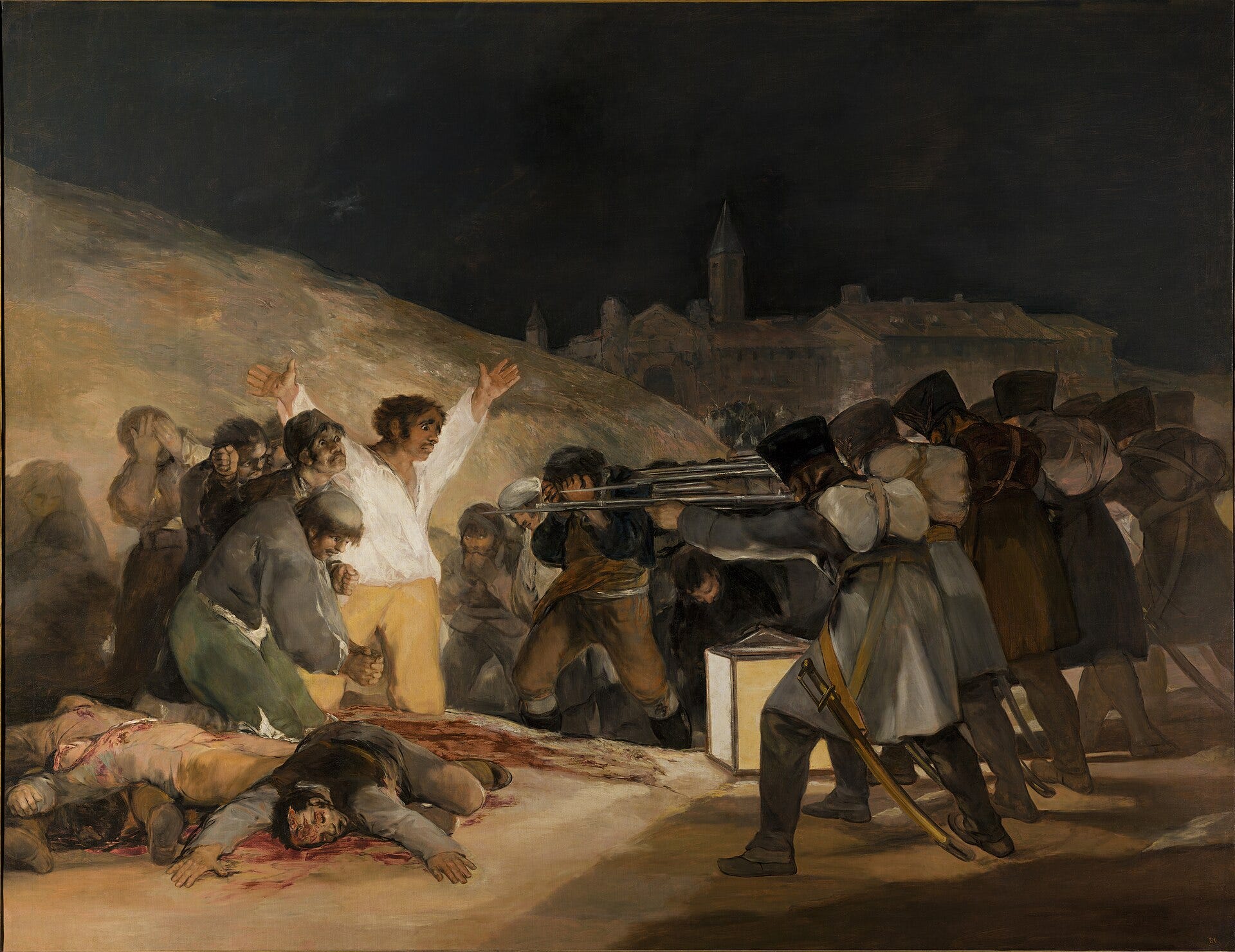
9. Francisco Goya, The Third of May 1808 (1814)

Goya Third of May execution
Francisco Goya, The Third of May 1808, 1814, Prado, Madrid

A man in a white shirt throws his arms wide before a firing squad, lit by a single lantern in the dark. Francisco Goya finished it in 1814, six years after the event, turning the execution of Spanish civilians by French troops into the first truly modern protest picture.

There is no glory here, only fear and a faceless line of soldiers. Goya took the side of the victims so plainly that painters from Manet to Picasso built their own war pictures on top of his.

10. Francisco Goya, Saturn Devouring His Son (about 1823)

Goya Saturn Black Painting
Francisco Goya, Saturn Devouring His Son, about 1823, Prado, Madrid

An old god, wild eyed and mad, stuffs the bloody body of his own child into his mouth. Goya painted Saturn Devouring His Son around 1823, not for a patron but straight onto the walls of his own house, for no one but himself.

Deaf, ill and sickened by war, he covered his home with these Black Paintings, among the darkest images in Western art. Only after his death were they peeled off the plaster and moved to the Prado, where I lay out my case for Goya as the greatest painter.

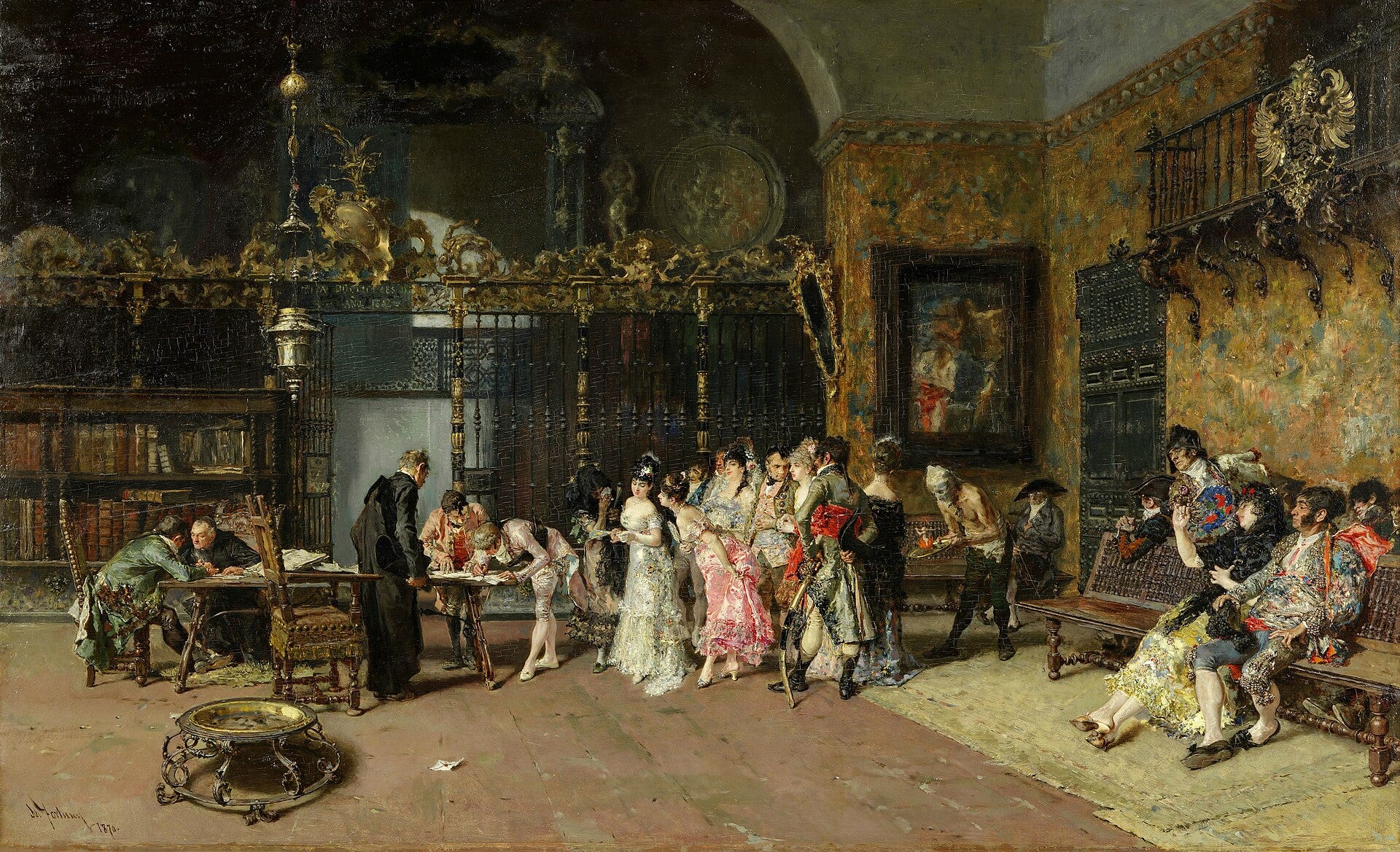
11. Mariano Fortuny, The Spanish Wedding (1870)

Fortuny Spanish Wedding vestry
Mariano Fortuny, The Spanish Wedding, La Vicaria, 1870, MNAC, Barcelona

A crowd of guests crams into a sunlit vestry to sign a wedding register, painted with the crispness of a photograph. Mariano Fortuny finished The Spanish Wedding in 1870, and its brilliant detail made him the most sought after Spanish painter of his day.

Fortuny died young at thirty six, just as he was becoming a European star. His bright light and quick touch pointed the way toward the sunlit Spanish painting that came next.

12. Joaquin Sorolla, Walking on the Beach (1909)

Sorolla beach white dresses light
Joaquin Sorolla, Walking on the Beach, 1909, Sorolla Museum, Madrid

After centuries of Spanish shadow, Joaquin Sorolla threw open the shutters and let in the sun. In 1909 he painted his wife and daughter Walking on the Beach, their white dresses billowing in a blaze of Mediterranean light off the water.

Sorolla worked outdoors at furious speed, chasing the exact glare of the Spanish coast. From El Greco's dark visions to this, Spanish painting had travelled all the way from heaven's gloom to a bright afternoon by the sea.


Join 130,000 readers who get the secrets behind the paintings. Free.


The Prado, and where else to look

  • Bermejo, Saint Michael Triumphs over the Devil: the National Gallery, London.

  • El Greco, The Burial of the Count of Orgaz: the church of Santo Tome, Toledo.

  • Velazquez, Las Meninas, Goya, The Third of May and Saturn, and Zurbaran: the Prado, Madrid.

  • Ribera, The Clubfoot: the Louvre, Paris.

  • Sorolla, Walking on the Beach: the Sorolla Museum, Madrid.


If Spain's intensity pulled you in, keep going:


Two new stories a week, 130+ secrets unlocked. Start free.


Spanish painting, a few quick questions

  • What is the most famous Spanish painting? Velazquez's Las Meninas and Goya's The Third of May 1808 are the most famous, with Picasso's Guernica the most famous of the modern age.

  • Who are the greatest Spanish painters? Velazquez, Goya and El Greco are the classic three, joined in the twentieth century by Picasso, Dali and Miro.

  • Where can I see Spanish paintings? The Prado in Madrid holds the greatest collection of Velazquez, Goya, El Greco and more.

  • What is tenebrism? The Spanish and Italian love of deep shadow pierced by one hard light, seen in Zurbaran and Ribera.

  • What is Guernica? Picasso's huge 1937 painting of the bombing of a Spanish town, the most famous anti war picture ever made, though it remains under copyright.

From heaven's gloom to a bright afternoon

Line them up and you feel a whole country's mood. Spanish painting rarely flatters. It kneels before God, stares poverty in the face, and refuses to look away from the firing squad or the madman eating his child.

Even its miracles come wrapped in shadow. Then, after four hundred years of that darkness, Sorolla walks onto a beach and paints nothing but light on water.

The single house in Madrid where Goya once covered his walls with nightmares is empty now, its Black Paintings long since cut from the plaster and hung in the Prado, where a quiet crowd files past them every day.