Storm Paintings: 12 Famous Raging Seas and Skies in Art

A storm painting is any work where wind, water and sky become the real subject, and the people are almost an afterthought. From Turner to Aivazovsky, painters used the storm to test the limits of paint itself and to say something about fate.

Storms gave artists an excuse to break the rules. No straight lines, no calm horizon, no polite lighting. Just pressure. Some had stood on a real deck in a real gale. Others invented the whole thing from a warm studio.

  • The sky does the acting: in storm painting the drama lives in the clouds and light, not in the faces below.

  • Scale shrinks the human: a tiny boat against a huge wave is the oldest trick for making you feel the danger.

  • Paint imitates weather: loose, fast, broken brushwork mimics rain and spray better than any careful finish.

  • The storm means something: shipwrecks and squalls almost always stand in for fate, faith, or the reach of empire.

If these draw you in, you will also love the untold story behind the Raft of the Medusa, 7 secrets hidden in famous paintings, and the mafia and the missing Caravaggio.


Learn art the fun way. Free stories every week, no boring lectures.


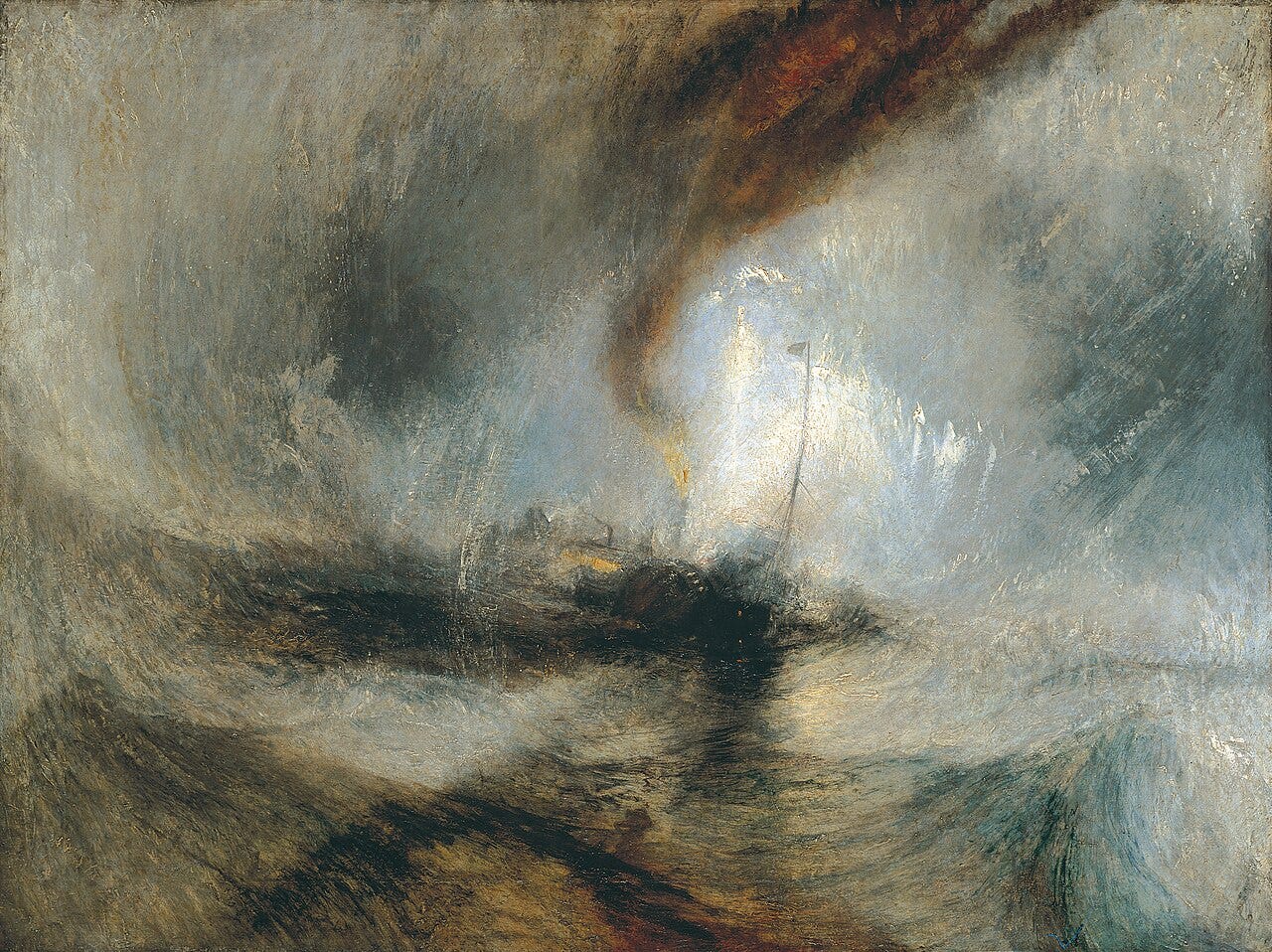
1. J.M.W. Turner, Snow Storm: Steam Boat off a Harbour Mouth

A paddle steamer swallowed by a spiral of snow and spray
J.M.W. Turner, Snow Storm: Steam Boat off a Harbour Mouth, 1842. Tate Britain, London.

Turner showed this at the Royal Academy in 1842. A paddle steamer is swallowed by a spiral of snow, spray and smoke, its mast the only steady thing in the frame.

The long title claims Turner was lashed to the mast for four hours to witness the storm. Scholars treat that story as a myth he encouraged, since no such ship or voyage has ever been traced.

One critic called it soapsuds and whitewash. Turner reportedly answered that they should have been out in it themselves.

2. Rembrandt, The Storm on the Sea of Galilee

A fishing boat pitching sideways as disciples panic
Rembrandt, The Storm on the Sea of Galilee, 1633. Isabella Stewart Gardner Museum, Boston.

Painted in 1633, this is Rembrandt only known seascape. A fishing boat pitches sideways as disciples panic and Christ stays calm, the sail already tearing.

Look at the terrified figure gripping a rope and staring out at you. Most historians read that face as Rembrandt himself, painted into the scene.

On March 18, 1990, two men dressed as police stole it from the Gardner Museum. The empty frame still hangs on the wall, waiting.

3. Ivan Aivazovsky, The Ninth Wave

Survivors clinging to a mast under a towering wall of water
Ivan Aivazovsky, The Ninth Wave, 1850. State Russian Museum, St Petersburg.

Aivazovsky finished this in 1850. Survivors cling to a broken mast at dawn as a towering wall of water builds behind them.

The title comes from an old sailors belief that waves arrive in sets and the ninth is the deadliest. Aivazovsky painted almost entirely from memory, rarely working from the sea in front of him.

He produced roughly 6,000 paintings in his life. This one stayed the crowd favorite, and it still draws lines at the museum in St Petersburg.

4. Winslow Homer, The Gulf Stream

A sailor on a dismasted boat with sharks circling
Winslow Homer, The Gulf Stream, 1899, reworked by 1906. Metropolitan Museum of Art, New York.

Homer painted the first version in 1899 after winters in the Bahamas. A Black sailor lies on a dismasted boat, sharks circling, a waterspout rising.

Buyers found it too bleak. Homer reworked it and, by 1906, quietly added a faint ship on the far horizon, a thin hint of rescue that changes the whole mood.

When a dealer pressed him to explain the ending, Homer snapped that the man would be rescued and returned to his friends and home. The Met bought it in 1906.

5. Giorgione, The Tempest

A soldier and a nursing mother under a lightning split sky
Giorgione, The Tempest, about 1508. Gallerie dell Accademia, Venice.

Painted around 1508, this small Venetian panel shows a soldier and a nursing mother in a landscape, with lightning splitting the green sky behind them.

Nobody has ever agreed on the subject. X rays revealed Giorgione first painted a second nude woman where the soldier now stands, so even he seems to have changed his mind.

A Venetian collector who saw it in 1530 simply called it the little landscape with the storm. Five centuries later, that is still the safest description anyone can give.

6. Pieter Bruegel the Elder, Storm at Sea

Ships heaving in a grey green swell with a whale surfacing
Pieter Bruegel the Elder, Storm at Sea, about 1569. Kunsthistorisches Museum, Vienna.

Made around 1569, near the end of Bruegel life, ships heave in a grey green swell while a whale surfaces between them.

A barrel floats in the water on purpose. Sailors threw barrels to distract whales, and old moralists read it as the soul tossing out worldly goods to survive the storm.

The panel was likely left unfinished when Bruegel died in 1569. Some scholars still argue it is by another hand entirely, which keeps the debate alive in Vienna.

7. Claude Joseph Vernet, A Shipwreck in Stormy Seas

Waves smashing a rocky shore as survivors climb the cliffs
Claude Joseph Vernet, A Shipwreck in Stormy Seas, about 1773. National Gallery, London.

Vernet painted this around 1773. Waves smash a rocky shore, one ship already broken on the rocks while survivors scramble up the cliffs in the rain.

Vernet built a career on staged disaster. He painted shipwrecks in pairs with calm harbor scenes so patrons could hang danger and peace side by side.

This one was bought by Clive of India in 1773. The National Gallery finally acquired it in 2004, more than two centuries later.

8. Theodore Gericault, The Raft of the Medusa

Survivors on a raft waving at a speck on the horizon
Theodore Gericault, The Raft of the Medusa, 1818 to 1819. Louvre, Paris.

Gericault worked on this from 1818 to 1819. Fifteen survivors on a makeshift raft wave at a speck on the horizon under a heavy, breaking sky.

This was ripped from the news. A French frigate wrecked in 1816, 147 people were left on a raft, and only about 15 lived through days of thirst and cannibalism.

To get the color right, Gericault studied corpses and severed limbs in his studio. The finished canvas is nearly seven meters wide.


Join 130,000 readers who get the secrets behind the paintings. Free.


9. John Constable, Rainstorm over the Sea

A black rain squall sweeping the sea with one shaft of light
John Constable, Rainstorm over the Sea, about 1824 to 1828. Royal Academy of Arts, London.

Painted on the Brighton coast between 1824 and 1828, this oil sketch shows a black rain squall sweeping the sea, with one shaft of light breaking through.

Constable studied weather like a scientist, filling notebooks with cloud types. Here he dropped the boats and figures almost entirely to paint pure atmosphere.

It is tiny, barely larger than a sheet of paper, and painted on paper at that. Some now rate this quick study above his big exhibition pieces.

10. Gustave Courbet, The Wave

A single green wave rearing toward a stormy sky
Gustave Courbet, The Wave, about 1869 to 1870. Stadel Museum, Frankfurt.

Courbet painted this around 1869 to 1870 after a stay on the Normandy coast. A single green wave rears up and curls toward a stormy sky, no boat, no story.

He painted the sea over and over that season, a whole series he called his waves. Stripping out ships and people was close to abstract for its time.

Courbet applied much of the paint with a palette knife, not a brush. The thick, scraped surface is part of why the water looks so heavy.

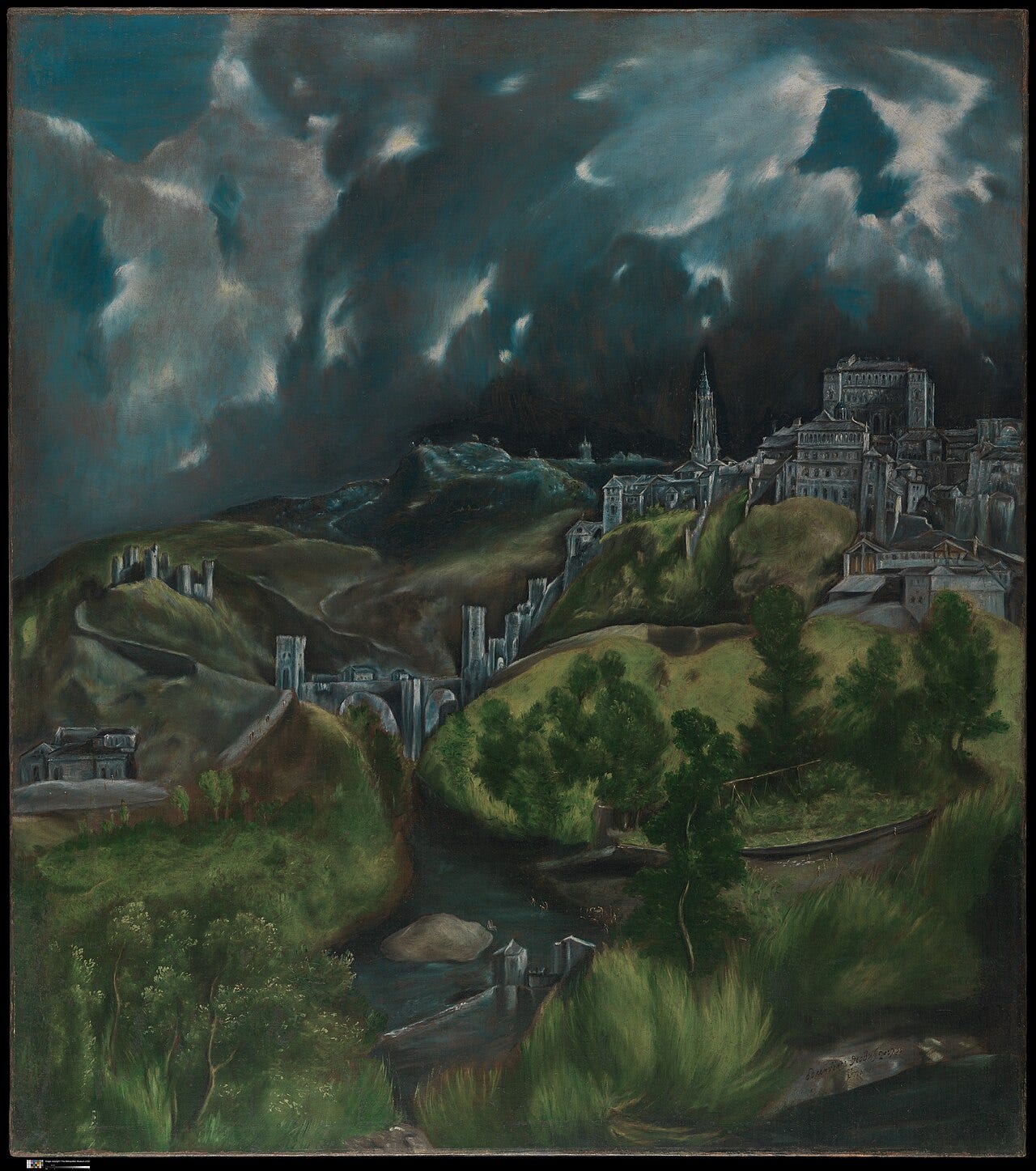
11. El Greco, View of Toledo

A city under a bruised electric sky the color of a coming storm
El Greco, View of Toledo, about 1599 to 1600. Metropolitan Museum of Art, New York.

Painted around 1599 to 1600, this is one of the first pure landscapes in Spanish art. The city of Toledo sits under a bruised, electric sky the color of a coming storm.

El Greco rearranged the real city to suit the drama, moving the cathedral to the left of where it actually stands. It is a mood, not a map.

It sat largely overlooked for centuries. Only in the twentieth century did painters and critics decide it was one of El Greco greatest works.

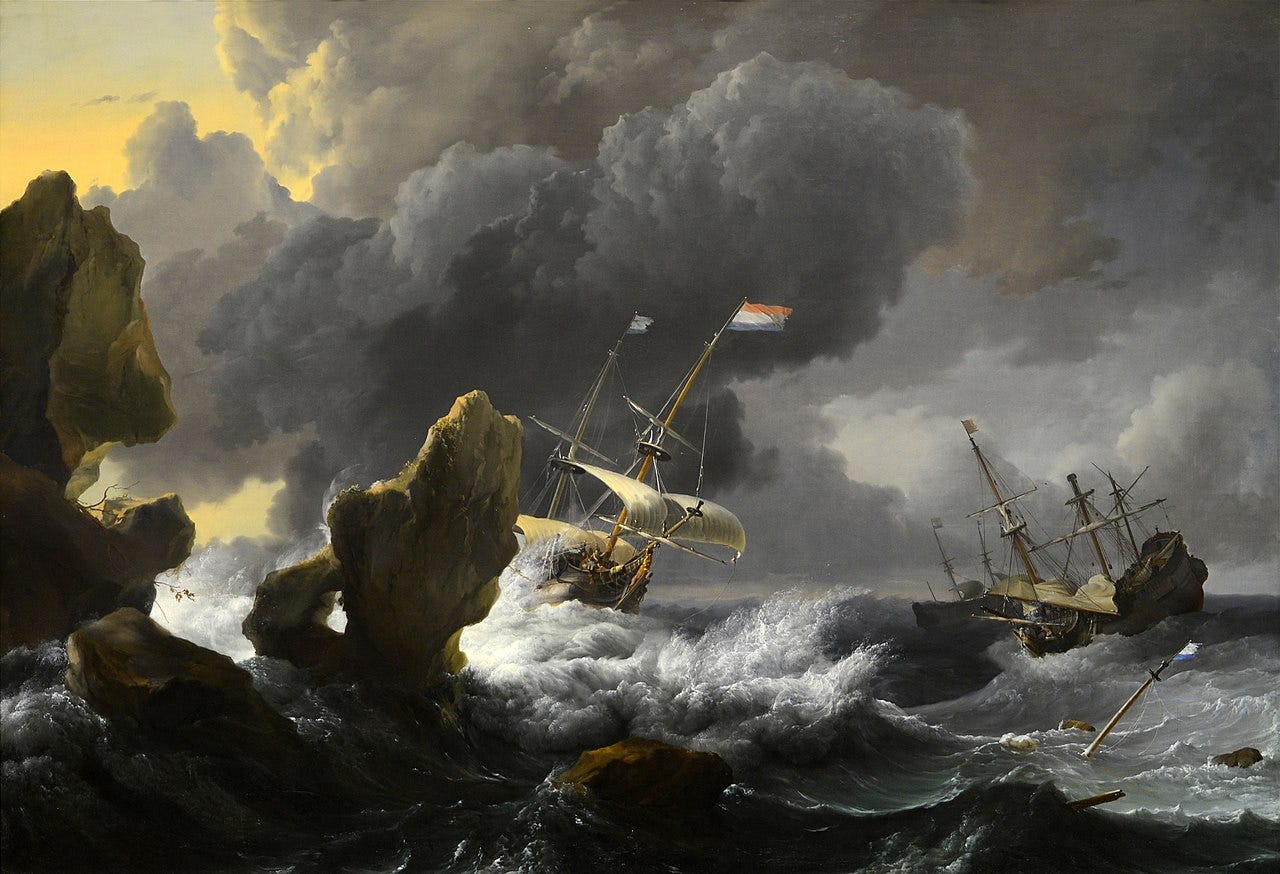
12. Ludolf Bakhuizen, Ships in Distress off a Rocky Coast

Sailing ships heeling over near rocks in a heavy gale
Ludolf Bakhuizen, Ships in Distress off a Rocky Coast, 1667. National Gallery of Art, Washington.

Bakhuizen painted this in 1667, ships heeling over in a heavy gale near a rocky coast, sails straining as the crews fight to stay off the rocks.

Bakhuizen was the leading Dutch marine painter of his day, and he was known to sail out in real storms in a small boat to study the waves up close.

The picture entered the National Gallery of Art in Washington. It shows the Dutch Golden Age at its most dangerous, the sea as a working hazard, not a spectacle.

Where to see them

  • Metropolitan Museum of Art, New York: Homer The Gulf Stream and El Greco View of Toledo.

  • Tate Britain and the Royal Academy, London: Turner Snow Storm and Constable Rainstorm over the Sea.

  • National Gallery, London: Vernet A Shipwreck in Stormy Seas.

  • Louvre, Paris: Gericault The Raft of the Medusa.

  • Farther afield: Aivazovsky The Ninth Wave (St Petersburg), Giorgione The Tempest (Venice), Courbet The Wave (Frankfurt) and Bakhuizen Ships in Distress (Washington).

How painters made weather the subject

Most of these are landscape and marine paintings where the sea itself carries the whole meaning, and the tiny figures only measure the danger.

The wildest belong to Romanticism, where a storm stood for fate and the reach of nature, painted in loose oil that mimics rain and spray.

Storms in art, questions people ask

  • What makes a painting a storm painting? The weather is the subject. Wind, water and sky carry the meaning, and any people present are usually there to show how small they are.

  • Which is the most famous storm painting? Turner Snow Storm and Aivazovsky The Ninth Wave are the usual answers, though Gericault Raft of the Medusa is the most dramatic.

  • Is Rembrandt storm painting still missing? Yes. It was stolen from the Gardner Museum in 1990 and has never been recovered. The empty frame remains on display.

  • Did Turner really tie himself to a mast? There is no evidence for it. The claim comes from the painting own title and is treated as a story Turner encouraged.

  • Where can I see the most storm paintings in one place? The Metropolitan Museum of Art in New York holds both Homer The Gulf Stream and El Greco View of Toledo.

The one storm you can only see as an empty frame

Every painting on this list still hangs somewhere you can visit. All except one. Rembrandt only seascape has been gone since two thieves walked out of the Gardner Museum in 1990, and the museum still displays its empty frame, refusing to fill the gap. It remains the largest unsolved art theft in history. The storm inside that frame is the one nobody alive has seen in person for over thirty years.


Two new stories a week, 130 secrets unlocked. Start free.