Famous Symbolist Paintings: 12 Dreams and Nightmares

Symbolist painters turned their backs on the real world and painted the inside of the mind instead, all dreams, death, desire and myth.

Arnold Bocklin, Isle of the Dead, 1880

Born in the 1880s as a revolt against cold realism, Symbolism filled its canvases with sphinxes, severed heads, sleeping cities and wounded angels, each one meant to stand for a feeling rather than a fact.

Here are twelve of the most famous Symbolist paintings, all now in the public domain. I have gathered the ones that pushed art out of daylight and into the dream.


Learn art the fun way. Free stories every week, no boring lectures.


Three I would pick for you

These go past the caption and into what actually happened:


1. Arnold Bocklin, Isle of the Dead (1880)

A small white figure stands upright in a boat gliding toward a rocky island crowned with black cypress trees, and nobody is ever told who has died.

Bocklin painted five versions of this haunted scene between 1880 and 1886, and his son finished a sixth in 1901.

He refused to explain any of them, calling it only a picture to dream over. The island seems to hold its breath, the water flat as glass, a coffin waiting in the boat.

Freud and Lenin owned copies, and Hitler bought one and hung it in the Berghof and later the Reich Chancellery. Rachmaninoff was so haunted by a print of it that he wrote a symphonic poem named after the island in 1908.

2. Gustave Moreau, The Apparition (about 1876)

Gustave Moreau, The Apparition, about 1876

Salome stops mid dance as the severed head of John the Baptist floats in the air before her, dripping light instead of blood. Moreau was the quiet teacher who shaped half of Symbolism, and here he drowns a Bible story in jewels, incense and gold.

The head hovers with no support, a vision only Salome can see, while the palace behind her is so loaded with ornament that the eye almost gets lost.

This kind of dense allegory, every inch packed with meaning, made Moreau a hero to writers and later to the Surrealists.

His Paris house is now a museum stuffed with thousands of the works he never sold.

3. Odilon Redon, The Cyclops (about 1914)

Odilon Redon, The Cyclops, about 1914

For the first half of his life Redon made only eerie charcoal drawings of floating eyes and grinning spiders, which he called his blacks. Then, near sixty, he burst into color and never looked back.

The Cyclops is where the color pours hardest, the giant Polyphemus peering shyly over a hill at the sleeping nymph Galatea, more lovesick than monstrous and painted in tones like crushed flower petals.

He is huge and tender and doomed. The little panel lives in the Kroller Muller Museum in the Netherlands, one of the last things Redon made before he died in 1916.

4. Edvard Munch, The Scream (1893)

Edvard Munch, The Scream, 1893

A figure on a bridge claps its hands to its head and screams under a blood red sky, in the most famous image of dread ever painted.

Munch said the idea came on a walk when he felt a great scream pass through nature, and the sky really did turn red, perhaps from the distant eruption of Krakatoa.

The screaming figure is not making the sound but hearing it, its face melted to a skull, and the picture stands on the border between Symbolism and Expressionism Two of the several versions were stolen in brazen gallery raids and later recovered, a story I tell in the full piece on the great museum heists Munch scratched a tiny line into one version reading, only a madman could have painted this.


Join 130,000 readers who get the secrets behind the paintings. Free.


5. Franz von Stuck, The Sin (1893)

Franz von Stuck, The Sin, 1893

A pale nude woman stares out of deep shadow while a thick snake coils around her body, its head resting on her shoulder, watching you. Von Stuck was the star of Munich Symbolism, and this dark icon of temptation made him rich and famous overnight.

He painted the subject again and again, framing each version in heavy gold like an altarpiece to danger. The woman is Eve, or sin itself, offering nothing and promising everything.

He built a whole villa as a temple to his own art, and it still stands in Munich as a museum.

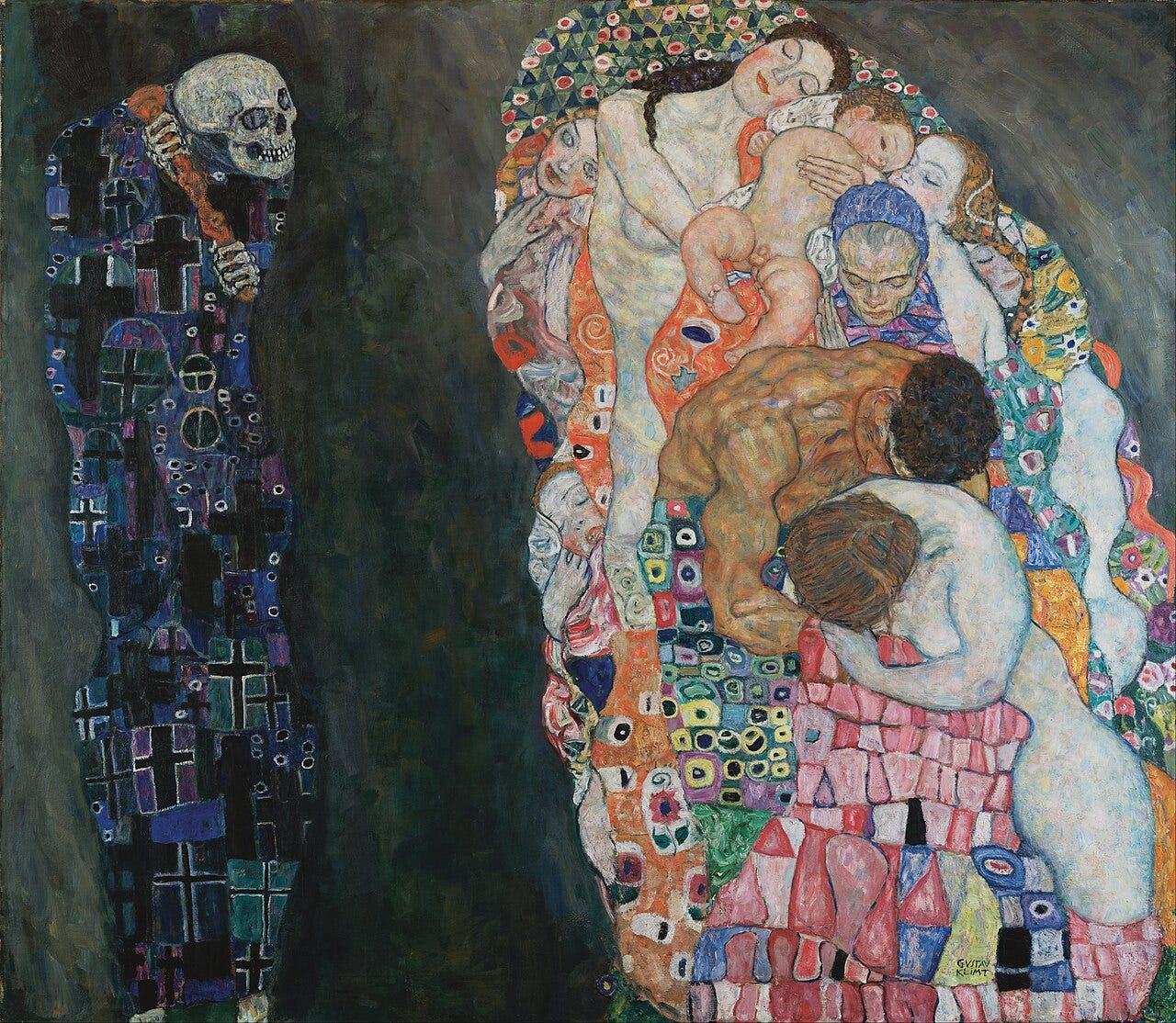
6. Gustav Klimt, Death and Life (1915)

Gustav Klimt, Death and Life, 1915

On one side a grinning skeleton wrapped in a robe of crosses; on the other a warm pile of sleeping bodies, lovers, a baby, an old woman, unaware they are being watched.

Klimt worked on this picture for years, and after it won first prize at a 1911 exhibition in Rome he went back and darkened the whole background from gold to deep green.

The painting now hangs in the Leopold Museum in Vienna. Death waits patiently, in no hurry, because he always wins in the end, while the living cling together in a mosaic of color, tender and doomed.

Klimt finished this meditation on the one certainty only a few years before the flu killed him in 1918.


Two new stories a week, 130 secrets unlocked. Start free.


7. Fernand Khnopff, Caresses (1896)

Fernand Khnopff, Caresses, 1896

A young man with a spear leans against a strange creature with the striped body of a cheetah and the calm face of a woman, and the two press cheek to cheek.

Khnopff, the great Belgian Symbolist, called it a sphinx, though it looks like no monster in any myth. The woman's face is his sister Marguerite, whom he painted over and over all his life.

Nothing is explained, and that airless silence is the point. The Royal Museums in Brussels keep the panel today, while Khnopff guarded his own privacy so fiercely that he built a nearly windowless white house and let almost no one inside.

8. Pierre Puvis de Chavannes, The Poor Fisherman (1881)

Pierre Puvis de Chavannes, The Poor Fisherman, 1881

The 1881 Salon did not know what to do with this picture, too plain and too sad to place. Puvis had stripped away detail, color and drama until only mood was left, a gaunt fisherman standing with bowed head in a pale landscape while his baby sleeps on the bank and a small child gathers flowers.

Younger painters worshipped him for exactly that bareness. Seurat, Gauguin and the young Picasso all studied its still simplicity. It hangs today in the Musee d'Orsay, and Picasso carried its quiet sadness into his own Blue Period twenty years later.

9. Hugo Simberg, The Wounded Angel (1903)

Hugo Simberg, The Wounded Angel, 1903

In 2006 the Finns voted this their national painting, a scene nobody has ever fully explained. Two solemn boys carry a wounded angel on a stretcher through a bare northern park, and the angel's eyes are bandaged so she cannot see where she is being taken.

Simberg, a Finnish Symbolist, refused to say what it means, and one of the boys stares straight out at you, as if challenging you to ask.

He painted it while recovering from a serious illness, and set the scene by a real Helsinki park where the blind and the poor were cared for.

He later frescoed the same angel across a whole wall of the cathedral in Tampere.

10. Mikhail Vrubel, The Demon Seated (1890)

Mikhail Vrubel, The Demon Seated, 1890

A muscular winged demon sits hunched at sunset, hands clasped, staring into the distance with enormous sorrowful eyes, more prisoner than devil.

Vrubel, the greatest Russian Symbolist, painted the demon over and over, borrowing him from a poem by Lermontov about a fallen spirit who longs for love.

He built the whole surface from hard, crystal like facets, as if the world were made of cracked gemstones. His obsession slowly darkened into madness, and he died blind in an asylum in 1910.

The Demon Seated hangs in the Tretyakov Gallery in Moscow, but Vrubel could not let the figure go, and each demon he painted after it grew stranger as his mind gave way.


Two new stories a week, 130+ secrets unlocked. Start free.


11. George Frederic Watts, Hope (1886)
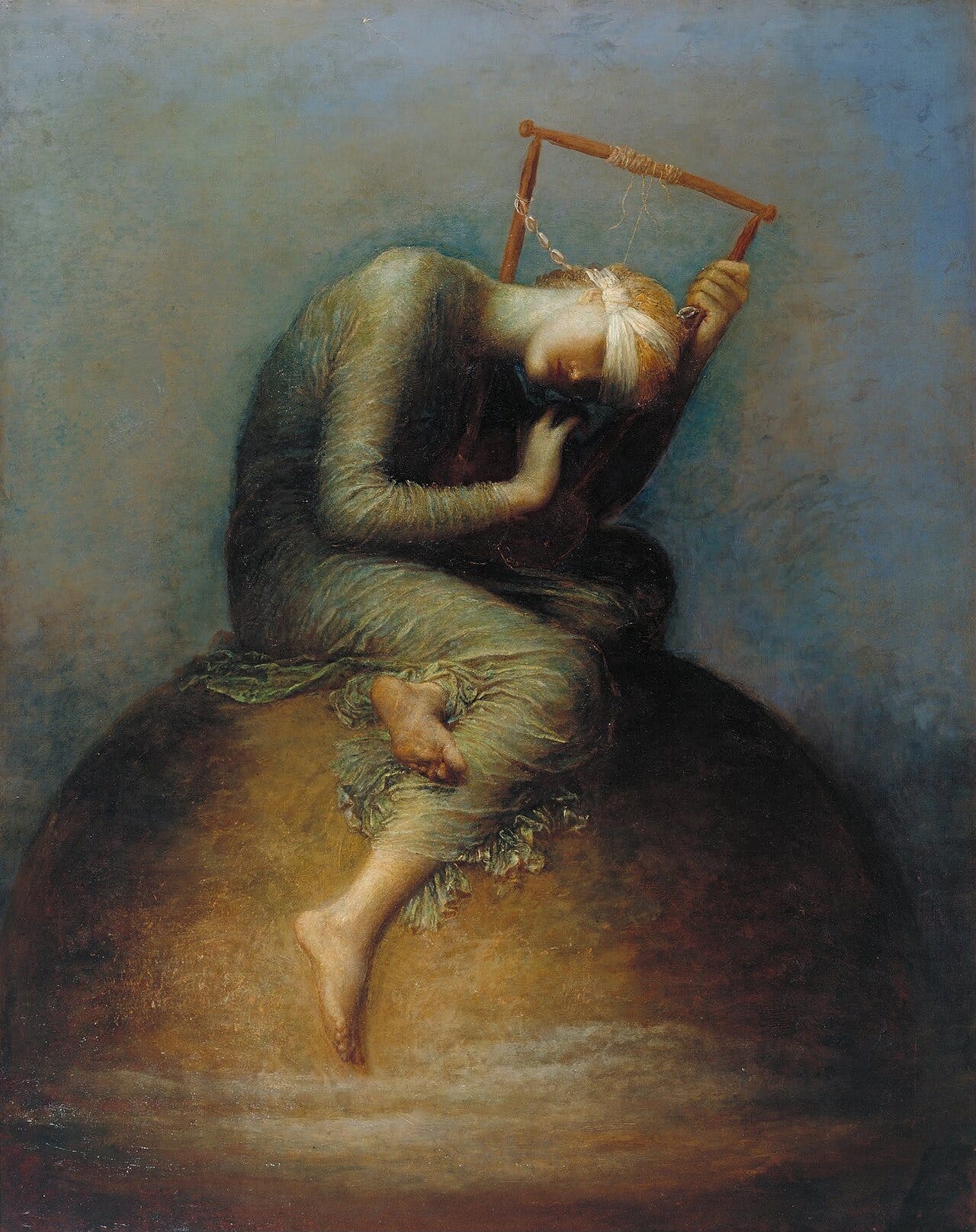
George Frederic Watts, Hope, 1886

A blindfolded woman sits alone on top of the world, bent over a lyre that has only one string left, straining to hear the faint note it can still make.

Watts called her Hope, though she looks close to despair, which was exactly his point. He wanted an image of hope at its hardest, when almost everything is already gone.

Two versions exist, and one so moved an American preacher that his sermon on it, decades later, gave Barack Obama the title of his book, The Audacity of Hope.

The original hangs in the Tate in London, and cheap prints of a second version reached millions of Victorian parlors, sickrooms and Sunday schools.

12. Jan Toorop, The Three Brides (1893)

Jan Toorop, The Three Brides, 1893

Toorop was a Dutch Symbolist born on the island of Java, and he poured the curving art of the East Indies into European mystery. In The Three Brides he sets a holy bride, a worldly bride and a bride of Satan in a forest of streaming hair and sound, long tangled lines rippling across the whole drawing like music made visible.

Everything bends and flows, bells and thorns and rippling locks, until the whole page seems to ring with pattern. The three figures stand for the pull between purity, love and evil.

This strange, beautiful sheet helped set off the curling style that soon became Art Nouveau.


Symbolism in art, common questions

  • What is Symbolist painting? Art from the 1880s to about 1910 that painted ideas, dreams and emotions through symbols instead of real scenes.

  • How is Symbolism different from Impressionism? Impressionists chased the look of daylight; Symbolists chased the feeling hidden behind it.

  • Who were the main Symbolist painters? Gustave Moreau, Odilon Redon, Arnold Bocklin, Gustav Klimt and Edvard Munch, among many others.

  • Is The Scream a Symbolist painting? It sits on the line between Symbolism and Expressionism, and both movements claim it.

  • What did the Symbolists paint? Myths, dreams, death, desire, sphinxes and angels, anything that could stand for an inner state.


If these dreamlike pictures pulled you in, you will love these too:


Painting the invisible

Symbolism lasted barely thirty years, and then Cubism and abstraction swept it aside as old fashioned. For a long time it looked like a strange dead end, all incense and severed heads.

Yet its real children are everywhere, in the Surrealists who painted their dreams, in film, in fantasy art, in every image that trusts a symbol over a fact.

These painters went looking for the invisible, and a surprising amount of it is still hanging on the wall.