Famous Tapestries in Art History: 12 You Should Know

The most famous tapestries in art history include the Bayeux Tapestry, the two Unicorn sets in New York and Paris, Raphael's Acts of the Apostles, and the Angers Apocalypse.

Each is a woven story that survived war, revolution, or neglect to reach us at all.

Bayeux Tapestry scene showing Halley's Comet
The Bayeux Tapestry, scene 32, with Halley's Comet, about 1070.

Tapestries were the most expensive art a court could own, worth more than paintings, and light enough to roll up and carry from castle to castle. That value nearly killed them.

One set was cut into horse blankets. Another was thrown over crops to survive a revolution. I find the survival stories as gripping as the images, so this list leans into them.

Four things a tapestry did that a painting could not:

  • Travel. Rolled up in a chest, a whole room of art could follow a king on the road.

  • Show off. Wool, silk, and real silver and gold thread turned a wall into a bank vault.

  • Argue. Rulers wove their victories, their bloodlines and their gods straight into the decor.

  • Take years. Many hands, one loom, months per panel. The slow labor was the whole luxury.


Learn art the fun way. Free stories every week, no boring lectures.


If this pulled you in

If you want the detail rather than the summary:


1. The Bayeux Tapestry (about 1070, Bayeux)

Along seventy meters of linen an army sails, horses tumble, and an arrow finds King Harold in the eye. The Bayeux Tapestry tells the Norman conquest of England in 1066 like a comic strip, scene after scene, with Latin captions running along the top.

Call it a tapestry and a weaver will correct you. It is embroidery, wool thread sewn onto linen, not woven on a loom. Up in the border of one scene hangs a blazing star. That is Halley's Comet, seen in 1066, the earliest known image of the comet.

It was probably made in England, at Canterbury, for Bishop Odo, the half brother of William the Conqueror. After almost a thousand years in France it crosses the Channel in September 2026 for a loan to the British Museum, the first time it has been shown in England since it was made.

2. The Apocalypse Tapestry (1377 to 1382, Angers)

Apocalypse tapestry, Saint Michael and the dragon
Jean Bondol, Saint Michael Fighting the Dragon, from the Apocalypse Tapestry, 1377 to 1382, Chateau d'Angers.

Louis the First, Duke of Anjou, wanted the end of the world on his walls. Between 1377 and 1382 his weavers in Paris made the Apocalypse Tapestry, six huge sections of the Book of Revelation, dragons and angels and the fall of Babylon, once about 140 meters from end to end.

Then it went out of fashion. During the turmoil of the Revolution the cloth was cut up and reused, as insulation, as horse blankets, even to cover plants against frost. It came within a step of the scrap heap.

A canon named Joubert began rescuing and stitching the pieces back together in the 1840s. Of the original 90 scenes, 71 survive. It is the largest medieval tapestry set still with us, and it hangs today inside the Chateau d'Angers.

3. The Devonshire Hunting Tapestries (about 1430 to 1450, Arras)

Medieval hunting tapestry, otter and swan hunt
The Otter and Swan Hunt, from the Devonshire Hunting Tapestries, about 1430 to 1450, Victoria and Albert Museum.

Falcons, boars, bears and finely dressed lords crowd four enormous cloths made in Arras around 1430 to 1450. The Devonshire Hunting Tapestries turn the aristocratic hunt into theater, men and women mixing in the latest fashion while the dogs do the real work.

The clothes are why costume historians treasure them. These panels are one of the best records we have of how the rich actually dressed in the mid 1400s, down to the sleeves and the headdresses.

The ground is scattered with millefleurs, a thousand tiny flowers.

They take their name from the Dukes of Devonshire, who kept them at Chatsworth for generations before they reached the Victoria and Albert Museum in London in 1957. The hunt here is less about meat than about who could afford to play at it.

4. The Hunt of the Unicorn (1495 to 1505, The Met Cloisters)

Unicorn resting in a fenced garden, tapestry
The Unicorn in Captivity, from The Hunt of the Unicorn, 1495 to 1505, The Met Cloisters.

Seven panels chase a unicorn through the forest, kill it, and then show it alive again, resting inside a low round fence. Woven in the Southern Netherlands around 1495 to 1505, The Hunt of the Unicorn may be the most famous set of tapestries in the world.

Nobody is sure who ordered it. A cipher, the letters A and E knotted with a cord, repeats across every panel, and no patron has been matched to it for certain.

I love a hidden mark like this, and I chase seven more of them in the secrets hidden in famous paintings.

During the French Revolution the set was looted from the La Rochefoucauld chateau at Verteuil and, so the story goes, used to wrap potatoes and shield fruit trees from frost, which left burns and tears in the cloth.

The family later recovered it, and John D. Rockefeller Junior bought it in 1922 for just over a million dollars, then gave it to The Met Cloisters in New York.


Two new stories a week, 130+ secrets unlocked. Start free.


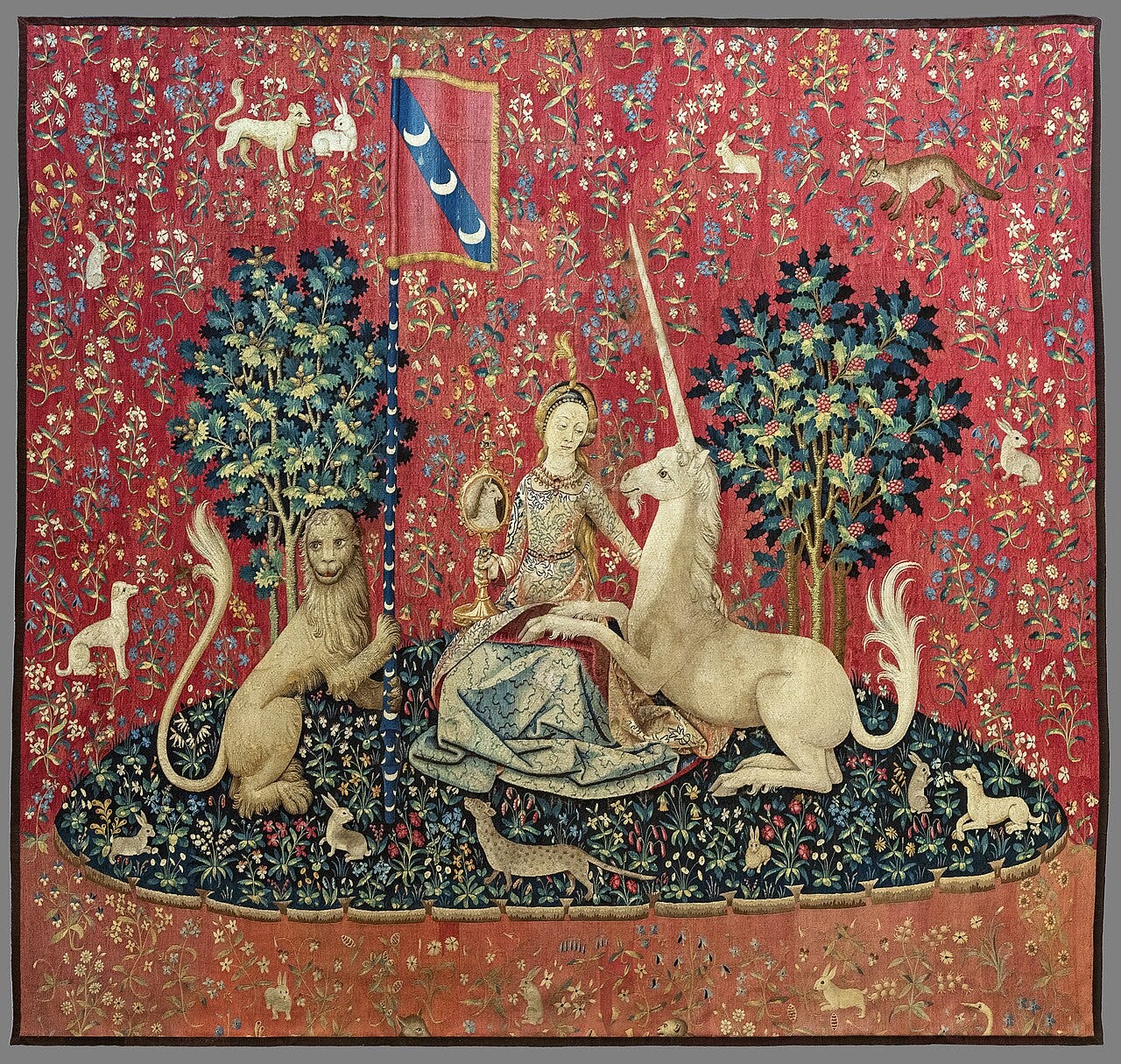
5. The Lady and the Unicorn (about 1500, Musee de Cluny)

Lady and the unicorn tapestry, the sense of taste
Taste, from The Lady and the Unicorn, about 1500, Musee de Cluny.

Six deep red panels show a noblewoman and a unicorn among flowers, banners and small animals. Woven around 1500, The Lady and the Unicorn is the quieter, stranger cousin of the hunt, and it lives at the Musee de Cluny in Paris.

Five of the panels stand for the five senses, touch, taste, smell, hearing and sight. The sixth, inscribed A Mon Seul Desir, has puzzled scholars for more than a century, often read as a sixth sense of the heart or a choice to let desire go.

It is an allegory you can read many ways.

They were nearly lost. Found rotting from damp and rats at Boussac castle, they were spotted by the writer Prosper Merimee in 1841 and made famous by the novelist George Sand, who dated them by studying the ladies' clothes.

France bought them for the nation in 1882.

6. Raphael's Acts of the Apostles (1515 to 1521, the Sistine Chapel)

Raphael cartoon, the miraculous draught of fishes
Raphael, The Miraculous Draught of Fishes, cartoon for the Acts of the Apostles, 1515, Victoria and Albert Museum.

In 1515 Pope Leo the Tenth handed Raphael the grandest job in Rome, a set of tapestries for the lower walls of the Sistine Chapel, directly beneath Michelangelo's ceiling.

Raphael designed ten scenes from the Acts of the Apostles, full size and in color.

A tapestry begins as a painting called a cartoon, set behind the loom for the weavers to copy. Raphael's cartoons still exist, which almost never happens, and seven of them hang at the Victoria and Albert Museum in London, on loan from the Royal Collection.

Woven in Brussels in wool, silk and gold at the workshop of Pieter van Aelst between 1516 and 1521, the set cost far more than Michelangelo was paid for the ceiling above it. The thread was the expensive part, not the picture.


Join 130,000 readers who get the secrets behind the paintings. Free.


7. The Battle of Pavia Tapestries (about 1528 to 1531, Naples)

Renaissance battle tapestry of Pavia
The Battle of Pavia, woven in Brussels, about 1528 to 1531, Museo di Capodimonte, Naples.

On 24 February 1525 the army of the Emperor Charles the Fifth crushed the French at Pavia and captured the French king, Francis the First, on the field.

Within a few years seven tapestries had turned that day into a near reporter's account, designed under Bernard van Orley and woven in Brussels.

Look closely and you can follow the tactics, the blocks of pikemen, the gunners, the moment the king is thrown from his horse. They are among the most detailed battle scenes of the age, made while the men who fought were still alive.

The States General of the Netherlands gave the set to Charles the Fifth in 1531, a gift of his own greatest victory. It has hung in the Museo di Capodimonte in Naples since 1957.

8. The Story of Abraham (1541 to 1543, Hampton Court)

Story of Abraham tapestry, Abraham and the angels
Abraham Entertaining the Angels, from a Story of Abraham tapestry, Brussels, 16th century, Metropolitan Museum of Art.

Henry the Eighth owned more tapestries than any ruler in Europe, more than 2,000 of them by the time he died. The best were the ten panels of the Story of Abraham, woven in Brussels around 1541 to 1543 and still hanging in the Great Hall at Hampton Court.

They glow because they are packed with gold and silver gilt thread, which made them ferociously expensive, the costliest kind of art a king could buy. It is often called the grandest 16th century tapestry set to survive in Britain.

Abraham was no random choice. A king who had broken with Rome and made himself head of his own church liked the sight of a patriarch favored directly by God. The Bible story worked as a statement about Henry himself.

9. The Valois Tapestries (about 1576, the Uffizi)

Valois festival tapestry with an elephant
Antoine Caron and workshop, Elephant, from the Valois Tapestries, about 1576, Uffizi.

Eight tapestries show the lavish festivals of the French Valois court, boat parties, tournaments, an elephant, a whale, all staged for visiting dignitaries. The Valois Tapestries were made around 1576 after designs by the court painter Antoine Caron.

They are propaganda in thread. In front of each festival stand life size portraits of Catherine de' Medici's children and relatives, arranged to argue that the shaky Valois line was strong and would last. It did not, the dynasty died out in 1589.

The set is bound up with Catherine de' Medici, the Florentine queen at the heart of French politics for decades. Fittingly, the tapestries ended up in Florence, at the Uffizi, where they hang today.


Join 130,000 readers who get the secrets behind the paintings. Free.


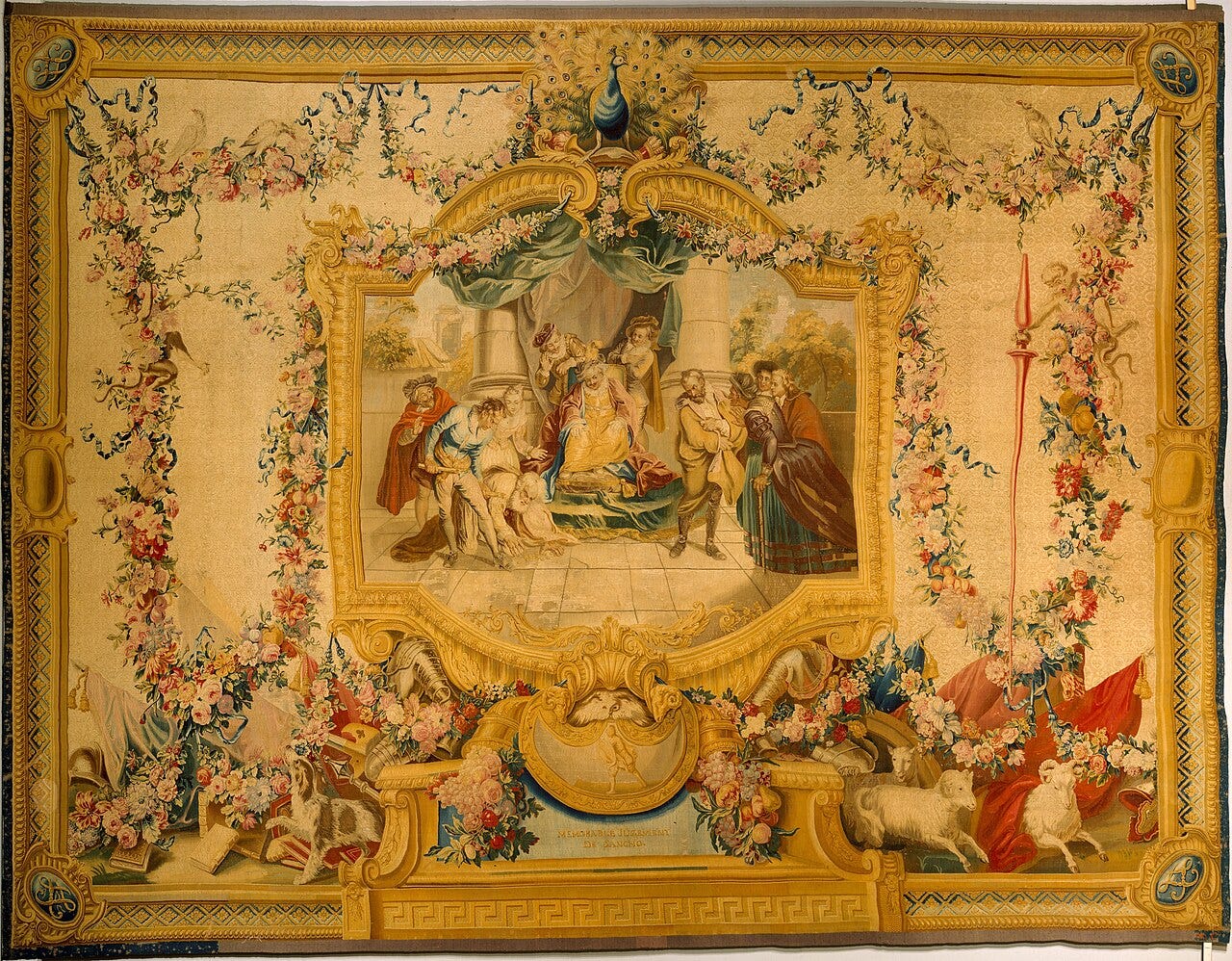
10. The Don Quixote Series by Charles Coypel (1714 to 1794, the Gobelins)

Gobelins Don Quixote tapestry
Don Quixote Guided by Folly, woven at the Gobelins after Charles Coypel, 18th century.

By the 1700s the great looms were French and royal. At the Gobelins works in Paris the painter Charles Coypel turned Cervantes' comic novel Don Quixote into tapestry, the deluded knight and his squire framed by wide golden borders.

It became the biggest hit the factory ever produced. Between 1714 and 1794 the Don Quixote scenes were rewoven again and again, more than 200 panels in all, for kings and courtiers who wanted a laugh on the wall.

The comedy was the selling point. A Spanish story that mocked chivalry became the height of French luxury, so popular that the painted models wore out and had to be repainted. Laughs, it turned out, sold better than saints.

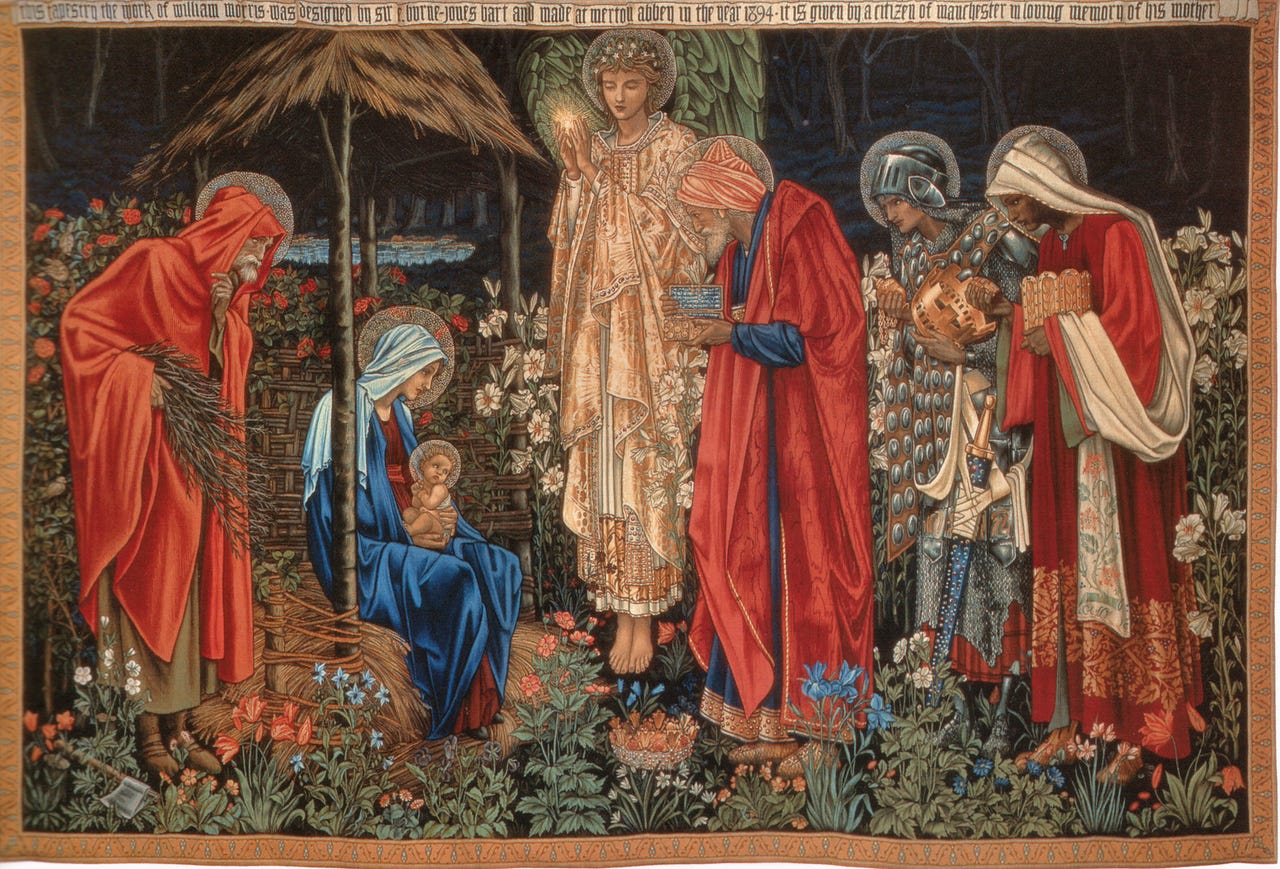
11. The Adoration of the Magi by Burne Jones and Morris (1890, Oxford)

Arts and Crafts tapestry, the Adoration of the Magi
Edward Burne Jones and William Morris, The Adoration of the Magi, 1890.

Tapestry looked dead by the 1800s until William Morris brought it back. In 1886 the rector of Exeter College in Oxford asked Morris and his friend Edward Burne Jones, both old students of the college, for a tapestry for the chapel.

Burne Jones designed a wide Adoration of the Magi beneath a great star.

Woven by Morris and Company and finished in 1890, it became the most popular tapestry the firm ever made. Ten versions were woven over the years, each with its own border, for churches and for private homes.

Morris dyed the wool himself with old plant recipes, indigo and madder, chasing the deep color of medieval cloth. Six centuries after Bayeux, the loom was in fashion again.

12. Chinese Kesi Silk Tapestry (Song to Qing dynasties)

Chinese kesi silk tapestry with lotus design
Kesi silk tapestry with lotus scroll, China, Qing dynasty, 1700s, Portland Art Museum.

Far from Europe, China had been weaving tapestry in pure silk for centuries. Kesi, meaning cut silk, builds an image by breaking the weft color by color, so every shape looks carved into the cloth and reads sharply on both sides.

It was the most precious weaving in the empire. The old saying ran, an inch of kesi, an inch of gold. By the Song dynasty weavers were copying paintings and calligraphy thread by thread, and by the Ming the finest kesi robes were kept for the emperor alone.

A single imperial robe could take several weavers years to finish. It is a useful reminder that the story of tapestry is not only European. Some of the slowest, richest cloth ever made came off silk looms in China.

Five to stand in front of

  • The Bayeux Tapestry: Bayeux Museum, Normandy, and the British Museum, London, from September 2026.

  • The Hunt of the Unicorn: The Met Cloisters, New York.

  • The Lady and the Unicorn: Musee de Cluny, Paris.

  • Raphael's cartoons: the Victoria and Albert Museum, London.

  • The Apocalypse Tapestry: Chateau d'Angers, in the Loire valley.

Threads worth pulling next

The people who wove these rarely signed them, and many were women whose names are gone. If that world pulls you in, keep going:


The tapestry questions I get asked

  • What is the most famous tapestry in the world? The Bayeux Tapestry, a seventy meter cloth from about 1070 showing the Norman conquest of England in 1066. Strictly it is embroidery, stitched rather than woven.

  • What is the difference between tapestry and embroidery? A tapestry is woven on a loom, with the image built into the cloth. Embroidery, like the Bayeux Tapestry, is stitched onto fabric that already exists.

  • Why were tapestries so expensive? They used wool, silk and real silver and gold thread, took months or years to weave, and could be rolled up and moved between palaces. They often cost more than paintings.

  • What is a tapestry cartoon? A full size painting placed behind the loom as a model for the weavers. Raphael's cartoons for the Acts of the Apostles are among the very few that still survive.

  • Where can I see the Unicorn Tapestries? The Hunt of the Unicorn hangs at The Met Cloisters in New York. The separate Lady and the Unicorn set is at the Musee de Cluny in Paris.

One last thread

Every set here is a survivor. The Angers Apocalypse spent years as horse blankets, the Unicorn set was looted and thrown over crops through a revolution, and the Lady panels rotted under damp until a novelist made the world care.

Henry the Eighth owned more than 2,000 tapestries. Rockefeller paid over a million dollars for seven. An imperial kesi robe took years off a weaver's life.

Whatever else these twelve are, they were the most costly art their owners could hang, and every one of them nearly did not make it.