Tavern Paintings: 12 Famous Scenes of Inns and Bars
The tavern was the theater of ordinary life, where painters could show drinking, cards, music, brawls, and quiet ruin all in one room. These 12 famous works take you inside the inn, from a Flemish barn wedding to a green lit cafe where a man might lose his mind.
For centuries the inn let artists paint what polite subjects would not allow, real bodies, real vice, and real fun. Some of these scenes wink at you. Others carry a warning about where the next drink leads.
The low life scene: Flemish and Dutch painters built careers on peasants smoking, drinking, and fighting in taverns.
The moral trap: many inn paintings hide a lesson about excess inside all the laughter.
The card table: the tavern was where cheats, gamblers, and con men were caught in the act.
The modern bar: by the 1800s the inn became the cafe and the cabaret, lonelier and stranger than before.
If these draw you in, you will also love 7 secrets hidden in famous paintings, the mafia and the missing Caravaggio, and the last day of Vincent van Gogh.
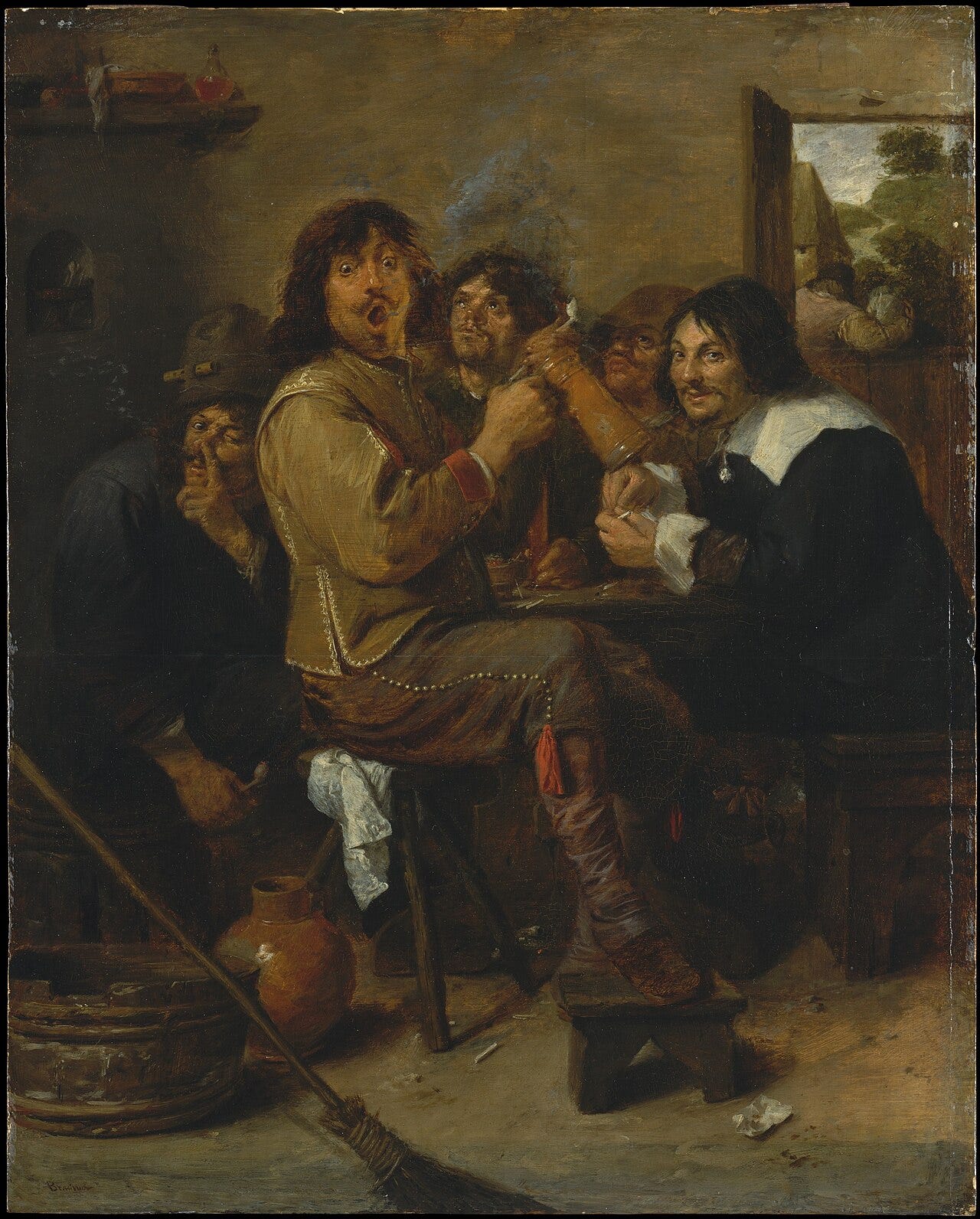
1. Adriaen Brouwer, The Smokers
Five men crowd a tavern bench, one blowing smoke straight up, another grimacing, all mid laugh as if we barged in on them. Brouwer painted this rowdy group around 1636, probably in Antwerp.
The faces are portraits. Brouwer put himself at the center and surrounded himself with fellow painters, including Jan Lievens and Jan Davidsz de Heem. Smoking was new and controversial then, and the picture doubles as an image of the sense of taste.
Brouwer died young and poor, but his tavern scenes were prized by Rubens and Rembrandt, who both owned his work. This one is now a small treasure at the Met.
2. Adriaen van Ostade, Peasants Drinking in a Tavern
In a dim, cluttered tavern, peasants drink and smoke by a low window, their faces caught in pockets of warm light. Van Ostade painted this interior in the early 1640s, a scene he returned to again and again.
The gloom is deliberate. Van Ostade built his low life scenes from strong contrasts of light and shadow, a lesson he took from his teacher circle and from Rembrandt Haarlem neighbor. The mess of pots and straw signals a world without restraint.
He painted hundreds of these tavern and barn scenes across his career. They made him one of the most collected Dutch genre painters of the 1600s.
3. David Teniers the Younger, Peasants in a Tavern
Villagers gather around a small table in a plain tavern, drinking and talking while a figure tends a fire in back. Teniers painted this early scene around 1633, near the start of his long Flemish career.
Teniers made the peasant tavern respectable. He painted so many that his tidy, good humored inns became a genre of their own, collected by the Archduke Leopold Wilhelm, who later made Teniers his court painter and gallery keeper.
The National Gallery of Art in Washington holds this modest example. It is a reminder that Teniers built a courtly career on the smell of ale and woodsmoke.
4. Frans Hals, Merrymakers at Shrovetide
A crowd presses in around a young woman at a holiday feast, sausages and a bagpipe on show, faces flushed with drink and laughter. Frans Hals painted this Shrovetide party around 1616, early in his career.
The clowns are named characters. Two figures come straight from the Dutch stage, Hans Wurst and Pekelharing, comic drunks whose props, the sausage and the pickled herring, are loaded with crude jokes about excess. Nothing here is as innocent as it looks.
Shrovetide was the last blowout before the fasting of Lent. Hals froze the moment of maximum indulgence, just before the party had to end.
5. Jan Steen, Beware of Luxury
A whole household falls apart at once, a woman asleep at the table, a child raiding a cabinet, a pig loose, and a couple flirting in the middle. Jan Steen dated this glorious disorder 1663.
A slate on the floor spells out the warning, be careful in the good life, and fear the rod. Above the revelers hang a sword and a crutch in a basket, the punishments coming for all this indulgence. The flirting woman was modeled on Steen own wife.
Steen ran a brewery and a tavern and knew ruin firsthand. He built the figures into a downward pointing triangle, so the whole room seems to be sliding toward collapse.
6. Pieter Bruegel the Elder, The Peasant Wedding
A wedding feast fills a barn, guests packed on benches while two men carry pies on an unhinged door used as a tray. Bruegel painted this crowded celebration around 1567, near the end of his life.
Find the bride. She sits under a paper crown before a green cloth, hands folded, doing nothing, exactly as Flemish custom demanded on her day. The groom is harder to spot, and scholars still argue over which figure he is, if he is present at all.
Look at the child in the foreground licking a plate. Bruegel filled the barn with small human truths, the real texture of a country feast set to run on beer.
7. Pieter de Hooch, A Man Smoking and a Woman Drinking in a Courtyard

In a walled courtyard behind an inn, two soldiers sit at a table, one drawing on a clay pipe while a serving woman tips back a tall glass of beer. De Hooch built this quiet outdoor scene around 1658 in Delft.
The glass is part of a game. It is a pass glass, marked with rings, used in drinking contests where each player had to drink down to the next line. The calm light and neat brick hide a scene of soldiers idling and a woman drawn into their sport.
De Hooch worked in Delft alongside Vermeer, and shares that same still, sunlit order. Here he turns a tavern yard into something almost peaceful, then hides the drinking game in plain sight.
8. Caravaggio, The Cardsharps
A well dressed boy studies his cards while an older man peers over his shoulder and signals with gloved fingers, and a second youth pulls a hidden card from behind his back. Caravaggio staged this con around 1595, newly arrived in Rome.
This early scene made his name. Cardinal del Monte saw it, bought it, and gave Caravaggio rooms in his palace, launching his career. The gloves on the older cheat have the fingertips cut away, the better to feel a marked deck.
The original vanished for about ninety years. It was rediscovered in a private collection in 1987 and bought by the Kimbell, where it draws crowds today.
9. William Hogarth, A Midnight Modern Conversation
Around a punch bowl at four in the morning, a dozen men sit in every stage of drunkenness, one setting his sleeve on fire with a candle, another sliding off his chair. Hogarth published this scene as a print in 1732.
It is a clock, not a portrait. Hogarth called it a modern conversation to mock the polite art of gathering, showing where a night of drink actually ends. The painting is lost, known only through the wildly popular engraving.
The scene was reprinted on jugs, snuffboxes, and fans across Europe. Hogarth picture of English drinking became a brand before copyright law existed to protect it, which is partly why he later fought for such a law.
10. Edouard Manet, The Cafe Concert
In a tight Paris cabaret, a top hatted man, a working woman, and a waitress with a beer share a marble counter, each ignoring the others while a singer performs in the background. Manet painted this crowded corner around 1879.
The setting was real, the Cabaret de Reichshoffen on the Boulevard Rochechouart, where women on the fringe of society mixed with paying gentlemen. When it showed in 1880, some praised its honesty and others called it crude.
The waitress pauses to drink her own glass mid service, a small human beat. Manet caught the modern cafe as a place of strangers side by side, together and alone at once.
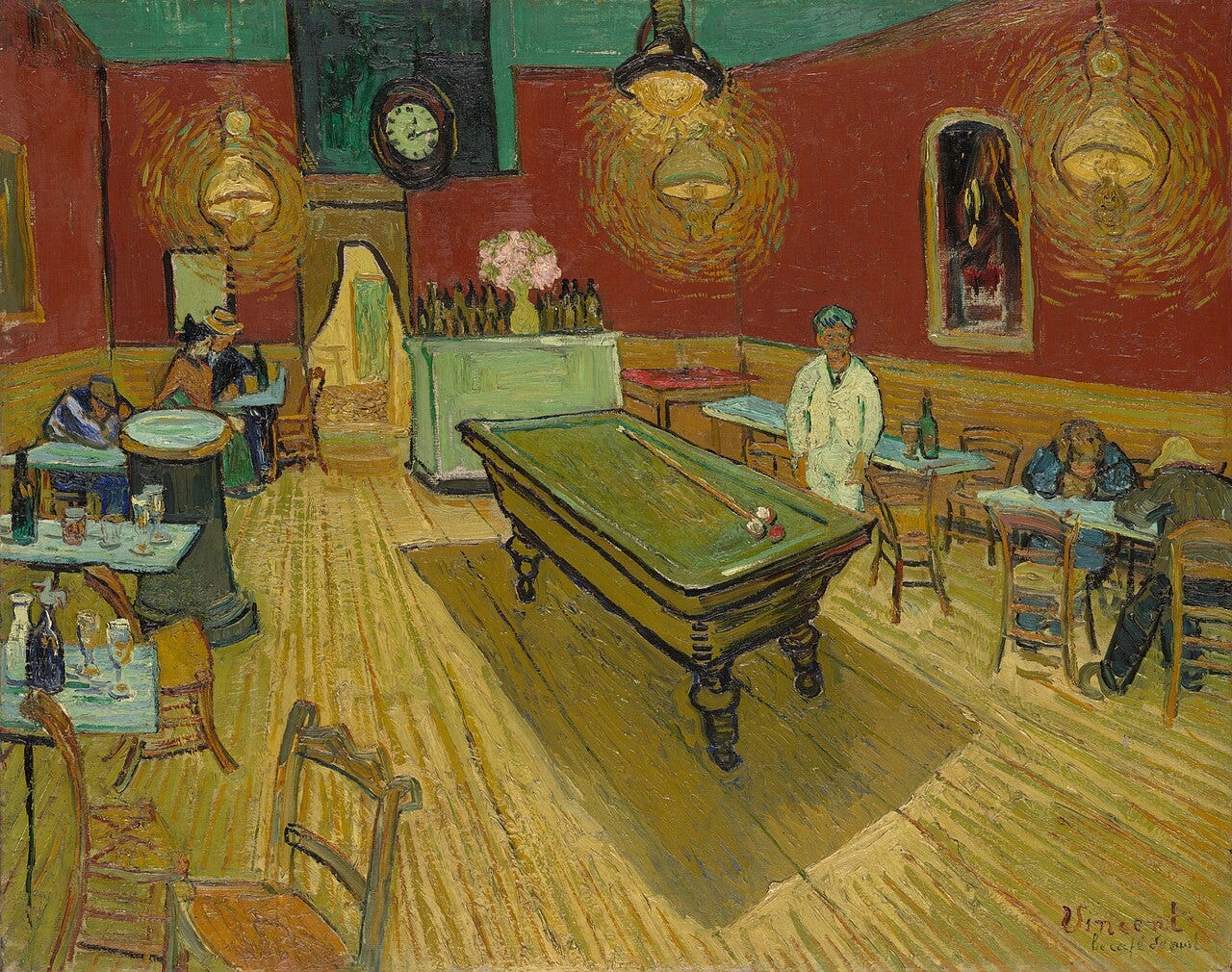
11. Vincent van Gogh, The Night Cafe
A near empty all night cafe glows sour green and blood red, a billiard table stranded in the middle, a few drinkers slumped at the walls under harsh gas lamps. Van Gogh painted the Cafe de la Gare in Arles in September 1888.
He meant the color to disturb you. In a letter to his brother Theo, Van Gogh wrote that he tried to show the cafe as a place where a man could ruin himself, go mad, or commit a crime, using clashing reds and greens to express the terrible passions of humanity.
He paid his rent in paintings and stayed up three nights to finish it. The picture is a room designed to make you want to leave, which was exactly the point.
12. Henri de Toulouse Lautrec, At the Moulin Rouge
Around a table at the famous Montmartre dance hall, a group of Lautrec friends sit over drinks while a woman face, lit harsh green from below, looms at the right edge. Lautrec painted this nightclub scene across the early 1890s.
The green face belongs to the dancer May Milton, and the odd cropping makes the viewer feel like one more patron at the table. Lautrec even painted himself into the crowd, a short figure in the background beside a very tall cousin, so his own height reads as a quiet joke.
The canvas was later cut down, then reassembled, which is why that green lit figure sits so strangely at the edge. The Moulin Rouge hung Lautrec posters, and he repaid it by making its late nights immortal.
Where to see them
Metropolitan Museum of Art, New York: Adriaen Brouwer The Smokers and Frans Hals Merrymakers at Shrovetide.
Kunsthistorisches Museum, Vienna: Jan Steen Beware of Luxury and Bruegel The Peasant Wedding.
Yale University Art Gallery, New Haven: Van Gogh The Night Cafe.
Art Institute of Chicago: Toulouse Lautrec At the Moulin Rouge.
Kimbell Art Museum, Fort Worth: Caravaggio The Cardsharps.
What the inn really shows
Most of these are genre paintings, scenes of ordinary life where drinking, cards and music let painters show bodies and behavior grander subjects forbade.
The Dutch ones lean on chiaroscuro to pull faces out of the gloom, while the modern cafes turn into Impressionist pictures of strangers side by side.
Tavern paintings, questions people ask
What is the most famous tavern painting? Van Gogh The Night Cafe and Bruegel The Peasant Wedding are among the most recognized. Caravaggio The Cardsharps is the definitive image of tavern trickery.
Why did Dutch and Flemish painters love tavern scenes? Inns let them show real bodies, drinking, cards, and fights that grander subjects forbade. These scenes sold well and often carried a hidden moral about excess.
What is a cardsharp? A cardsharp is a cheat who wins at cards through hidden cards, marked decks, or secret signals. Caravaggio painted one in the act around 1595.
What did Van Gogh mean by The Night Cafe? Van Gogh wrote that he used clashing red and green to show the cafe as a place where a person could go to ruin. The unsettling color is intentional.
Where can I see famous tavern paintings? The Metropolitan Museum of Art, the Kunsthistorisches Museum in Vienna, the Art Institute of Chicago, and Yale University Art Gallery hold key examples.
Last call
Van Gogh sat up three nights in a row in September 1888 to paint the Cafe de la Gare, then told his brother he had tried to show a place where a man could lose his mind. Within two years he would be dead. The billiard table still stands in the middle of that green room, waiting for a game no one will finish. Every tavern in this list kept its lights on long after the drinkers left the frame.