
Thomas Cole wanted to be remembered for invented pictures of ancient cities, myths and allegories. Buyers in New York kept asking him for American scenery instead. From his first trip up the Hudson in 1825 to his death in 1848, he painted both, and his patrons did not always follow him where he wanted to go.
Cool Stories About Art is a newsletter to learn art the fun way.
Join 200,000+ readers and get:
10 new art stories / month
The entire archive of content (140+ articles)
Comment, ask questions, and chat with other readers
Places He Saw, Worlds He Invented
Thomas Cole made his name with real places in the Catskills, and collectors wanted more of them. The academies of his time taught a different ranking. A picture that told a story stood above any likeness of a place, and Cole believed it.
So he painted both kinds, often in the same years. The real places paid the bills. The invented ones, drawn from the Bible, from novels, from myth or from his own allegories, were the work he cared about most.
The twelve chosen here run from 1825 to 1847 and keep that balance: six invented scenes, five places he saw with his own eyes, and one novel set in real country. Even the real places did not always reach the canvas as he found them. Twice he removed what tourists had built, and once he changed the season.
12. The Architect's Dream (1840)
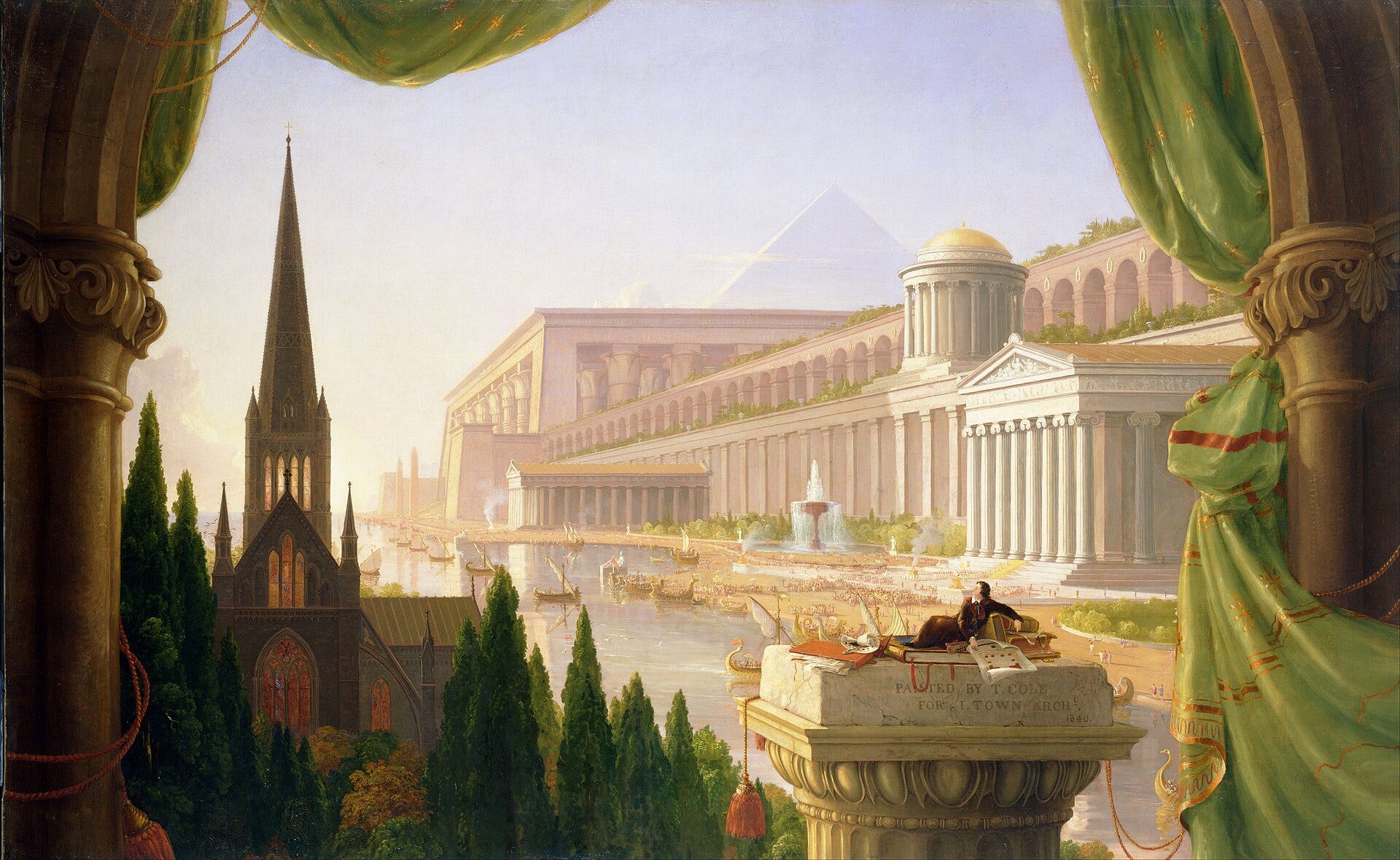
At the top of a giant column, a man lies on his back, propped on a pile of huge books. Below him, under a raised curtain, a bay is lined with buildings from ancient Egypt to the Middle Ages: a pyramid and an Egyptian temple far off, a Greek temple, a Roman one with a dome, and on the left, in shadow, a Gothic cathedral.
The Architect's Dream began as an order. In 1839, Ithiel Town, a New Haven architect who had helped make the Greek and Gothic revivals fashionable in the United States, asked Cole for a view of Athens, ancient or modern. Cole had never been to Athens, and the subject made him uneasy.
So he painted a dream, and filled it with the styles Town used in his own buildings. The Greek temple follows a type Cole had seen in 1832 at Paestum, the ancient site in southern Italy, and the cathedral copies an engraving of Salisbury from a book by John Britton.
On the stone under the sleeper, Cole lettered a dedication in capitals: "PAINTED BY T. COLE FOR I. TOWN ARCHt, 1840." Town did not want the picture. He called it "a fine Architectural painting," but he had wished "the landscape to predominate," with the architecture "various and subservient."
Cole answered that he was "surprised and mortified exceedingly," and he gave no ground: "The picture I have painted is one of the best I have ever painted."
Neither man moved, and Cole never painted for Town again. He did not paint out the dedication either. The words "FOR I. TOWN" are still on the stone beneath the sleeper.
At a Glance
Artist: Thomas Cole (1801 to 1848)
Painted: 1840
Medium: Oil on canvas
Size: 134.6 × 213.5 cm (53 × 84 1/16 in)
Where to see it: Toledo Museum of Art, Toledo, Ohio
11. The Notch of the White Mountains (1839)
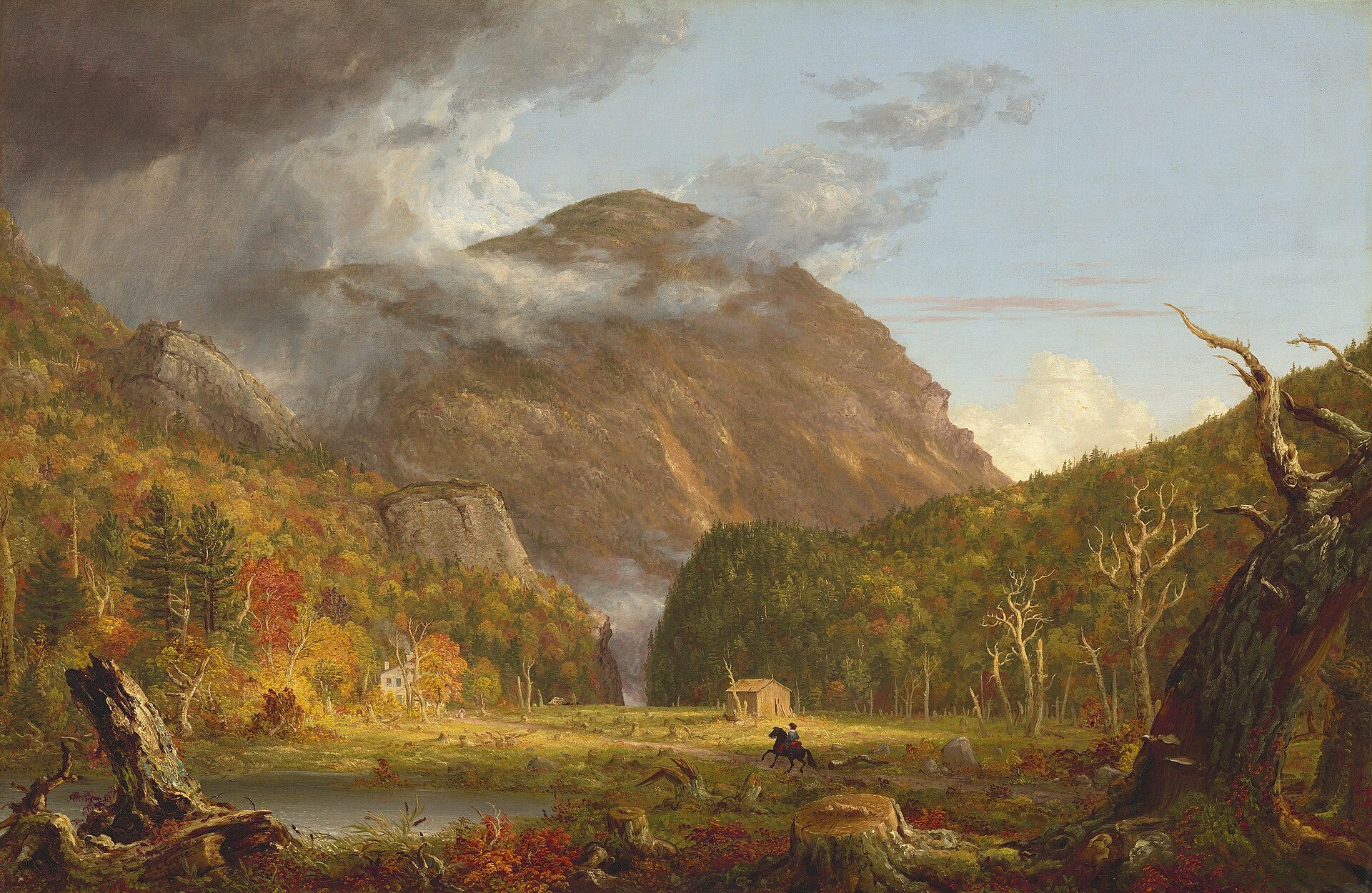
A rider in a blue coat gallops along a wide road in a mountain valley, toward a small white house at the foot of a hill. Two children and a white dog walk toward him, a stagecoach follows far behind, and on the left a storm is closing around a bare peak. Thirteen years before this canvas was painted, a family who lived in the valley died in a single night, and their house was found standing.