
Titian died in Venice in 1576, and even his age at the time is a matter of guesswork. He had worked in the city for more than sixty years and painted for patrons as far away as Rome, Augsburg and Madrid. His style changed so much over that span that some of his last pictures were hardly studied before the twentieth century.
Cool Stories About Art is a newsletter to learn art the fun way.
Join 200,000+ readers and get:
10 new art stories / month
The entire archive of content (140+ articles)
Comment, ask questions, and chat with other readers
How Titian Painted, and Where to See Him
Around 1500, Venetian painters began to build a picture out of color more than out of a drawn line. Titian pushed that idea further than most of his rivals. He laid oil in thin, transparent layers, let his brushwork show and made skin and fabric out of color alone.
That skill made him wanted far from home, and his pictures are now spread across five countries. In the 1890s his name even entered English as a color word, for the brownish orange hair of the women he painted.
The twelve paintings below follow his career from his early twenties to his final years. Each entry opens with Titian's age, city and circumstances at the time, and where scholars disagree about a title or a date, the entry says so.
12. Portrait of a Man with a Quilted Sleeve (about 1510)
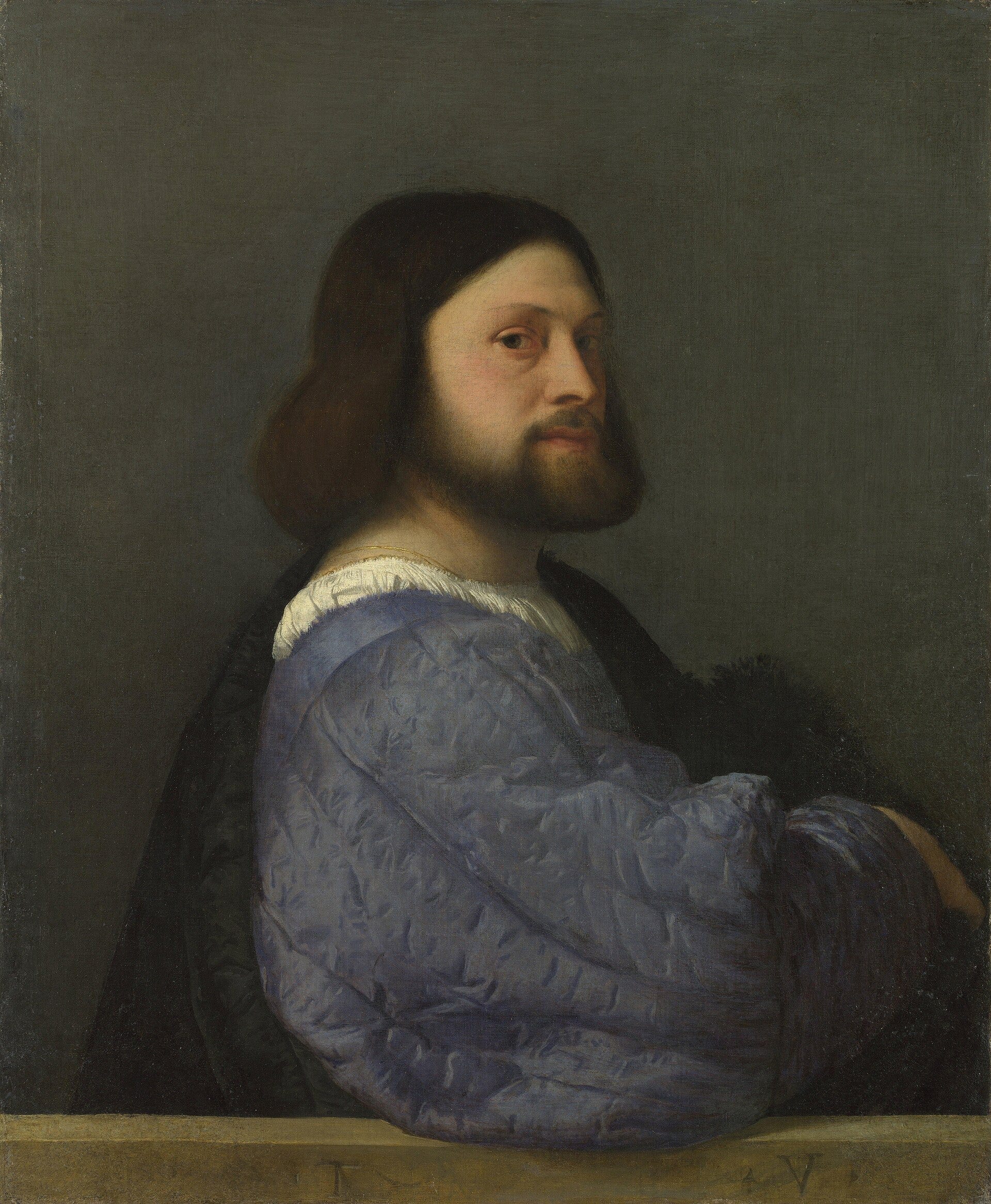
The first thing anyone notices in Portrait of a Man with a Quilted Sleeve is the sleeve. Blue satin, puffed and stitched into ridges, it swells across the foreground and lies on a stone parapet, as though the sitter were leaning over a windowsill toward the viewer. Above it, the young sitter glances sideways over his shoulder and watches from the corner of his eye.
Titian himself was young, about twenty, when he painted it around 1510, and nobody can pin down his age more closely. The biographer Giorgio Vasari said Titian was no more than eighteen when he decorated the façade of a German merchants' warehouse in Venice in 1509. The writer Lodovico Dolce said no more than twenty.
He was then working close to Giorgione, an older painter who had begun to show his sitters in the act of turning. Titian signed the parapet with two letters, T and V, for Tiziano Vecellio. Infrared photographs reveal a third letter, a second V, painted between them and later removed.
The sitter is harder to name than the painter. For a long time he was taken for the poet Ludovico Ariosto, and later for Titian himself. Today the picture is officially called Portrait of Gerolamo (?) Barbarigo, after a member of a Venetian family, perhaps a grandson of Doge Marco Barbarigo, whose portrait Vasari described in 1568.
The mistake about the poet lasted, and it produced the picture's strangest offspring. In the 1630s the canvas belonged to a merchant named Alfonso Lopez in Amsterdam, the city where Rembrandt lived and worked. In 1640 Rembrandt painted Self Portrait at the Age of 34 with the same parapet and the same arm laid across it.
Rembrandt thought he was borrowing the pose of a celebrated poet. For me, that twist is the heart of the story: the sideways look of a young Venetian, mistaken for a great writer, became the way a Dutch painter chose to present himself as a great man.
At a Glance
Artist: Titian (about 1488 to 1576)
Painted: About 1510
Medium: Oil on canvas
Size: 81.2 × 66.3 cm (32 × 26.1 in)
Where to see it: National Gallery, London
11. The Flaying of Marsyas (about 1570 to 1576)
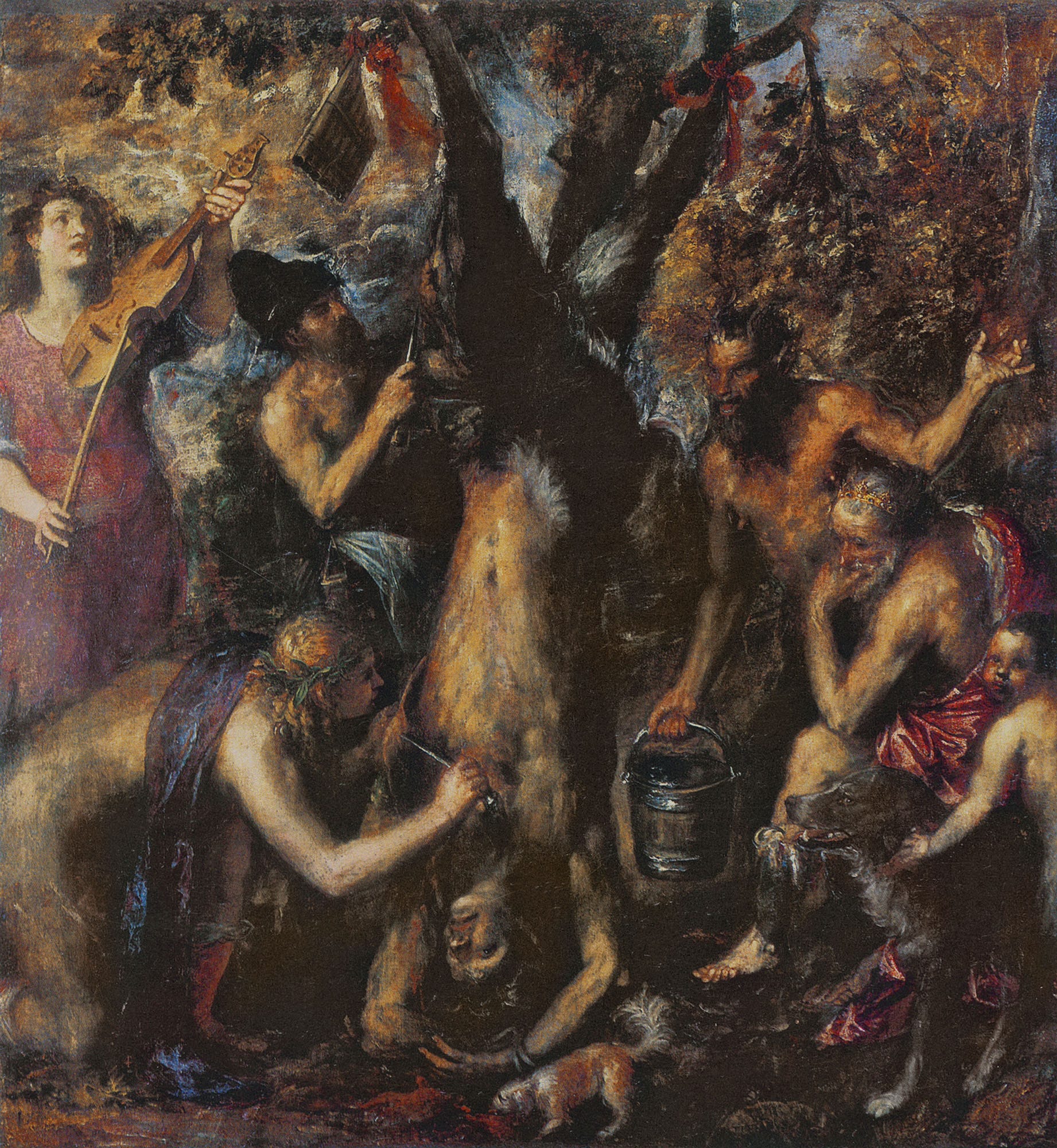
In The Flaying of Marsyas, a satyr hangs head down from a tree while men cut away his skin with knives. A small dog laps at the blood, and an old man sits watching, his chin in his hand. It is a huge canvas, more than two meters each way, by a painter whom popes and kings had kept busy for decades. Yet nobody wrote about it until 1909, and the great art historian Erwin Panofsky discussed it without ever having seen it.