Tree Paintings: 12 Famous Works to Know

The most famous tree paintings turn a plant into a whole worldview. Klimt spun a tree into swirls of gold, Van Gogh made cypresses writhe like green flames, and Mondrian slowly dissolved a single tree until it became pure abstract lines. Here are twelve to know, and where to see them.

A tree is a gift to a painter: rooted yet alive, still yet always growing, a natural symbol of life, family and time. Some artists drew every leaf, others reduced a tree to a pattern or an idea. The twelve below run from a golden mosaic to a bare winter branch.

Use this as a quick tour:

  • The symbols: Klimt and Friedrich, the tree as life and solitude.

  • The abstractors: Mondrian, who turned one tree into pure line.

  • The blossoms: Van Gogh and Hiroshige, trees in flower.

  • Where to see them: a museum list at the end, grouped by city.


New here? Learn art the fun way. Free stories every week, no boring lectures.


Gustav Klimt, The Tree of Life

A golden tree with spiralling branches curls across a decorative mosaic wall
Gustav Klimt, The Tree of Life, around 1909

Gustav Klimt designed The Tree of Life around 1909 as part of a mosaic frieze for a grand house in Brussels, a golden tree whose branches curl into swirling spirals across the whole wall. It is pure gold.

The spiralling branches join earth, heaven and the underworld, an ancient symbol of life reaching in every direction. Klimt turned the tree into ornament, closer to jewellery than to nature.

The design is preserved at the MAK museum in Vienna, and the real mosaic is in the private Stoclet House in Brussels. It is the most decorative tree in all of art.

Piet Mondrian, The Gray Tree

A single tree reduced to a web of curving grey and black lines on a pale ground
Piet Mondrian, The Gray Tree, 1911

Piet Mondrian painted The Gray Tree in 1911, a single tree reduced almost to a web of curving grey and black lines. It is a key step on his road to pure abstraction.

Mondrian painted the same tree again and again, each time stripping away more, until the branches became a flat pattern of lines. The real tree slowly vanishes into design before your eyes.

It hangs at the Kunstmuseum in The Hague. This one tree is where one of the great abstract painters found his way to leaving the visible world behind.

Piet Mondrian, The Red Tree

A twisting tree in fierce red against a deep blue evening sky
Piet Mondrian, Evening; The Red Tree, around 1908

A few years earlier, around 1908, Mondrian painted the same kind of tree in fierce red against a deep blue evening sky, its bare branches twisting outward. Here the colour is intense and emotional.

Set beside The Gray Tree, it shows the whole journey: from a burning, expressive tree to a cool web of lines. The subject barely changes, but the way of seeing it changes completely.

It also hangs at the Kunstmuseum in The Hague. Together the red and grey trees are a short course in how modern art learned to abstract the world.

Caspar David Friedrich, The Lonely Tree

A single battered old oak stands alone in a wide valley under a soft morning sky
Caspar David Friedrich, The Lonely Tree, 1822

Caspar David Friedrich painted The Lonely Tree in 1822, a single battered old oak standing alone in a wide valley under a soft morning sky, its top branches dead and bare. It is the heart of German Romanticism.

The tree is old, storm scarred and half dead at the crown, yet still standing, sheltering a shepherd below. For Friedrich it stood for endurance, faith and the passing of time.

It hangs at the Alte Nationalgalerie in Berlin. One weathered oak becomes a portrait of a whole life weathering the years.

Vincent van Gogh, The Mulberry Tree

A single autumn mulberry tree blazes orange and yellow against blue rocks and sky
Vincent van Gogh, The Mulberry Tree, 1889

Vincent van Gogh painted The Mulberry Tree in 1889 during his time at the asylum in Saint Remy, a single tree blazing orange and gold against blue rocks and sky, its foliage a storm of thick swirling strokes.

Van Gogh called it one of his own favourites. He threw the paint on in twisting knots, so the tree seems to writhe and flame with life, alive with the energy he felt in nature.

It hangs at the Norton Simon Museum in California. A single autumn tree becomes an explosion of colour and feeling.

Vincent van Gogh, Wheat Field with Cypresses

Tall dark green cypress trees twist like flames beside a golden wheat field under a swirling sky
Vincent van Gogh, Wheat Field with Cypresses, 1889

Vincent van Gogh painted Wheat Field with Cypresses in 1889, tall dark cypress trees twisting up like green flames beside a golden field, under a sky full of rolling clouds.

Van Gogh was fascinated by cypresses, which he thought as beautiful as an Egyptian obelisk, and he made them writhe with the same restless energy as his famous starry skies. To him they were the trees of the south.

It hangs at the Metropolitan Museum in New York. The living, flame like cypress became one of his signature shapes.

Vincent van Gogh, Almond Blossom

White almond blossom on dark branches spreads across a bright blue sky
Vincent van Gogh, Almond Blossom, 1890

Vincent van Gogh painted Almond Blossom in 1890 to celebrate the birth of his nephew, white blossom on dark branches spread flat against a bright blue sky. He copied the design straight from Japanese prints.

The flat blue ground and cropped branches come directly from the woodblocks he loved. He gave the painting to his brother Theo and his wife for their baby, a gift of new life.

It hangs at the Van Gogh Museum in Amsterdam, one of its most loved works. A blossoming tree becomes a hymn to a new beginning.

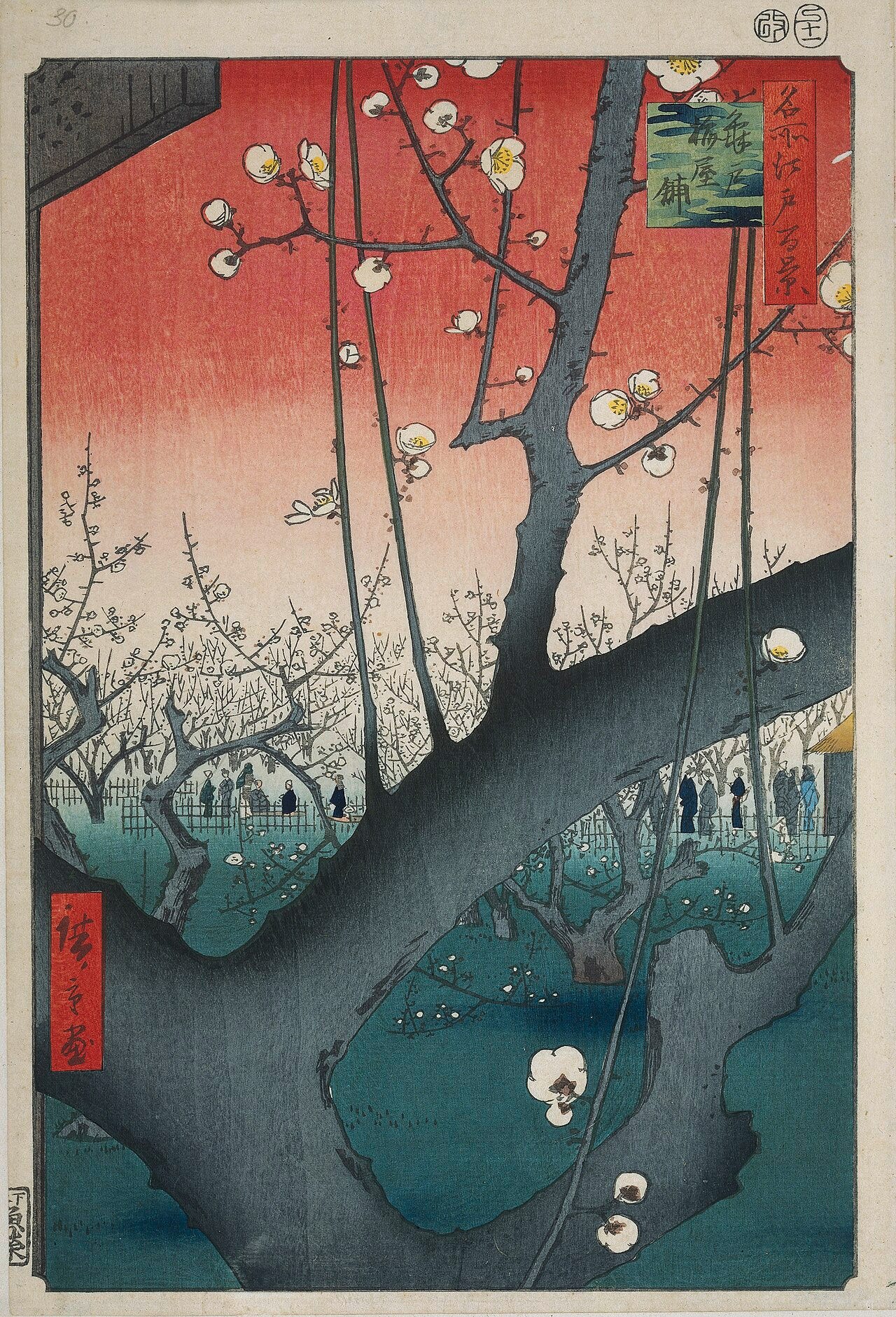
Utagawa Hiroshige, Plum Park in Kameido

A dark plum tree trunk cuts across the foreground with white blossom and a red sky behind
Utagawa Hiroshige, Plum Park in Kameido, 1857

Utagawa Hiroshige made this print in 1857, a dark plum tree trunk cutting boldly right across the foreground, white blossom scattered against a glowing red sky, with tiny visitors beyond. It is a daring woodblock design.

The huge trunk slicing across the picture was startlingly modern, cropping the tree as no Western painter yet dared. Van Gogh loved it so much he copied it faithfully in oil.

Impressions hang in the Metropolitan Museum and beyond. This one plum tree helped teach Europe a whole new way to compose a picture.

John Constable, The Cornfield

A leafy country lane shaded by tall trees leads past a boy drinking from a stream
John Constable, The Cornfield, 1826

John Constable painted The Cornfield in 1826, a leafy English lane shaded by tall trees, a boy drinking from a stream and sheep passing toward a sunlit field beyond. The great trees frame the whole scene.

Constable painted the trees of his home countryside with deep love, each one full and specific rather than generic. He wanted the ordinary English landscape taken as seriously as any grand subject.

It hangs at the National Gallery in London. His towering, leafy trees are as much the heroes of the picture as any figure.

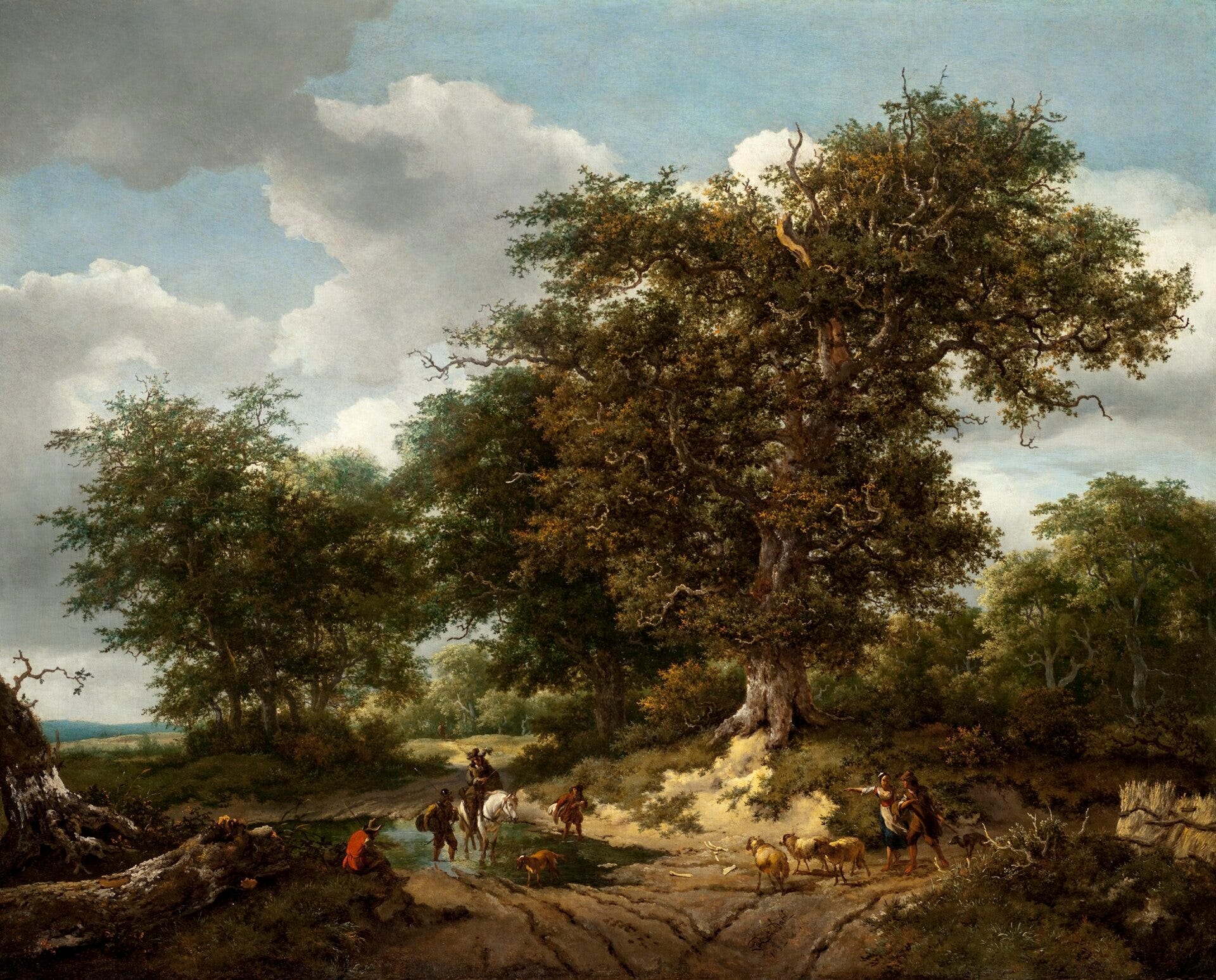
Jacob van Ruisdael, The Great Oak

A massive old oak tree spreads over a still pool in a wide Dutch landscape
Jacob van Ruisdael, an oak by a pool, around 1660

Jacob van Ruisdael, the great Dutch landscape master, painted mighty oaks around 1660, a single huge old tree spreading over a still pool, gnarled and grand against a big cloudy sky.

Ruisdael gave his trees real character and age, often placing a dead or dying tree among the living as a quiet reminder of time. His oaks feel like ancient monuments.

His work hangs in museums worldwide, from the Getty to the Louvre. He made the single great tree a subject worthy of a whole painting, long before the Romantics.

Theodore Rousseau, Oaks

Ancient spreading oak trees in the Fontainebleau forest under warm afternoon light
Theodore Rousseau, oaks in the forest of Fontainebleau, around 1855

Theodore Rousseau, leader of the Barbizon painters, painted the ancient oaks of the Fontainebleau forest around 1855, spreading trees rendered with almost portrait like care under warm light.

Rousseau loved these old trees so much he campaigned to have part of the forest protected from logging, one of the first conservation efforts in history. He wanted the oaks left standing.

His work hangs at the Louvre and beyond. He painted trees not as scenery but as living beings worth saving.

Camille Corot, Ville d’Avray

Feathery silver green trees lean over a still pond in soft misty light
Camille Corot, Ville d’Avray, around 1867

Camille Corot painted the feathery trees around the ponds of Ville d’Avray near Paris again and again, most famously in the 1860s, silver green foliage leaning over still water in soft misty light.

Corot developed a whole late style out of these trees, their leaves dabbed on in a soft blur that seems to tremble in the air. He was building the bridge toward Impressionism.

His Ville d’Avray scenes hang in the Louvre and museums worldwide. His hazy, poetic trees are among the most tender in all of landscape painting.


Join 130,000 readers who get the secrets behind the paintings. Free.


Questions people ask about tree paintings

  • What is the most famous tree painting? Klimt The Tree of Life and Van Gogh’s writhing cypresses are among the most famous, along with Mondrian’s trees that dissolve into abstraction.

  • Why did Mondrian paint the same tree so many times? He used one tree to work his way from realism toward pure abstraction, stripping it down step by step until only a web of lines remained.

  • What do the branches in Klimt Tree of Life mean? The spiralling branches join earth, heaven and the underworld, an ancient symbol of life connecting every level of the world.

  • Why did Van Gogh love cypress trees? He thought them as beautiful as an Egyptian obelisk and made them twist like green flames, one of his most personal shapes.

  • Did Van Gogh copy a Japanese tree print? Yes. His flat blue backgrounds and cropped blossoming branches came straight from Japanese woodblocks like Hiroshige’s plum tree.

Where to see them

  • Kunstmuseum, The Hague: Mondrian The Gray Tree and The Red Tree.

  • Van Gogh Museum, Amsterdam: Van Gogh Almond Blossom.

  • Metropolitan Museum, New York: Van Gogh Wheat Field with Cypresses and Hiroshige prints.

  • National Gallery, London: Constable The Cornfield.

  • Alte Nationalgalerie, Berlin: Friedrich The Lonely Tree.

Keep exploring

If the trees pulled you in, three more paths from here. Walk through the whole life behind those flaming cypresses in Vincent van Gogh, the complete story, learn to read the hidden clues in famous canvases in seven secrets hidden in famous paintings, or start with the basics of landscape painting.


Two new stories a week, 130+ secrets unlocked. Start free.


One last thing. A tree stands still for a painter, but it is never really still, growing, aging, dropping and budding leaves. That is why it carries so much: life, family, endurance, time. From Klimt’s gold to Mondrian’s bare lines, these twelve turn one tree into a whole way of seeing.