
For half a century, London argued over a painter who seemed more interested in the weather than in the things it fell on. A teenager once wrote a furious defense of him that the painter asked him not to publish. A rival watched his own reds go weak beside a single dab of scarlet.
Cool Stories About Art is a newsletter to learn art the fun way.
Join 200,000+ readers and get:
10 new art stories / month
The entire archive of content (140+ articles)
Comment, ask questions, and chat with other readers
What Turner Was After
J.M.W. Turner spent his life painting what never holds still: mist, smoke, spray, fire, a low sun. London critics often found his later canvases formless. He kept going, until light itself was often the real subject.
The twelve paintings chosen run through his whole career, from the oil that launched him in the 1790s to an unfinished canvas of the 1840s. Most are the pictures people expect to find. Two rarely appear on such lists.
The best place to see many at once is Tate Britain in London, which holds the largest collection of his work.
12. Juliet and her Nurse (1836)
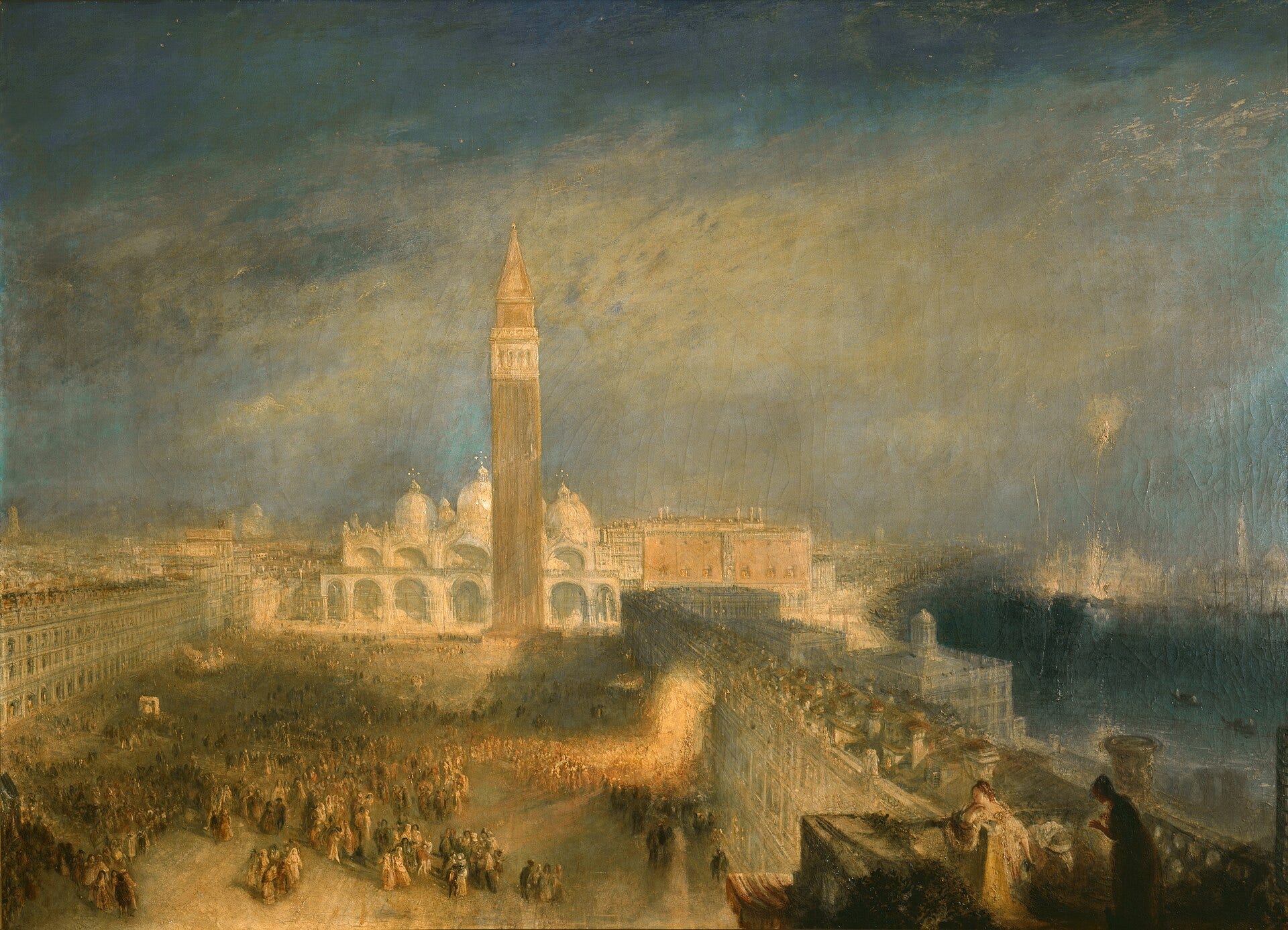
Fireworks burst over St Mark's Square in Juliet and her Nurse, above a carnival crowd so small it reads as a scatter of dots. On a rooftop at the lower right, two tiny figures look down at the square. They are Shakespeare's Juliet and her nurse, moved by Turner from Verona to Venice, where the lit-up square seems to stand in for the Capulets' ball.
That move is what upset the critics. Londoners first saw it at the Academy in 1836, and that October a review in Blackwood's Magazine attacked it, unable to make sense of a Juliet in Venice.
A boy of seventeen named John Ruskin read the review and was outraged. Long afterward he wrote that it raised him to "the height of 'black anger' in which I have remained pretty nearly ever since." Three weeks before he went up to Oxford, he wrote a reply.
The reply calls Turner's imagination "Shakespearian in its mightiness." Ruskin's father thought it right to ask the painter's leave first, so a fair copy went to Turner. Turner wrote back that he would rather it was not published, and the draft stayed in one of the boy's notebooks.
Ruskin's later editors saw that unsent letter as the seed of a book. In 1843 the first volume of Modern Painters came out, signed only "A Graduate of Oxford," and much of it was a defense of Turner by the boy he had asked to keep quiet.
At a Glance
Artist: Joseph Mallord William Turner (1775 to 1851)
Painted: 1836
Medium: Oil on canvas
Size: 88 × 121 cm (34 5/8 × 47 5/8 in)
Where to see it: Colección de Arte Amalia Lacroze de Fortabat (Colección AMALITA), Buenos Aires
11. Helvoetsluys (1832)
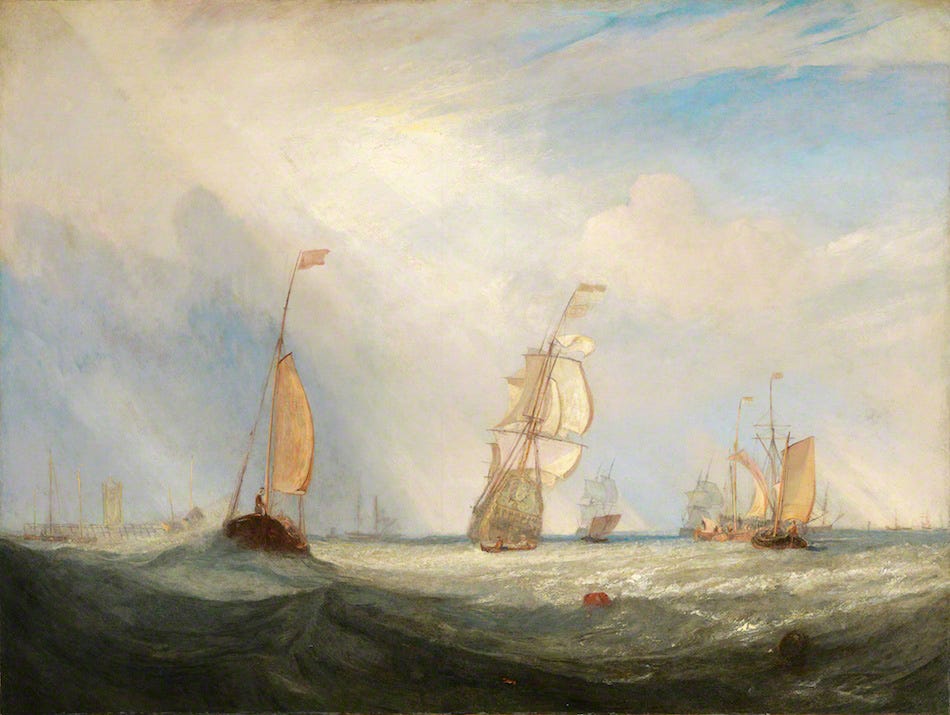
Nothing in this gray harbor scene is bright. A Dutch warship heads out under a heavy sky, small boats toss around it, and the water, the clouds and the sails share the same cool tones. When the canvas went up on the wall in 1832, the painter whose picture hung beside it had pushed Turner off the center of a wall the year before.