Famous Vanitas Paintings: 12 Reminders of Death
Every famous vanitas painting says the same blunt thing, that you are going to die and none of your things are coming with you. Yet each one is gorgeous, thick with silver, silk and gold, which is the strange joke at its heart.
Here are twelve of the greatest, all now in the public domain.
Dutch and Spanish painters of the 1600s turned death into a language of skulls, candles and wilting flowers, hidden in the most luxurious still lifes ever made. I have gathered the pictures that make beauty and doom share a single table.
What lurks in them:
The skull. Death staring out from among the riches.
The clock. Hourglasses and watches, time draining away.
The smoke. Snuffed candles and bubbles, life gone in a breath.
The luxury. Gold and silk laid out only to be called worthless.
Where the detail is
The ones I would send you to next:
Vermeer, Woman Holding a Balance, what is actually on those scales
Twelve famous portraits and the real people, the faces behind the paintings
The Last Supper, detail by detail, the detail hiding at that table
1. Harmen Steenwijck, An Allegory of the Vanities of Human Life (about 1640)
If you want to learn the whole language of the vanitas painting, start here, because Steenwijck laid out every symbol like a lesson.
A skull, a snuffed lamp, a shell, a sword, a book and a flute sit on a table in a shaft of cold light. Each one stands for something you are going to lose.
The skull is death, the lamp smoke is the soul leaving the body, the shell is vanity, and the sword and books are power and learning that will not save you.
Only the light itself, falling from above, offers any hope at all. The National Gallery in London has owned it since 1888, a small panel that quietly tells every visitor they will die.
2. Philippe de Champaigne, Vanitas (about 1671)
The most economical warning about death in all of art uses just three objects. A tulip, a skull and an hourglass sit in a row on a plain ledge, and that is the entire painting. Life, death and time, with nothing wasted.
The flower is the shortness of life, the skull is the end of it, the hourglass is the time draining away in between. Champaigne was tied to a strict religious movement that stripped away all luxury, and you can feel it in the bareness.
It hangs in the Tesse museum in Le Mans, proof that a whole sermon can fit into three objects.
3. Pieter Claesz, Vanitas Still Life (1628)
A toppled glass, a watch, a quill and an overturned skull lie scattered as if someone left the room in a hurry. This is a still life by Pieter Claesz, a master who could make silver and glass look wet with light.
Look into the glass ball on the table and you will find him.
Reflected in the round glass is the painter himself at his easel, a tiny hidden self portrait. The overturned glass and the ticking watch both mark time running out, even for the artist.
It hangs in the Germanisches Nationalmuseum in Nuremberg, its maker forever caught inside his own warning.
4. David Bailly, Self Portrait with Vanitas Symbols (1651)
A young man holds up a small painted portrait of himself grown old, though in truth the artist was sixty seven when he made it. David Bailly cast himself as his own younger self, cradling a picture of the old man he had actually become.
It is a puzzle about time folded inside a self portrait.
Around him float soap bubbles, a skull, a snuffed candle and wilting flowers, every sign of a life passing. He even wrote on a slip of paper that all things are vanity.
It hangs in the Lakenhal museum in Leiden, a young man and an old man who are, impossibly, the same person.
5. Antonio de Pereda, The Knight's Dream (about 1650)
A sleeping nobleman slumps in his chair while an angel holds up a banner and, behind it, a heap of crowns, armor, gold and a skull.
Pereda gives Spain its grandest vanitas, a dream of everything the world offers and everything it takes back. The banner warns that it all ends fast.
The angel's ribbon reads that our glory shoots by, pierces and kills, a line meant to jolt the dreamer awake. Piled around him are money, weapons, a globe and books, all worthless against the skull.
It hangs in the San Fernando academy in Madrid, a warning aimed straight at the powerful.
6. Juan de Valdes Leal, In Ictu Oculi (1672)
Death itself, a walking skeleton carrying a coffin and a scythe, leans in to snuff out a candle, and above the flame are the words in the blink of an eye.
Valdes Leal painted the most terrifying vanitas ever made for a hospital church in Seville. It was designed to frighten the living into behaving.
Beneath the skeleton lie crowns, mitres and books, the crushed trophies of pope and king alike. Its companion piece shows a bishop's corpse rotting in his tomb, so gruesome that the painter Murillo said you had to hold your nose to look.
Both still hang where they were meant to, in the church of the Hospital de la Caridad.
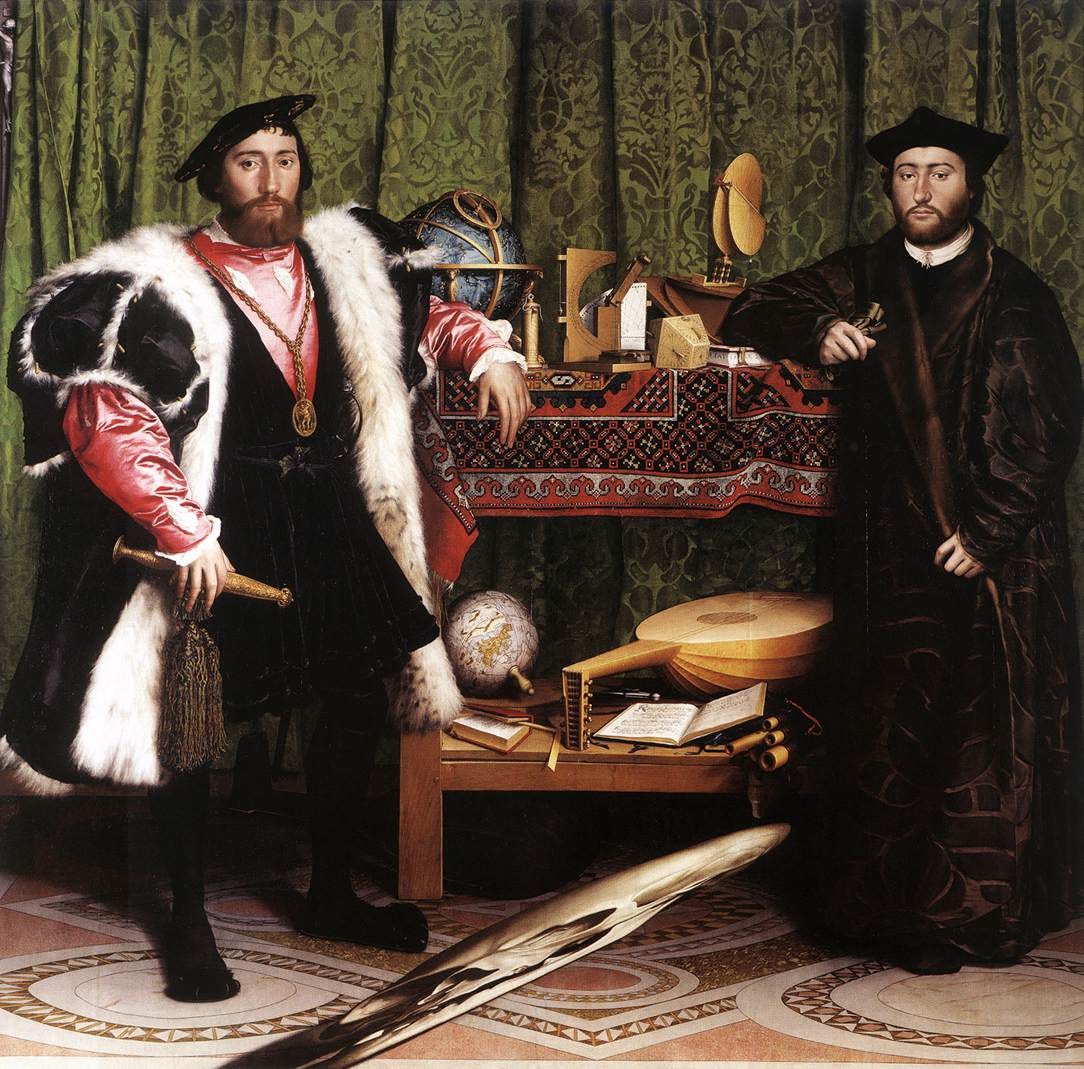
7. Hans Holbein the Younger, The Ambassadors (1533)
Two rich young men stand among globes and instruments at the height of worldly power, and a strange smear stretches across the floor at their feet.
Step to one side and it snaps into a skull, a hidden reminder that all their wealth ends in the grave. It is the most famous vanitas trick in art.
The distorted skull can only be read from the painting's edge, so you must step away from all that glory to see death waiting. A lute with a broken string hints at discord in a dangerous year for England.
I take the whole picture apart in the Ambassadors.
8. Jan Davidsz de Heem, Vanitas Still Life with Books (about 1630)
A pile of worn books tumbles across a table beside a skull, a violin and a fluttering sheet of music. De Heem, one of the finest still life painters of the age, argues that learning and art are as fleeting as anything else.
Even the wisdom in the books will turn to dust.
The dog eared pages and the cracked spines show that knowledge decays like a body. De Heem worked in both Holland and Antwerp and grew rich painting exactly this kind of luxurious warning. His books have long outlived the man who painted them.
9. Guercino, Et in Arcadia Ego (about 1620)
Two young shepherds in a sunny landscape stop short at a skull resting on a broken wall, a fly crawling over the bone. The Latin words below mean even in Arcadia, I am here, and the I is death.
Guercino was the first painter to give that haunting phrase a face.
Arcadia was the ancient dream of a perfect country paradise, and here death interrupts it with a grin. The idea proved so powerful that the great Poussin borrowed it twice.
This first version hangs in the Palazzo Barberini in Rome, death let loose in paradise.
10. Adriaen van Utrecht, Vanitas Still Life (1642)
A skull crowned with a fresh wreath of flowers sits among jewels, a purse of coins, a pipe and a globe, everything the good life can buy.
Van Utrecht was a Flemish master of lavish still lifes, and here he lays out temptation only to condemn it. The flowers are already starting to droop.
Bubbles and smoke drift up as signs of how quickly pleasure vanishes. The richer the objects, the sharper the warning that none of them can be carried past the grave.
Van Utrecht sold these lavish warnings to the same wealthy buyers who owned the jewels painted in them.
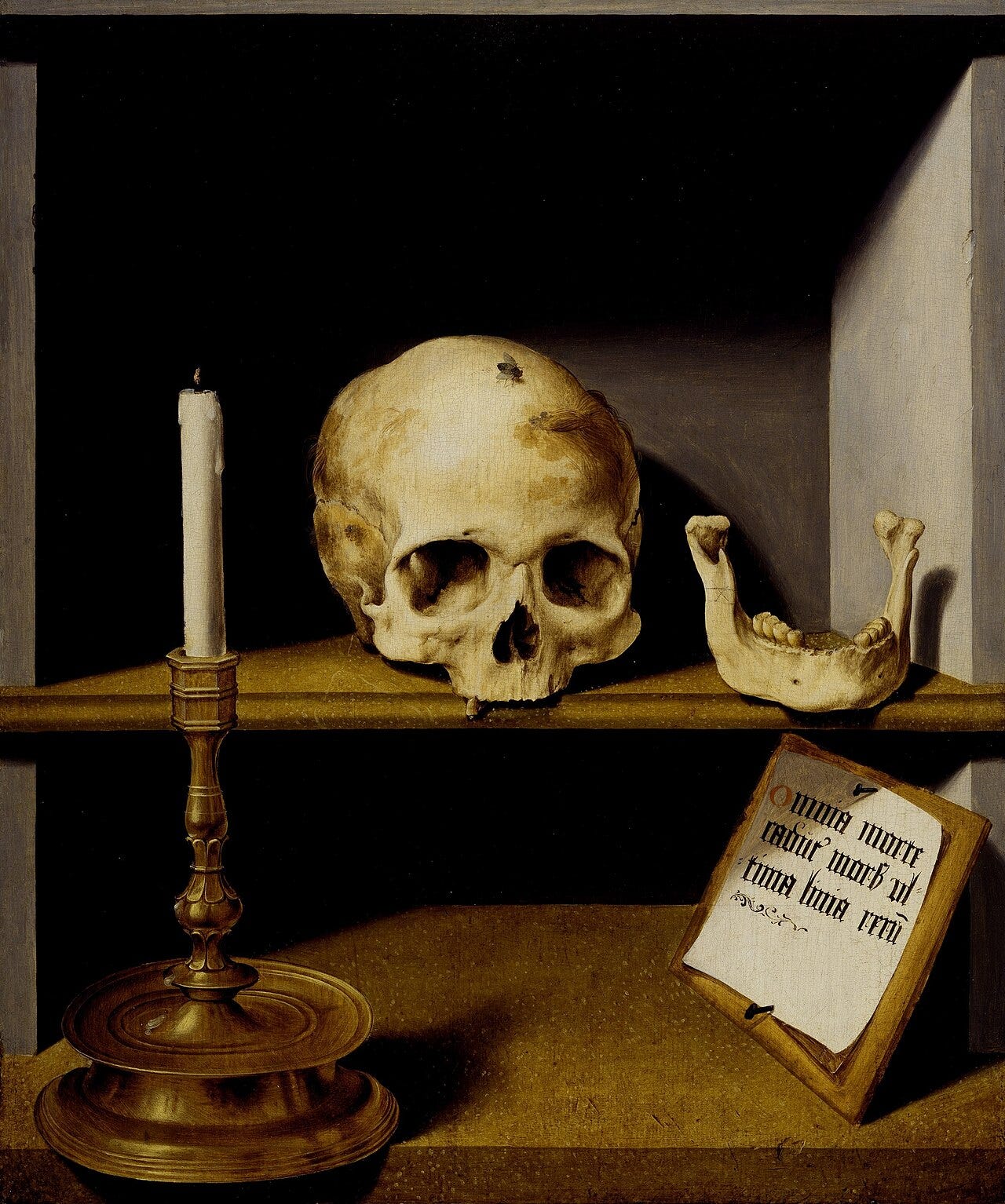
11. Barthel Bruyn the Elder, Vanitas (about 1524)
Turn over a certain German portrait of a lady and you find a shock waiting on the back, a skull in an empty niche. Barthel Bruyn painted the living face on the front and the reminder of death behind it, so the sitter could never quite forget.
It was made to be flipped.
A Latin line by the skull warns that all things fall to death, the plainest reminder there is. Portraits like this doubled as private sermons, kept in the home and turned over in quiet moments.
Now in the Kroller Muller museum in the Netherlands, it is a whole life on one small panel, a face on one side and a skull on the other.
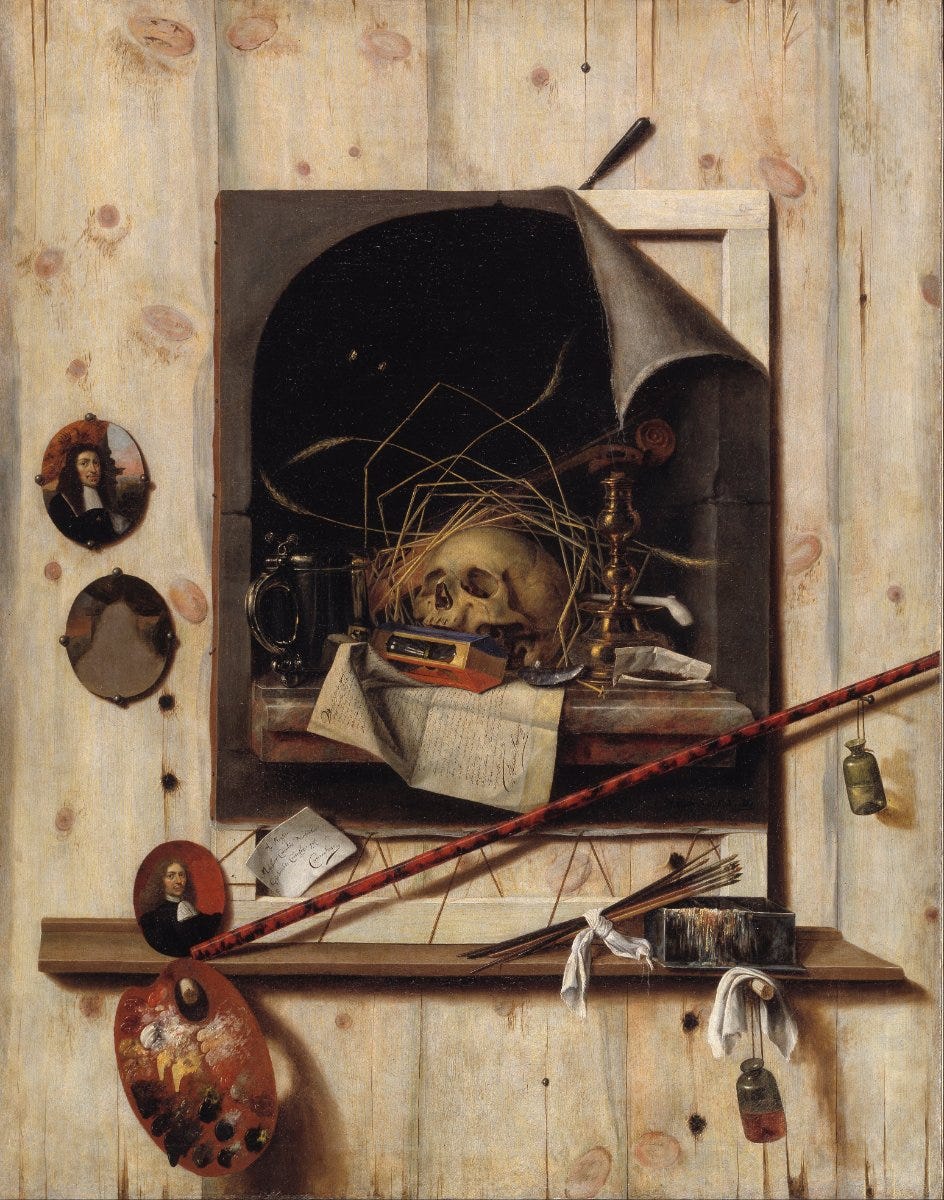
12. Edwaert Collier, Vanitas Still Life (about 1690)
Letters, a newspaper, a seal, a crown and a skull crowd a shelf so real you almost reach in to pick them up. Collier was a master of trompe l'oeil, the trick of painting things flat enough to fool the eye. His subject is the vanity of fame and news.
The papers and pamphlets stand for gossip and glory that will be forgotten by next week. Collier worked in both Holland and London, selling these clever deceptions to buyers who loved to be tricked.
Three hundred years later the news he mocked is dust, and the painting remains.
Where these reminders are kept
Harmen Steenwijck, An Allegory of the Vanities of Human Life, and Hans Holbein, The Ambassadors: the National Gallery, London.
Philippe de Champaigne, Vanitas: a museum in Le Mans, France.
Antonio de Pereda, The Knight's Dream: the Real Academia de San Fernando, Madrid.
Juan de Valdes Leal, In Ictu Oculi: the Hospital de la Caridad, Seville.
David Bailly, Self Portrait with Vanitas Symbols: the Lakenhal museum, Leiden.
Guercino, Et in Arcadia Ego: the Galleria Nazionale, Rome.
If these warnings pulled you in, keep going:
The Arnolfini Portrait, detail by detail, the mirror, the dog, and the question everyone asks
Six women, one monster, what Picasso did to the women who loved him
The darker truth about Gauguin, the part of the Tahiti story that never makes the wall label
Vanitas paintings, a few quick questions
What is a vanitas painting? A kind of still life, popular in the 1600s, packed with symbols of death and the shortness of life, from skulls to snuffed candles.
What do the symbols mean? A skull is death, an hourglass or watch is time, bubbles and smoke are how fast life fades, flowers wilt, and books and money are the vanity of worldly things.
What does vanitas mean? It comes from a line in the Bible, vanity of vanities, all is vanity, meaning that everything we chase is empty in the end.
Why were they so popular in Holland? The wealthy Dutch loved luxurious pictures, and the vanitas let them enjoy the riches on the table while piously admitting it all meant nothing.
Where can I see vanitas paintings? The National Gallery in London, the Prado and Seville in Spain, and museums across the Netherlands hold the finest.
Enjoy it while you can
The joke buried in every vanitas is that the painting scolds you for loving beautiful things while being a beautiful thing itself. Painters warned against silver and silk in silver and silk so perfect that collectors paid fortunes for the warning.
That contradiction is exactly why the pictures still work. Four hundred years on the message lands, because the skull on the table is, sooner or later, looking at you.