
For almost forty years, Diego Velázquez worked for a single patron, the king of Spain, and he rarely signed his pictures. That habit has left puzzles behind. One composition he painted as a teenager survives in three versions, and one of them hung behind a door in a Houston museum, labeled as a work in his style.
Cool Stories About Art is a newsletter to learn art the fun way.
Join 200,000+ readers and get:
10 new art stories / month
The entire archive of content (140+ articles)
Comment, ask questions, and chat with other readers
From Seville to the Palace
Diego Velázquez is the great painter of 17th-century Spain, in the period known as the Baroque. He served the king in Madrid from 1623 to his death in 1660, and many of his canvases are portraits of the royal family, painted from life for the palace.
The court asked him for likeness, and over the years he delivered it with less and less paint. As a young man in Seville, he described every pot and every fold in hard detail. In his last years, a sleeve or a face is built from loose strokes that only resolve into a shape at a distance.
The twelve paintings follow that change across his whole career, from his first years in Seville, through two journeys to Italy, to the last large canvases he painted in Madrid. They include the pictures people look for most and a few that are rarely shown.
12. Kitchen Maid with the Supper at Emmaus (about 1617 to 1618)
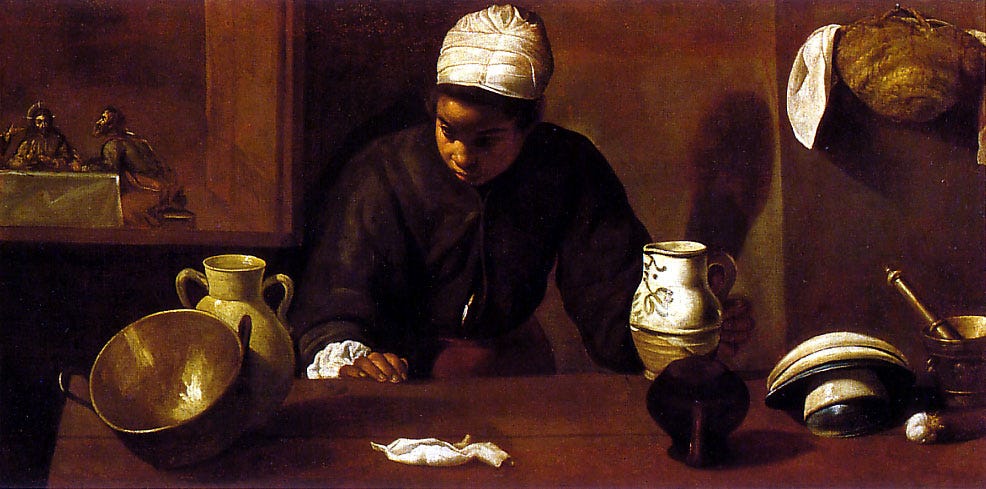
A young servant leans over a crowded counter, one hand near a jug, her head turned slightly as though she has caught a voice behind her. In the upper left corner, through a small hatch in the wall, three men sit at a table. One of them is Christ.
The picture is Kitchen Maid with the Supper at Emmaus, painted in Seville around 1617 or 1618, soon after Velázquez had qualified as a master painter in the city at eighteen or nineteen. Luke's Gospel supplies the scene in the hatch. After the Crucifixion, two disciples on the road to Emmaus are joined by a stranger, and they recognize him as Christ only when he breaks bread at supper.
Putting the kitchen in front and the holy scene in a corner was not his invention. Flemish painters had used the same reversal in the previous century.
The servant herself is harder to explain. Nobody knows for certain why Velázquez made her a woman of African origin. One theory, still unproven, links the canvas to the archbishop of Seville, Pedro de Castro y Quiñones, who was then publishing instructions for the baptism of Africans. In that reading, the maid stands for salvation offered to the poorest.
Yet for centuries the hatch was invisible. The scene of Christ came to light only when the canvas, now in Dublin, was restored in 1933. Until then it looked like a plain kitchen picture, close to another version in the Art Institute of Chicago that has no religious scene.
The two pictures raise the question of which came first. The Chicago one was long taken for the original and the Dublin one for a copy, until the Spanish-born scholar José López-Rey argued the reverse. Specialists still disagree.
A third version surfaced in Texas in 2018. Cut down almost to a square, it had hung behind a door at Rienzi, a house museum belonging to the Museum of Fine Arts, Houston, labeled as a work in the style of Velázquez. Once it had been cleaned, the museum relabeled it as attributed to him.
In all three versions, the maid keeps the same pose, bent over her work with her head half turned. Only the Dublin canvas shows what she might be listening to.
At a Glance
Artist: Diego Velázquez (1599 to 1660)
Painted: About 1617 to 1618
Medium: Oil on canvas
Size: 55 × 118 cm (21.7 × 46.5 in)
Where to see it: National Gallery of Ireland, Dublin
11. Juan de Pareja (1650)
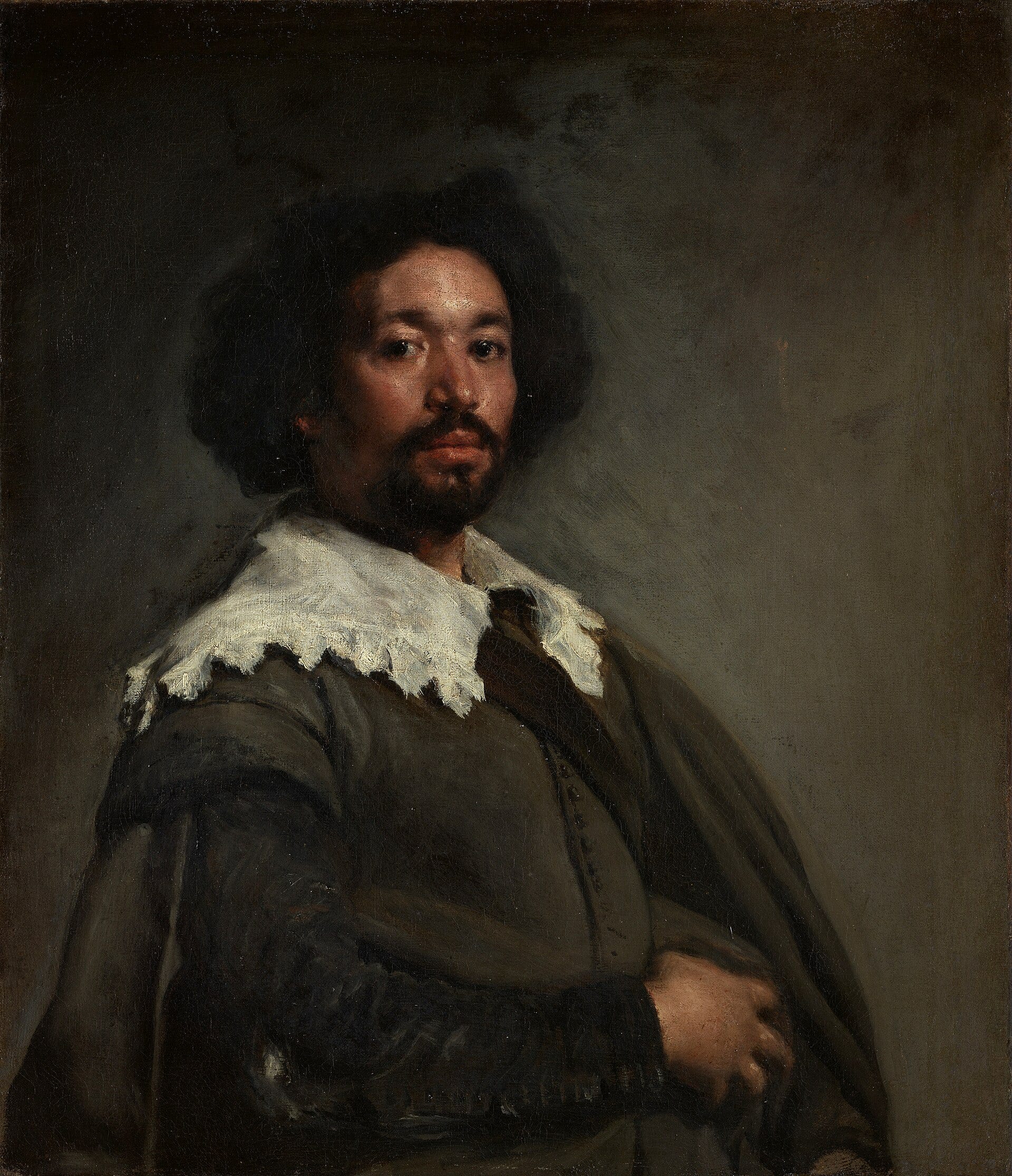
In March 1650, under the portico of the Pantheon in Rome, a newly painted portrait went on public show. It showed a man with dark curly hair and a short beard, in a plain doublet with a wide lace collar, looking straight out at the crowd. The painter had brought him to Rome. By law, the man in the picture belonged to the man who had painted him.