Venice in Painting: 12 Famous Views of the City

Venice has drawn painters for five centuries. From Bellini and Canaletto to Turner, Manet and Monet, artists chased its light, water and crowds. These twelve paintings capture the city across 400 years, from Renaissance processions to Impressionist haze.

Some painters recorded the city stone by stone. Others dissolved it into color. A few used Venice to talk about time, faith or death. Read them together and you get a portrait of the city itself, changing with every century.

  • The view painters: Canaletto, Guardi and Bellotto sold Venice to tourists on the Grand Tour.

  • The Renaissance eyewitnesses: Bellini and Carpaccio painted real Venetian crowds around a sacred relic.

  • The foreign visitors: Turner, Manet, Renoir and Monet came for the light and left with something looser.

  • Where to see them: the canvases are split between Venice, London, Boston and Cardiff.

If these draw you in, you will also love the mafia and the missing Caravaggio, 7 secrets hidden in famous paintings, and who painted the first Impressionist.


Learn art the fun way. Free stories every week, no boring lectures.


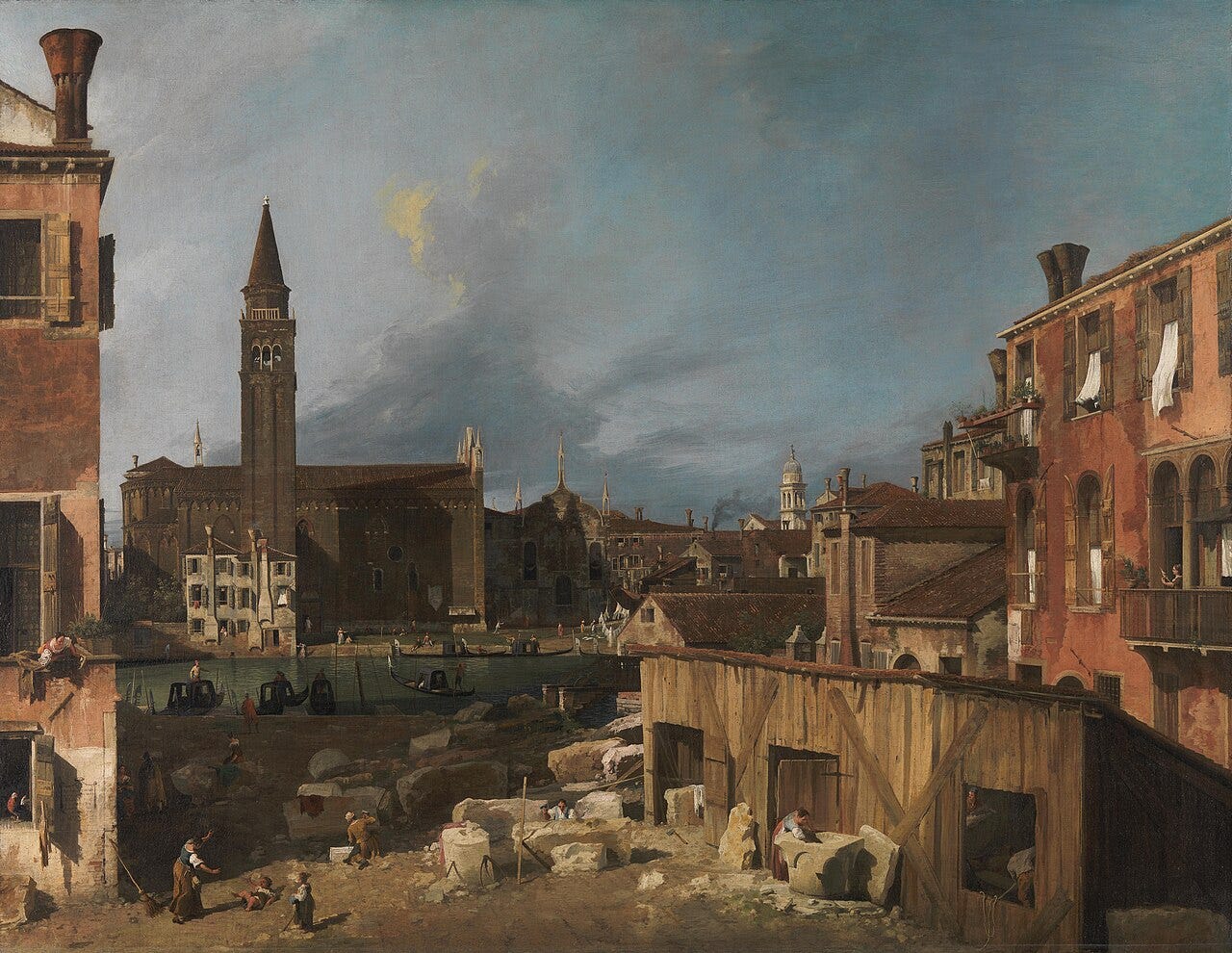
1. Canaletto, The Stonemason Yard

A working Venetian square with laundry and stone blocks
Canaletto, The Stonemason's Yard, about 1725. National Gallery, London.

Around 1725, Canaletto set up his view across a working square. The Campo San Vidal had become a temporary stonemason yard. Workers were cutting blocks for a new church facade. Beyond them, the Grand Canal and the church of Santa Maria della Carita catch the morning light.

Most Canaletto scenes flatter the tourist. This one does the opposite. Instead of the postcard Venice of gondolas and palaces, he painted laundry, chickens, a woman at a window and a child who has fallen over. It is the daily city, not the show.

The National Gallery bought it in 1828. It is still treated as the finest thing Canaletto ever painted, precisely because it forgets to sell you anything.

2. Gentile Bellini, Procession in St Mark Square

A religious procession crossing a gold Saint Mark square
Gentile Bellini, Procession in Saint Mark's Square, 1496. Gallerie dell'Accademia, Venice.

In 1496, Gentile Bellini finished a canvas almost eight meters wide. It shows a religious procession crossing Piazza San Marco on 25 April 1444. Members of a Venetian confraternity carry a relic of the True Cross. The Basilica of San Marco rises behind them in gold.

This is not an imagined scene. Bellini painted the square as it looked in his day, down to the mosaics on the basilica, several of which were later replaced. Art historians use the picture as a record of what San Marco actually looked like in the 1490s.

The relic had a reputation. According to the confraternity, it once fell into a canal and floated, refusing to be touched by anyone but its guardian. Bellini colleagues painted that story too.

3. Vittore Carpaccio, The Miracle of the Relic of the Cross at the Rialto Bridge

A healing on a balcony above the Grand Canal by the old wooden Rialto
Vittore Carpaccio, The Miracle of the Relic of the Cross at the Rialto Bridge, about 1496. Gallerie dell'Accademia, Venice.

Around 1496, Carpaccio painted the same relic at work. On a balcony above the Grand Canal, the Patriarch of Grado heals a man who is possessed. The old wooden Rialto Bridge crosses the canal behind, crowded with gondolas and chimneys shaped like funnels.

People come for the miracle and stay for the background. Carpaccio recorded the first Rialto Bridge, a wooden drawbridge that no longer exists. The stone bridge everyone photographs today was not built until the 1590s.

Look at the rooftops. Those cone shaped chimneys were a Venetian fire precaution. Carpaccio painted dozens of them, giving us a street map of a city that has largely vanished.

4. Francesco Guardi, The Grand Canal, Venice

The Grand Canal under a wide moving sky, palaces sketched in quick strokes
Francesco Guardi, The Grand Canal, Venice, about 1760. Art Institute of Chicago.

Around 1760, Guardi painted the Grand Canal under a wide, moving sky. Gondolas cut across choppy water. The palaces are sketched with quick, broken strokes rather than ruled lines. The whole city seems to tremble in the air.

Guardi worked in Canaletto shadow and was long dismissed as the lesser man. That verdict has flipped. His loose, nervous touch now looks closer to the Impressionists than to his rival precision.

He sold these views cheaply to tourists who wanted a souvenir. Guardi died poor in 1793. Two centuries later his canal scenes hang in Chicago, Paris and London.

5. Bernardo Bellotto, Venice: The Grand Canal facing Santa Croce

A crisp view of the Grand Canal facing Santa Croce
Bernardo Bellotto, Venice: The Grand Canal facing Santa Croce, about 1738. National Gallery, London.

Around 1738, a teenager painted this crisp view of the Grand Canal facing Santa Croce. He was Bernardo Bellotto, Canaletto nephew, working in his uncle studio. He was roughly sixteen years old.

The two men painted so alike that Bellotto used the name Canaletto for the rest of his life, even after he moved abroad. Scholars still argue over which early views belong to the uncle and which to the nephew.

Bellotto took the family style to Dresden, Vienna and Warsaw. His later views of Warsaw were so exact that they helped rebuild the city after 1945.

6. J.M.W. Turner, Venice, the Bridge of Sighs

The Bridge of Sighs flooded with pale gold light
J.M.W. Turner, Venice, the Bridge of Sighs, exhibited 1840. Tate, London.

Turner showed this Venice scene at the Royal Academy in 1840. The Bridge of Sighs links the Doge Palace to the old prison. Turner floods the whole view with pale gold light until stone and water almost dissolve.

He hung it with two lines from Byron, a palace and a prison on each hand. Critics were not kind. Some dismissed his Venetian pictures as color for its own sake.

Turner left the painting to Britain in his bequest of 1856. The men who mocked it are forgotten. The picture now anchors his Venice room at Tate.

7. Felix Ziem, Venice, Evening

Santa Maria della Salute dark against a burning sunset sky
Felix Ziem, Venice, Evening, about 1865. Walters Art Museum, Baltimore.

Around 1865, Ziem painted the mouth of the Grand Canal at sunset. Santa Maria della Salute stands dark against a burning sky. The Doge Palace and the campanile glow on the right. Boats drift on gold water.

Ziem was obsessed. He visited Venice more than twenty times and painted it hundreds of times. He even rented boats and turned them into floating studios to reach the best angles.

William Walters bought this canvas in 1865 and carried it to Baltimore. Ziem became one of the first living French painters to enter the Louvre, largely on the strength of his Venice.

8. Edouard Manet, The Grand Canal of Venice (Blue Venice)

A gondola on the Grand Canal between blue and white mooring posts
Edouard Manet, The Grand Canal of Venice (Blue Venice), 1875. Shelburne Museum, Vermont.

In September 1875, Manet traveled to Venice with the painter James Tissot. He painted a gondola on the Grand Canal between the blue and white mooring posts. The water is all broad, quick strokes of blue.

The picture was first called simply The Grand Canal of Venice. The American collector Louisine Havemeyer loved it so much she renamed it Blue Venice, and the nickname stuck.

It now hangs at the Shelburne Museum in Vermont, far from any canal. Manet made only a handful of Venice paintings, which makes this one rare.


Join 130,000 readers who get the secrets behind the paintings. Free.


9. Pierre Auguste Renoir, Grand Canal, Venice

Palace facades dissolved into flickering reflections on the water
Pierre Auguste Renoir, Grand Canal, Venice, 1881. Museum of Fine Arts, Boston.

In 1881, Renoir stood between the Ca Foscari palace and the Rialto and painted the Grand Canal. He dissolved the stone facades into flickering reflections of pink, yellow and orange on the water.

One critic called his Venice pictures the most outrageous daubs any enemy of the city could imagine. Renoir had broken with the tradition of exact Venetian views on purpose.

Alexander Cochrane bought it in Boston in 1889 and left it to the Museum of Fine Arts. The insult aged into a compliment.

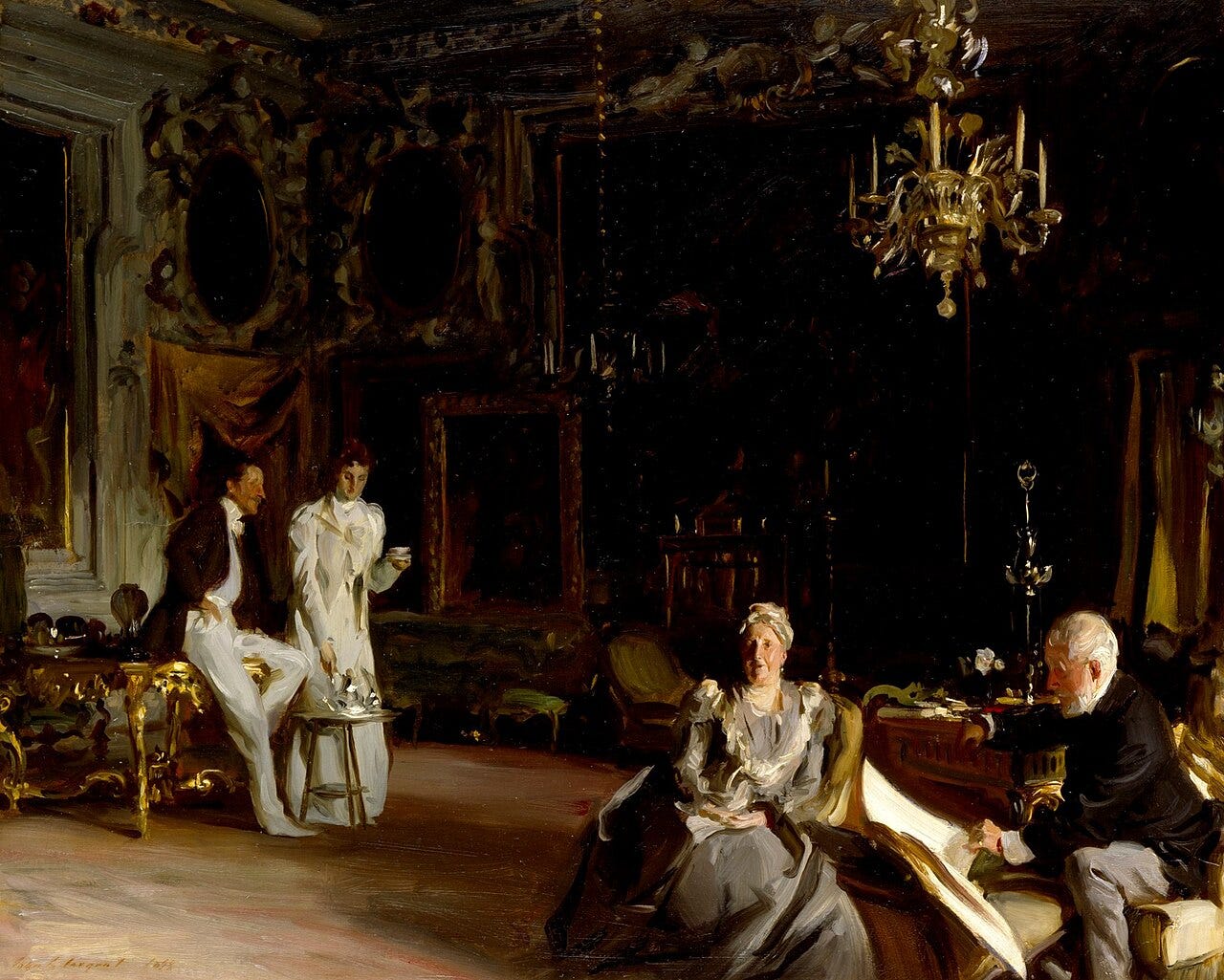
10. John Singer Sargent, An Interior in Venice

An American family in a grand Venetian salon with light pouring through tall windows
John Singer Sargent, An Interior in Venice, 1899. Royal Academy of Arts, London.

In the summer of 1899, Sargent stayed at the Palazzo Barbaro as a guest of the American Curtis family. He painted them inside their grand Venetian salon, light pouring through tall windows behind them.

Mrs Curtis refused the gift. She thought it made her look too old and that her son was shown without enough dignity. Sargent kept it and gave it to the Royal Academy instead.

The Palazzo Barbaro also hosted Monet and Henry James. James saw the painting and wrote that he adored it and craved to own it. Mrs Curtis had turned down what a novelist begged for.

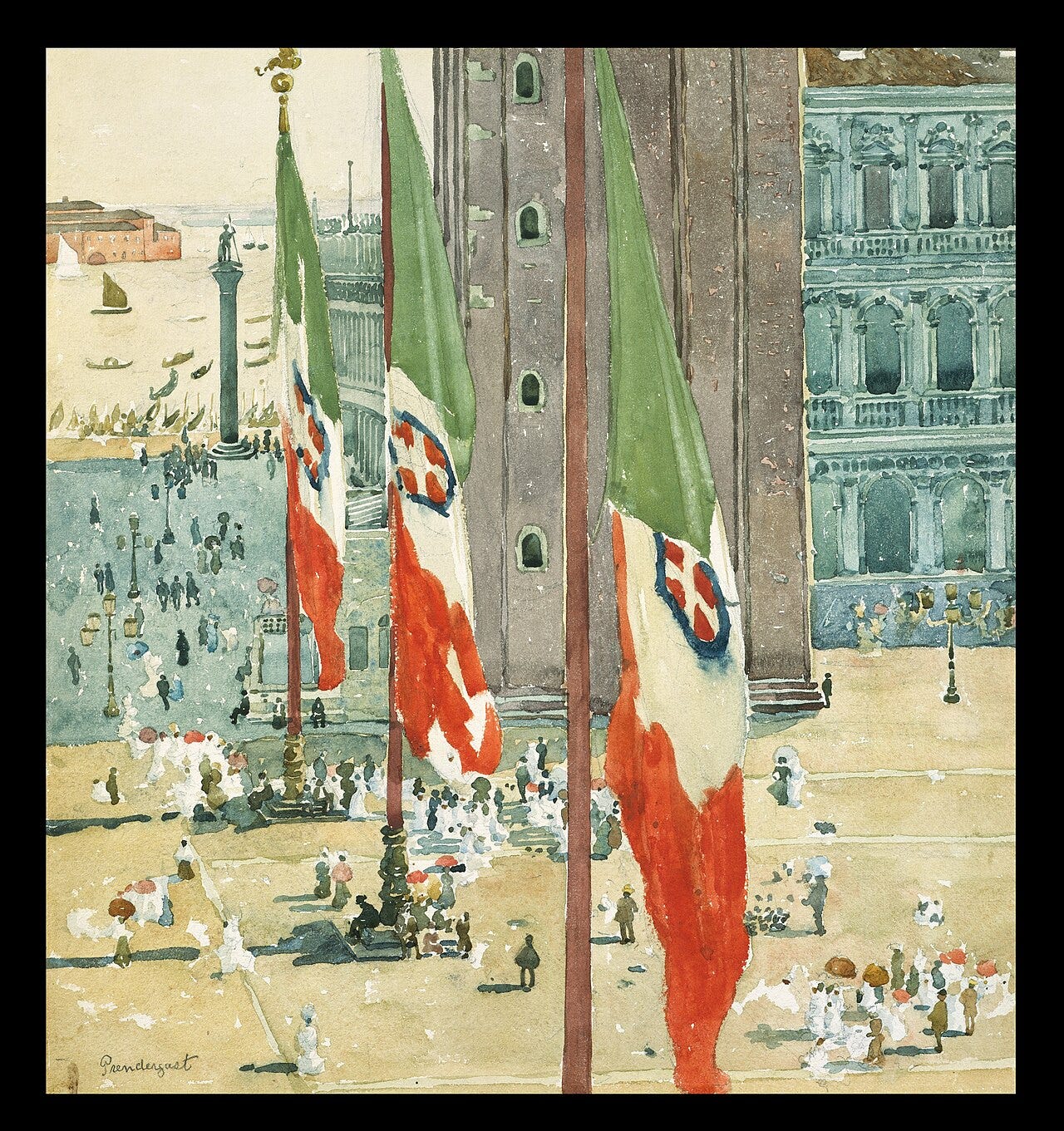
11. Maurice Prendergast, Festival, Venice

Crowds along a canal under flags, painted in bright dabs
Maurice Prendergast, Festival, Venice, 1898 to 1899. Museum of Modern Art, New York.

In 1898 and 1899, the American Maurice Prendergast filled sheets with Venetian festivals. In this watercolor, crowds press along a canal under flags and banners, painted in bright dabs of color like a mosaic.

Prendergast trained in Paris but found his subject in Venice. He watched the Festa del Redentore, the city summer holiday, when Venetians once hired lamp lit gondolas for the night.

Abby Aldrich Rockefeller gave the sheet to the Museum of Modern Art. His watercolors of Venice are now counted among his best work.

12. Claude Monet, San Giorgio Maggiore at Dusk

The island church burning orange against a violet sky
Claude Monet, San Giorgio Maggiore at Dusk, 1908. National Museum Cardiff, Wales.

In the autumn of 1908, Monet visited Venice for the only time. From the shore he watched the island church of San Giorgio Maggiore burn orange against a violet sky and painted it dissolving into its own reflection.

Monet was 68 and nearly gave up. He complained the city was too beautiful to paint. He worked up the Venice canvases later from memory and studies, back in his studio at Giverny.

The Welsh collector Gwendoline Davies bought this version and left it to Cardiff. Monet only trip to Venice produced some of the last great works before his sight began to fail.

Where to see them

  • National Gallery, London: Canaletto The Stonemason Yard and Bernardo Bellotto The Grand Canal facing Santa Croce.

  • Gallerie dell Accademia, Venice: Gentile Bellini Procession in St Mark Square and Vittore Carpaccio Miracle at the Rialto Bridge.

  • Museum of Fine Arts, Boston: Pierre Auguste Renoir Grand Canal, Venice.

  • Tate, London: J.M.W. Turner Venice, the Bridge of Sighs.

  • National Museum Cardiff: Claude Monet San Giorgio Maggiore at Dusk.

How painters kept reinventing Venice

The oldest of these are history paintings of real events, painted so exactly they double as a record of a city that has since changed.

The tourist views are precise landscape paintings, while the foreign visitors turned Venice into Impressionist color, chasing the light off the lagoon.

Venice in art, questions people ask

  • Who painted the most famous views of Venice? Canaletto is the name most tied to Venice. His precise 18th century views of the Grand Canal were sold across Europe to Grand Tour tourists.

  • Did Claude Monet paint Venice? Yes. Monet visited once, in 1908, at age 68. He painted about 37 Venice canvases, including San Giorgio Maggiore at Dusk, now in Cardiff.

  • Where can I see Canaletto Venice paintings? The National Gallery in London holds The Stonemason Yard. Others hang in Venice, Windsor, Boston and many major museums.

  • What is the Bridge of Sighs in Turner painting? It is the covered bridge linking the Doge Palace to the old Venetian prison. Turner exhibited his glowing version in 1840.

  • Why do Venice paintings often look hazy? Venice sits on water, and the light bounces off the lagoon. Painters from Guardi to Monet chased that shifting glare rather than sharp detail.

The city that sells its own reflection

Venice has been sinking and posing for the same painters for five hundred years. Canaletto turned it into a souvenir. Monet turned it into a memory. In 1908 Monet said the city was too beautiful to paint, then painted it anyway. That tension, a real place that keeps dissolving into light, is why artists never stop coming back.


Two new stories a week, 130 secrets unlocked. Start free.