
Thieves twice carried off the same painting by Johannes Vermeer from a house in Ireland. A second picture by the Dutch master passed for another artist's work for years, until his real signature turned up under false initials.
In a third, scans found a basket that he had painted over.
Cool Stories About Art is a newsletter to learn art the fun way.
Join 200,000+ readers and get:
10 new art stories / month
The entire archive of content (140+ articles)
Comment, ask questions, and chat with other readers
Twenty Years in One Small City
Johannes Vermeer is known for fewer than forty pictures, made over about twenty years in Delft, a small Dutch city where he was born and where he died in 1675. Most show one or two people in a quiet room, with light falling from a window.
Because so little happens in those rooms, small decisions carry each picture: where a jug stands, how big a balance is, what hangs on the wall. X-rays and infrared scans now show how often he changed his mind, painting out whole objects and enlarging one that mattered.
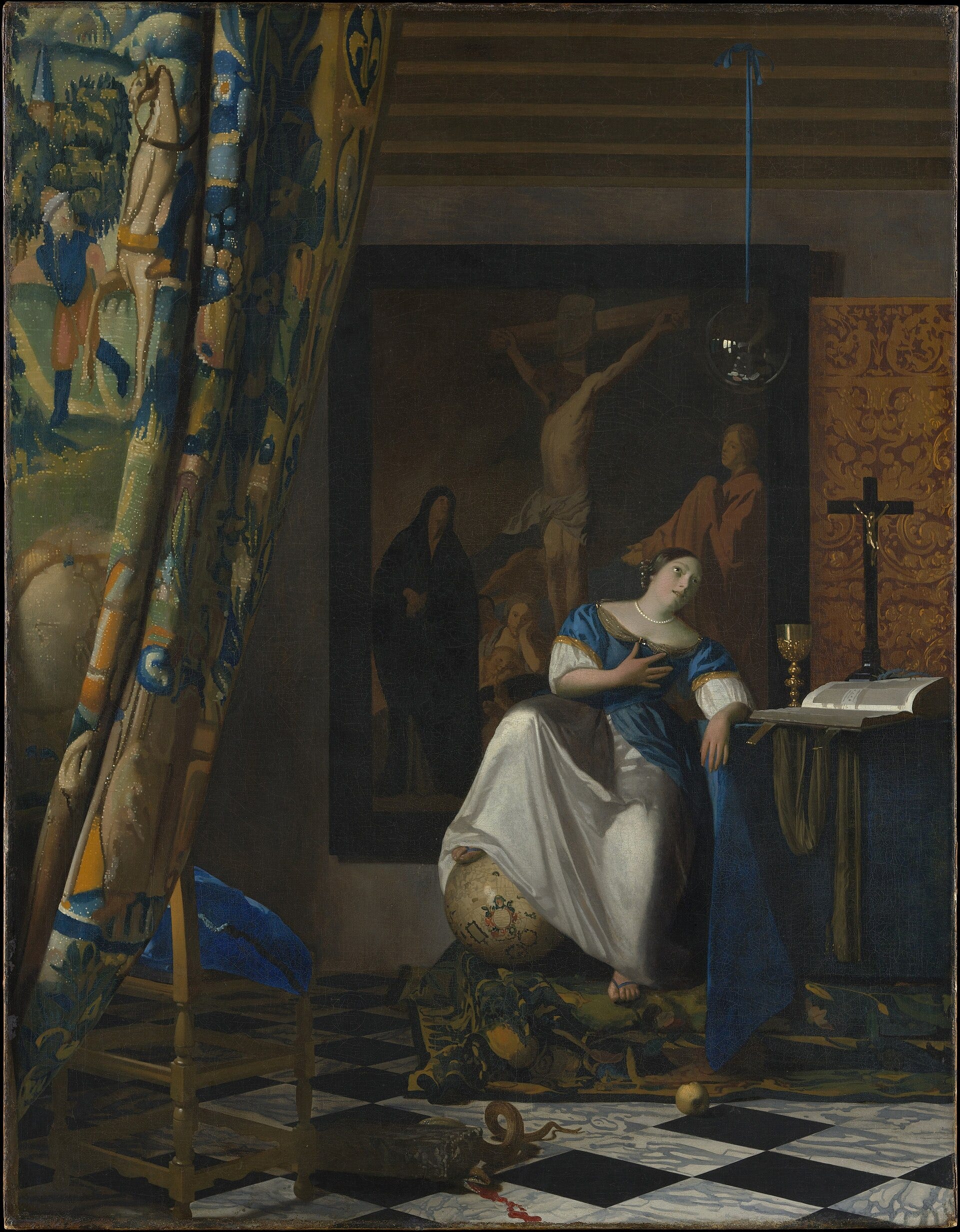
His working life runs from a goddess painted at about twenty-one to the Allegory of the Catholic Faith of his last years. Girl with a Pearl Earring draws crowds wherever it travels, while early pictures such as The Procuress are rarely discussed.
12. Lady Writing a Letter with Her Maid (about 1670)
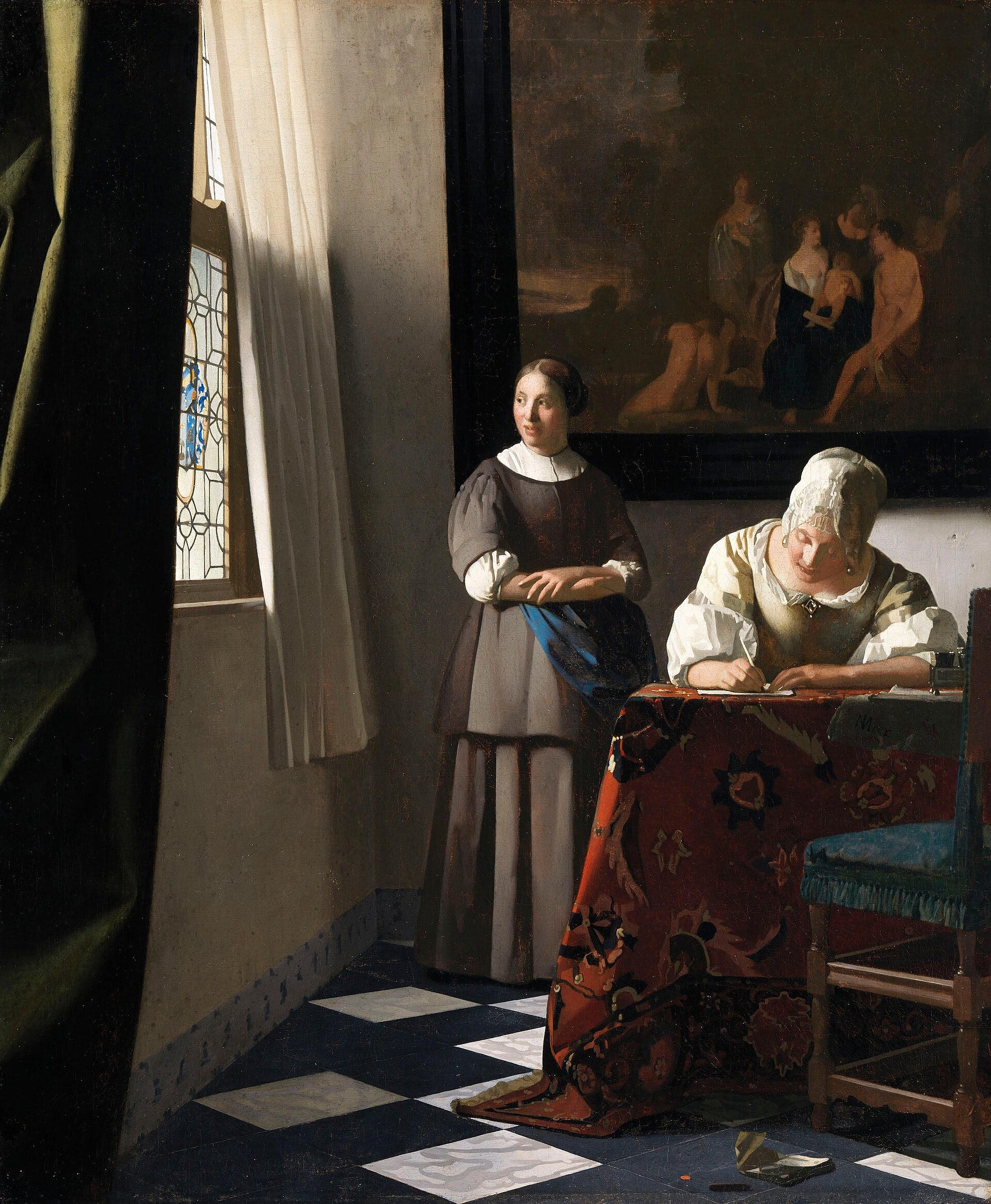
While a lady in a yellow jacket writes at a table, her maid stands behind her, looking out through a leaded window. Lady Writing a Letter with Her Maid has been carried off by thieves from the same house twice.
The house was Russborough, a country mansion near Dublin. Sir Alfred Beit lived there with the collection his uncle, a diamond and gold magnate, had built up, this Vermeer included.
In April 1974 an IRA gang left the house in under ten minutes with 19 paintings. In exchange, the thieves wanted IRA prisoners moved from English jails to Northern Ireland, and a ransom.
The plan failed. In early May the police found the paintings in a rented cottage in County Cork, and the Vermeer came back with only a few small scratches.
The second raid, in May 1986, was the work of Dublin criminals. They took 18 pictures, the Vermeer again among them, and this time it stayed missing for seven years.
Beit did not wait for its return. In 1987 he gave it to the National Gallery of Ireland anyway, a gift of a picture that no one could yet hang.
It reappeared in 1993 in a garbage bag in the trunk of a car in an Antwerp parking lot. Charles Hill, a Scotland Yard detective, found it after posing as a go-between for buyers in the Middle East.
In the picture itself, the figure who holds the eye is the maid, not her mistress. She stands at full length in the middle of the room, arms clasped, gazing out of the window.
At her feet, on the floor by the table, lie a crumpled letter, a stick of sealing wax and a red seal.
At a Glance
Artist: Johannes Vermeer (1632 to 1675)
Painted: About 1670, Delft
Medium: Oil on canvas
Size: 71.1 × 60.5 cm (28 × 23.8 in)
Where to see it: National Gallery of Ireland, Dublin
About This Painting
Which Vermeer painting was stolen?
Several were. This one was taken from Russborough House in 1974 and again in 1986. The Love Letter was taken from an exhibition in Brussels in 1971 and recovered within weeks, and The Guitar Player was stolen from Kenwood House in London in 1974 and found in a churchyard. The Concert was stolen in Boston in March 1990 along with twelve other works and has not been found.
11. Diana and Her Nymphs (about 1653 to 1654)
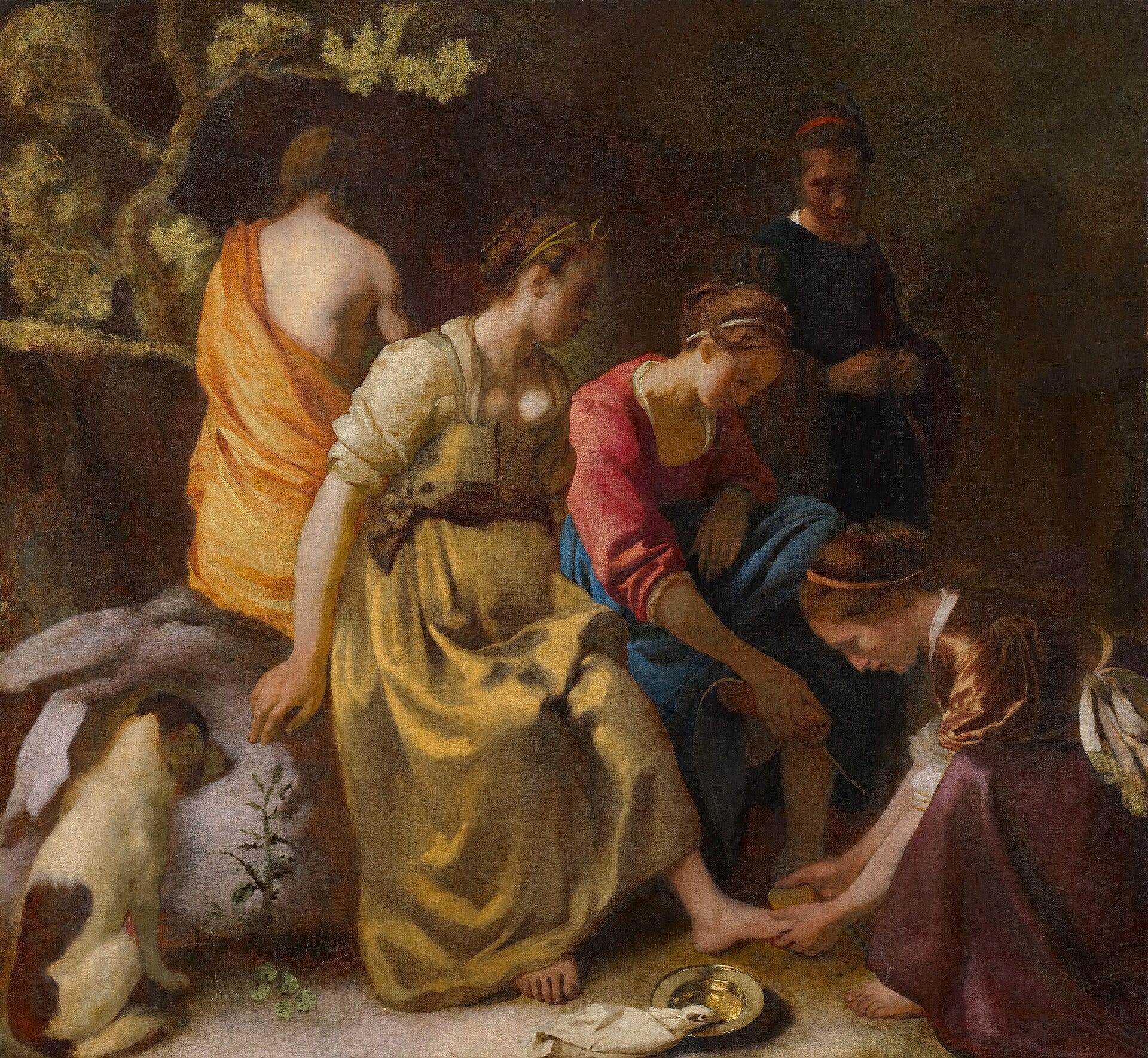
In a dark clearing, a seated goddess wears a small crescent moon on her head. A woman kneels to wash one of her feet, other young women gather around, and a dog sits at the lower left, its back to the viewer.
The goddess is Diana, the Roman deity of the hunt and of the moon, and the women are her nymphs, the lesser spirits who follow her through the woods.
In 1876 Diana and Her Nymphs was sold at auction in Paris as the work of Nicolaes Maes, a Dutch painter trained by Rembrandt, and the initials N.M. on the canvas seemed to prove it. In 1885 a restoration showed what those initials were covering.