
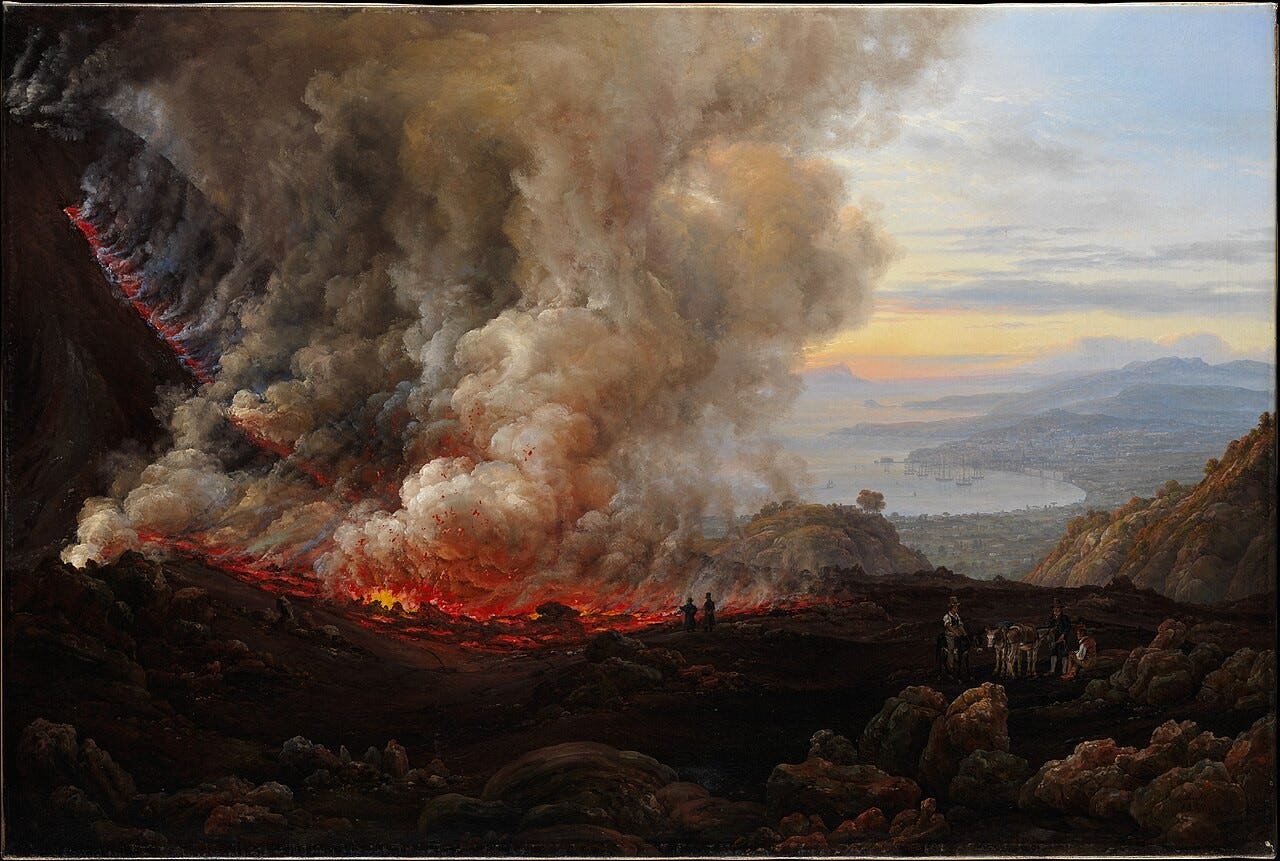
Painters have put volcanoes in their pictures for nearly two thousand years, from a house in Pompeii to a pop artist's series, yet an eruption is rarely painted from life. Much of the fire in these pictures came from someone else's sketch or account. And one painter who did climb a crater at night pushed it to the back of his canvas.
Cool Stories About Art is a newsletter to learn art the fun way.
Join 200,000+ readers and get:
10 new art stories / month
The entire archive of content (140+ articles)
Comment, ask questions, and chat with other readers
How These Were Chosen
A volcano gives a painter two subjects. The mountain can sleep for generations and still rule every view of the plain below. The eruption brings what a landscape rarely has: fire at night, a light inside the picture, ash that changes the color of the sky.
An eruption rarely waits for an easel, though. It breaks out far from painters, and getting close is dangerous. So most eruptions on canvas were painted later, in a studio, from a sketch, a witness's account or another image.
Every mountain here is a volcano known to have erupted, whether it burns in the picture or sleeps there. One question runs through the entries: what was the painter looking at while he worked? The answers run from the lip of a crater to a studio on another continent.
12. Unknown Roman painter, Bacchus and Vesuvius (before AD 79)
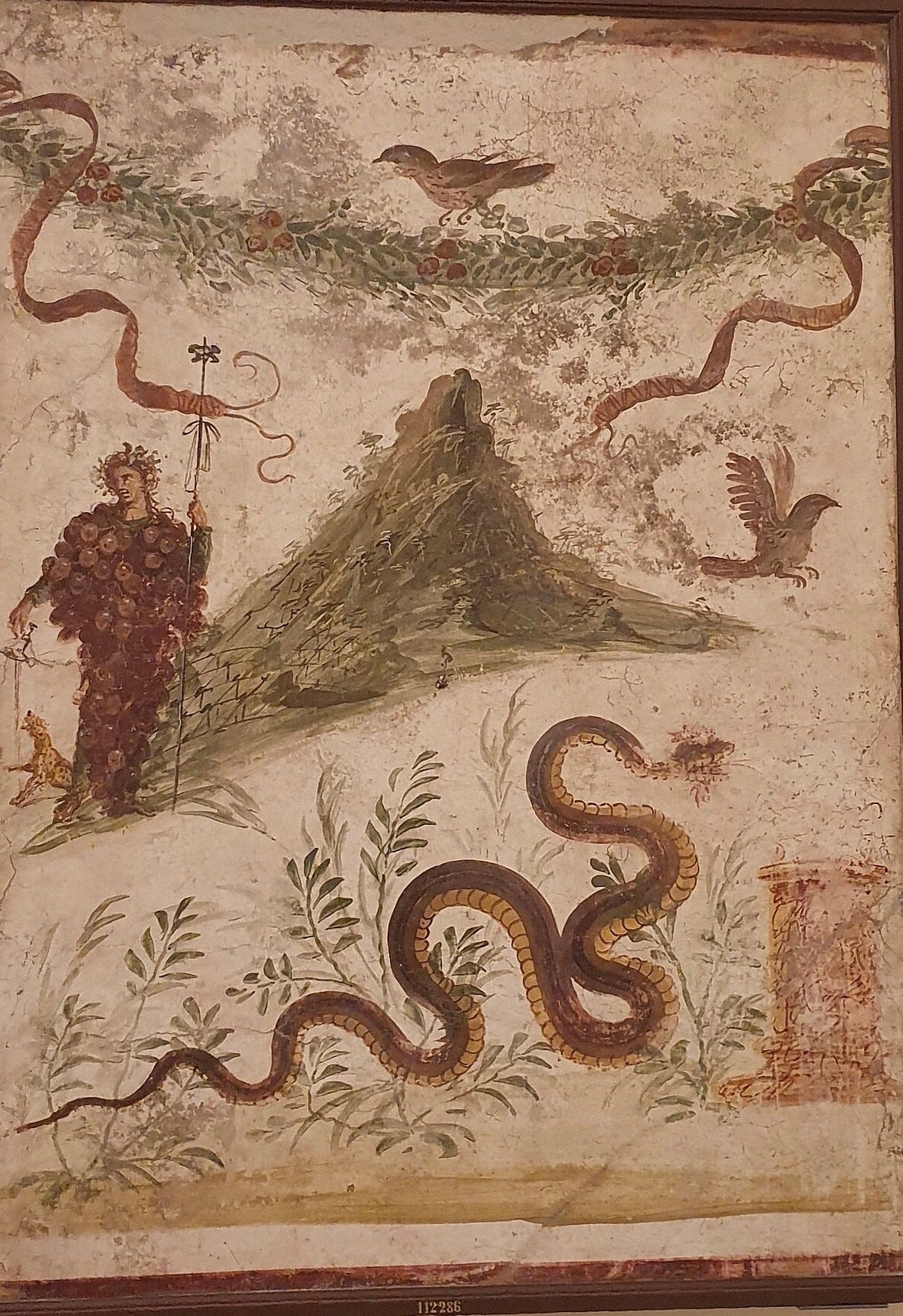
On a wall from Pompeii, a mountain rises behind Bacchus, the god of wine, painted as if his whole body were one heavy bunch of grapes, and the mountain may well be Vesuvius. The god pours wine from a cup for a panther at his feet, and below him a crested snake slides toward an altar. An unknown Roman painter put the scene on the wall some time before AD 79, the year Vesuvius buried the city.
The wall stood in the House of the Centenary, in its lararium, the small shrine where a Roman family prayed to the spirits that protected its home. The snake is one of those spirits, the Agathodaemon, the good genius of the place, who watched over the vines and the grain. A god made of grapes and a spirit of the vines and the grain share this wall, and that is why the mountain behind them deserves a second look.
Which mountain it is remains an open question. The usual answer is Vesuvius, and the vines are the argument. In those years the real volcano was planted with vines far up its slopes, and the owner of this house may have had vineyards there himself. Some scholars prefer Mount Nysa, where the infant Bacchus was raised in myth.
The poet Martial, writing after the eruption, describes Vesuvius in terms that fit the wall: a hillside that had lately been green under the shade of its vines, whose hills Bacchus had loved more than his own Nysa.
If the painter meant Vesuvius, he painted it as Pompeii knew it: a working hillside under vines, with no sign of the fire inside.
At a Glance
Artist: Unknown Roman painter
Painted: Before AD 79
Medium: Fresco
Size: not published
Where to see it: Museo Archeologico Nazionale, Naples
11. Jules Tavernier, The Volcano at Night (about 1885 to 1889)
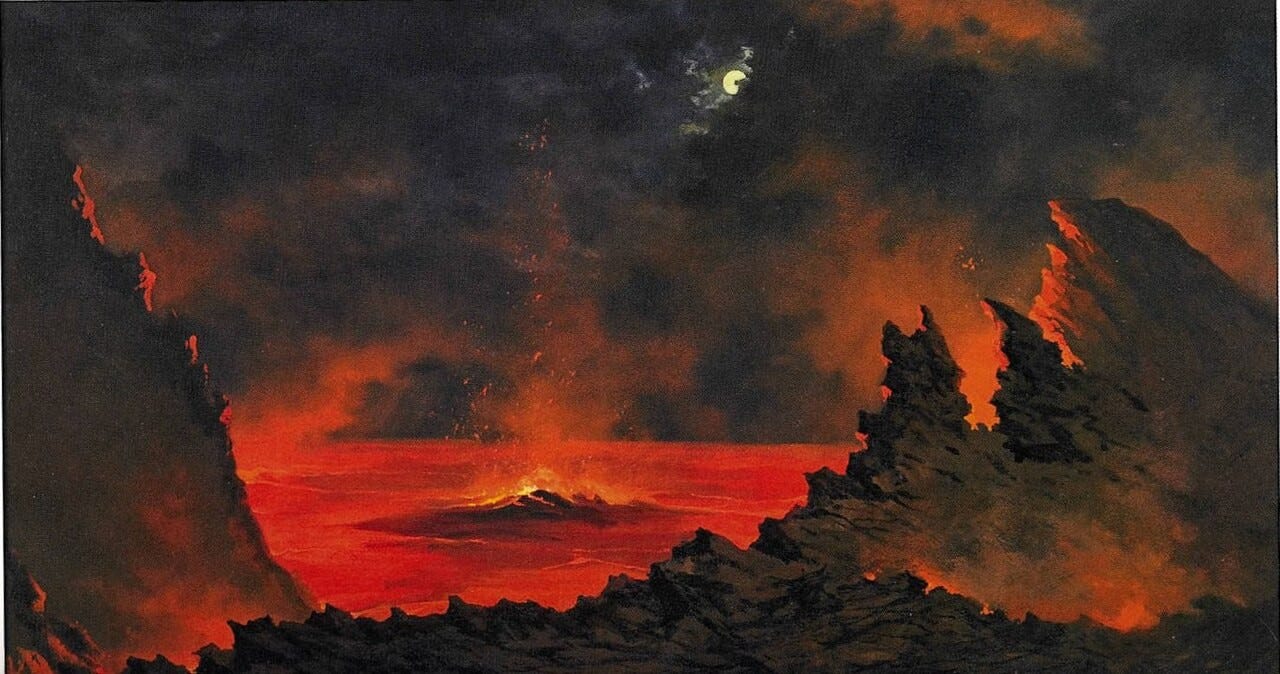
The ground simply stops at the bottom of the canvas, and beyond that edge a volcanic crater opens in the dark. A glow rises from below, steam escapes from vents, and heavy clouds press down over the whole scene. Jules Tavernier painted it in Hawaii, where he arrived in 1884. He had painted volcanoes before. He had never painted one from where this picture stands.