Famous War Paintings: 12 From Glory to Horror
People have painted war for as long as they have painted anything, first to celebrate the winners and then, slowly, to mourn the dead. The most famous war paintings track that whole change, from glittering pageants of glory to ditches full of bodies.
Here are twelve of the greatest, all now in the public domain.
From the first great battle scene to a silent pyramid of skulls, painters have used war to show off, to warn and to grieve. I have gathered the pictures where the heroes get smaller and the cost gets larger.
How war changes on the wall:
The glory. Victories staged like theatre, heroes lit like saints.
The mercy. Rare moments of grace between winner and loser.
The horror. Atrocities recorded without a single flag in sight.
The cost. Empty fields, beaten soldiers and towers of bone.
Three that dig further
Three that changed how I look at a picture:
Inside Monet house at Giverny, room by room, including his own bedroom
The Ambassadors, detail by detail, the object at the bottom that only works from one side
Luncheon of the Boating Party, detail by detail, who everybody at that table actually was
1. Paolo Uccello, The Battle of San Romano (about 1440)
The first truly great battle painting is also a maths lesson in disguise. Uccello was so obsessed with the new science of perspective that he laid the broken lances on the ground like lines on a page, all pointing to a single vanishing point.
A real cavalry clash becomes a geometric puzzle.
He painted three huge panels of a minor Florentine victory, glittering with silver armor that has since tarnished dark. The set was later split up, and the three panels now hang apart in London, Paris and Florence.
Uccello, it was said, loved perspective more than he loved his wife.
2. Peter Paul Rubens, The Consequences of War (1638)
The god of war lunges forward dragging a screaming woman, trampling books, an artist and a mother with her child underfoot. Rubens painted this as the Thirty Years War tore Europe apart, and he meant every figure as a warning.
Even Venus, the goddess of love, cannot hold Mars back.
In a letter Rubens explained the whole scene, the trampled book standing for learning destroyed, the broken lute for the harmony that war ruins. He was a diplomat as well as a painter, and he knew exactly what war cost.
The picture hangs in the Pitti Palace in Florence, painted while the Thirty Years War still had ten years left to run.
3. Diego Velazquez, The Surrender of Breda (1635)
The most gracious moment in the history of war painting shows a victory without a hint of gloating. The Spanish general Spinola gently stops his beaten Dutch rival from kneeling, laying a hand on his shoulder like a friend.
Behind them a forest of upright lances gives the picture its nickname, the Lances.
Velazquez painted the handover of the keys to a captured city as an act of mercy rather than triumph, almost unheard of at the time. He may have met the real Spinola on a voyage to Italy, sharing the ship for weeks.
It was one of a dozen victory scenes made for a great hall of the Buen Retiro palace, and now hangs in the Prado.
4. Benjamin West, The Death of General Wolfe (1770)
An American painter in London caused a scandal by dressing a dying general in his real uniform instead of a Roman toga. Benjamin West turned the death of General Wolfe at Quebec in 1759 into a piece of history painting that broke every rule.
His own teacher begged him not to do it.
Grand deaths were supposed to wear classical dress, but West painted muskets, buckskin and a real battlefield, and the public loved it. King George liked it enough to order a copy, and the modern history painting was born.
So many people wanted it that West produced at least five versions, the first now in the National Gallery of Canada.
5. John Singleton Copley, The Death of Major Peirson (1783)
Musket smoke fills a town square as a young British officer falls, and a Black servant fires back to avenge him in the same instant.
Copley staged the death of Major Peirson during a French raid on the island of Jersey as pure theatre. Every figure is caught at the peak of drama.
The avenging servant, based on a man in Copley's own household, was one of the most prominent Black figures in British art of the day. Copley built the whole scene like a stage set, cramming in a fleeing mother and terrified children.
It hangs in Tate Britain, loud with the noise of a single deadly minute.
6. Emanuel Leutze, Washington Crossing the Delaware (1851)
The most famous American painting of war was made in Germany by a painter who wanted to inspire European revolutions. Leutze showed George Washington standing heroically in a boat as it pushes through the ice toward a surprise attack.
Almost nothing in it is accurate.
The flag had not yet been designed, the boat is the wrong kind, and no one could really stand like that without capsizing, yet the picture became an icon anyway.
The first version was damaged in a studio fire and later destroyed in a wartime bombing. This second version has hung in the Metropolitan Museum in New York since 1897, myth outlasting fact.
7. Francisco Goya, The Disasters of War (about 1815)
The most unflinching record of war ever made was hidden for decades because it was too terrible to show. Goya cut about eighty scenes of atrocity into etching plates during Spain's war against Napoleon, bodies hanged, mutilated and heaped in ditches.
He captioned one of them simply, I saw this.
There are no heroes and no flags here, only ordinary people doing and suffering unspeakable things. Goya never published the series in his lifetime, and it appeared only in 1863, thirty five years after his death.
It reads today like the first war reporting, decades before the camera.
8. Henri Rousseau, War (1894)
A wild eyed figure in black gallops across a blasted landscape on a rearing horse, a sword in one hand and a torch in the other, over a field of pale corpses.
Rousseau, a self taught customs officer, painted war as a childlike nightmare that is somehow more frightening for its strangeness. Black crows pick at the dead below.
He worked in a flat, dreamlike style the trained painters mocked, yet Picasso and the modernists would soon worship him. War was one of his few openly political pictures, a raw howl against slaughter.
Rousseau spent most of his life as a Paris customs officer and painted only in his spare time, and War now hangs in the Orsay.
9. Vasily Vereshchagin, The Apotheosis of War (1871)
A pyramid of human skulls rises in a scorched desert under a bright sky, crows circling and settling on the bones. Vereshchagin, a Russian who had seen real war up close, painted this as the ultimate warning against it.
On the frame he wrote that it was dedicated to all conquerors, past, present and future.
He drew on old tales of warlords who built towers of skulls, and turned them into a message for every age. Vereshchagin later died as he had lived, killed when a battleship struck a mine and sank beneath him.
His pyramid of skulls hangs in the Tretyakov Gallery in Moscow, where it has warned against war for more than a hundred and fifty years.
10. Elizabeth Thompson, Scotland Forever! (1881)
A wall of cavalry horses thunders straight at you, hooves flying, nostrils flaring, riders roaring, in one of the most exciting battle paintings ever made.
Elizabeth Thompson showed the charge of the Scots Greys at Waterloo, and she caught the motion by having horses gallop toward her as she worked. It puts you directly in the path of the charge.
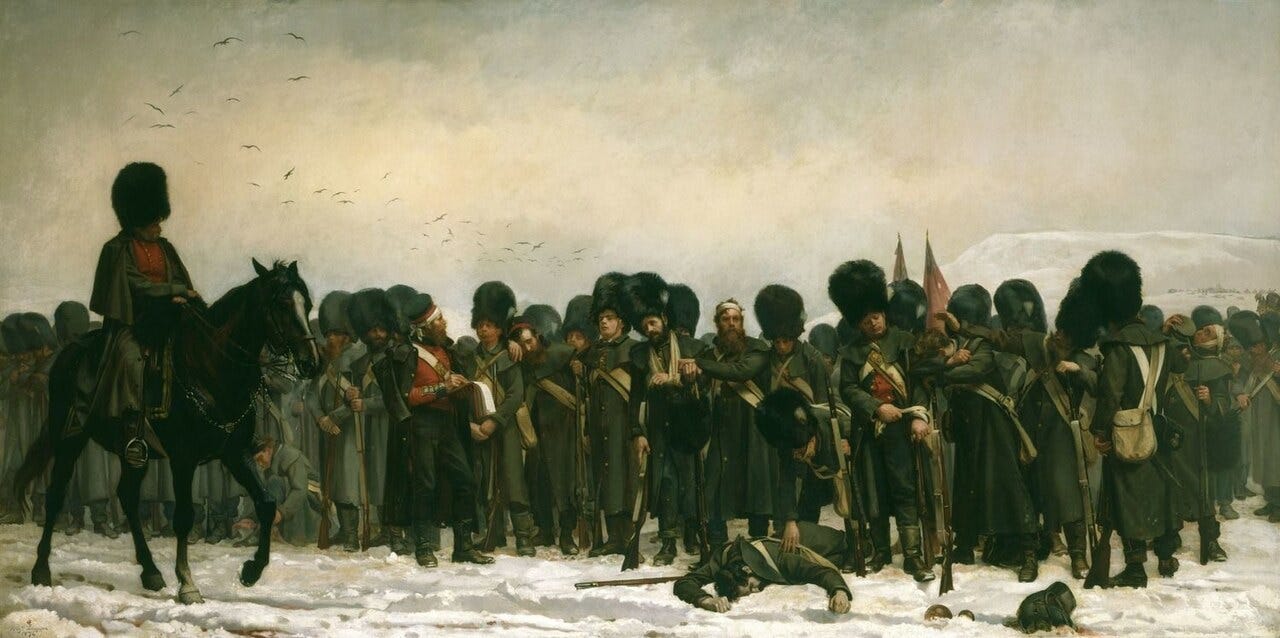
Thompson was the most celebrated battle painter in Britain, a rare thing for a woman shut out of the art schools. Her earlier scene of exhausted Crimean soldiers had been mobbed at the Royal Academy and bought by Queen Victoria herself.
Scotland Forever now hangs in the Leeds Art Gallery, and its charging horses were later borrowed by wartime propaganda posters.
11. Jan Matejko, The Battle of Grunwald (1878)
A vast wall of clashing knights, banners and rearing horses fills a canvas nearly thirty feet wide, chaos frozen at its peak. It shows Poland's crushing victory over the Teutonic Knights in the year 1410, a national dream of a proud past.
Almost every major figure is a real historical person, worked up from research.
For Poles living under foreign rule, the picture was a rallying cry, so much so that the Nazis put a bounty on it and hunted for it during the war. Museum staff hid it in the countryside, and it barely survived.
It now hangs in the National Museum in Warsaw, a whole nation's pride in one enormous frame.
12. Theodore Gericault, The Wounded Cuirassier (1814)
A single armored soldier struggles down a slope leading his frightened horse, wounded, retreating and utterly alone. Gericault painted no glory here, just the exhaustion of defeat, at the very moment Napoleon's empire was collapsing.
It is a war picture with no battle in it.
Shown beside heroic images of triumph, this lone beaten soldier baffled the critics of the day. Gericault was only twenty three and already painting the truth others avoided, the cost of war rather than the cause.
Gericault showed it at the Paris Salon of 1814 to open bafflement, and it hangs in the Louvre today.
Where these pictures hang now
Diego Velazquez, The Surrender of Breda, and Goya's war prints: the Prado, Madrid.
Paolo Uccello, The Battle of San Romano: split between the National Gallery in London, the Louvre and the Uffizi.
Benjamin West, The Death of General Wolfe: the National Gallery of Canada, Ottawa.
John Singleton Copley, The Death of Major Peirson: Tate Britain, and Theodore Gericault and Henri Rousseau: the Louvre and the Orsay, Paris.
Emanuel Leutze, Washington Crossing the Delaware: the Metropolitan Museum, New York.
Vasily Vereshchagin: the Tretyakov Gallery, Moscow, and Jan Matejko: the National Museum, Warsaw.
If these battles pulled you in, keep going:
Ten women artists you need to know, the names the textbooks skipped
Was Monet really the first Impressionist, the painting that may have got there first
The secret behind Monet Magpie, one bird in the snow, and why it matters
War paintings, a few quick questions
What is the most famous war painting? Picasso's Guernica is the most famous of all, though it is still under copyright, so here we show the great war pictures that are free to see.
Are war paintings pro war or anti war? Both. Some, like Leutze's Washington, glorify the cause, while others, like Goya's Disasters and Vereshchagin's skulls, are among the sharpest protests ever made.
What was the first great battle painting? Paolo Uccello's Battle of San Romano, from around 1440, which used war as an excuse to show off the new science of perspective.
Why did artists stop glorifying war? After Goya, and especially after the two World Wars, more and more painters showed war as horror rather than glory, a shift that still shapes how we picture it.
Where can I see famous war paintings? The Prado, the Louvre, Tate Britain, the Metropolitan Museum and the Tretyakov in Moscow all hold major war pictures.
The oldest subject in art
You can watch a whole change of heart across these twelve, from Uccello's glittering pageant to Goya's ditches full of bodies and Vereshchagin's silent pyramid of skulls.
The heroes get smaller and the cost gets larger with every century. By the twentieth century the battle itself has almost vanished from the picture, leaving only the wreckage.
The last picture on this list has no battle in it at all, only a single beaten soldier leading his horse downhill.