Famous Watercolor Paintings: 12 That Prove It Is Serious Art

The most famous watercolor paintings shake off the idea that watercolor is only for beginners. From Durer's patch of weeds to Turner's glowing mountains and Kandinsky's first pure abstraction, these twelve prove the humblest paint can carry the biggest ideas.

Durer Great Piece of Turf grass
Albrecht Durer, The Great Piece of Turf, 1503, Albertina, Vienna

Watercolor gives you no second chances: the paper shows through, the water dries fast, and a wrong stroke cannot be hidden. That difficulty is exactly why the masters loved it, and you can read how it works in what watercolor is.

Why watercolor is so hard, and so loved:

  • No going back. The paper shows through, so a wrong stroke cannot be painted over the way oil can.

  • The light. White paper left bare becomes the brightest light in the whole picture.

  • The speed. Water dries fast, so a painter must be quick, sure and a little brave.

  • The glow. Thin, clear washes let light bounce off the paper, a freshness oil rarely matches.


Learn art the fun way. Free stories every week, no boring lectures.


For readers who want the whole picture

Three that take a single painting apart, properly:


1. Albrecht Durer, The Great Piece of Turf (1503)

Most painters would never waste a sheet on a clump of weeds. Albrecht Durer did exactly that in 1503, kneeling at the edge of a meadow to record dandelions and grasses, every blade and root, with the care others saved for a saint.

Nobody had taken a scrap of turf so seriously. By studying nature this closely in watercolor, Durer treated the medium as real research rather than a quick sketch, three centuries before it was widely respected.

2. Thomas Girtin, The White House at Chelsea (1800)

Girtin White House Thames dusk
Thomas Girtin, The White House at Chelsea, 1800, Tate, London

Turner himself said that if Girtin had lived, he would have starved. Thomas Girtin painted The White House at Chelsea in 1800, a calm stretch of the Thames at dusk with one bright house glowing at its heart.

Girtin died at just twenty seven, yet in a few short years he helped lift English watercolor from tinted drawing to serious art. That single spot of pure white paper, left bare for the house, shows the trick that made watercolor sing.

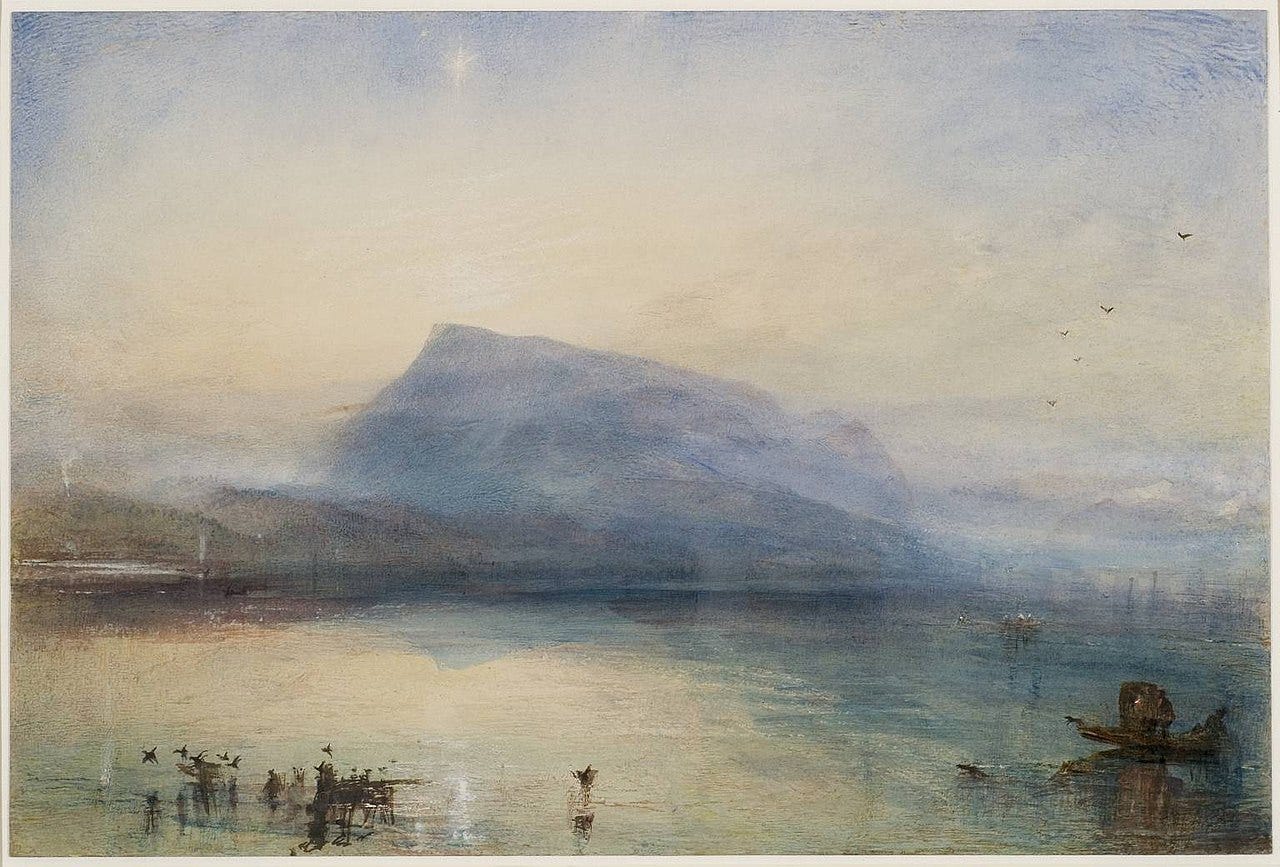
3. J M W Turner, The Blue Rigi (1842)

Turner Blue Rigi mountain dawn
J M W Turner, The Blue Rigi, 1842, Tate, London

A Swiss mountain floats in cool blue haze as first light touches the lake and a deer drinks at the shore. This is The Blue Rigi, one of Turner's supreme watercolors, made in 1842 at the height of his powers with nothing but washes of color.

In 2007 the Tate acquired it for nearly five million pounds after a public appeal to keep it in Britain, proof that a sheet of watercolor can be treasured like any great oil.

Turner built the glow from thin washes and tiny scratches that let the white paper shine through.

4. William Blake, The Ancient of Days (1794)

Blake Ancient of Days compass
William Blake, The Ancient of Days, 1794

A bearded god crouches inside a blazing sun, reaching down with a golden compass to measure the dark below. This is William Blake's The Ancient of Days from 1794, a hand colored print that he finished with washes of watercolor and ink.

It shows Blake's own private god, a figure he called Urizen, forcing cold order onto the world. He loved the image so much that he was still coloring a fresh copy of it just days before he died.

5. John James Audubon, Wild Turkey (1825)

Audubon Wild Turkey plate
John James Audubon, Wild Turkey, about 1825, New York Historical Society

A wild turkey strides across the sheet at full life size, so large it barely fits the page. John James Audubon drew it around 1825, and it became the very first plate of his enormous Birds of America.

He built the bird from watercolor, pastel and ink, layering the feathers until it seemed to breathe. Audubon insisted every bird be shown life size and alive, which is why his sheets still feel more real than any stuffed specimen in a case.

6. Thomas Moran, Yellowstone Watercolors (1871)

Moran Yellowstone hot springs watercolor
Thomas Moran, Hot Springs of Gardiner's River, Yellowstone, 1873, National Gallery of Art

These bright field sketches helped create the first national park on earth. In 1871 Thomas Moran travelled into the Yellowstone wilderness and painted its canyons and hot springs in glowing watercolor, colors so strange that people back east doubted them.

Shown to Congress alongside survey photographs, Moran's watercolors helped convince lawmakers that the place was real and worth saving.

Yellowstone became a protected park in 1872, and Moran signed himself T Y M, for Thomas Yellowstone Moran, ever after.

7. Winslow Homer, Sloop, Nassau (1899)

Homer Sloop Nassau watercolor
Winslow Homer, Sloop, Nassau, 1899, Metropolitan Museum

Winslow Homer put down his oils for months at a time just to chase Caribbean light in watercolor. Around 1899 he painted Sloop, Nassau, a small boat on water so clear the paper itself becomes the glare of the sun.

He worked fast and left the white sheet bare wherever the light was brightest, a risky gamble that pays off in freshness. Homer once said he expected to be remembered for his watercolors above all, and time has proved him right.


No lectures, no jargon. Just the stories, free every week.


8. John Singer Sargent, Venetian Watercolors (about 1908)

Sargent Venice boats watercolor
John Singer Sargent, Boats, Venice, about 1908

Late in life, the great portrait painter John Singer Sargent escaped his rich sitters by painting watercolors for pure pleasure. Around 1908 he made pictures like his boats at Venice, rigging and hulls dissolving into bright reflected light on the water.

He worked wet and fast, catching sun and shade in a few swift strokes, and once described the whole practice as making the best of an emergency. He left roughly two thousand watercolors, some of the freest and happiest work of his career.

9. Paul Cezanne, Mont Sainte Victoire in Watercolor (about 1900)

Cezanne Sainte Victoire watercolor
Paul Cezanne, Mont Sainte Victoire seen from Les Lauves, about 1902

Cezanne's late watercolors of his favorite mountain are mostly bare paper. Around 1900 he laid down only a few floating patches of blue, green and ochre, letting the white sheet do most of the work, and somehow the mountain still rises.

By leaving so much unsaid, he pushed toward the pure structure that would feed Cubism and modern art, and I make the fuller case for him in is Cezanne the greatest painter.

10. Anders Zorn, Sommarnoje (1886)

Zorn Sommarnoje water scene
Anders Zorn, Sommarnoje, watercolor, 1886

Before he became Sweden's most famous oil painter, Anders Zorn was a watercolor prodigy. Through the 1880s he built an international name entirely in watercolor, painting water, skin and light with a control few of his rivals could match.

He loved painting ripples and reflections, and his watercolor scenes of people at the water's edge made him rich enough to switch to oils. Those early sheets remain some of the most admired watercolors of the century.

11. Paul Signac, La Rochelle (about 1920)

Signac La Rochelle harbor
Paul Signac, La Rochelle, about 1920, watercolor

Paul Signac spent his life sailing from port to port, and at each harbor he unpacked a watercolor kit. Around 1920 he painted views like La Rochelle, its towers and boats set down in quick, luminous washes of clear color.

For Signac the watercolors were both studies and joys in themselves, faster and freer than his careful dotted oils. They caught the exact light of a morning harbor in a way that hours of studio work never could.

12. Wassily Kandinsky, First Abstract Watercolour (1910)

Kandinsky first abstract watercolour
Wassily Kandinsky, First Abstract Watercolour, about 1910, Pompidou, Paris

The picture often called the first purely abstract work in Western art is, of all things, a watercolor. Wassily Kandinsky signed it 1910, though many scholars now think he made it a few years later, and on it he floated marks and washes of color that stand for nothing at all, no landscape and no figure, only feeling.

He wanted color and line to work like music, moving a viewer with no subject to lean on. It says a great deal that art took its first step into pure abstraction in a light, quick medium many still dismiss as a hobby, a leap you can follow in what abstract art is.


Join 130,000 readers who get the secrets behind the paintings. Free.


Where these sheets are kept

  • Durer, The Great Piece of Turf: the Albertina, Vienna.

  • Girtin, The White House at Chelsea, and Turner, The Blue Rigi: the Tate, London.

  • Audubon, Wild Turkey: the New York Historical Society and major libraries.

  • Homer and Sargent watercolors: the Metropolitan Museum and Boston, among others.

  • Kandinsky, First Abstract Watercolour: the Pompidou, Paris.


If light and water pulled you in, keep going:


Two new stories a week, 130+ secrets unlocked. Start free.


Watercolor, a few quick questions

  • What is the most famous watercolor painting? Durer's nature studies, Turner's Blue Rigi, and Kandinsky's first abstract watercolor are among the most famous of all.

  • Why is watercolor considered hard? You cannot paint over a mistake the way you can in oil, and the paper shows through every stroke, so there is little room for error.

  • Was the first abstract painting a watercolor? Often, yes. Kandinsky's abstract watercolor of around 1910 is frequently named the first purely abstract work in Western art.

  • Who is the greatest watercolor painter? Turner and Winslow Homer are the usual answers, with Durer as the great early pioneer.

  • Why is white paper important in watercolor? Because watercolor has no true white paint, the brightest light in the picture is the bare paper left untouched.

The light left in the paper

Line them up and one thing runs through all of them: the white of the paper, glowing untouched where the light is brightest. Oil painters add white, while watercolor painters must save it, planning every highlight before they even begin.

That single discipline turned a supposed hobby into the medium of Durer's weeds, Turner's mountains and the first abstract picture ever made.

The next time someone calls watercolor a beginner's paint, point them to a small blue Swiss mountain that Britain paid nearly five million pounds to keep.