Waterfall Paintings: 12 Famous Works to Know
The most famous waterfall paintings turn falling water into pure spectacle. Church made Niagara roar without a single foreground rock to hide behind, Turner chased the Rhine into spray, Hokusai stylised a cascade into a ribbon, and the Hudson River School treated a mountain falls like a shrine. Here are twelve to know, and where to see them.
A waterfall is one of the hardest things to paint. It never holds still, it is half air, and it can tip into kitsch in a second. The painters below each solved it differently, from thunderous American panoramas to a Japanese print that reduces the whole thing to line.
Use this as a quick tour:
The showstoppers: Church and Bierstadt, who painted waterfalls as national wonders.
The Europeans: Ruisdael, Turner and Courbet, from calm to violent.
The stylist: Hokusai, who turned a cascade into a pattern.
Where to see them: a museum list at the end, grouped by city.
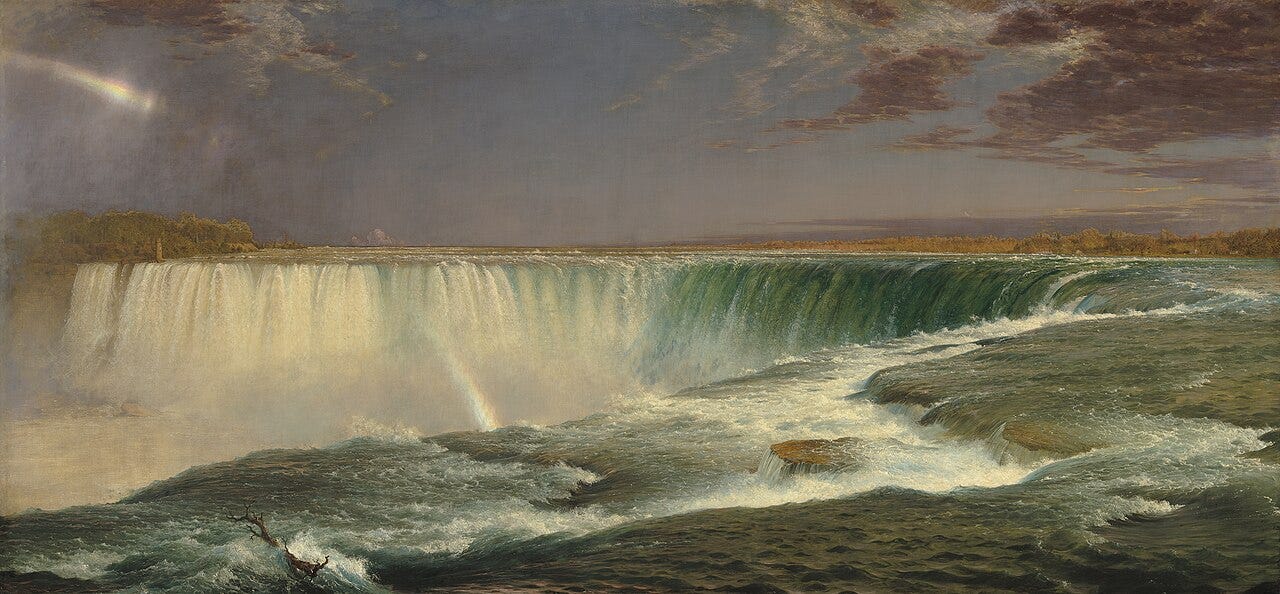
Frederic Edwin Church, Niagara
Frederic Church unveiled Niagara in 1857, and it made him the most famous painter in America overnight. He placed the viewer right on the brink, with no shoreline to stand on, so the green water seems to pour out of the bottom of the frame.
Church studied the falls for months and painted them on a very wide canvas to match the panorama. People paid to see it as a single attraction, filing past it like a natural wonder.
It hangs at the National Gallery of Art in Washington. More than a landscape, it was read at the time as an image of American power and destiny, water as the voice of a young nation.
Albert Bierstadt, Bridalveil Fall, Yosemite
Albert Bierstadt painted the waterfalls of Yosemite after travelling west in the 1860s. A slender fall spills down a vast granite wall while light floods the valley below.
Bierstadt turned the American West into theatre, with glowing skies and enormous scale. His huge canvases helped convince the public and Congress that places like Yosemite were worth protecting.
His Yosemite paintings are spread across major American museums, including the Metropolitan Museum. The scenery looks almost too grand to be real, which was exactly the effect he wanted.
Thomas Cole, Kaaterskill Falls
Thomas Cole, the founder of the Hudson River School, painted Kaaterskill Falls in 1826, a famous two tier cascade in the Catskill Mountains of New York. A tiny figure stands on the ledge behind the water.
Cole deliberately left out the tourist stairs and viewing platforms that already crowded the real site. He wanted a wild, untouched America, so he painted the falls as if no visitor had ever reached them.
The painting helped launch American landscape as a serious subject. Cole treated the wilderness as sacred, a theme his student Frederic Church would carry to Niagara twenty years later.
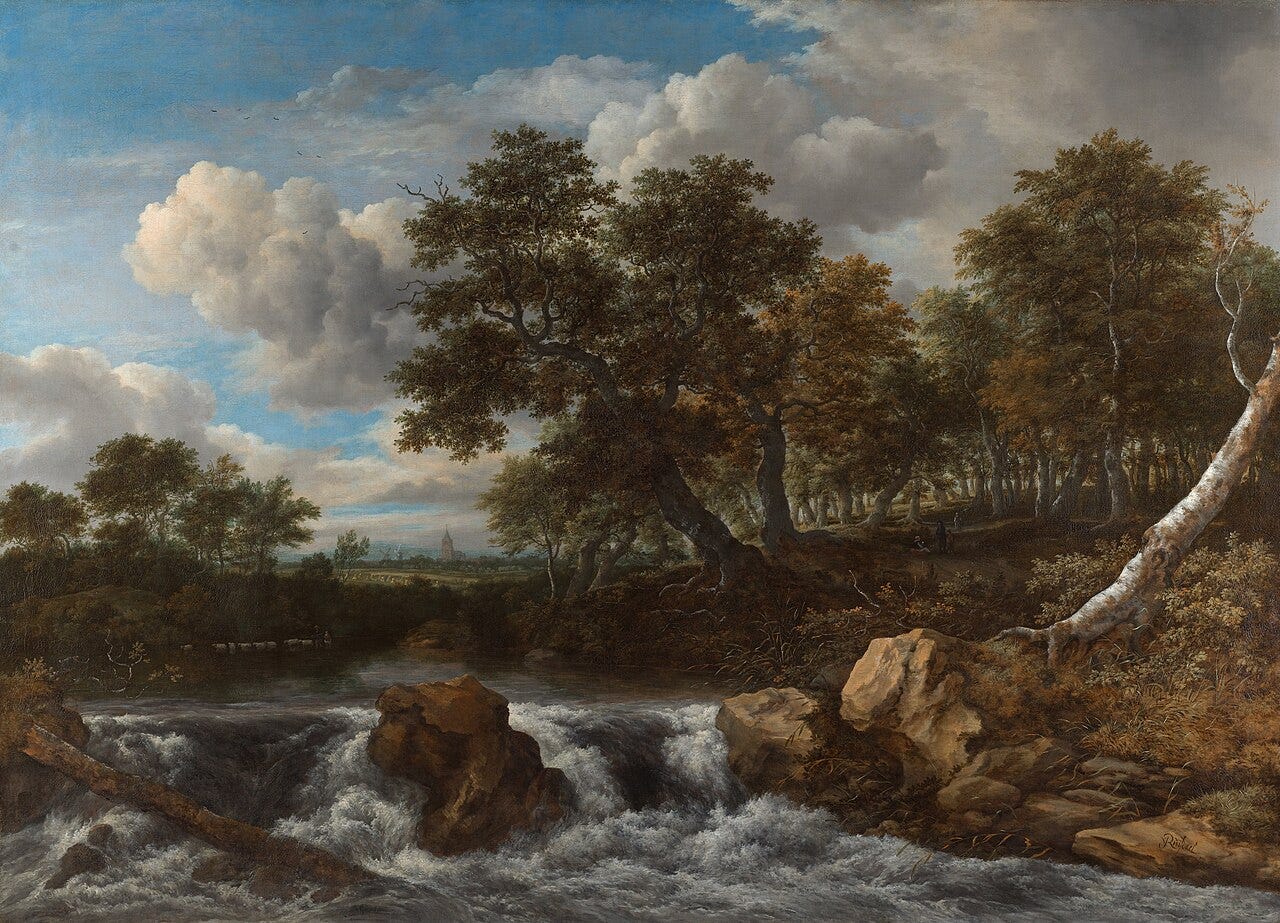
Jacob van Ruisdael, A Waterfall in a Rocky Landscape
Jacob van Ruisdael painted dozens of rushing waterfalls in the 1600s, water tumbling over dark rocks past a ruin, under a heavy Dutch sky. He had never seen the Scandinavian scenery he imagined.
Ruisdael learned the motif from a fellow painter who had travelled to Norway, then made it his own in oil. The falling water became a symbol of time and change, everything in flux.
His waterfalls hang in the National Gallery in London and across Europe. They set the template for the wild, moody cascade that the Romantics would seize on a century later.
Katsushika Hokusai, Amida Falls
The circular basin was said to resemble the head of the Buddha Amida, which gave the falls their name. Hokusai reduced the whole cascade to flat pattern and line, a woodblock print rather than a study from nature.
Tiny travellers rest at the base, dwarfed by the design. Hokusai cared less about how the water really looked than about turning it into an unforgettable shape.
Katsushika Hokusai, Kirifuri Waterfall
Hokusai treats the water almost like hair or veins, branching lines against solid colour. It is nature seen as decoration, which is what made these prints so shocking and fresh in the West.
When prints like this reached Europe, they helped spark Japonisme, changing how painters from Monet to Van Gogh saw pattern, flatness and design.
J.M.W. Turner, The Falls of the Rhine at Schaffhausen
J.M.W. Turner painted the great Rhine falls at Schaffhausen around 1806, a wall of foam throwing spray into the air. Small figures and animals cluster at the edge, almost lost in the mist.
Turner was after force, not detail. He blurred the water into light and vapour, more interested in the roar and danger than in any single rock, decades ahead of his time.
The painting is at the Museum of Fine Arts in Boston. It points straight toward the way Turner would eventually dissolve whole scenes into pure atmosphere.
Frederic Edwin Church, The Falls of Tequendama
Frederic Church painted the Tequendama Falls near Bogota in Colombia in 1854, after travelling through South America in the footsteps of the explorer Alexander von Humboldt. The water drops into a deep tropical gorge.
Church went south to paint the whole living world, from volcanoes to jungle to falling water. He filled his canvases with accurate plants and light, science and spectacle at once.
Works from this journey are held in American museums including the Cincinnati Art Museum. The waterfall here is not a national monument but a window onto an entire exotic continent.
Gustave Courbet, The Source of the Loue
Gustave Courbet painted the source of the river Loue near his hometown in eastern France several times in the 1860s. Water bursts from a black cave mouth in a limestone cliff.
Courbet the realist was not chasing the sublime. He built the rock and water with a palette knife, thick and physical, so you feel the cold weight of the stone and the flow.
Versions hang in the National Gallery of Art in Washington and elsewhere. This is a waterfall painted as fact, close up and unsentimental, the opposite of Church roaring Niagara.
Sanford Robinson Gifford, Kauterskill Falls
Sanford Gifford painted Kauterskill Falls in 1862, the same Catskill site Cole had made famous, but bathed in warm, hazy light. The falls sit far off, small in a glowing valley.
Gifford belonged to a group nicknamed the Luminists, obsessed with air and light. Here the subject is really the golden haze itself, with the waterfall as a distant accent.
It hangs at the Metropolitan Museum. Where Cole painted the falls up close and wild, Gifford dissolved them into pure atmosphere and calm.
Asher Brown Durand, Kindred Spirits
Asher Durand painted Kindred Spirits in 1849 as a tribute to Thomas Cole, who had just died. Two men, the painter Cole and the poet William Cullen Bryant, stand on a ledge above a Catskill gorge and its waterfall.
The cascade and cliffs are stitched together from several real Catskill sites into one ideal wilderness. It is a memorial disguised as a landscape, art and nature honouring a lost friend.
The painting sold in 2005 for a record sum and now hangs at Crystal Bridges Museum in Arkansas. It has become the emblem of the whole Hudson River School.
Albert Bierstadt, Valley of the Yosemite
Bierstadt returns with a wider Yosemite view, the valley glowing at sunset, cliffs and distant falls reflected in still water. It is the American West as paradise.
Bierstadt sold canvases like this for record prices to buyers who would never make the journey. He was selling a dream of the frontier as much as a real place.
His Yosemite scenes are held across American collections. Look past the golden haze and you can see why these paintings helped turn wild valleys into protected national parks.
Questions people ask about waterfall paintings
What is the most famous waterfall painting? Frederic Church Niagara of 1857 is probably the most famous in Western art, and Hokusai Amida Falls is the best known in Japanese printmaking.
Why did Church paint Niagara without a foreground? He put the viewer right on the brink, with no safe shoreline, so the water seems to pour out of the painting and overwhelm you.
Who painted waterfalls as Japanese prints? Katsushika Hokusai, in his series A Tour of the Waterfalls of the Provinces, made around 1833.
Where is Kindred Spirits? It hangs at Crystal Bridges Museum of American Art in Bentonville, Arkansas, after a record sale in 2005.
Did Ruisdael see the waterfalls he painted? No. He learned the motif from a colleague who had travelled to Scandinavia, then invented his own rushing cascades.
Where to see them
National Gallery of Art, Washington: Church Niagara and Courbet The Source of the Loue.
Metropolitan Museum, New York: Bierstadt, Gifford Kauterskill Falls and Hokusai prints.
Museum of Fine Arts, Boston: Turner The Falls of the Rhine at Schaffhausen.
Crystal Bridges Museum, Arkansas: Durand Kindred Spirits.
Keep exploring
If the falling water pulled you in, three more paths from here. Dive into the print that changed the world in the true story behind Hokusai and the Great Wave, learn to read the hidden clues in famous canvases in seven secrets hidden in famous paintings, or start with the basics of landscape painting.
One last thing. A waterfall never stops moving, which is why painting one is a kind of dare. Church made it roar, Turner made it vanish into mist, Hokusai froze it into a shape. Twelve painters, twelve ways to hold water still.