Wedding Paintings: 12 Famous Marriages in Art History

The most famous wedding paintings are full of hidden clues. Van Eyck signed a mirror like a witness. Bruegel left out the groom. Hogarth turned a marriage into a slow disaster. Each canvas below tells you more about love and money than any vow.

A wedding is a public promise, and painters have always known it makes a rich scene. There is spectacle, family, money, faith, and often a catch hidden in plain sight. They range from a Flemish room in 1434 to a Russian bride marrying against her will.

  • The signed one: Van Eyck wrote his name on the wall like a legal witness to the couple.

  • The missing groom: Bruegel Peasant Wedding hides its bridegroom, and viewers still argue over which figure he is.

  • The trap: Hogarth painted an arranged marriage doomed from the first handshake.

  • The forced one: Pukirev showed a young bride marrying a rich old man, and painted his own heartbreak into it.

If these draw you in, you will also love the secret detail in the Arnolfini Portrait, 7 secrets hidden in famous paintings, and 12 famous portraits and the real people behind them.


Learn art the fun way. Free stories every week, no boring lectures.


1. Jan van Eyck, The Arnolfini Portrait

A couple hand in hand in a Flemish bedroom with a round mirror
Jan van Eyck, The Arnolfini Portrait, 1434. National Gallery, London.

A merchant and a woman in a green gown stand hand in hand in a Flemish bedroom. A little dog sits at their feet. A round mirror on the back wall reflects the whole room. Van Eyck painted it in Bruges in 1434.

Above the mirror he wrote, in careful Latin, Jan van Eyck was here. It reads like a witness signing a marriage record. Scholars still argue whether the scene shows a wedding, a betrothal, or a memorial, since the single lit candle may mark a death.

The woman is not pregnant, despite the myth. She simply gathers the heavy folds of a fashionable dress. The panel is one of the most studied works in the National Gallery.

2. Pieter Bruegel the Elder, The Peasant Wedding

A village wedding feast crowded into a barn
Pieter Bruegel the Elder, The Peasant Wedding, about 1567. Kunsthistorisches Museum, Vienna.

Guests crowd a barn for a village feast. Two men carry bowls of porridge on a door lifted off its hinges. The bride sits under a paper crown against a green cloth. Bruegel packed the room with hungry faces.

Where is the groom? Nobody agrees. Custom said he served his own guests, so some point to the man pouring drinks, others say he is simply absent by tradition. The bagpiper stares longingly at the passing food.

Bruegel used the feast to study ordinary people with real care, not mockery. The panel is one of the great treasures of the Vienna collection.

3. Paolo Veronese, The Wedding Feast at Cana

More than a hundred guests at a grand wedding banquet
Paolo Veronese, The Wedding Feast at Cana, 1563. Louvre, Paris.

More than a hundred guests fill a grand balcony for a wedding banquet. At the center sits Christ, calm in the noise, at the moment he turns water into wine. Veronese painted the huge canvas for a monastery refectory in Venice.

It is the largest painting in the Louvre, nearly ten meters wide. Veronese slipped musicians into the foreground and, by tradition, painted himself among them in white. He dressed a Bible scene as a lavish Venetian party.

Napoleon troops seized it in 1797 and cut it from the wall to ship to Paris. It never went back to Venice, which now displays a full sized copy in its place.

4. William Hogarth, Marriage A la Mode: The Marriage Settlement

A merchant and a nobleman signing a marriage contract
William Hogarth, Marriage A la Mode: The Marriage Settlement, 1743. National Gallery, London.

A rich merchant and a broke nobleman sign a contract to marry off their children. The young couple sit apart, bored and turned away from each other. Two chained dogs in the corner say it all. Hogarth painted the first scene of a six part story.

This is money buying a title. The earl points to his family tree, the merchant counts the dowry, and the bride and groom already ignore one another. Hogarth read arranged marriage as a business deal that ends in ruin.

The series runs to murder and death across five more canvases. All six hang together at the National Gallery, an early comic strip about a wedding gone wrong.

5. Jean Baptiste Greuze, The Village Betrothal

A father handing over a dowry to his daughter future husband
Jean Baptiste Greuze, The Village Betrothal, 1761. Louvre, Paris.

A father hands over a dowry to his daughter future husband while the family looks on. A notary sits ready with the contract. A hen and her chicks peck on the floor. Greuze painted honest country virtue in 1761.

The hen with her brood is the clue, a quiet symbol of the daughter leaving the nest to start her own. The writer Diderot praised the scene for its plain feeling at a time when French art favored courtly games.

The painting was a hit at the Paris Salon and made Greuze famous for moral storytelling. It entered the royal collection and now hangs in the Louvre.

6. Vasily Pukirev, The Unequal Marriage

A young bride at the altar beside a wrinkled old groom
Vasily Pukirev, The Unequal Marriage, 1862. Tretyakov Gallery, Moscow.

A young bride stands at the altar beside a wrinkled old groom, her eyes lowered, a candle drooping in her hand. A priest raises the ring. Pukirev painted the moment a girl is married off against her will.

The story is that it is personal. Many believe Pukirev painted his own lost love wedding a richer man, and put his own face into the grim young witness on the right. A pale figure behind the bride reads as a ghost of her fate.

The picture struck a nerve across Russia and helped fuel debate about forced marriage. It hangs today in the Tretyakov Gallery in Moscow.

7. Konstantin Makovsky, A Boyar Wedding Feast

A glowing hall toasting a young couple with a roast swan
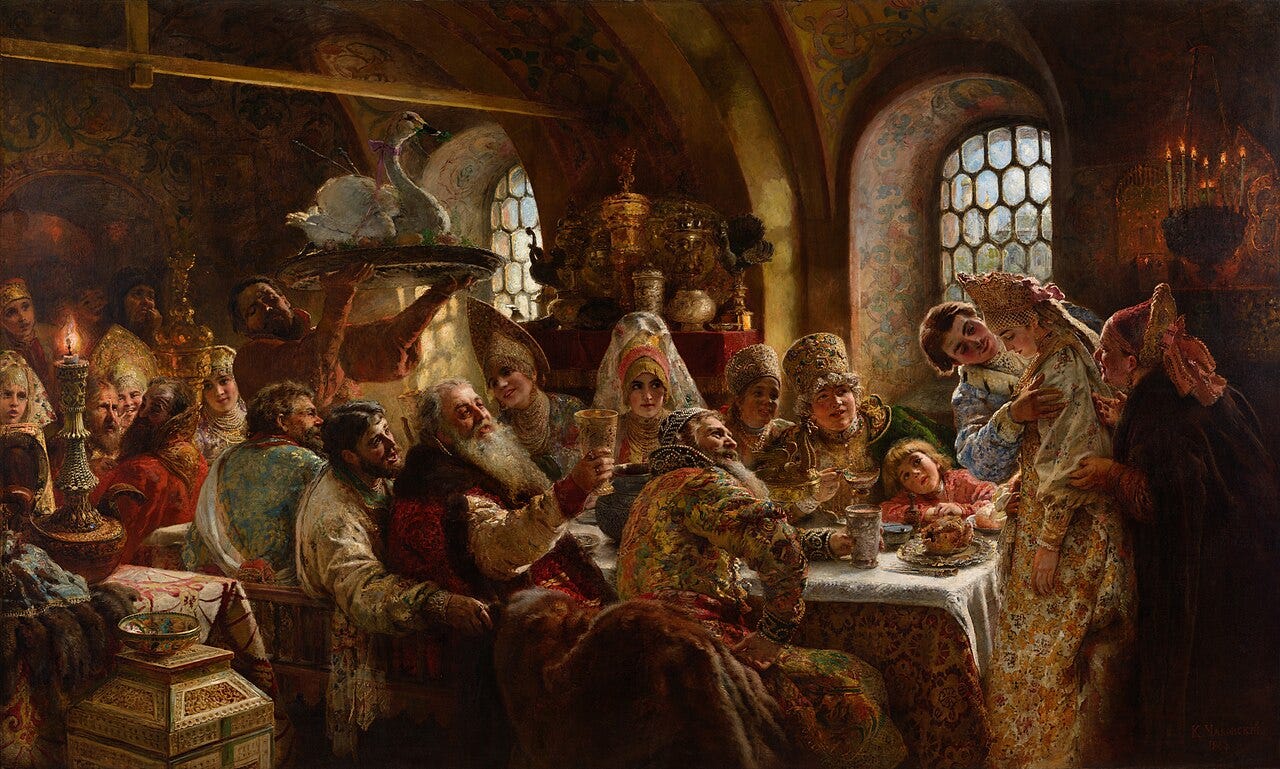
Konstantin Makovsky, A Boyar Wedding Feast, 1883. Hillwood Estate, Museum and Gardens, Washington.

A great hall glows with silk and gold as guests toast a young couple. A servant carries in a roast swan. Makovsky recreated a wedding among Russia old noble class, the boyars, of the seventeenth century.

The guests are chanting gorko, meaning bitter. By custom the wine is called bitter until the newlyweds kiss to sweeten it, so the whole room waits for the couple to embrace. Every fur, cup and gown was studied from real antiques.

An American jeweler bought it in 1885, reportedly outbidding the Tsar of Russia himself. It later reached the Hillwood museum near Washington.

8. Sandro Botticelli, The Story of Nastagio degli Onesti

A wedding banquet under open arches
Sandro Botticelli, The Story of Nastagio degli Onesti, fourth episode, 1483. Museo del Prado, Madrid.

Guests sit at a long banquet table under open arches while servants bring food. This is the happy ending of a dark tale from Boccaccio, a wedding feast that finally unites two lovers. Botticelli painted a set of four panels for the wall of a Florentine home.

The panels were made to celebrate a real wedding. Lorenzo de Medici commissioned them for the marriage of a young couple from the Pucci and Bini families, and their coats of arms appear in the scene.

The set was split up over the centuries. Three panels are now in the Prado in Madrid, while the fourth wedding feast belongs to a private collection.


Join 130,000 readers who get the secrets behind the paintings. Free.


9. Peter Paul Rubens, The Wedding by Proxy of Marie de Medici

A royal wedding in a cathedral with a stand in for the king
Peter Paul Rubens, The Wedding by Proxy of Marie de Medici, 1622 to 1625. Louvre, Paris.

In a bright cathedral, Marie de Medici marries the king of France, though the king himself is not there. A stand in takes his place at the altar. Rubens painted the scene as part of a huge cycle glorifying the queen life.

Royal weddings were often done by proxy, with a substitute standing for the absent partner until the couple met in person. Rubens filled the sky with gods and angels to make a political match look like destiny.

The full cycle runs to twenty four giant canvases, all commissioned by Marie herself. They now fill a dedicated room in the Louvre.

10. Edmund Blair Leighton, Signing the Register

A bride signing the marriage register after the ceremony
Edmund Blair Leighton, Signing the Register, 1920. Bristol Museum and Art Gallery, Bristol.

A young bride bends to sign the marriage register just after the ceremony, her white gown spilling across the floor. The groom waits at her shoulder. Leighton painted the tender pause after the vows.

This is the legal heart of a wedding, the moment the marriage is written down and made real. Leighton was known for polished scenes of chivalry and romance, and he showed the private feeling behind the paperwork.

He exhibited it at the Royal Academy in 1920, near the end of his career. The painting now belongs to the Bristol Museum and Art Gallery.

11. Pieter Bruegel the Elder, The Wedding Dance

Dozens of peasants dancing in a field at a wedding
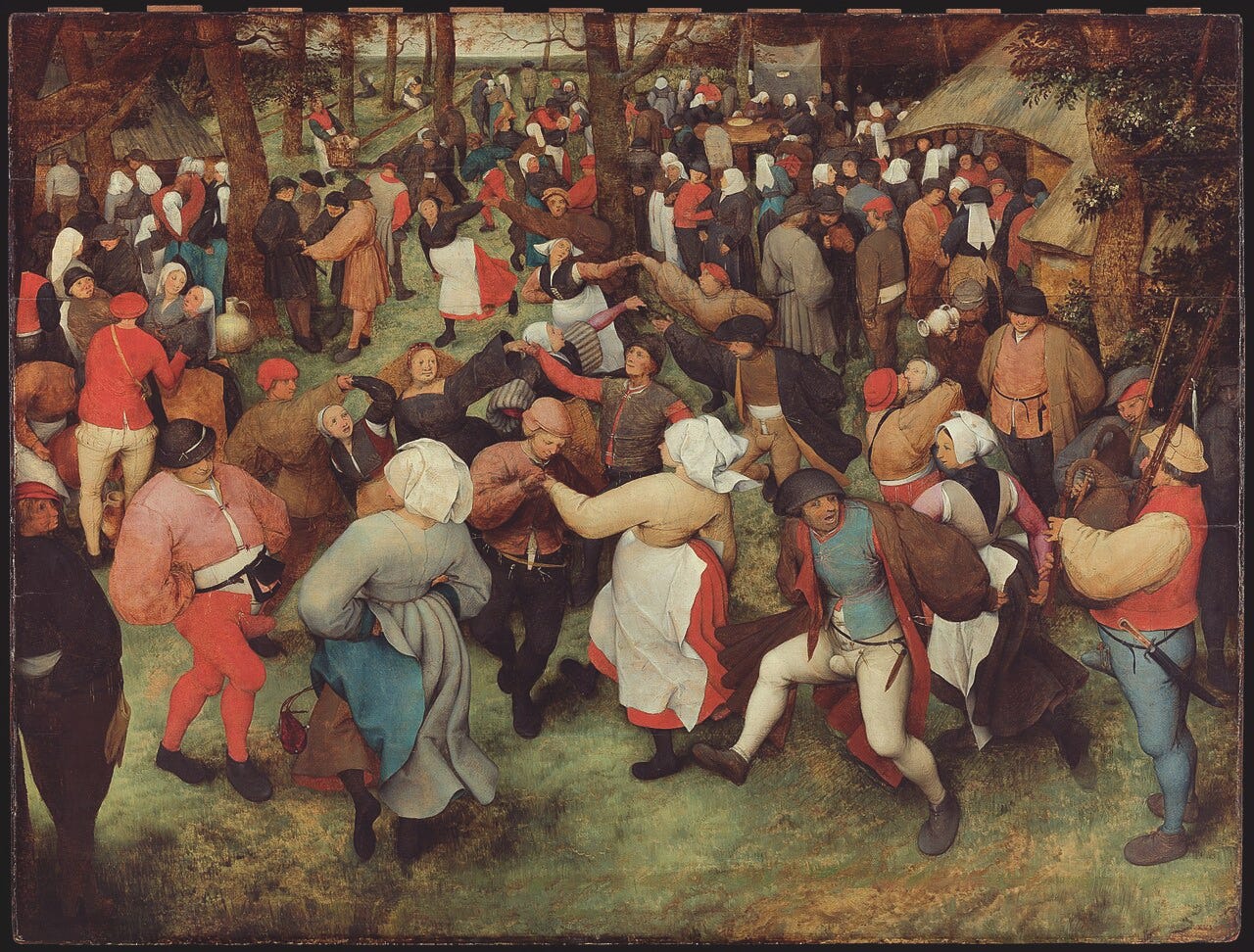
Pieter Bruegel the Elder, The Wedding Dance, about 1566. Detroit Institute of Arts.

Dozens of peasants dance in a field at a wedding, swinging their partners while others eat and drink. Bruegel filled the panel with heavy bodies in motion, red codpieces and swirling skirts.

The dance was not just fun to Bruegel eye. Preachers of the day warned that wedding revels led to drink and lust, and he laid on the earthy detail to let viewers judge for themselves.

The panel was lost to view for centuries and rediscovered in the 1930s. Detroit bought it, and it is now one of the museum most visited works.

12. Rembrandt, The Jewish Bride

A tender couple in gold and red, his hand on her chest
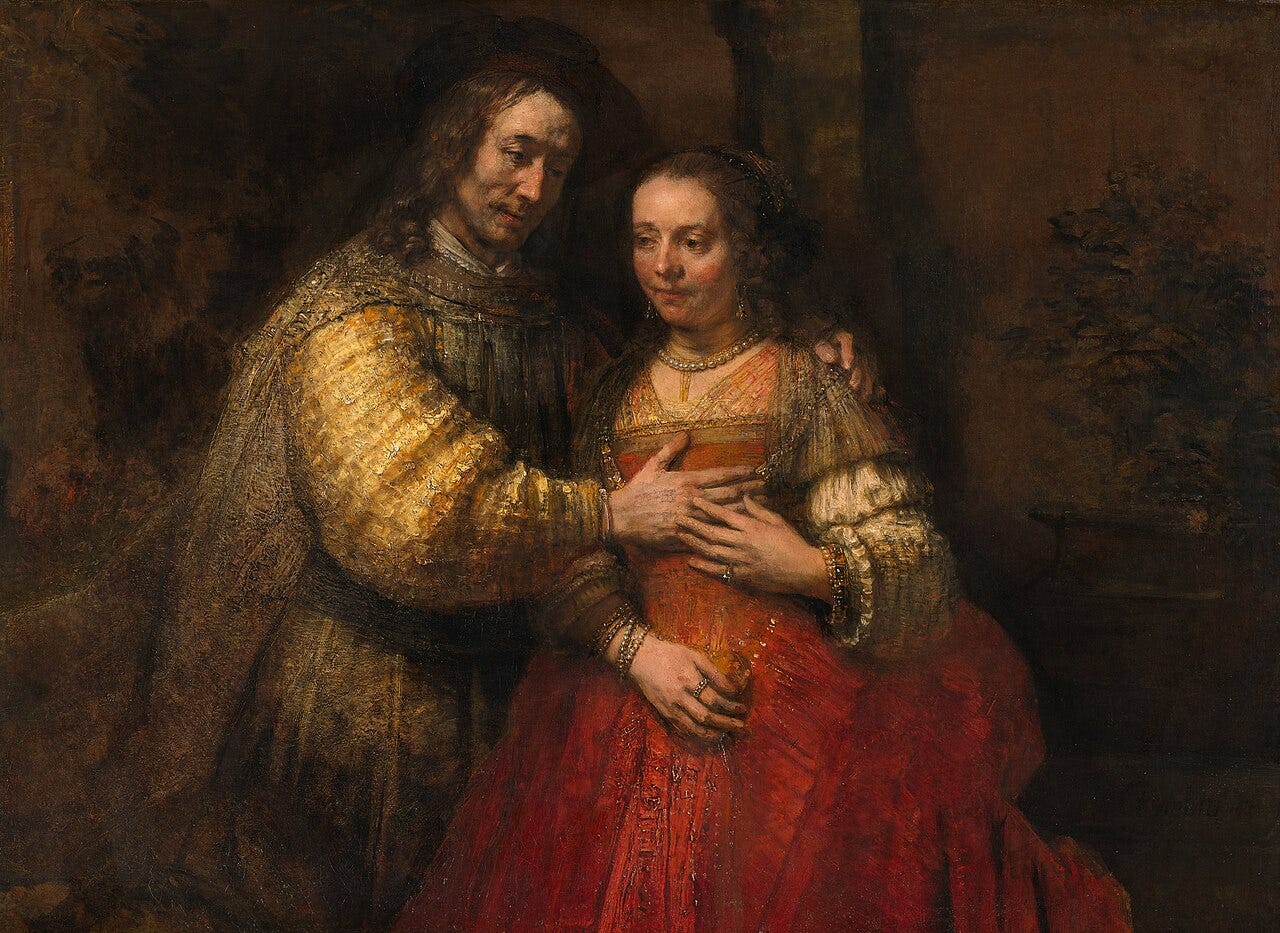
Rembrandt, The Jewish Bride, about 1665 to 1669. Rijksmuseum, Amsterdam.

A man rests his hand gently on a woman chest while she touches his fingers, both dressed in gold and red. Rembrandt painted this tender couple late in his life, laying the paint on thick with a knife.

Nobody knows who they are. The name The Jewish Bride was invented later, and the couple may be a real husband and wife posed as biblical lovers. The picture is about trust, not spectacle.

Van Gogh once said he would give ten years of his life to sit before this painting for a fortnight with only a crust of bread to eat. It hangs in the Rijksmuseum in Amsterdam.

Where to see them

  • National Gallery, London: Jan van Eyck The Arnolfini Portrait and William Hogarth Marriage A la Mode.

  • Kunsthistorisches Museum, Vienna: Pieter Bruegel the Elder The Peasant Wedding.

  • Louvre, Paris: Paolo Veronese The Wedding Feast at Cana, Greuze The Village Betrothal, and Rubens The Wedding by Proxy.

  • Museo del Prado, Madrid: Sandro Botticelli The Story of Nastagio degli Onesti.

  • Rijksmuseum, Amsterdam: Rembrandt The Jewish Bride.

What a wedding scene really shows

Many of these are genre paintings of real customs, from a dowry handed over to a village dance, painted with an eye for how people actually lived.

Others are portraits of real couples, or grand history paintings that dress a royal or biblical marriage as pure spectacle.

Wedding paintings, questions people ask

  • What is the most famous wedding painting? Jan van Eyck Arnolfini Portrait, from 1434, is the best known. It shows a couple in a Flemish room and hangs at the National Gallery in London.

  • Is the Arnolfini Portrait really a wedding? Scholars are not sure. It may show a wedding, a betrothal, or a memorial to a dead wife. The signature on the wall reads like a witness statement.

  • Why is the groom missing in Bruegel Peasant Wedding? By old custom the bridegroom served his own guests, so he may be one of the men pouring drinks, or simply absent by tradition. Viewers still debate it.

  • What does the toast in Makovsky Boyar Wedding Feast mean? The guests shout gorko, meaning bitter. The wine is called bitter until the newlyweds kiss to make it sweet again, so the room waits for their embrace.

  • Where can I see The Wedding Feast at Cana? At the Louvre in Paris. It is the largest painting in the museum. Napoleon army took it from Venice in 1797 and it never returned.

The wedding painting that outbid a Tsar

When Makovsky Boyar Wedding Feast went on the market in 1885, the buyer was not Russian royalty. An American jeweler named Charles Schumann paid a fortune and, by the account passed down, outbid Tsar Alexander III himself to take the painting to New York. A scene of old Russian nobility left Russia for good, and now hangs a short drive from the White House.


Two new stories a week, 130 secrets unlocked. Start free.