
James McNeill Whistler borrowed the titles of his paintings from music and insisted that a picture owed nobody a story. London went on finding stories in them anyway. A gallery hung one of his canvases under the name of a bestselling novel he said he had never read. A critic's insult over a later picture ended in a libel trial.
Cool Stories About Art is a newsletter to learn art the fun way.
Join 200,000+ readers and get:
10 new art stories / month
The entire archive of content (140+ articles)
Comment, ask questions, and chat with other readers
Titles From Music, Subjects From Life
Whistler was born in Lowell, Massachusetts, in 1834, trained as a painter in Paris and settled in London. There he became a central figure of the Aesthetic movement, whose motto was art for art's sake: a painting answered to the eye, not to a moral.
In 1878 he put the idea in one line: "As music is the poetry of sound, so is painting the poetry of sight." Critics who expected a story called his canvases unfinished, and he answered them in letters to the papers.
Yet behind his musical titles there was nearly always a real person or a real place: the woman he lived with, his mother, a patron who became his enemy, the Thames after dark.
12. Wapping (1860 to 1864)
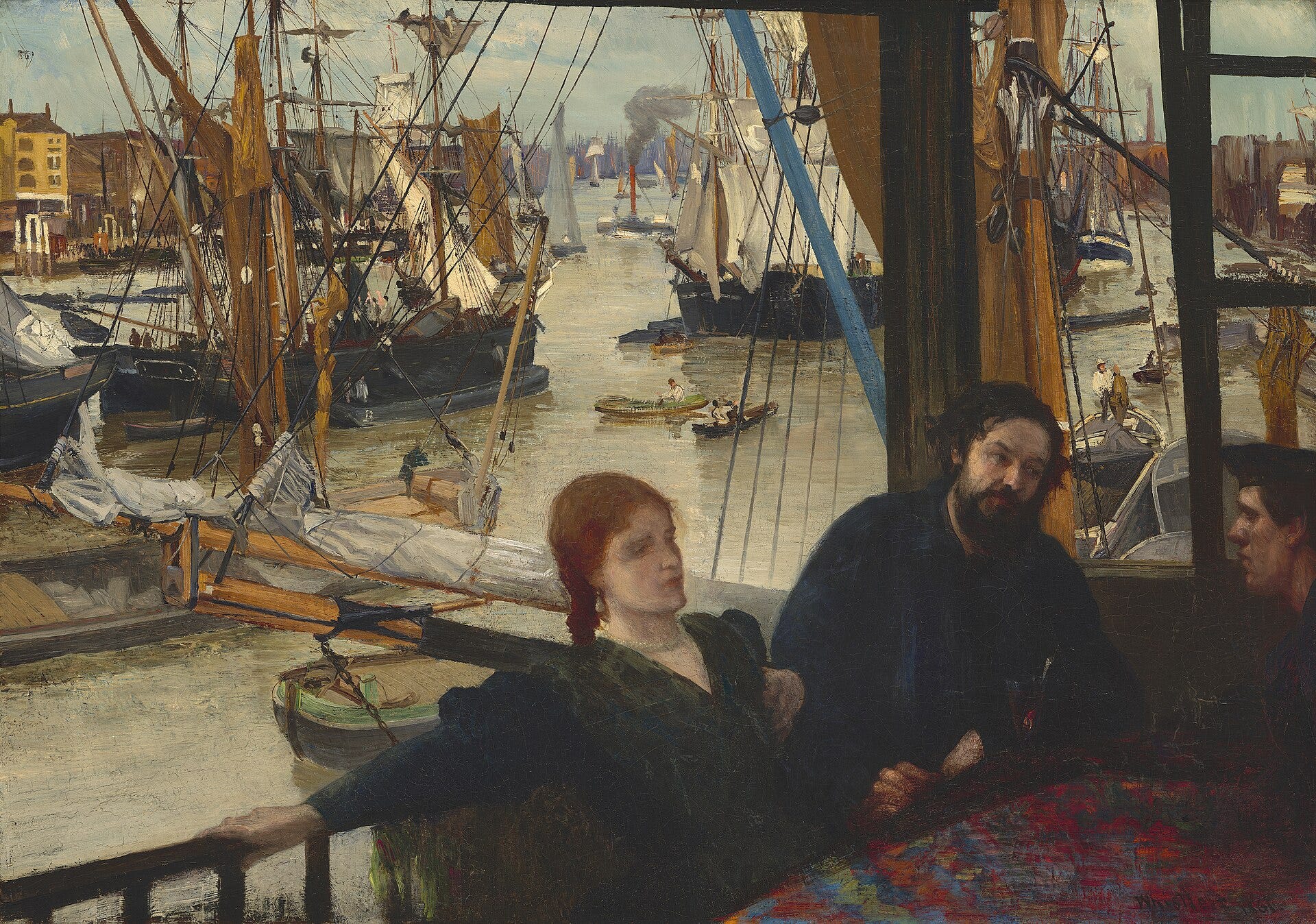
Three people share a table on a wooden balcony above the Thames. A young woman with red hair, in a dark gray dress, sits between a bearded man and a sailor in a cap. Behind them the river is so crowded with moored ships that their masts and rigging fill the sky.
Wapping takes its name from the district of docks across the river from that balcony. Whistler was etching that stretch of the Thames in the same months, and he told his friend the French painter Henri Fantin-Latour that the background was "like an etching" and extremely hard to paint.
He knew every one of the people at the table. The young woman was Joanna Hiffernan, known as Jo, his companion and his favorite model. The bearded man was painted from the French artist Alphonse Legros, who took the place of an earlier figure.
Whistler first gave Jo a far more brazen part. In a letter of 1861 to Fantin, he wrote that she had the air of telling her sailor "That is all very well, my friend! I have seen others!" She was "winking and laughing at him," her throat bare and her shirt almost entirely visible. He repainted her head three times.
The finished picture covers her up. The open shirt and the patterned white jacket gave way to a dark gray dress, and no record says why. Even so, once the Academy hung it in 1864, The Times regretted a view "marred by a trio of grim and mean figures."
One viewer had already read the scene the way Whistler first described it. In April 1863, Benjamin Moran, secretary of the American legation in London, wrote in his diary: "A drunken sailor, with his Molly, is drinking and smoking on the balcony of a Thames grog shop." In the slang of the 1860s, a Molly was a woman of loose morals.
At a Glance
Artist: James McNeill Whistler (1834 to 1903)
Painted: 1860 to 1864
Medium: Oil on canvas
Size: 72 × 101.8 cm (28.4 × 40.1 in)
Where to see it: National Gallery of Art, Washington
11. The Gold Scab (1879)
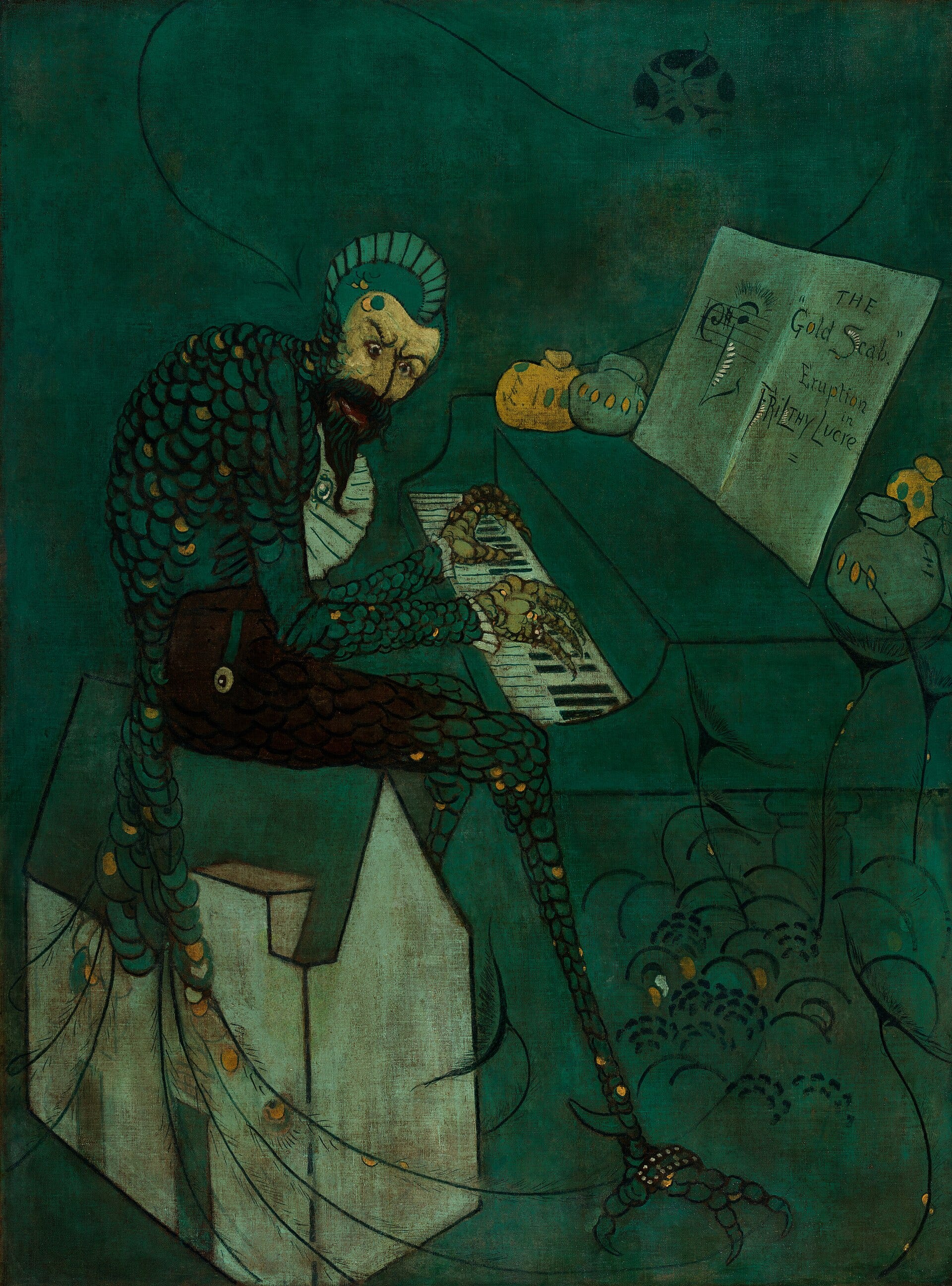
A monstrous peacock covered in gold coins sits at a piano in a frilled shirt front, on a canvas taller than most men. The year was 1879. Whistler was bankrupt and a committee of his creditors was about to inspect his house in Chelsea. Among them would be the man he blamed for his ruin, and that man used to wear exactly that kind of shirt front.