
In 1809, the only newspaper to review William Blake's exhibition called him an unfortunate lunatic. He was a poet who made his living as an engraver, and he printed his own books at home, coloring every sheet by hand so that no two copies came out alike. Two centuries later, a bronze copied from one of his prints sits outside the British Library in London.
Cool Stories About Art is a newsletter to learn art the fun way.
Join 200,000+ readers and get:
10 new art stories / month
The entire archive of content (140+ articles)
Comment, ask questions, and chat with other readers
A Poet Who Printed His Own Pictures
William Blake belongs to the generation of the English Romantics, yet his way of working set him apart from the painters around him. He had trained as an engraver, and he made his pictures with the tools of that trade: copper plates, ink, watercolor, and a water-based paint that he called fresco.
Those tools also solved a practical problem. His subjects came from books, the Bible, Milton, Dante, Chaucer and his own poems, and he found a way of printing that let him publish them without any publisher. That is why a list of his paintings is mostly a list of prints and watercolors.
The twelve run from a design he dated 1780 to drawings that his death in 1827 left unfinished. Many of them exist in several copies, each colored differently, so the version shown is not always the best known.
12. The Canterbury Pilgrims (1808)
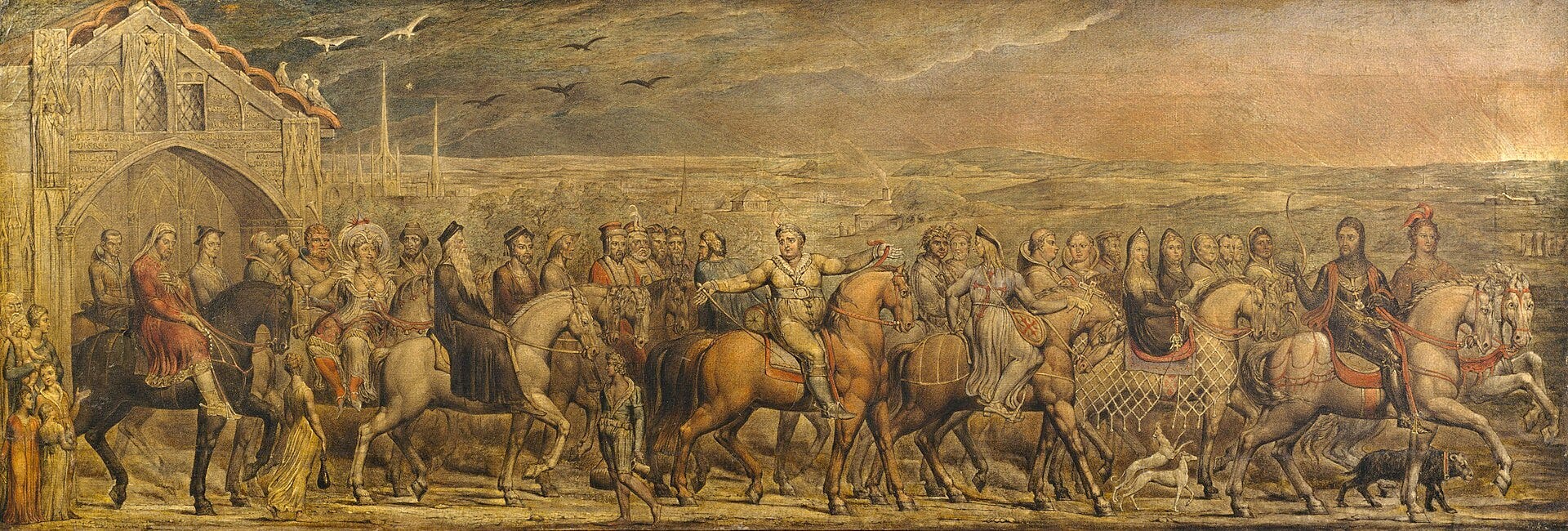
The pilgrims of Geoffrey Chaucer, the medieval English poet, ride out of an inn gateway on the left and file across the canvas in a single long row, under a pale sky. Blake fixed the hour himself, in the catalogue he wrote for The Canterbury Pilgrims: "early morning, before sunrise, when the jolly company are just quitting the Tabarde Inn."
That catalogue came out of a quarrel. Blake had discussed the subject with the print dealer Robert Cromek, hoping to engrave it and sell the prints. Cromek then commissioned the same scene from Thomas Stothard, a painter Blake had known since their student days at the Royal Academy. Stothard's picture had the same long format, and its engraving was planned at the same size.
Who thought of it first is still argued over. Blake himself had no doubt, and he broke with Stothard. In 1808 he painted his own version in tempera, a water-based paint, then looked for a way to sell it without going through a dealer.
His answer, in 1809, was to show it himself. He hung about sixteen of his works in the rooms above his brother James's hosiery shop in Broad Street, in Soho, and wrote the catalogue to go with them. Visitors paid a shilling at the door, and James showed them round. Hardly anyone came, and nothing sold, though the show stayed open for months.
Only one newspaper wrote about it. In The Examiner of September 17, 1809, the critic Robert Hunt said that "the poor man fancies himself a great master" and called him "an unfortunate lunatic, whose personal inoffensiveness secures him from confinement."
Blake replied with the trade he knew best. He engraved the procession on copper himself and published it in October 1810, the largest print he ever made. On the plate he cut the words "Painted in Fresco by William Blake."
At a Glance
Artist: William Blake (1757 to 1827)
Painted: 1808
Medium: Pen and tempera on canvas
Size: 46.7 × 137 cm (18.4 × 53.9 in)
Where to see it: Pollok House (Glasgow Museums), Glasgow
11. Nebuchadnezzar (1795 to about 1805)
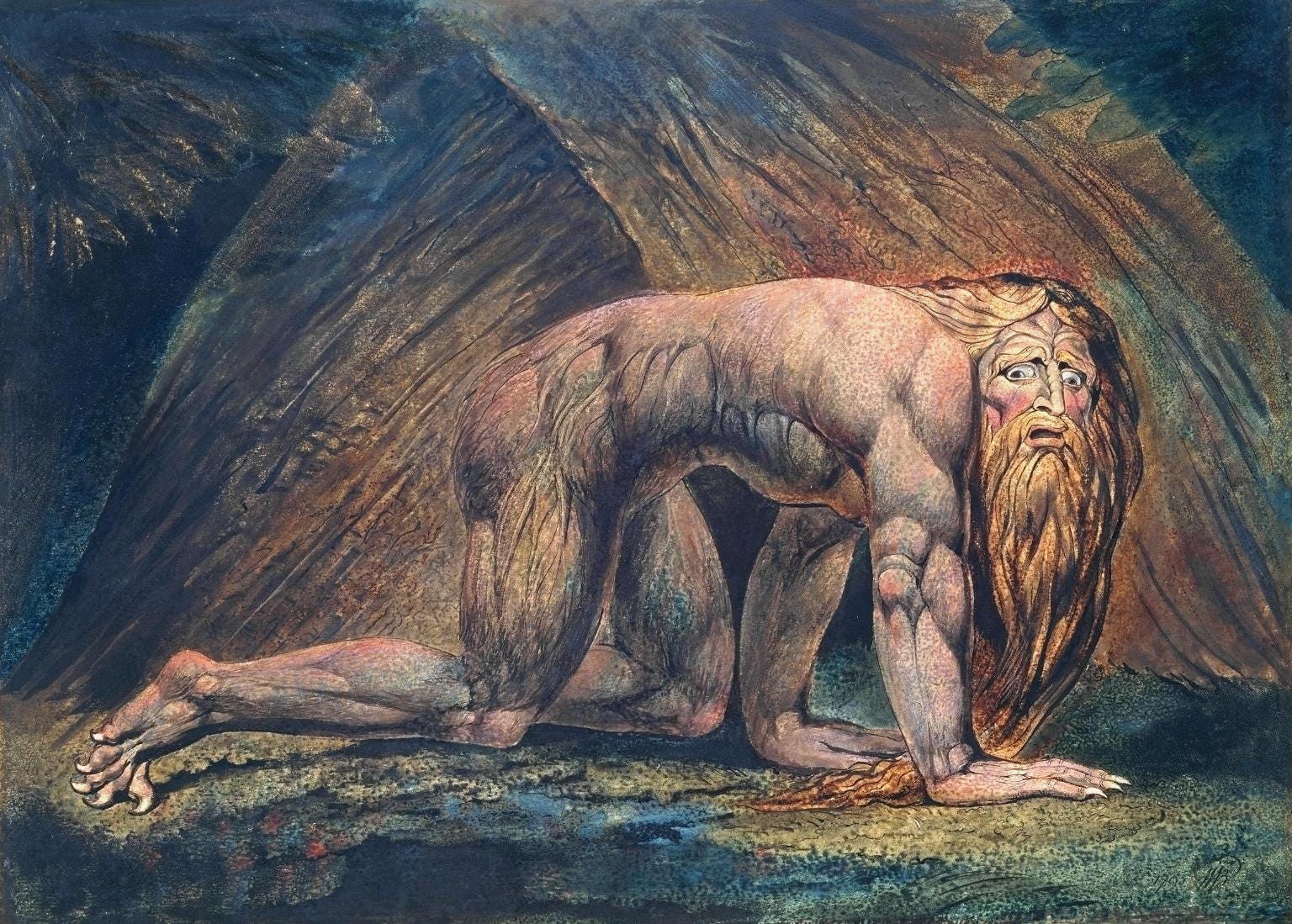
A naked man crawls on all fours through a dark landscape. His hair and beard hang to the ground, his fingers have curled into claws, and his eyes are wide with fear. He had once been a king, and what brought him down to the ground was a single sentence he spoke aloud.