
Painters have put windows in their pictures for centuries, and rarely just to show a view. In the twelve below, a window decides who gets the light and where the room ends and the street begins. In one of them, it even stands in for a person: a pair of torn curtains that the painter called the portrait of a woman who never appears.

Cool Stories About Art is a newsletter to learn art the fun way.
Join 200,000+ readers and get:
10 new art stories / month
The entire archive of content (140+ articles)
Comment, ask questions, and chat with other readers
How These Were Chosen
A window is a hole in a wall, and painters have long treated it as a gift. It lights the room and decides where the shadows fall. It is also a frame already built into the house, which turns the street or the harbor outside into a second picture.
Each painting here was chosen because its window does that kind of work: it brings in the light, puts someone at the glass, or blurs the line where the picture ends and the world begins. Pictures where the window is just furniture were left out.
One figure keeps coming back: a person standing at the glass, face turned away. Four of the twelve hide that face, and the eye has nowhere to go but where the person is looking.
12. René Magritte, The Human Condition (1933)
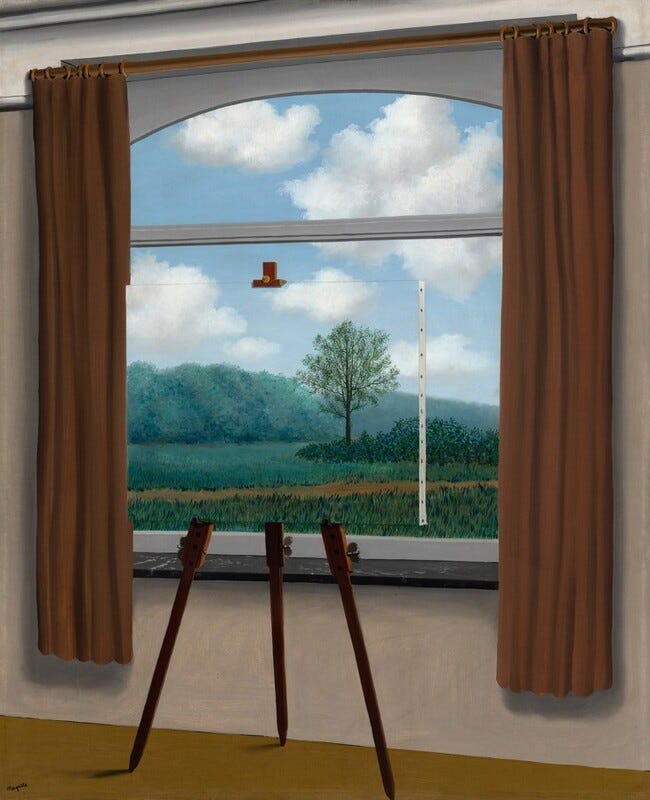
An easel stands in front of a window, and the canvas on it shows the same stretch of open country that lies beyond the glass, lined up so exactly that its edge seems to vanish. The Human Condition, La condition humaine in French, dates from 1933. Its painter, René Magritte, was the Belgian Surrealist known for his dreamlike scenes.
A window and a painting are both rectangles that hold a view, and Magritte would come back to each of them all his life. This canvas is among his earliest attempts at both subjects, and here he merges them into one.
The trick rests on a simple fact. The country outside and the country on the easel are on the same canvas, painted with the same brush, so nothing marks where the view stops and the copy starts. Magritte kept at the idea for two more years and painted four variants under the same title through 1935. In the last of them, the easel stands at the mouth of a cave.
At a Glance
Artist: René Magritte (1898 to 1967)
Painted: 1933
Medium: Oil on canvas
Size: 100 × 81 cm (39 × 32 in)
Where to see it: National Gallery of Art, Washington (East Building, Upper Level, Gallery E415)
11. Vilhelm Hammershøi, Interior in Strandgade, Sunlight on the Floor (1901)

Sunlight comes through a window hung with white curtains and lands in a bright patch on the bare floorboards. Vilhelm Hammershøi painted the scene in 1901, in his own apartment at Strandgade 30, in Copenhagen. A woman sits in the room, close to the window, and yet everything in the picture seems arranged so that no one looks at her.