
Winslow Homer probably finished his first oil painting in 1863, during a war he had been sketching for a magazine, and he was still painting large canvases at seventy-three. Several of his pictures kept changing after they looked finished. In one of the best known, a strip of red cloth hides a man's face that Homer had already painted in full.
Cool Stories About Art is a newsletter to learn art the fun way.
Join 200,000+ readers and get:
10 new art stories / month
The entire archive of content (140+ articles)
Comment, ask questions, and chat with other readers
From Virginia Camps to a Maine Cliff
Winslow Homer came to painting through illustration. In 1862 Harper's Weekly, an illustrated magazine, sent him to the Union camps in Virginia, and his first oils grew out of the drawings he made there. After the war, his pictures turned to freed families and country schoolchildren.
By 1885 he had settled his easel at Prouts Neck, a stretch of Maine coast, and the sea and the men who fished it took over his canvases. The twelve oils chosen run from 1863 to 1909, so his war years and his Virginia scenes sit beside his seascapes.
Watercolors, which he began painting in series in 1873, come in only where they prepared an oil. In several of these pictures Homer changed something on the way to the finished canvas, and what he painted out or replaced tells much of their story.
12. The Life Line (1884)
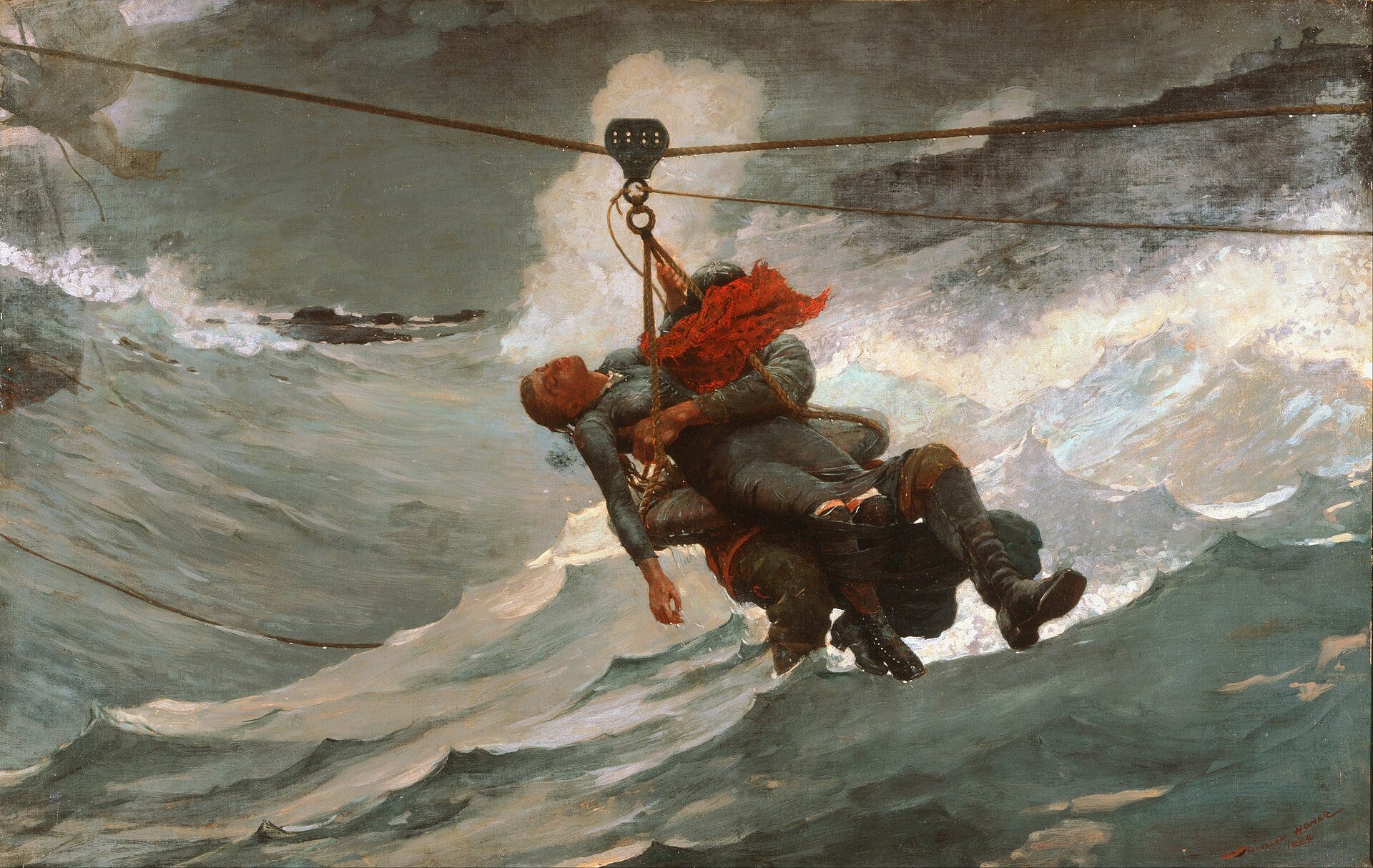
A red scarf, the only bright color in the picture, blows across a man's face. He hangs from a rope above a heaving gray sea, holding a woman who has fainted, her soaked dress clinging to her legs. In The Life Line, painted in 1884, the two of them are sliding toward the shore on a pulley.
The rope belongs to a rescue device called a breeches buoy, a cork ring with a pair of trousers, the breeches, sewn into it. It runs along a line strung between a stranded ship and the beach. Women often refused to use it, because they had to hike up their skirts to climb in. Homer's woman is not in the breeches at all, since her rescuer carries her across his body.
Homer knew the device because he had watched it work. In 1883 he was in Atlantic City, on the New Jersey shore, while the United States Life-Saving Service was testing it, and he probably went out with friends from the service to draw. Back in his Manhattan studio, he posed models and soaked them with water to get the look of wet cloth.
The scarf was the last thing he added. Kathleen Foster, the Philadelphia Museum of Art's curator of American art, noticed it as she walked past the canvas: "The scarf was added at the 11th hour," after Homer had already painted the face of the surfman, the name given to the lifeguards of the Life-Saving Service.
By the time New Yorkers first saw the picture, in 1884, that face was already gone, and the man who saves the woman has stayed faceless ever since. Hers is the only face left in the picture.
At a Glance
Artist: Winslow Homer (1836 to 1910)
Painted: 1884
Medium: Oil on canvas
Size: 72.7 × 113.7 cm (28 5/8 × 44 3/4 in)
Where to see it: Philadelphia Museum of Art, Philadelphia
11. Sharpshooter (1863)
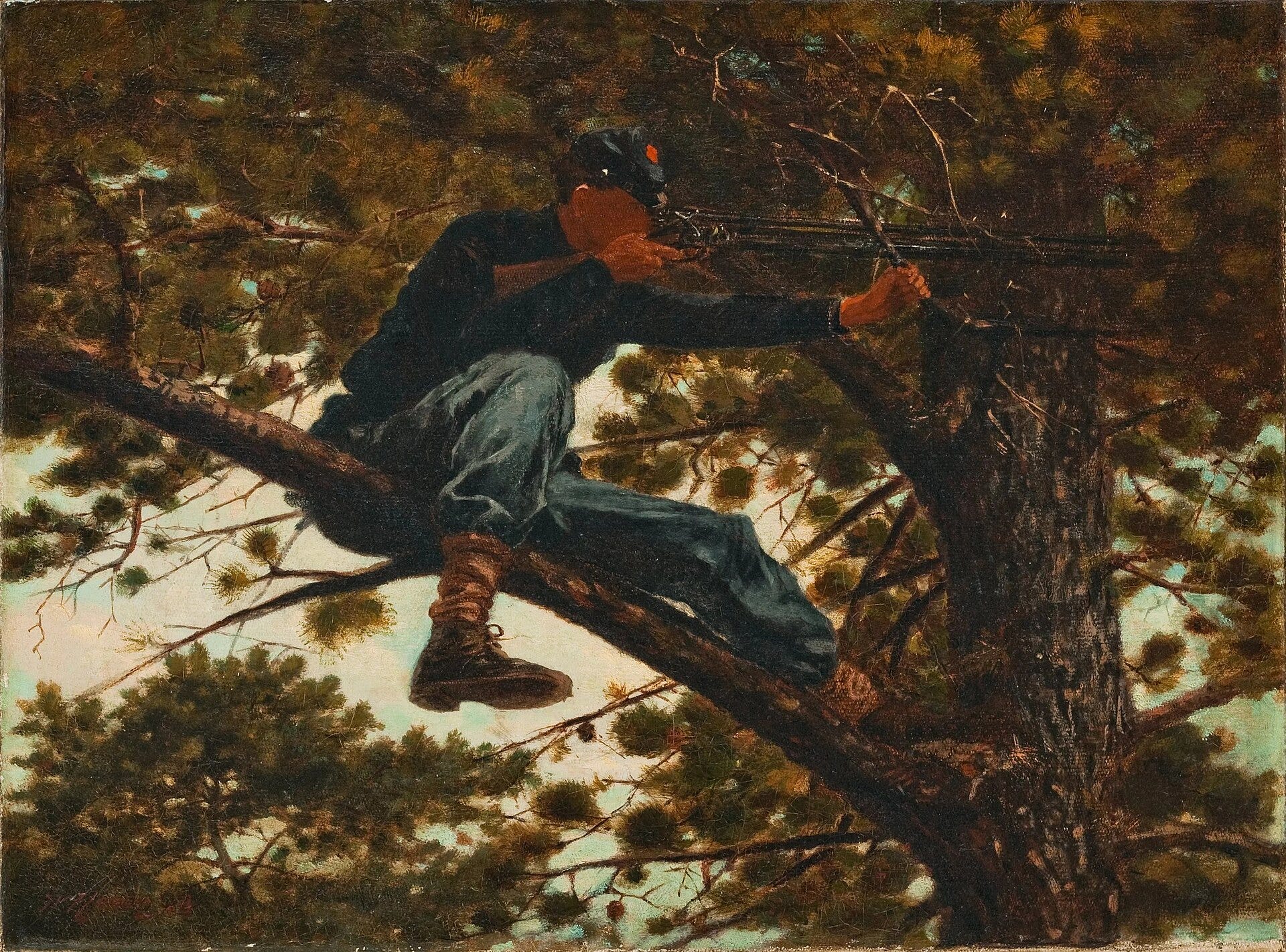
High in the branches of a pine, a soldier in a blue uniform and cap sits with one leg braced on a limb. He holds a long rifle to his shoulder, a telescopic sight mounted on top, and aims at something out of view. A canteen hangs beside him. The painter himself had once put his eye to a sight like that one.