Famous Winter and Snow Paintings: 12 Frozen Scenes
The most famous winter and snow paintings prove that white is never really white. For four centuries painters have found whole worlds in the cold, a frozen carnival on the ice, a village alive in the drifts, blue and pink hiding in a shadow.
Here are twelve of the greatest, all now in the public domain.
From a Bruegel snow scene to a lone magpie on a gate, snow has drawn out some of the finest painting in art. I have gathered the pictures that still make you feel the hush and the chill.
What glitters in them:
The cold. Winters so hard the canals froze for months on end.
The color. Snow full of blue, pink and violet, never plain white.
The quiet. Whole scenes hushed under a soft, deep white.
The life. Skaters, hunters and lonely walkers, tiny against the snow.
Three to keep reading
These go past the caption and into what actually happened:
The secret behind Monet Magpie, one bird in the snow, and why it matters
The secret behind Hopper Soir Bleu, the clown picture that went wrong
Titian, Sacred and Profane Love, which of the two women is which
1. Pieter Bruegel the Elder, Hunters in the Snow (1565)
Three tired hunters trudge home over a hill with their dogs, looking down on a frozen valley where tiny figures skate on green ponds.
It is the first great snow scene in Western art, and still the most loved. Bruegel painted it during the Little Ice Age, when winters really were this brutal.
It was one of a set showing the turning months, of which five survive, and this is the coldest. Look closely and a whole village lives inside it, from a burning chimney to a bird trap on the ice.
It was painted for the Antwerp merchant Niclaes Jongelinck, and now anchors a room of Bruegels in the Kunsthistorisches Museum in Vienna.
2. Hendrick Avercamp, A Scene on the Ice (about 1608)
The Dutch turned the frozen canal into a whole world, and no one painted it better than a man who could not speak. Avercamp was deaf and mute, known as the Mute of Kampen, and he filled his ice with hundreds of tiny skaters, sledges and spills.
It is a winter carnival seen from above.
Look and you will find couples courting, a man fallen through a hole in the ice, even a pair relieving themselves behind a fence.
Rich and poor share the same frozen surface, a rare thing in his day. He sold these crowded scenes across Holland and built a whole career out of the cold.
3. Caspar David Friedrich, Winter Landscape (1811)
A crippled man has thrown away his crutches and props himself against a rock in the deep snow, hands clasped in prayer before a crucifix.
Behind him, faint through the mist, rises the outline of a church. Friedrich turned a bleak winter into a picture about faith and the promise of spring.
The bare firs point upward like the spires of the ghostly church, and a little green grass shows through the snow at the man's feet.
He painted at least two versions of the scene. One hangs in the National Gallery in London, which believed it lost until it reappeared and was bought in 1987.
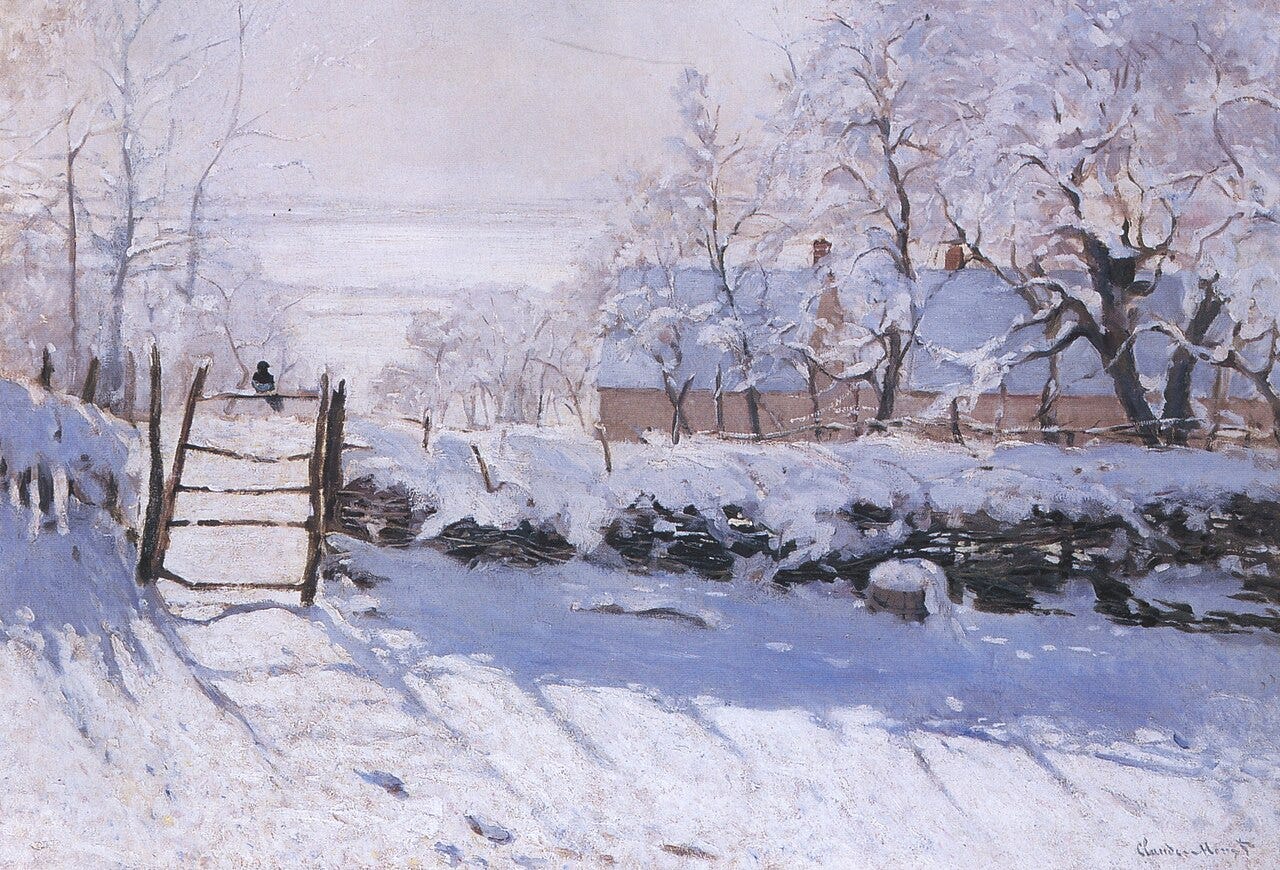
4. Claude Monet, The Magpie (1869)
A single black and white magpie sits on a gate in a field of snow, and that tiny bird carries the whole picture. Monet painted it across the winter of 1868 to 1869, hunting for the faint blues and pinks that snow really holds in shadow.
The Salon rejected it as too strange.
Monet found a hundred colors in the shadows, and the judges were not ready for it. For years the picture stayed unsold and unseen. The Orsay finally bought it in 1984, and it is now one of the most loved paintings in the museum.
5. Alfred Sisley, Snow at Louveciennes (1878)
No Impressionist loved snow like Alfred Sisley, who painted it again and again while his friends chased sunlight. Here a lone figure walks a hushed village lane under heavy white, everything softened and still. It is winter as pure quiet.
Sisley stayed loyal to plain landscape all his life and never found the fame the others did. He died poor in 1899, only months before his prices finally soared. This snowy lane now hangs in the Orsay, worth more than he earned in his lifetime.
6. Gustave Caillebotte, Rooftops in the Snow (1878)
There is no street and no people here, only a field of Paris rooftops buried under snow, seen from high in an apartment window. Caillebotte, a rich engineer who painted for love, turned the city into a near abstract pattern of white and slate chimneys.
It looks startlingly modern.
He was drawn to odd angles and empty views that other painters avoided. This rooftop scene now hangs in the Orsay, alongside the great collection of Impressionism he left to France, though the state at first refused to accept half of it.
7. Utagawa Hiroshige, Evening Snow at Kanbara (about 1834)
Snow falls thickly on a silent mountain village as three tiny figures push through the drifts, in one of the most beloved of all Japanese prints.
The strange thing is that the real Kanbara, on the warm Pacific coast, almost never sees snow. Hiroshige invented the whole storm for its mood.
The white of the paper itself becomes the snow, left bare where the sky and roofs should be. It came from his series of the fifty three stations of the Tokaido road. Prints like this later amazed Van Gogh and Whistler and helped change Western art.
8. Ivan Shishkin, Winter (1890)
A great pine forest stands buried in snow, so still and detailed you can almost hear the silence. Shishkin was called the tsar of the forest for his love of Russian woods, and here he freezes one solid.
Nothing moves except, if you look, a single bird.
He painted every branch and drift with the patience of a botanist, refusing to prettify a thing. Russians treat his forests as a kind of national portrait, and copies hang in homes across the country.
He died at his easel in 1898, brush in hand, still painting trees.
9. Isaac Levitan, March (1895)
This is winter caught in the act of ending, the first warmth of March eating into the snow. A horse waits in the sun outside a wooden house while the drifts turn to slush and the sky goes soft blue.
Levitan painted mood more than place, and here the mood is relief.
A close friend of the writer Chekhov, he made landscape carry pure feeling, with no story and no figures. As a Jew he was twice expelled from Moscow, yet he became Russia's greatest painter of its land.
He died at forty, worn out, with this thaw among his best loved works.
10. Camille Pissarro, The Boulevard Montmartre on a Winter Morning (1897)
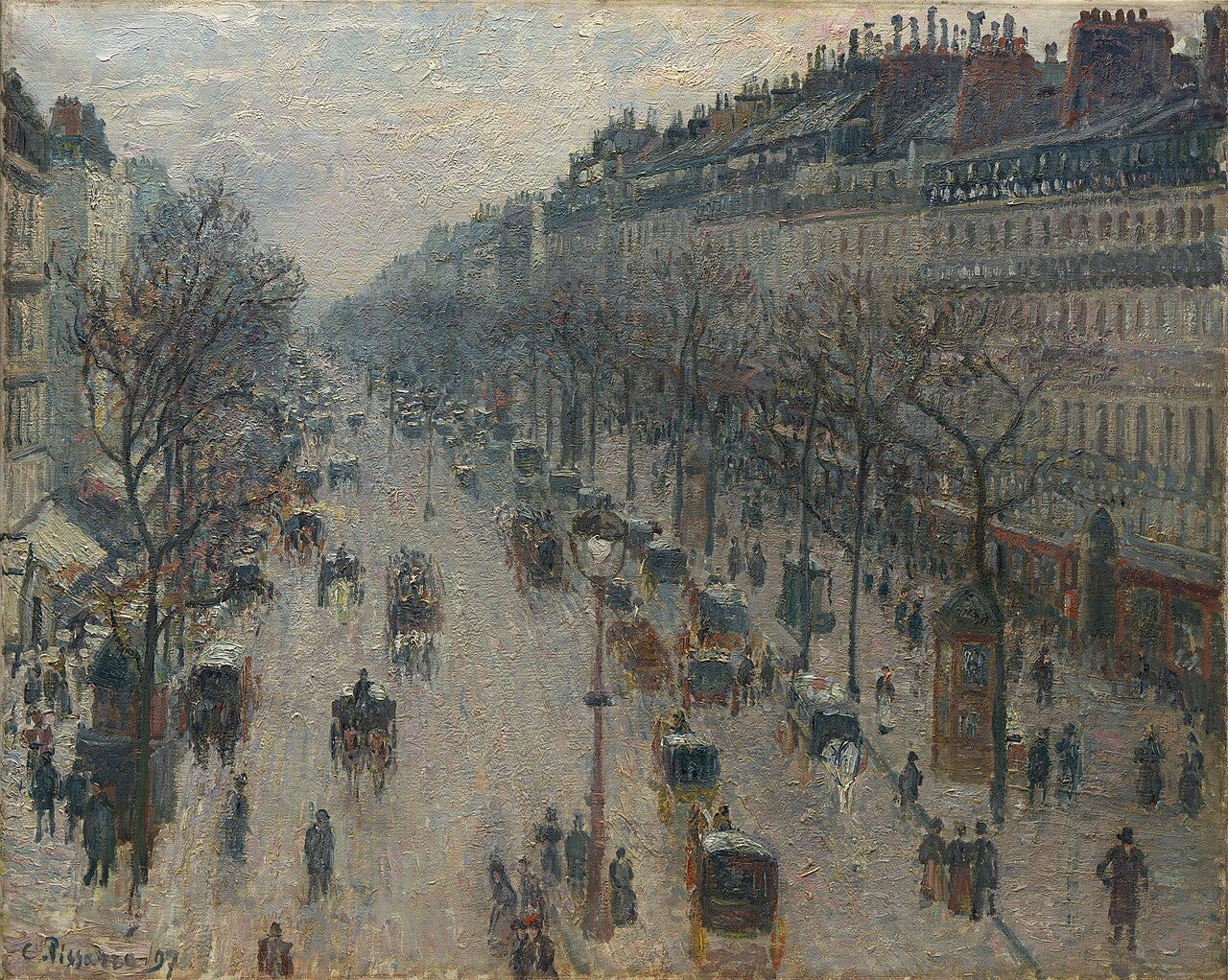
Late in life Pissarro rented a hotel room above a grand Paris boulevard and painted it over and over, through every season and hour.
This one shows the street on a raw winter morning, bare trees and hurrying dots of people under a pale sky. He made a whole series from that single window.
An eye infection made painting outdoors painful, so the window became his studio. He caught the same boulevard in sun, rain, fog and snow, a city breathing through the day. The series scattered across the world, this one reaching the Met in New York.
11. Vincent van Gogh, Landscape with Snow (1888)
Just after he reached the south of France, Van Gogh was met by a rare snowfall and rushed out to paint it. A man and his dog cross a white field toward a huddle of houses under a heavy sky. He had come south chasing the sun and found winter waiting.
He wrote to his brother Theo that the snowy fields looked to him like the white winter scenes in Japanese prints. Snow scenes are rare in his short career, which makes this early southern one unusual.
Within weeks the fields around him would blaze yellow, and he would never paint the cold again.
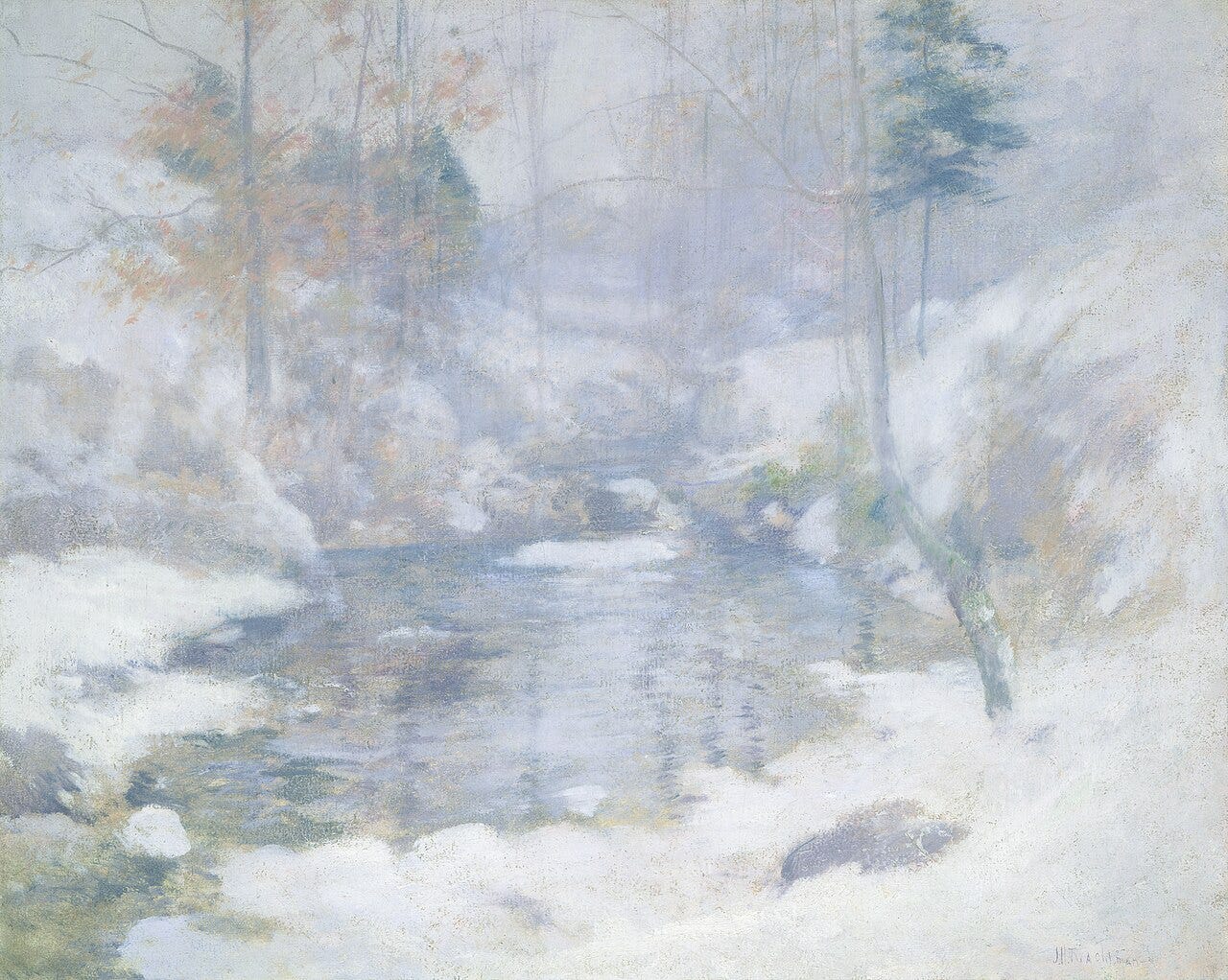
12. John Henry Twachtman, Winter Harmony (about 1900)
A frozen brook winds through pale woods in a picture that is almost all white on white, the quietest painting on this list. Twachtman, an American, painted his own farm in Connecticut over and over in the snow.
He was after a mood so soft it nearly disappears.
He built whole pictures from a few whispered tones of cream, slate and palest blue. This hushed brook now hangs in the National Gallery of Art in Washington, though in his own day it barely sold, and only later was he seen as one of America's finest painters of winter.
Where the snow scenes live
Pieter Bruegel, Hunters in the Snow: the Kunsthistorisches Museum, Vienna.
Claude Monet, The Magpie, Alfred Sisley, Snow at Louveciennes, and Gustave Caillebotte: the Musee d'Orsay, Paris.
Caspar David Friedrich, Winter Landscape: the National Gallery, London.
Ivan Shishkin and Isaac Levitan: the Russian Museum and the Tretyakov Gallery.
Vincent van Gogh, Landscape with Snow: the Guggenheim, New York.
John Henry Twachtman, Winter Harmony: the National Gallery of Art, Washington.
If the snow pulled you in, keep going:
Twelve famous portraits and the real people, the faces behind the paintings
The Last Supper, detail by detail, the detail hiding at that table
Six women, one monster, what Picasso did to the women who loved him
Winter and snow paintings, a few quick questions
What is the most famous winter painting? Pieter Bruegel's Hunters in the Snow, painted in 1565, is the most celebrated of all.
Why did the Dutch paint so much ice? During the Little Ice Age the canals froze solid for months, and painters like Avercamp turned the whole frozen country into a stage.
How do you paint snow? Not as flat white. The Impressionists showed that snow is full of blue, pink and violet, catching the color of the sky and the light around it.
Which artists loved winter most? Bruegel and Avercamp among the old masters, and Monet, Sisley and Pissarro among the Impressionists, along with the Russians Shishkin and Levitan.
Where can I see famous winter paintings? The Musee d'Orsay, the Kunsthistorisches Museum in Vienna and the Russian Museum hold the greatest snow scenes.
The color hidden in the snow
For centuries painters treated snow as a blank, a flat white sheet thrown over the world. Then Bruegel found a whole village alive in it, the Dutch found a carnival on the ice, and the Impressionists found that white is never white at all but a mirror of blue skies and pink dawns.
Look hard at any of these and the cold turns luminous. Winter, it turns out, is one of the most colorful seasons an artist can paint.