Wolf Paintings: 12 That Prowl Through Art History

Wolves haunt art as villains, saviors and symbols. The most famous wolf paintings include Rubens Romulus and Remus, Sassetta Wolf of Gubbio, Vasnetsov Ivan Tsarevich Riding the Grey Wolf and Franz Marc The Wolves. Each turns a predator into a story.

No animal splits the imagination like the wolf. In one painting it nurses the founders of Rome. In the next it eats a grandmother. Painters have made it a monster, a magical helper, a hunted beast and a saint friend.

  • The founder: a she wolf raises Romulus and Remus in Rubens Roman scene.

  • The saved: Saint Francis tames a killer wolf in two paintings on this list.

  • The fairy tale: from Little Red Riding Hood to a Russian folk hero riding a grey wolf.

  • The myth we correct: that the wolf is always the villain of the picture.

If these draw you in, you will also love 7 secrets hidden in famous paintings, the mafia and the missing Caravaggio, and the last day of Vincent van Gogh.


Learn art the fun way. Free stories every week, no boring lectures.


1. Peter Paul Rubens, Romulus and Remus

A she wolf suckling two infant boys as a river god watches
Peter Paul Rubens, Romulus and Remus, 1615 to 1616. Capitoline Museums, Rome.

A she wolf lowers her head to two infant boys, letting them nurse, while a woodpecker hovers and a bearded river god watches. Rubens painted the founding myth of Rome around 1615 to 1616.

The story is stranger than the wolf. In legend the twins Romulus and Remus, thrown into the Tiber, are rescued and suckled by the she wolf, then found by a shepherd. Rubens crams every character into one frame, wolf, bird, god and rescuer.

The painting later moved to Rome itself and was sold to the Capitol in 1750. The city that a wolf supposedly built now owns the picture of it.

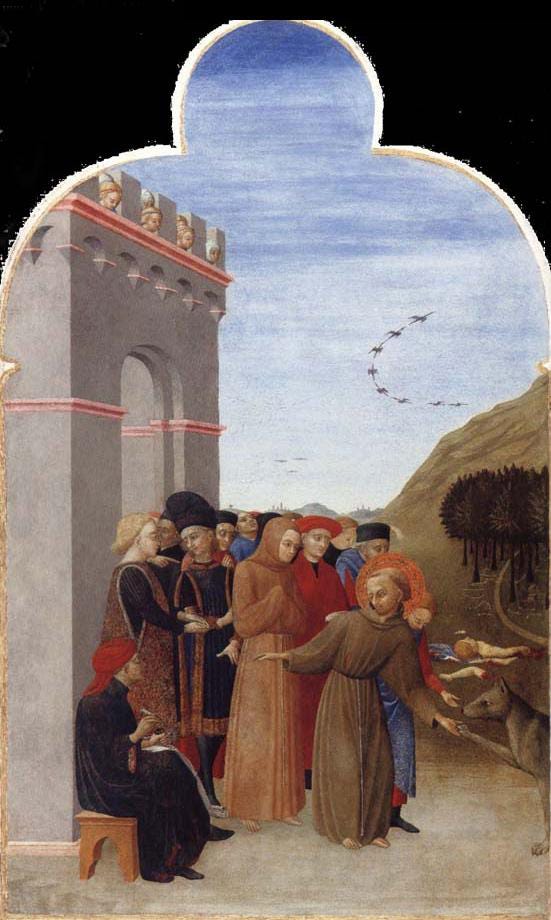
2. Sassetta, The Wolf of Gubbio

A wolf placing its paw in the hand of Saint Francis
Sassetta, The Wolf of Gubbio, 1437 to 1444. National Gallery, London.

A wolf lifts its paw and places it gently in the hand of Saint Francis, while townspeople sign a written pact. Sassetta painted this scene in Siena between 1437 and 1444.

The legend says a wolf was terrorizing Gubbio, killing livestock and people. Francis went out to meet it, learned it was simply starving, and brokered a deal. The town would feed it, and it would stop killing. The paw in the hand seals the treaty.

This panel came from the back of a huge two sided altarpiece for Sansepolcro. Seven of its eight Saint Francis scenes now hang together in London.

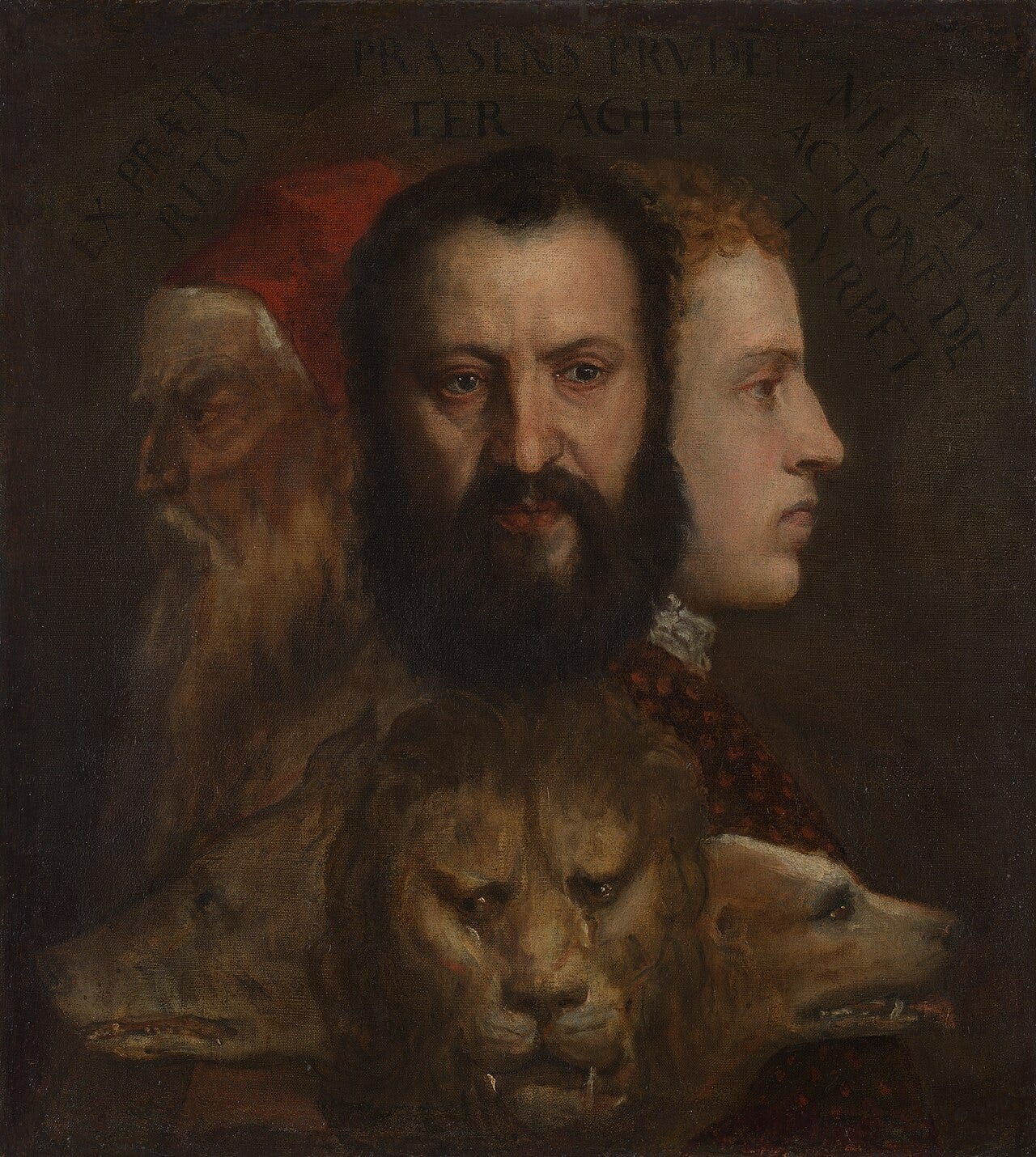
3. Titian, An Allegory of Prudence

Three human faces above a wolf, a lion and a dog
Titian, An Allegory of Prudence, about 1550 to 1565. National Gallery, London.

Three men faces at different ages sit above three animal heads. A wolf on the left, a lion in the center, a dog on the right. Titian and his workshop painted this puzzle in Venice, late in his life.

The animals are time itself. The devouring wolf is the past, the lion is the roaring present, the dog is the hopeful future. A Latin motto runs across the top, learn from yesterday, act today, so you do not spoil tomorrow.

X rays show Titian added the animal heads late and quickly. The strangest part of the picture was almost an afterthought, yet it became the reason we still talk about it.

4. Peter Paul Rubens, The Wolf and Fox Hunt

Hunters closing in on wolves and foxes in a mass of spears
Peter Paul Rubens, The Wolf and Fox Hunt, about 1616. Metropolitan Museum of Art, New York.

Hunters on horseback and on foot close in on two wolves and three foxes in a churning mass of spears and teeth. Rubens painted this enormous canvas around 1616.

It was a workshop production, made with assistants, but Rubens insisted on one thing. The wolves were his own hand. The rest could be delegated. The most dangerous animals in the scene had to be his.

The canvas was once even bigger. A later owner trimmed it to fit his home. Even cut down, it is nearly four meters wide, the first of Rubens great hunting pictures.

5. Jean Baptiste Oudry, Wolf Hunt in the Forest of Saint Germain

Hounds cornering a wolf under tall forest trees
Jean Baptiste Oudry, Wolf Hunt in the Forest of Saint Germain, 1748. Musee des Beaux Arts, Nantes.

Hounds swarm a cornered wolf under tall trees while riders gallop up through the forest. Oudry painted this royal hunt in 1748, deep in the woods near Paris.

Oudry was the official painter of Louis XV hunts, and this was reporting as much as art. Wolves were a real threat in the French countryside, and the crown organized hunts to clear them. The painting is a record of the machine that did it.

Oudry measured and drew from the field, not from fantasy. That is why his forest feels damp and specific, and why his wolf looks less like a demon and more like prey.

6. Gustave Dore, Little Red Riding Hood

A girl in bed beside a wolf wearing the grandmother cap
Gustave Dore, Little Red Riding Hood, about 1862. National Gallery of Victoria, Melbourne.

A small girl in a red hood lies in bed beside the wolf, who wears the grandmother cap and stares at her with awful patience. Dore made this image around 1862 for an edition of Perrault fairy tales.

Dore illustrated Perrault original 1697 story, not the softened later versions. In that telling there is no woodsman and no rescue. The wolf simply wins. Dore froze the moment just before the end.

An oil version of the scene now hangs in Melbourne. The tension is all in the eyes, the girl dawning fear against the wolf calm. No blood needed.

7. Luc Olivier Merson, The Wolf of Agubbio

A haloed wolf gently taking meat from a butcher in a frozen square
Luc Olivier Merson, The Wolf of Agubbio, 1877. Palais des Beaux Arts, Lille.

On a frozen town square, a large wolf with a faint halo stands at a butcher door, gently taking a scrap of meat from his hand. Merson painted this in 1877.

It is the wolf of Gubbio again, but years after Saint Francis. The pact held. The town now feeds the reformed wolf, who moves through the streets like a tamed citizen. Merson gave it a halo to make the point.

Look around the square and you find pigeons, a magpie, a donkey, a dog and a crowd hauling firewood. The miracle here is not violence. It is a whole town living peacefully with its former killer.

8. Viktor Vasnetsov, Ivan Tsarevich Riding the Grey Wolf

A prince and princess riding a huge grey wolf through a dark forest
Viktor Vasnetsov, Ivan Tsarevich Riding the Grey Wolf, 1889. Tretyakov Gallery, Moscow.

A young prince and a frightened princess ride on the back of a huge grey wolf as it bounds through a dark forest. Vasnetsov painted this Russian fairy tale in 1889.

Here the wolf is the hero ally. In the folk story it carries Ivan Tsarevich on his quest and helps him rescue his bride. Vasnetsov turned a scary predator into pure loyalty and speed.

Blossoming apple branches glow in the gloom around them. It is a fairy tale rescue rendered like a religious vision, and it made Vasnetsov the great painter of Russian myth.


Join 130,000 readers who get the secrets behind the paintings. Free.


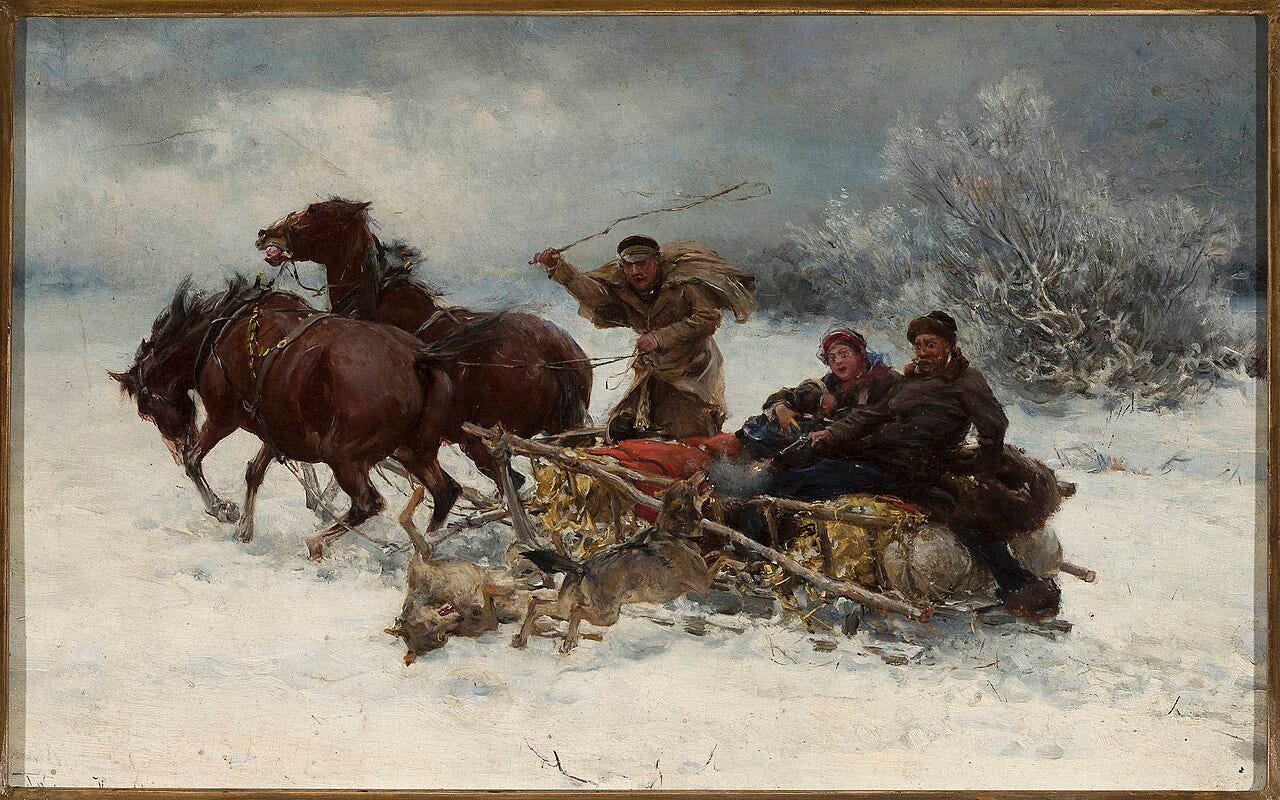
9. Alfred Wierusz Kowalski, Wolves Attacking a Sleigh

A pack of wolves racing after a fleeing horse and sleigh in snow
Alfred Wierusz Kowalski, Wolves Attacking a Sleigh, about the 1890s. National Museum, Warsaw.

A pack of wolves races across the snow toward a fleeing horse and sleigh under a cold twilight sky. Kowalski painted many versions of this winter chase in the 1880s and 1890s.

This was his signature subject. A Polish painter working in Munich, he sold these tense snow scenes across Europe and America. His single image The Lone Wolf, a wolf alone on a snowy hill, became one of the most reproduced paintings of its day.

The fear is in the empty space. All that white gives the wolves nowhere to hide and the traveler nowhere to run. Kowalski turned a Polish winter into pure suspense.

10. Frederic Remington, Moonlight, Wolf

A lone wolf turning to face us across a moonlit snowfield
Frederic Remington, Moonlight, Wolf, about 1909. Addison Gallery of American Art, Andover.

A lone wolf turns to face us across a snowfield lit only by the moon, its eyes catching the light. Remington painted this nocturne around 1909, the last year of his life.

Remington built his fame on cowboys and cavalry, but late in his career he chased mood over action. Here almost nothing happens. A wolf, some snow, blue darkness. The whole drama is a single pair of glowing eyes.

He died at forty eight, just as these quiet night scenes were pushing his art somewhere new. Moonlight, Wolf is a glimpse of the painter he was becoming.

11. Franz Marc, The Wolves (Balkan War)

Angular wolves pushing across a jagged dark landscape
Franz Marc, The Wolves (Balkan War), 1913. Buffalo AKG Art Museum, Buffalo.

Sharp, angular wolves push in from the right across a jagged, dark landscape. Franz Marc painted them in 1913, in the tense years before the First World War.

This is not a nature study. Marc made the wolves an allegory of the Balkan Wars of 1912, the conflict that helped light the fuse of the wider war to come. A single dying flower in the corner stands for everything war destroys.

Marc himself was killed at Verdun in 1916. He painted violence as animals and then was swallowed by the real thing, which gives this pack of wolves a terrible afterlife.

12. Leonardo da Vinci, Allegory with Wolf and Eagle

A wolf steering a boat by compass toward an eagle on a globe
Leonardo da Vinci, Allegory with Wolf and Eagle, about 1516. Royal Collection, Windsor.

A wolf sits in the stern of a small boat, one paw on a compass, steering toward an eagle perched on a globe. The mast is an olive tree. Leonardo drew this odd vision in red chalk around 1516.

It is a political riddle. Scholars read the wolf and eagle as powers of Leonardo day, most likely the papacy and the king of France, with the boat navigating between them. The olive tree hints at a hoped for peace.

Leonardo probably made it for a Medici wedding. Even his doodles carried coded messages, and here a wolf becomes a helmsman steering the politics of Renaissance Italy.

Where to see them

  • National Gallery, London: Sassetta The Wolf of Gubbio and Titian An Allegory of Prudence.

  • Metropolitan Museum of Art, New York: Rubens huge The Wolf and Fox Hunt.

  • Tretyakov Gallery, Moscow: Vasnetsov Ivan Tsarevich Riding the Grey Wolf.

  • Capitoline Museums, Rome: Rubens Romulus and Remus.

  • Palais des Beaux Arts, Lille: Merson The Wolf of Agubbio.

What the wolf really means

Some of these are history paintings of Rome and of Saint Francis, where the wolf carries a founding myth or a miracle.

Others are fairy tale scenes and Romantic hunts, and Franz Marc turned the pack into an Expressionist warning about war.

Wolves in art, questions people ask

  • What is the most famous wolf painting? Two stand out. Rubens Romulus and Remus, showing the she wolf of Rome, and Viktor Vasnetsov Ivan Tsarevich Riding the Grey Wolf in Moscow.

  • Why does a wolf appear with Saint Francis? The legend of the wolf of Gubbio tells how Francis tamed a killer wolf by making peace with it. Sassetta and Luc Olivier Merson both painted the story centuries apart.

  • Is the wolf always the villain in art? No. It nurses the founders of Rome, carries a fairy tale hero to safety and becomes a tame citizen in Merson Gubbio scene. Only in Little Red Riding Hood is it purely the predator.

  • Which painter used wolves to talk about war? Franz Marc. His 1913 painting The Wolves (Balkan War), now in Buffalo, turns a pack of wolves into an allegory of the conflict that preceded the First World War.

  • Where can I see famous wolf paintings? The National Gallery in London, the Metropolitan Museum in New York, the Tretyakov in Moscow, the Capitoline Museums in Rome and the Palais des Beaux Arts in Lille.

The animal that plays every role

No creature in art wears more masks than the wolf. It founds a city and it eats a grandmother. It saves a Russian prince and it menaces a French village until a saint talks it down. Franz Marc even made it stand in for a coming war. The fangs never change. What changes is us, and what we need the wolf to mean. When Leonardo wanted an image for the cunning of Renaissance politics, he put a wolf at the tiller and let it steer.


Two new stories a week, 130 secrets unlocked. Start free.