Félix Vallotton: The Complete Story
Felix Vallotton was the Swiss painter of interiors where something is clearly wrong. Born in Lausanne in 1865, he joined the Nabis in Paris as the foreign Nabi, reinvented the woodcut, and painted bourgeois rooms like crime scenes without a body.
His nickname among the prophets says it all: the outsider inside. Here is the coldest eye of the Belle Epoque.
Vallotton at a glance:
Born in Lausanne in 1865; Paris at 16, naturalized French in 1900.
His 1890s woodcuts made him famous before his paintings did.
Married into the Bernheim art-dealing dynasty in 1899.
Painted interiors that feel like crime scenes before the crime.
Died in Paris in 1925, leaving a sardonic journal and 1,700 paintings.
Lausanne to Paris at sixteen
Vallotton arrived in Paris in 1882, at sixteen, to study at the Academie Julian, and stayed. In the 1890s he fell in with the young Nabis around Bonnard and Vuillard, who called him le Nabi etranger, the foreign Nabi: with them but never quite of them, which became the position of his entire art.
The woodcuts that went around the world
In the 1890s he took up the woodcut, a medium then half dead, and cut it into flat black masses and white silence: crowds, police charges, and the ten prints of Intimites in 1898, couples in dark rooms caught mid lie.
The prints travelled through magazines across Europe and influenced everyone from Munch to the German Expressionists. He had modernised an ancient medium in under a decade.
More incredible painter stories
If Félix Vallotton pulled you in, you will love these too:
Marriage, money, and the cold interiors
In 1899 he married Gabrielle Rodrigues-Henriques, a widow of the Bernheim gallery family, and the anarchist printmaker became a prosperous painter, a French citizen from 1900.
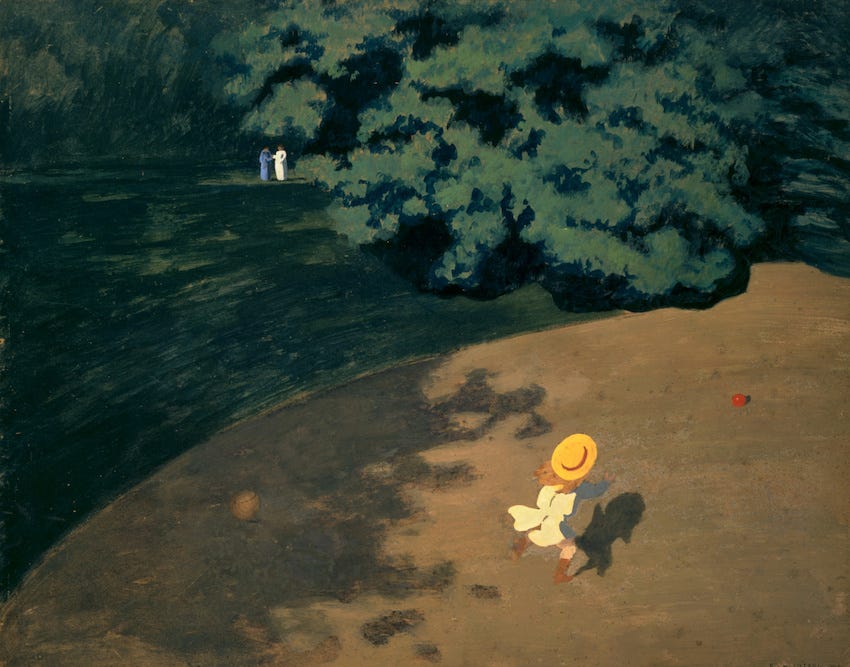
The paintings that followed are his signature: interiors in airless colour, a couple by a lamp, a red room behind a half open door, everything composed, nothing at ease. Domestic life painted like testimony.
The myth: cold means empty
Vallotton gets called detached, as if the temperature were a failure of feeling. The 2019 retrospective in London and New York had it right in its title: Painter of Disquiet.
The chill is the subject; he painted what politeness covers, and the suspense in his rooms is the feeling. He also wrote it: his novel La Vie meurtriere, published after his death, reads exactly like his paintings.
The war, in black and white
Too old to fight in 1914, he answered with the woodcut one last time: the portfolio C'est la guerre! of 1915 to 1916, trenches and barbed wire in his flat blacks, and after an official mission to the front he painted Verdun in 1917 as searchlights and coloured beams, a battle picture with no soldiers in it, decades ahead of its time.
Where to see Vallotton
The Musee cantonal des Beaux-Arts in Lausanne, his home city, holds the largest collection. The Musee d'Orsay keeps the great interiors, and his woodcuts circulate in print rooms from the Met to Geneva.
The black that swallowed Paris
His woodcut series Intimités of 1898 compressed adultery and secrets into flat black rooms, printed in editions the whole city passed around.
The blocks revived European woodcut single-handedly and reached Munch and the Expressionists within years. He drew silence the way others drew noise.
Marriage as a plot twist
In 1899 the bohemian anarchist sympathizer married Gabrielle Rodrigues-Henriques of the Bernheim gallery family, into money and the establishment.
Friends never quite forgave the comfort; his painting kept the unease. The interiors he painted afterward stage marriage as negotiation in lamplight, doors ajar.
The war he painted without soldiers
Too old for service in 1914, he toured the front officially in 1917 and answered with Verdun, a battlefield of searchlights and fire with no visible human being.
It is one of the strangest war paintings ever made: strategy diagram as apocalypse, at the Musée de l'Armée in Paris.
The Félix Vallotton questions that keep coming up
What is he known for? Flat, ominous interiors and the woodcuts that reinvented the medium in the 1890s.
Was he a Nabi? Yes, the group called him le Nabi etranger, the foreign Nabi.
What is Intimites? His 1898 series of ten woodcuts of couples in dark rooms, love as suspicion.
When did he die? In Paris in December 1925, the day after his sixtieth birthday.
What are the Intimités? Ten woodcuts of 1898 on love and deceit in bourgeois rooms, the prints that made his reputation and helped revive the woodcut across Europe.
What is Verdun? His 1917 painting of the battle as pure searchlights, gas, and fire, with no soldier in sight, held by the Musée de l'Armée.
More secrets to unlock
One last fact
He died on 29 December 1925, one day after turning sixty, following cancer surgery. The diary he kept to the end was as unsparing as the pictures; the last entries record the details of his own case with the same cold clarity he had spent forty years training on everyone else.