
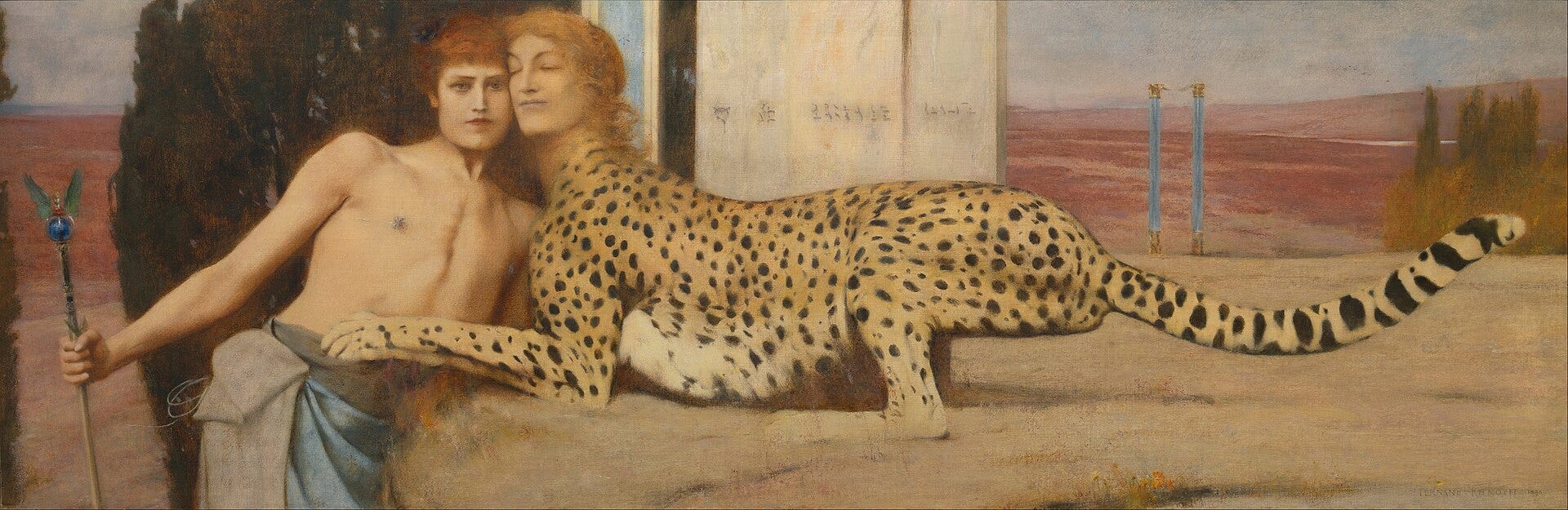
Fernand Khnopff (1858 to 1921) was a Belgian Symbolist painter, one of the artists who painted dreams and myths rather than everyday life. His best-known works are Caresses, where a Greek sphinx has a woman's face, and I Lock My Door Upon Myself.
Cool Stories About Art is a newsletter to learn art the fun way.
Join 200,000+ readers and get:
10 new art stories / month
The entire archive of content (140+ articles)
Comment, ask questions, and chat with other readers
Fernand Khnopff drew Bruges again and again, often with no one in its streets. Yet once he was a grown man, he almost never went back to see it. He drew the town from memory and from photographs.
Khnopff was born on September 12, 1858, at Grembergen, a village near Termonde in Flanders, the northern half of Belgium, where most people spoke Dutch. Like many well-off families in Flanders at the time, the Khnopffs spoke French. The men of the family were judges and lawyers, and his father, Edmond, was a magistrate.
When Fernand was a baby, in 1859, his father was named deputy public prosecutor in Bruges, an old city of canals and brick churches near the North Sea. In the 1400s, Bruges had been one of the richest trading cities in Europe.
Four centuries later, trade had moved elsewhere, and Bruges had become a quiet provincial town. Fernand spent his early years there. His sister Marguerite, who would become his favorite model, was born in Bruges in 1864.
A few years later, the family moved to Brussels, the Belgian capital. Fernand was expected to become a lawyer. He began law school in 1875, then left within a year to study painting at the Royal Academy of Fine Arts in Brussels.
From 1877 to 1880, the young painter made long stays in Paris, where he studied at the Académie Julian, a private art school that welcomed foreign students. At the World's Fair held in Paris in 1878, he saw the paintings of Gustave Moreau, a French painter of ancient myths, and of Edward Burne-Jones, an English painter of dreamlike legends.
Moreau became one of Khnopff's masters, as he still said nearly thirty years later. Khnopff came back to Brussels in 1880 and settled there for good, less than seventy miles from Bruges.
Why did Fernand Khnopff stay away from the town he drew for so many years?
In the rest of the story
What Khnopff hid about the way he painted his sister Marguerite.
What a former classmate accused Khnopff of in 1886.
How a novel set in Bruges changed the town Khnopff remembered.
What became of his favorite portrait of Marguerite after his death.