
Filippo Brunelleschi (1377 to 1446) was a goldsmith from Florence who became an architect and engineer. He built the dome of Florence's cathedral, still the largest brick dome ever built.
Brunelleschi also designed Florence's hospital for abandoned children and two of its great churches. He is credited with discovering perspective, the rules that make a flat picture look deep.
In 1401, Brunelleschi lost the contest to make new bronze doors for Florence's Baptistery. Less than twenty years later, the city gave him a roof that none of its builders knew how to make.
Cool Stories About Art is a newsletter to learn art the fun way.
Join 200,000+ readers and get:
10 new art stories / month
The entire archive of content (140+ articles)
Comment, ask questions, and chat with other readers
In 1401, Florence was one of the richest cities in Europe, a republic of bankers and merchants in central Italy. Across from its cathedral stood the Baptistery, an eight-sided building where the children of the city were baptized.
The Baptistery already had one pair of bronze doors. The Calimala, the guild of cloth merchants that looked after the building, wanted a second pair and held a contest to choose the artist.
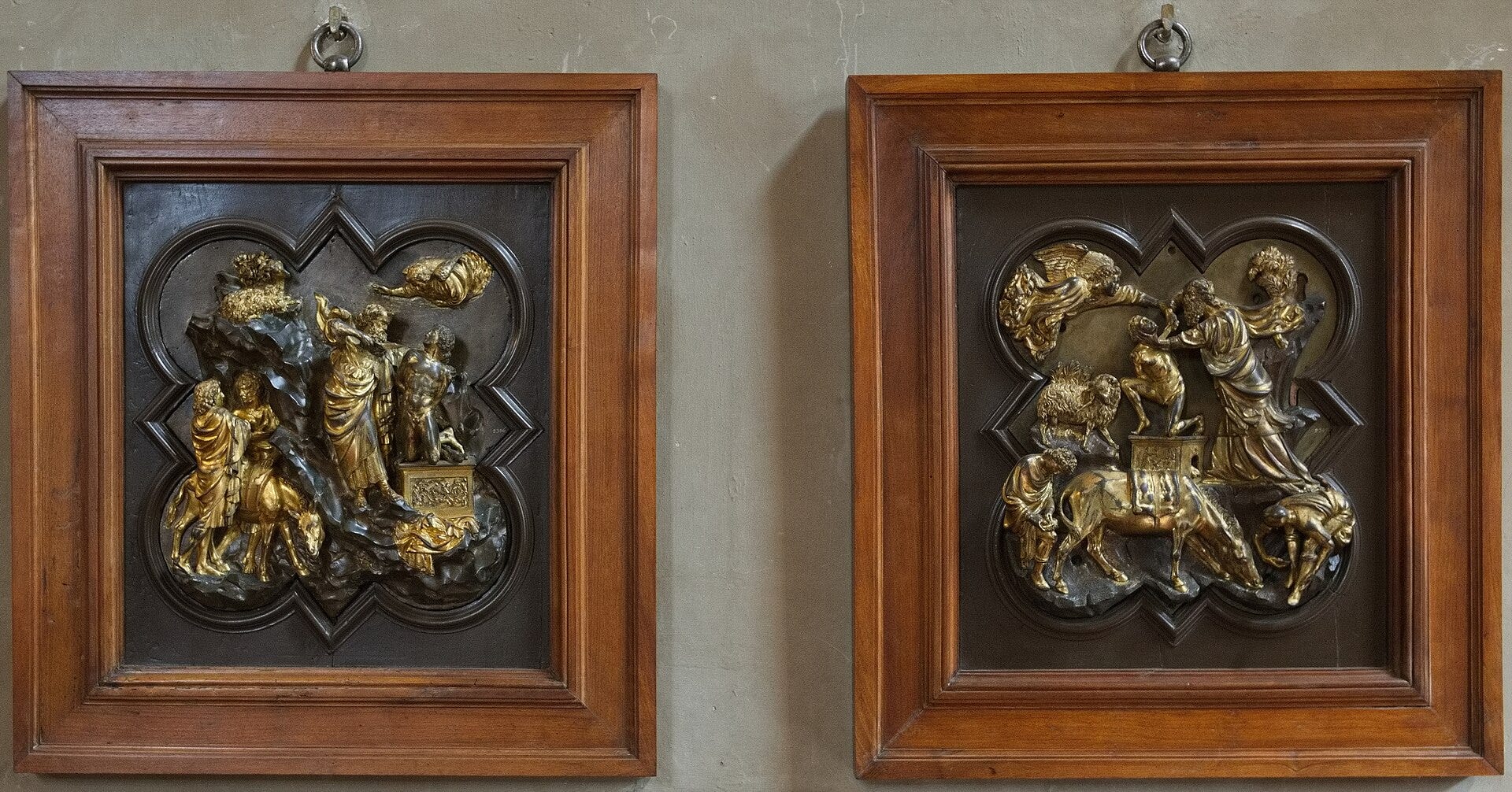
Seven artists entered. Each had to make a bronze panel of the same scene from the Bible, the sacrifice of Isaac: Abraham is about to kill his son because God has asked him to, and an angel stops his arm at the last moment.
Two of the competitors were goldsmiths in their twenties. One was Filippo Brunelleschi, the son of a Florentine notary, an official who drew up contracts and wills. The other was Lorenzo Ghiberti.
In Brunelleschi's panel, the angel swoops in and seizes Abraham's arm while Isaac twists in fear. Ghiberti's scene is calmer, and he cast it in a single piece of bronze, while Brunelleschi's panel came out in three separate pieces.
Ghiberti later wrote that the judges gave him "the palm of victory." Antonio Manetti, a Florentine who wrote Brunelleschi's biography decades later, tells another story: the judges wanted the two men to share the work, and Brunelleschi refused. No document confirms either version. Whoever was right, Ghiberti got the doors.
Across the square, the cathedral of Florence had been rising since 1296. Its builders had left a huge eight-sided opening above the center of the church, to be closed one day by a dome about 140 feet wide. A century later, no one in the city knew how to build it.
How did the goldsmith who lost the Baptistery doors end up building the dome that no one in Florence could build?
In the rest of the story
What Brunelleschi and his friend Donatello were digging for in the ruins of Rome.
The painting with a hole in it, and the mirror that fooled the eye.
The egg, and the challenge Brunelleschi set the builders of Florence.
The day a guild had Brunelleschi arrested, and how the city answered.