

170 000+ readers. Learn art the fun way.
This is a preview. Paid subscribers get the full story.
You’ll also get:
10 new stories every month
The full archive (130+ Art stories)
Your personal art guide. Comment, ask questions, DM me anytime
iPhone user? Subscribe at coolstoriesabout.art, not via the app. Apple adds 30% to the price.
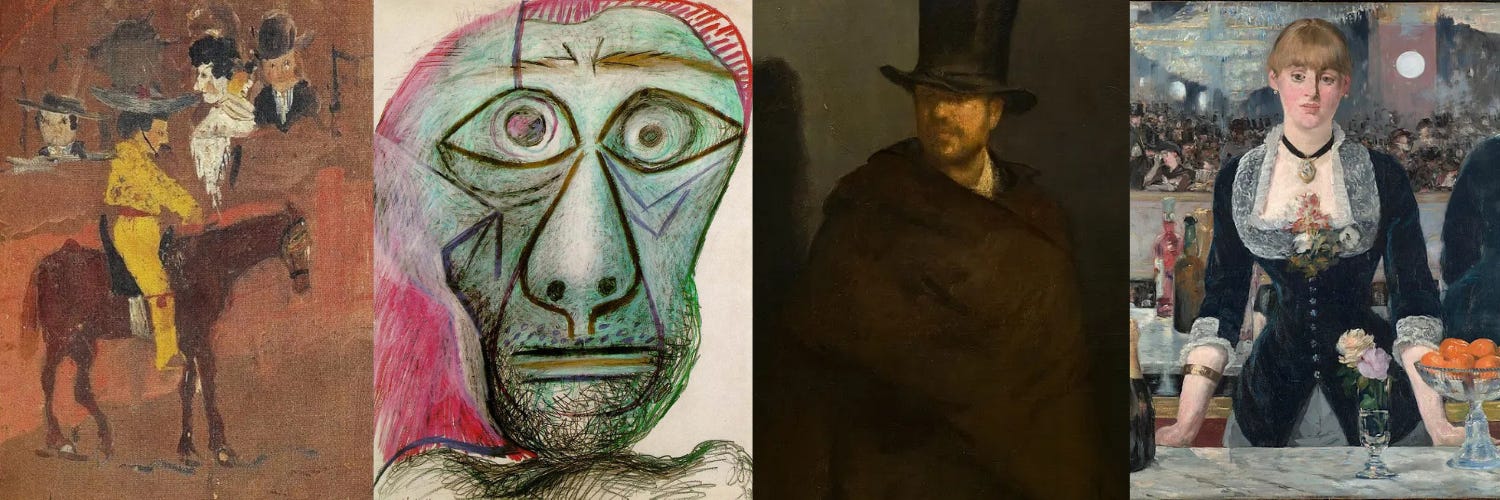
Pablo Picasso (1881-1973)


Picasso was a child prodigy who painted like an Old Master at eight, then spent his life learning to paint like a child again. He co-founded Cubism in 1907, a movement that shattered objects into geometric fragments and showed multiple perspectives simultaneously on a flat canvas.
His 73-year career spans every major 20th century movement: Blue Period melancholy, Rose Period warmth, African-inspired primitivism, Cubist deconstruction, Surrealist experiments, and finally a raw, expressionist late style.
Édouard Manet (1832-1883)


Manet bridged Realism and Impressionism in 1860s Paris, painting modern life with the same seriousness reserved for historical subjects. He rejected academic smoothness for visible brushwork and flat compositions influenced by Spanish masters like Velázquez and Goya.
The Salon repeatedly rejected his work for being too contemporary and confrontational, but younger Impressionists considered him their spiritual leader. He painted cafés, bars, and boulevards until dying from syphilis at 51.
Read art the way it was lived


Remedios Varo (1908-1963)


Varo was a Spanish Surrealist who fled Franco’s regime and Nazi-occupied France to settle permanently in Mexico City in 1941. She created meticulous dreamlike paintings blending alchemy, medieval mysticism, and scientific imagery with technical precision learned from her architect father.
Her work depicts solitary female figures in tower rooms conducting magical experiments and spiritual transformations. She died suddenly from a heart attack at 54 while at the height of her powers, leaving her final painting unfinished on her easel.