
A fish in a painting is either a secret code, a Friday dinner or a technical dare. Early Christians used it as a password, Dutch painters used it to prove they could paint wet scales, and Bosch used sea creatures to build the parts of hell that walk on land.
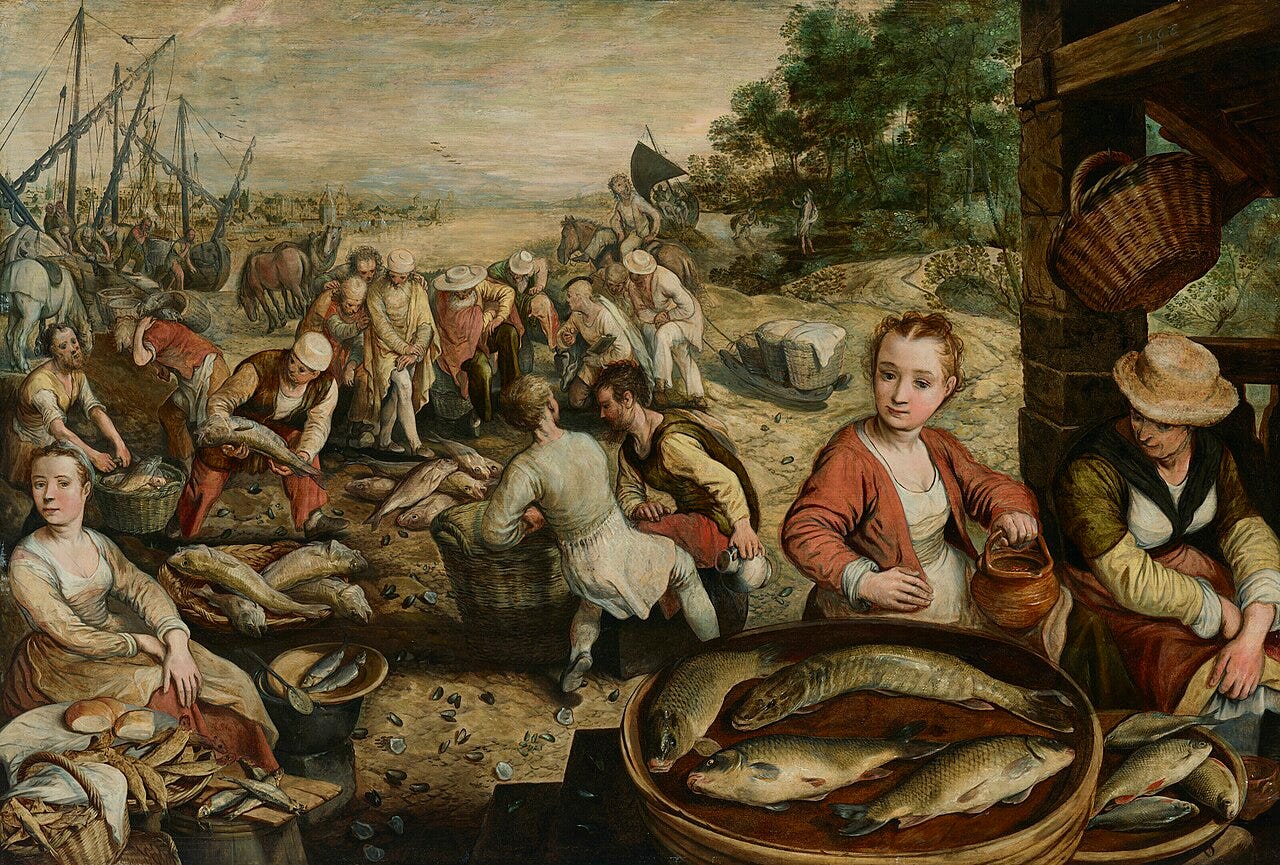
Fish are a small piece of a much larger subject. The ocean itself, painted for its danger and its beauty, is covered in Famous Ocean Paintings: 12 Great Waves. The people who caught these fish get their own gallery too, in Fishermen in Painting: 12 Famous Works.
Twelve fish, briefly
The Greek word for fish spelled out a phrase early Christians used as a sign.
A fish stall painting could be a display of wealth, a religious calendar and a still life at once.
Painting a fish is a test: wet, reflective, silver and dead, all at the same time.
Bosch filled his panels with fish that have legs.
The oyster in a Dutch picture is almost never innocent.
Learn art the fun way
1 | The fish as a password
Ichthys, the Greek for fish, works as an acrostic for a short creed. Early Christians scratched it on walls and tombs where a cross would have been dangerous.
The system is set out in what is iconography.
The word is an acrostic: iota, chi, theta, upsilon, sigma spell out a short creed in Greek. It is scratched on tombs in the Roman catacombs, where a cross would have identified the owner as a Christian.
2 | The Miraculous Draught of Fishes, Raphael (1515)
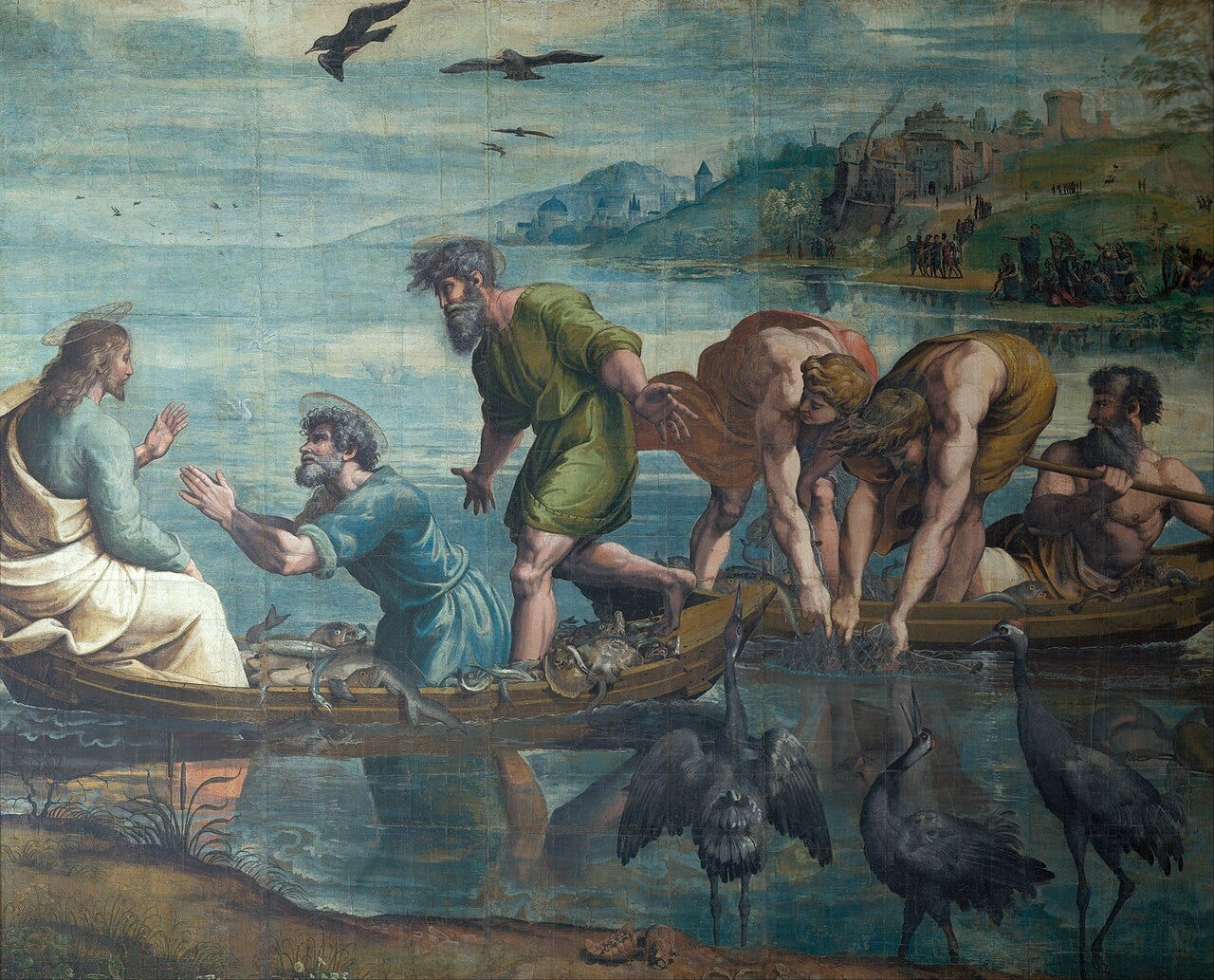
A cartoon for a tapestry, with boats so overloaded they are sinking and cranes standing on the bank watching. Raphael drew birds and fish with the same attention as the apostles.
More on him in Raphael.
The cartoons were made in 1515 and 1516 for tapestries to hang in the Sistine Chapel below Michelangelo’s ceiling. Seven survive and hang at the Victoria and Albert Museum, on loan from the Royal Collection.
3 | The Dutch fish still life
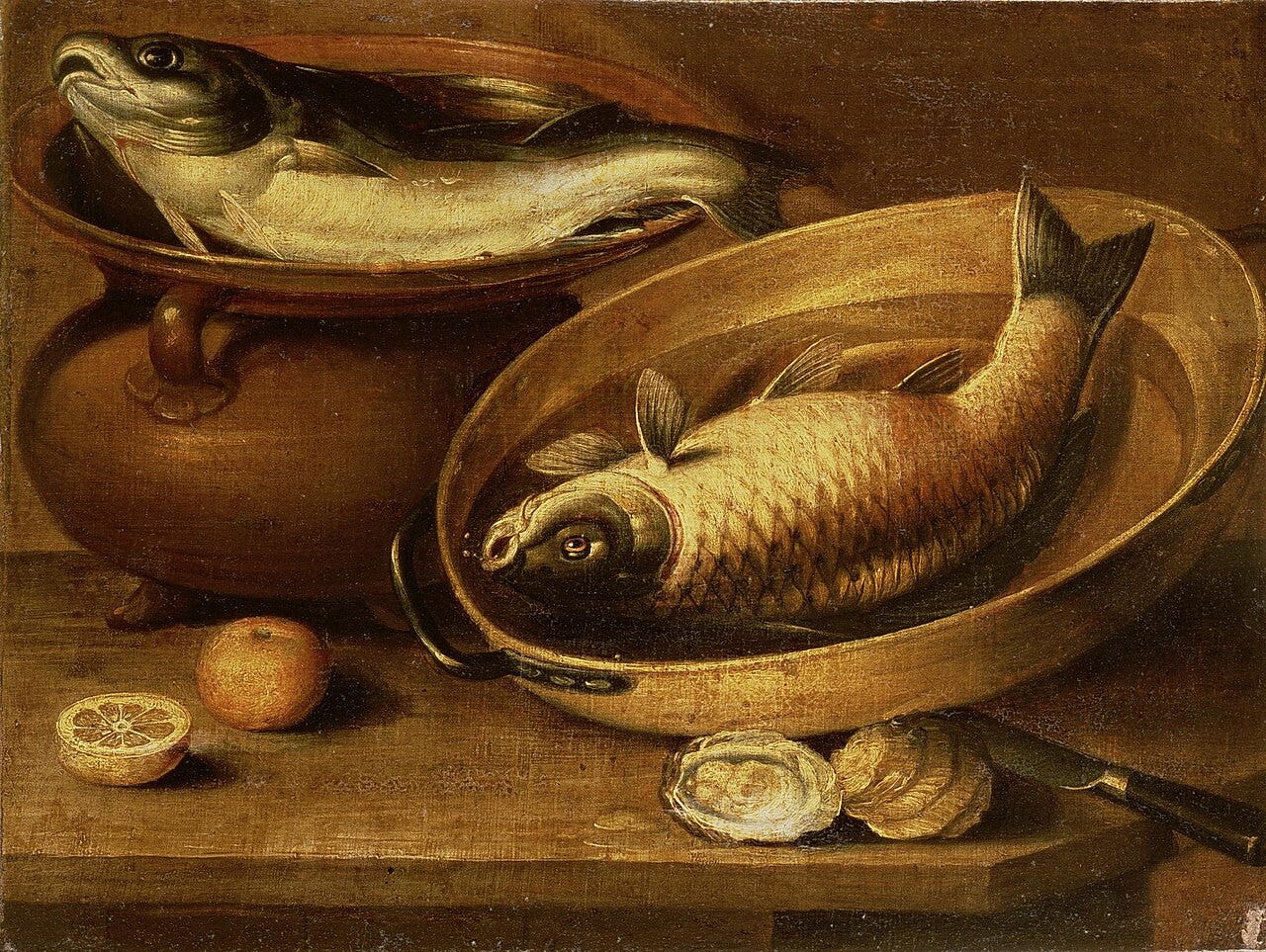
Whole subgenres were built on herring, cod and flatfish laid on a table with a lemon and a knife. Painting a dead fish convincingly was the fastest way to advertise skill.
More on the genre in what is still life painting.
Herring was the engine of the Dutch economy, salted at sea and exported across Europe. Painters like Pieter Claesz and Willem Claesz Heda built entire careers on tables of fish, bread and a tipped pewter plate.
4 | Bosch and the walking fish
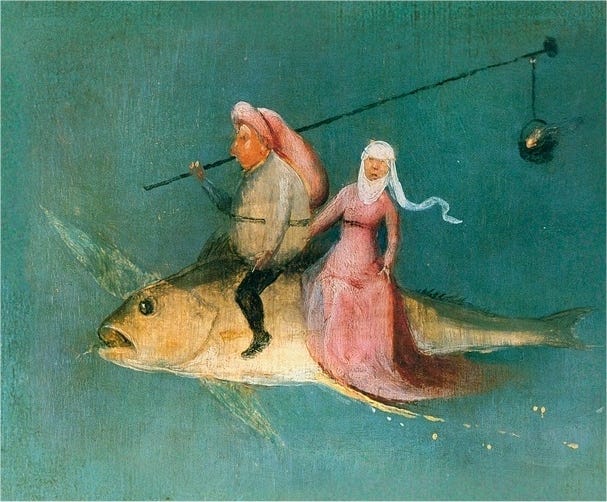
In the Garden of Earthly Delights and the Temptation of Saint Anthony, fish sprout legs, wear armour and carry passengers. The category error is the horror.
More on him in Hieronymus Bosch.
Bosch buries jokes where nobody looks. I pull several of them out in 7 secrets hidden in famous paintings.
5 | The fish market as a genre
Antwerp painters like Joachim Beuckelaer built huge kitchen and market pieces with a small religious scene tucked into the background behind piles of fish.
The sacred story is behind the groceries. More in kitchens and cooks in painting.
Beuckelaer and his uncle Pieter Aertsen invented the inverted still life, where the market goods fill the front and the biblical story is a small scene through a doorway. Contemporaries called it putting the world in front of the gospel.
6 | Oysters and what they meant
An opened oyster in a Dutch interior is a sexual signal, and everyone at the time knew it. It sits beside a lute, a wine glass and a woman being offered something.
More on the genre in what is genre painting.
7 | Jonah and the great fish
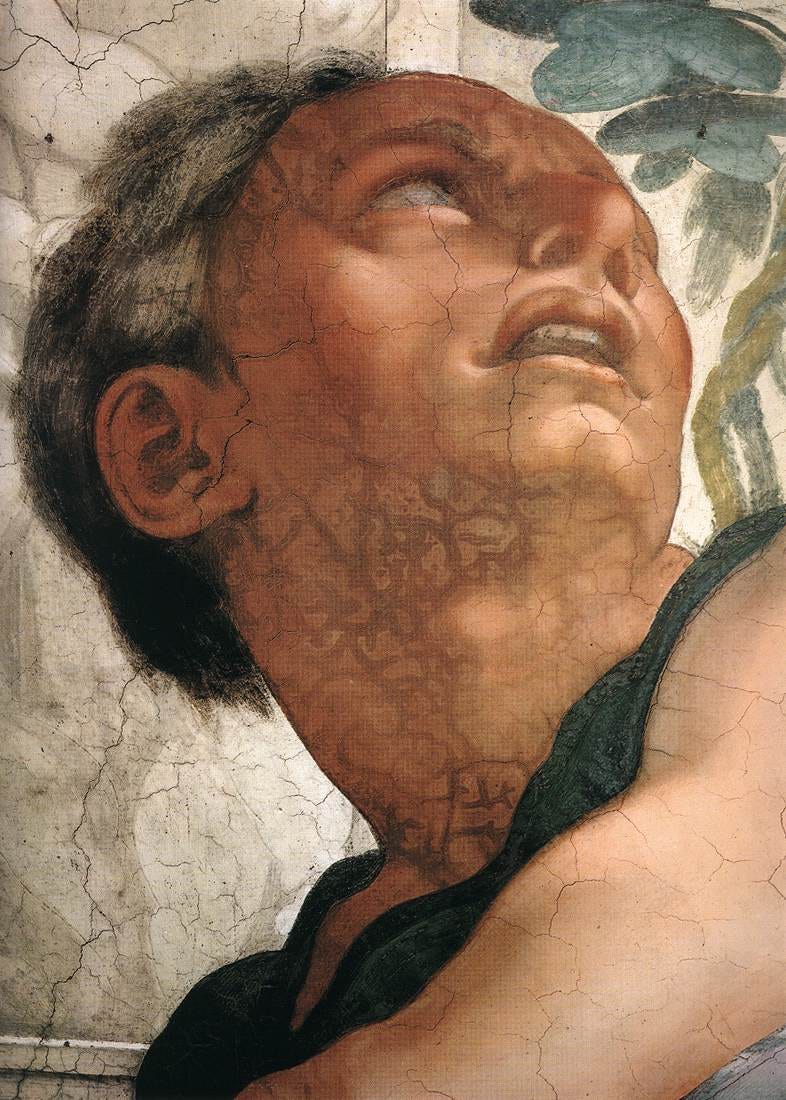
The Bible says a great fish, not a whale. Painters drew it as anything from a serpent to a hybrid, because nobody who painted it had seen one.
Michelangelo put Jonah above the altar in the Sistine Chapel. More on him in Michelangelo.
8 | Sea monsters on maps and in painting
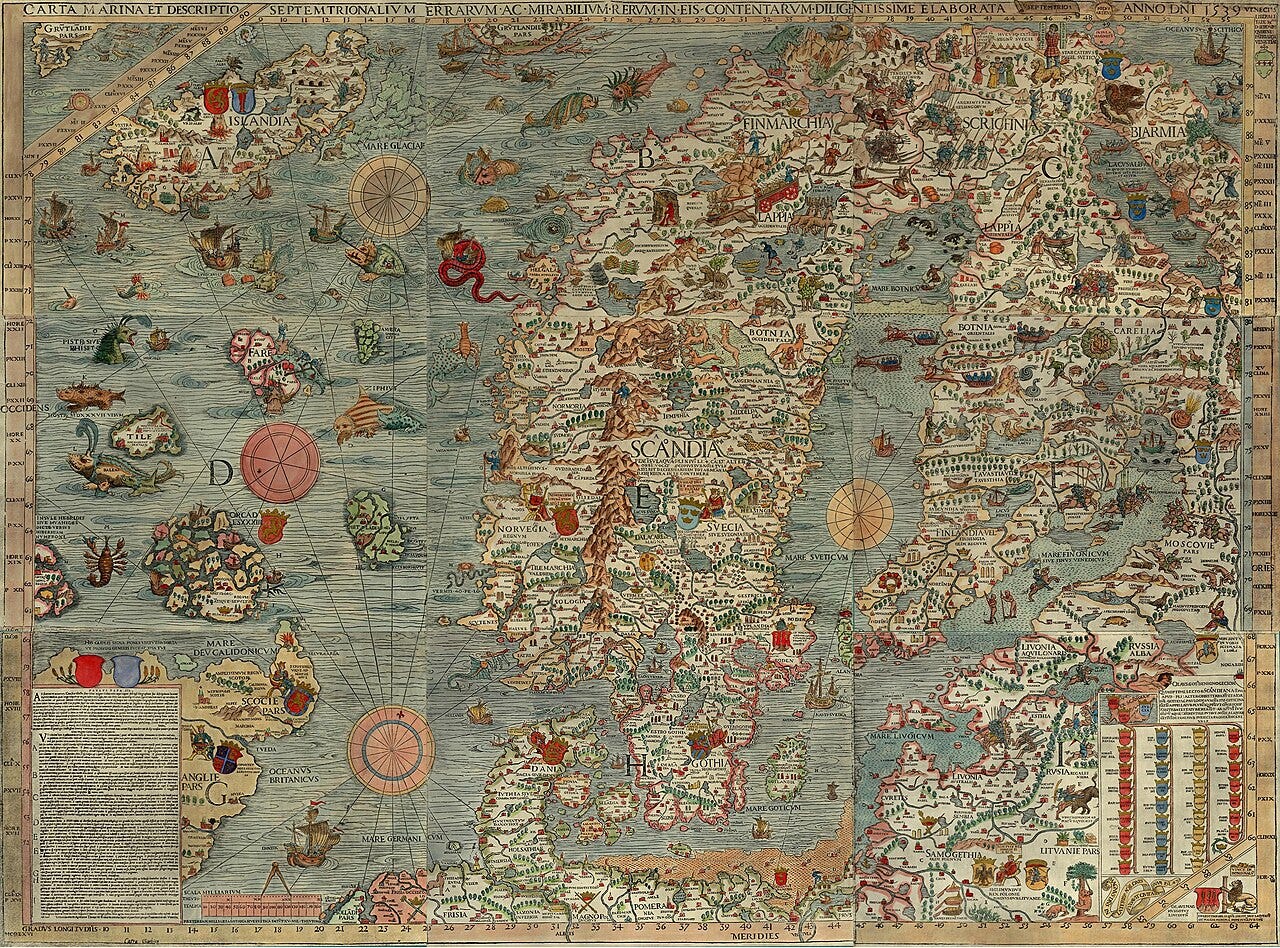
The monsters drawn on sixteenth century sea charts were copied into paintings of storms and shipwrecks. They were understood as reports, not decoration.
More in famous shipwreck paintings.
9 | Turner and the Slave Ship
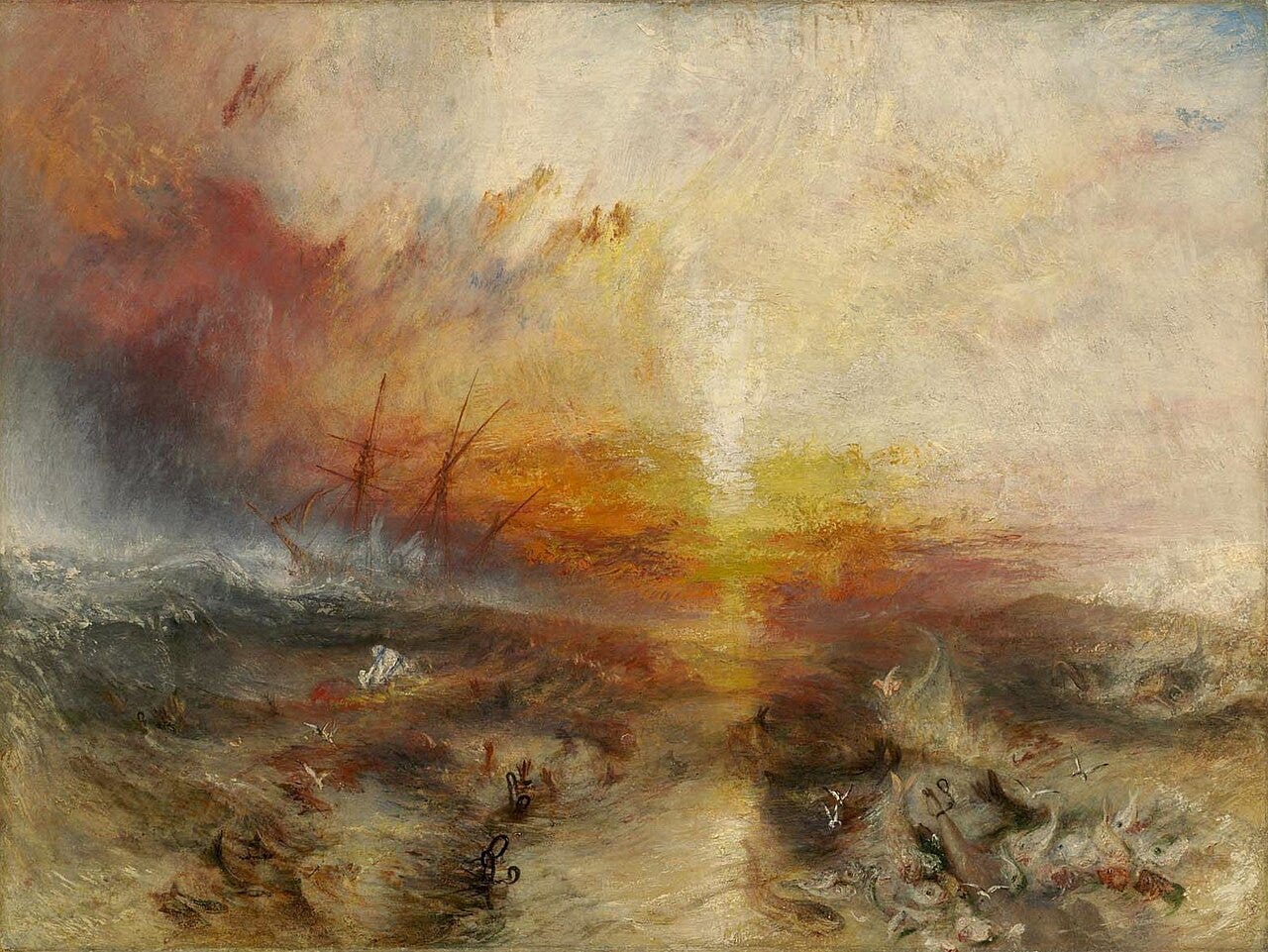
Fish and a shackled leg in the foreground of a burning sea. Turner used the water’s creatures to say what the sky could not.
More on him in JMW Turner.
It was shown in 1840, the year of the World Anti Slavery Convention in London, and Ruskin owned it for nearly thirty years before selling it because he could not live with it.
10 | The carp in East Asian painting
A carp swimming upstream is perseverance and success, an entire moral in one animal, and it appears on scrolls, screens and prints for centuries.
More on him in Katsushika Hokusai.
The story is that a carp which swims up the Yellow River and leaps the Dragon Gate becomes a dragon. It is the standard image for passing the imperial examinations, and it is why carp appear on scholars’ scrolls.
11 | Why a fish is hard to paint
Scales are reflective, wet surfaces mirror the room, and a dead fish loses colour in minutes. Painters worked fast, or from a fish they had already painted once.
The good ones show the eye clouding over.
12 | The fish as a calendar
Catholic Europe ate fish on fast days, which was a large part of the year. A table of fish in a painting is telling you the day of the week as much as the wealth of the household.
Count the fish and you can guess the season.
Ranked purely on technical difficulty, the Dutch fish still life beats everything else on this list. A dead fish loses its color within minutes and its eye clouds over within hours, so painters like Pieter Claesz and Willem Claesz Heda were racing decay every time they set up a table. A fresco or a tapestry cartoon does not rot while you work on it.
Bosch and Turner both use a sea creature to carry weight the rest of the composition avoids. Bosch’s walking fish, made around 1500, turn the category error itself into the horror. Turner put a shackled leg and feeding fish in the foreground of The Slave Ship, shown in 1840, the same year as the World Anti Slavery Convention in London.
Of the coded fish on this list, the carp travels best across time. Its meaning, perseverance rewarded with transformation, still reads today without an explanation. The ichthys password needs a footnote for most readers now, and the oyster’s meaning has faded enough that a modern viewer reads it as seafood on a table, nothing more.
Fish on canvas, questions readers ask
What does a fish symbolise in art? In Christian imagery it is a sign of Christ, from the Greek acrostic ichthys. In still life it also signals fast days, trade and technical skill.
Why so many fish still lifes in Dutch painting? Fish were a major trade and a religious dietary requirement, and painting wet scales convincingly was a way to advertise ability.
Was Jonah swallowed by a whale? The text says a great fish. Painters drew it as a serpent, a hybrid or a monster, since none of them had seen a whale.
What do oysters mean in Dutch pictures? They are a sexual signal, usually placed beside wine, music and a woman being courted.
Which museum has the best Dutch fish still lifes? The Victoria and Albert for Raphael’s cartoons, the Rijksmuseum for the fish still lifes, the Prado for Bosch.
Look at the eye. A fresh fish has a clear domed eye and a dead one goes flat and cloudy within hours. The painters who got that right were painting from the market, not from another painting.
Two collections worth an hour of your time: the Met and the Rijksmuseum.