
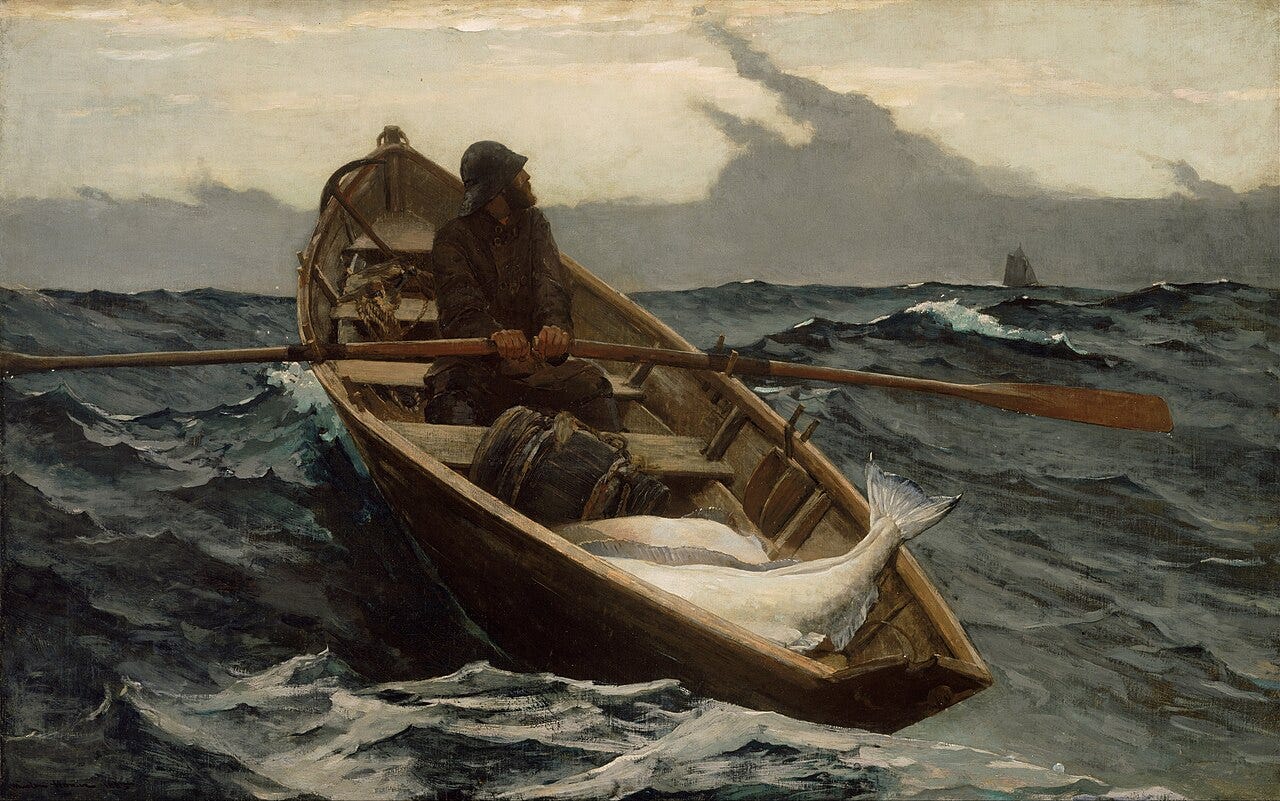
A painted fisherman is rarely only at work. Painters have made him an apostle, a preacher fighting for souls, a widower on a riverbank, a man racing the fog back to his ship. Behind some of these pictures lies a second story, from a net filled in decades after the paint dried to a canvas cut from its frame in 1990.
Cool Stories About Art is a newsletter to learn art the fun way.
Join 200,000+ readers and get:
10 new art stories / month
The entire archive of content (140+ articles)
Comment, ask questions, and chat with other readers
How These Were Chosen
Fishing is a trade a painting can show whole. The gear and the catch say what the work is, and the water says what it costs, because a man in an open boat depends on wind, waves and fog. The trade also has a half on land, where families wait for the boats.
For Christian painters, fishermen carried one more meaning. Several of the first apostles earned their living with nets on the Sea of Galilee, so a fishing boat could hold a sacred story without leaving everyday work behind.
Both meanings shaped the choice. Every picture here keeps the trade in view, at sea or ashore, even when the catch has become a sermon. A sail lost on a calm horizon was not enough, and neither was a fish on a market stall.
12. Unknown Painter of Akrotiri, The Fisherman (about 1600 BC)
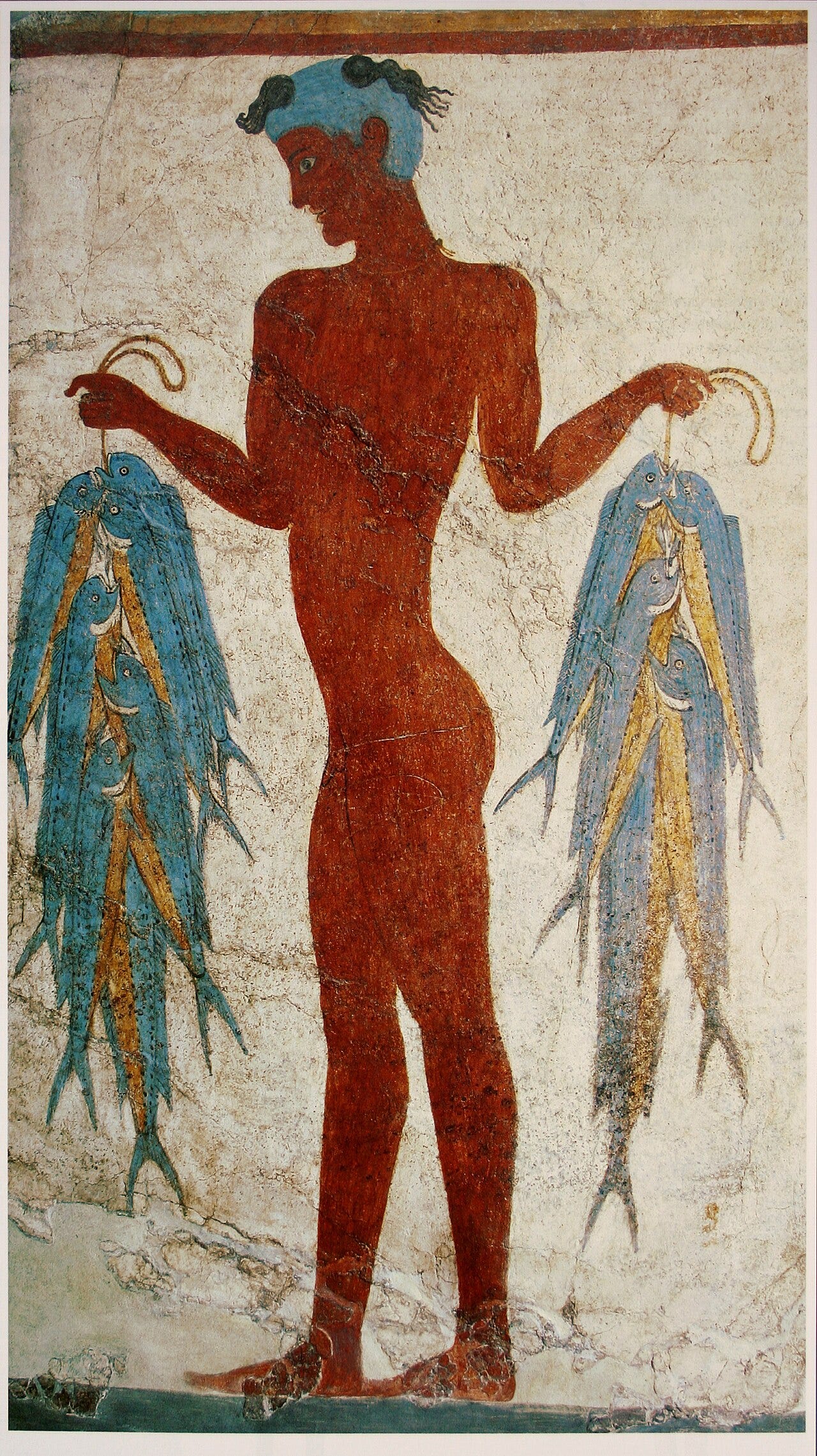
A young fisherman walks along a wall with a string of fish hanging from each hand, his skin painted red ochre and his head a flat blue. An unknown painter made him in the 17th century BC at Akrotiri, a Bronze Age port on the Aegean island of Thera, today's Santorini. When a volcanic eruption later buried the town in ash, the ash kept its painted walls.
The blue head was the first puzzle, and one early reading took it as a sign of divinity. Spyridon Marinatos, the Greek archaeologist who began excavating Akrotiri in 1967, proposed something plainer. The blue, he concluded, stands for a shaved scalp, with two locks of hair left uncut.
Marinatos's reading turns the figure back into a young man, and the room where he was found shows what that young man is doing. The fresco covered a corner of Room 5 in a building the excavators named the West House. A second fisherman, painted in a very similar style, filled the next wall, and the two walk toward the same corner.
That corner explains the walk. The excavators found an offering table there, so the two fishermen seem to be bringing their catch to it rather than simply carrying it along.
At a Glance
Artist: Unknown painter of Akrotiri, Thera (Late Bronze Age, Cycladic culture)
Painted: In the 17th century BC, before the eruption that buried the town
Medium: Wall painting on lime plaster
Size: 147 cm high (57.9 in)
Where to see it: Museum of Prehistoric Thera, Fira, Santorini
11. Konrad Witz, The Miraculous Draught of Fishes (1444)
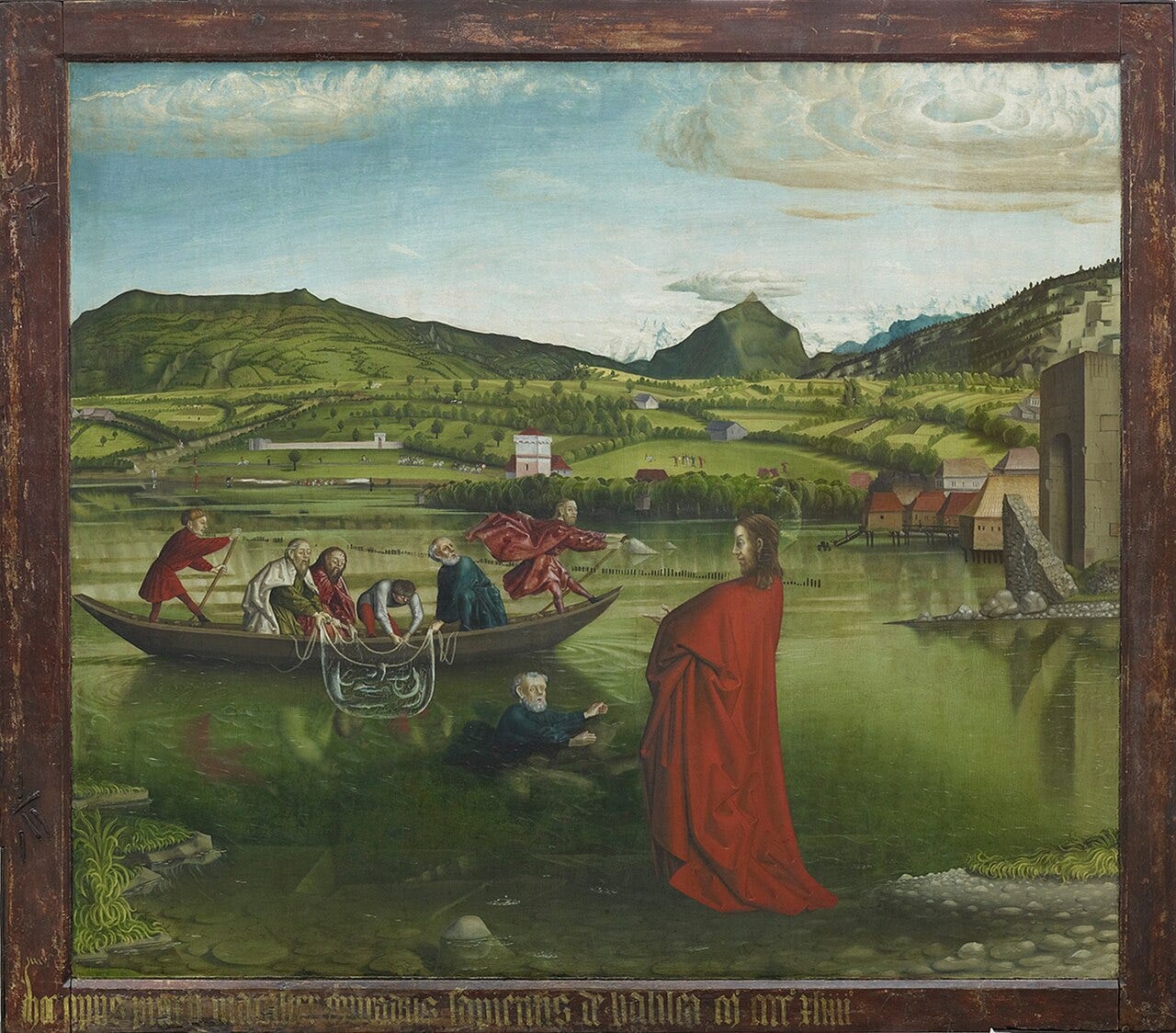
Peter makes his way through the water toward Christ, who stands at the water's edge, while the other disciples haul their net into the boat. The scene is The Miraculous Draught of Fishes, a miracle the Gospel of John sets on the Sea of Galilee.
Konrad Witz, a painter based in Basel, signed the panel in Latin on its frame and dated it 1444, as one wing of an altarpiece for Saint Peter's Cathedral in Geneva. Yet the people of Geneva who first stood before it did not find Galilee behind the boat.