
Matthew's Gospel tells the flight into Egypt in one sentence: Joseph rose in the night, took the child and his mother, and left. It mentions no road and no donkey. Painters filled that silence over six centuries, and one of them, a man once enslaved in the studio of Velázquez, painted his own name in large letters on the road, four years after he was freed.
Cool Stories About Art is a newsletter to learn art the fun way.
Join 200,000+ readers and get:
10 new art stories / month
The entire archive of content (140+ articles)
Comment, ask questions, and chat with other readers
The Road Matthew Left Out
Matthew explains the danger in a few words. In a dream, Joseph is told by an angel that King Herod means to kill the newborn child, and the family sets out for Egypt at once, to stay there until Herod is dead.
The road itself came from elsewhere. Later accounts of Christ's childhood, which the Church never admitted into the Bible, supplied what Matthew left out. In those legends a palm tree bends down to feed Mary, pagan idols crash to the ground as the child goes by, and a field of wheat ripens overnight to throw the soldiers off the trail.
The halt along the way, when the family stops to sleep or eat, has no text behind it at all. Painters invented it, and it is treated here as part of the same subject. A picture is included when it added something later painters took up, or when it has its own story to tell.
12. Juan de Pareja, The Flight into Egypt (1658)
Pareja 1658: the signature runs in large letters across a rock in the bottom left corner. Above it, Mary rides a horse led by an angel, holding the child, while Joseph walks behind and small angels watch from the clouds. When Juan de Pareja lettered his name on this Flight into Egypt, he was no longer anyone's property.
Before that, he had belonged to another painter. Born around 1608 in Antequera, in the south of Spain, Pareja spent over two decades enslaved in the studio of Diego Velázquez, the painter who served King Philip IV. He worked beside his master there long before he could work for himself.
How he learned to paint is less certain. In the eighteenth century, the Spanish painter and biographer Palomino told how Pareja practiced in secret until the king stumbled on his talent. The story is probably a legend. The documents point instead to Rome.
Velázquez brought Pareja along on a long Italian journey, from 1649 to 1651. In Rome, in 1650, he painted his assistant's portrait, now in New York, and signed the act that would free him four years later. In 1654, Pareja was free.
No dated painting by Pareja is known from before this Flight into Egypt. In place of the customary donkey, he gave Mary a horse, and he set his name where no one could overlook it, on the very ground the travelers are crossing.
It was not the only time he signed so boldly. On his Baptism of Christ, now in the Prado, the letters look as though they had been cut into stone, and in a Calling of Saint Matthew, also in Madrid, he painted himself among the figures. Of all these signatures, the one on the Flight into Egypt came first, laid across the path of the Holy Family by a man who had been enslaved only four years earlier.
At a Glance
Artist: Juan de Pareja (about 1608 to 1670)
Painted: 1658
Medium: Oil on canvas
Size: 168.9 × 125.4 cm (66 1/2 × 49 3/8 in)
Where to see it: The John and Mable Ringling Museum of Art, Sarasota, Florida
11. Luc-Olivier Merson, Rest on the Flight into Egypt (1879)
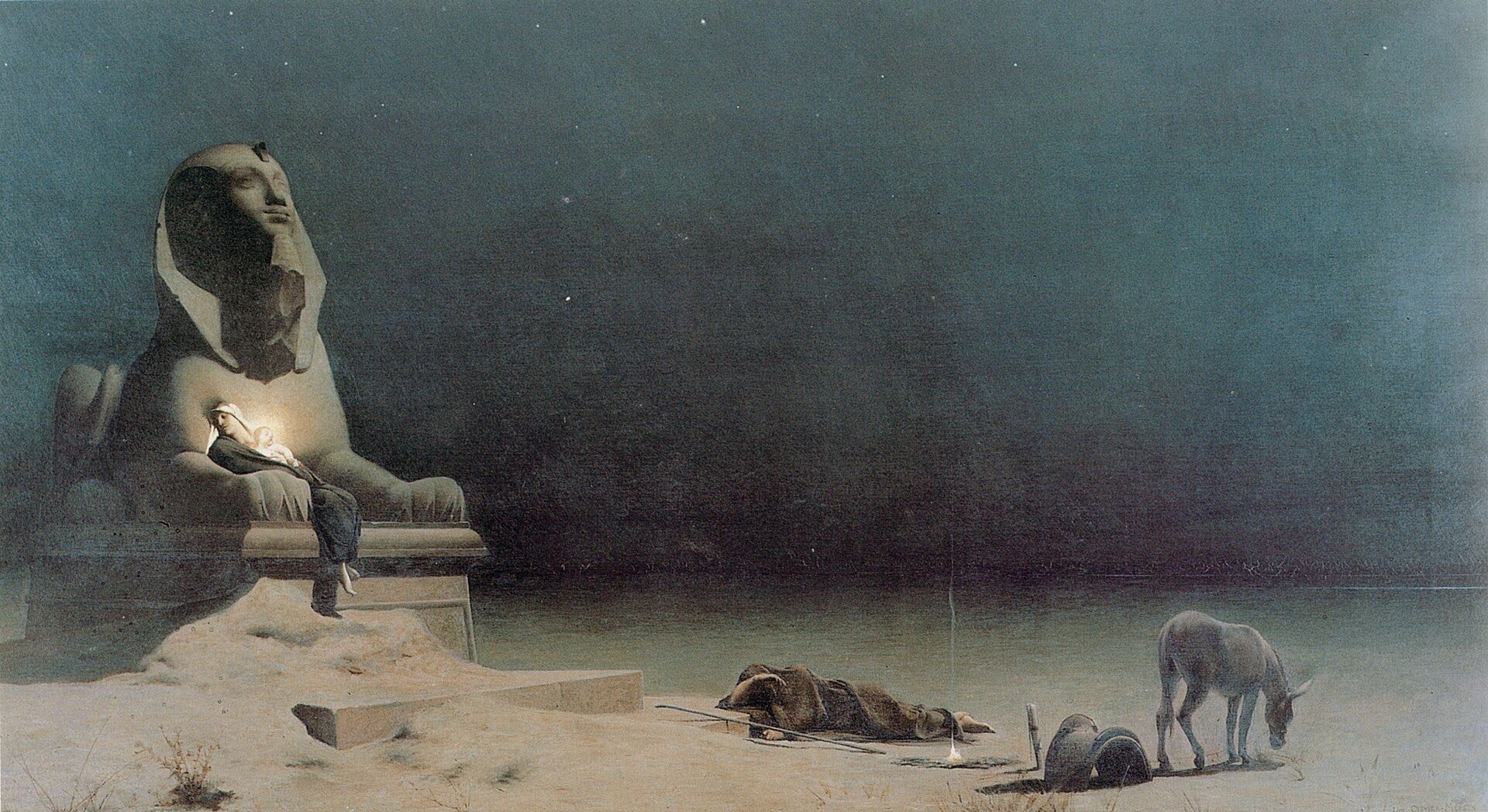
Mary has fallen asleep between the paws of a colossal stone Sphinx, the child in her lap. Joseph dozes beside a fire that is nearly out, and the donkey noses through the sand for a few blades of grass. Only the Sphinx stays awake, its stone eyes lifted toward the first stars. In 1879, Luc-Olivier Merson imagined this Rest on the Flight into Egypt. He had never traveled to Egypt, or to any other part of North Africa.