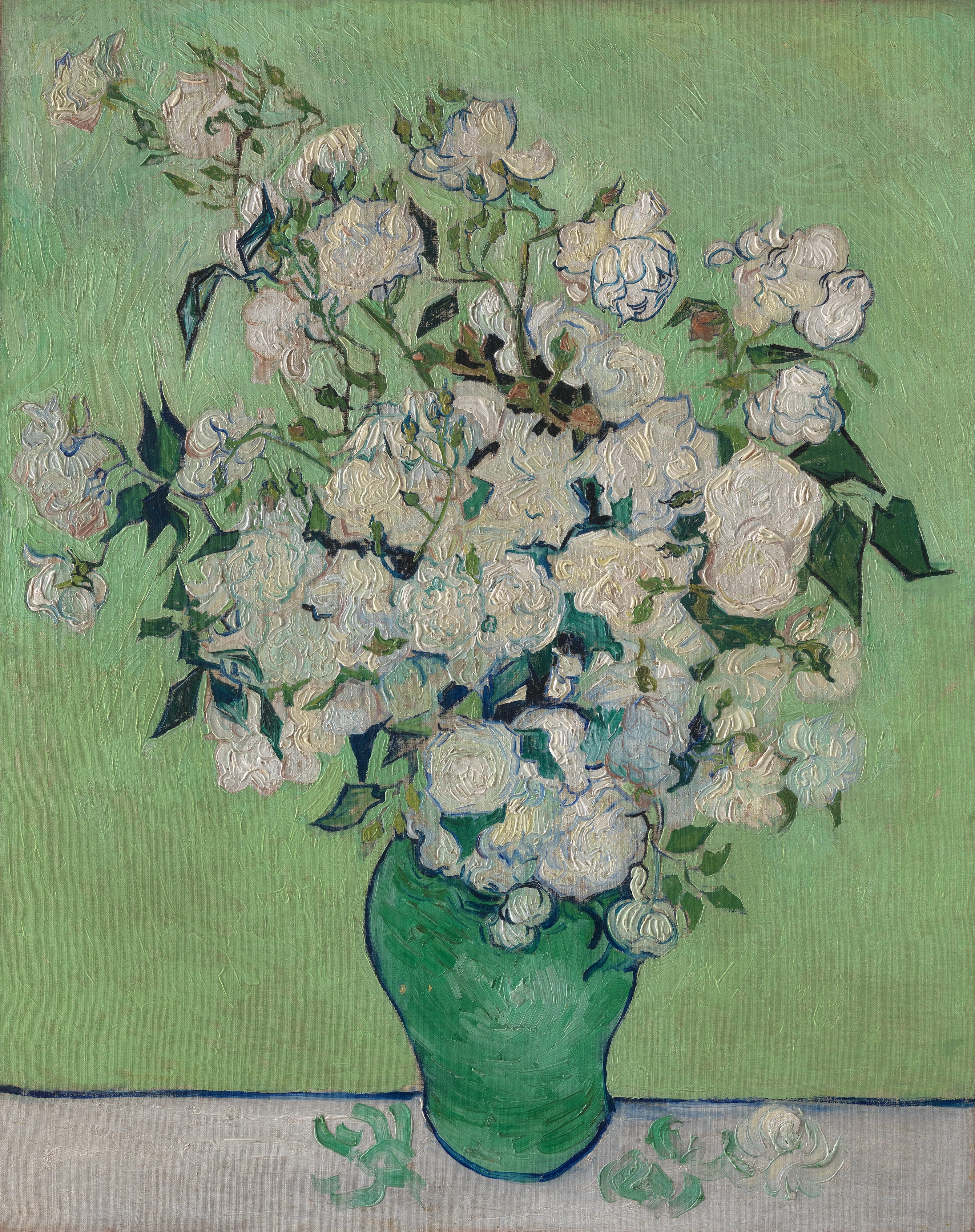
Flowers and plants in art cover the still life bouquets of the Dutch Golden Age, symbolic flowers like the lily and the rose, and landscape subjects such as trees, forests, mushrooms and waterfalls, painted by artists from Jan Brueghel the Elder to Van Gogh, Monet and Mondrian.
That is the territory of this page. It is large, and each corner of it has its own logic, its own market history, and its own famous pictures.
A rose in a Manet still life and a waterfall in a Frederic Edwin Church landscape belong to different traditions with different rules. Reading them together is where it gets interesting.
How this guide works
This pillar page organizes eight deep guides published on Cool Stories About Art, each one a standalone article on a single botanical subject. Every section below summarizes one of them and links to the full piece.
The order runs from single flowers to full bouquets, then out of the vase entirely, into trees, forests, forest floors and falling water.
Roses: the flower painters kept overpaying for
The rose has cost painters real money. Lawrence Alma Tadema had fresh roses shipped weekly from the French Riviera through winter so he could paint The Roses of Heliogabalus (1888) accurately, and Rossetti had real roses delivered daily for Venus Verticordia (about 1866) while complaining about the expense.
Some rose paintings have physically changed since they were made. Van Gogh painted his Roses in 1890, in his last weeks at Saint Remy, in pink; the red pigment has since faded, and the flowers now read as white at the National Gallery of Art in Washington.
The subject also rewarded persistence. Renoir painted roses around 1890 late in life with the brush strapped to his arthritic hand, and Fantin Latour painted them so well that a real garden rose was named after him.
Twelve of these works, from Courbet's palette knife roses to Rachel Ruysch's roses with insects, are covered in Rose Paintings: 12 Famous Works to Know.
Lilies: the most loaded flower in art
For six centuries of Annunciation paintings, the white Madonna lily served as the fixed symbol of the Virgin's purity, from Fra Angelico to Leonardo's Annunciation of around 1472 at the Uffizi to Botticelli. The same white lily appeared at deathbeds and funerals, purity and mortality read as one idea from two ends.
The lily kept getting recruited. A stylized version became the fleur de lis, the badge of French royalty, and later the flower became the signature of the Pre Raphaelites, as in Rossetti's Ecce Ancilla Domini, and then of Art Nouveau through Alphonse Mucha.
One clarification matters here. Monet's water lilies are a completely different, unrelated plant from the Madonna lily, and lily of the valley is a third plant again, smaller and bell shaped, carrying its own meanings of humility and returning happiness.
The great flower paintings, from tulip mania to the Orangerie
Put every species in one vase and you get the flower still life, a genre the Dutch turned into a science. Ambrosius Bosschaert's Bouquet of Flowers in a Niche (1620), painted in the tulip mania era, is an impossible bouquet mixing flowers from different seasons, and Jan van Huysum, who kept his studio locked, took up to two years per painting around 1720.
The genre paid. Rachel Ruysch, painting flowers into her eighties, out earned Rembrandt at times and was hired in 1708 as court painter to the Elector Palatine.
The modern era gave the subject its two most famous chapters. Van Gogh painted his Sunflowers in Arles in 1888 with a new chrome yellow pigment that has since browned in spots, and Monet painted almost nothing except water lilies in his last decades, giving large panels to France after World War I.
All twelve works, including Redoute's roses from Empress Josephine's garden at Malmaison and Manet's small bedside bouquets from his final year, are in Famous Flower Paintings: 12 in Full Bloom.
Trees: from portrait to pure line
A single tree can carry an entire artistic project. Piet Mondrian proved it by painting a real tree over and over starting around 1908, breaking it further into lines each time, until by about 1920 nothing remained except horizontal and vertical lines in primary colors, white, grey and black.
Gustav Klimt's Tree of Life, designed between about 1905 and 1911, was never a painting on canvas at all. It was a full size design for a mosaic in the dining room of the Stoclet Palace in Brussels, executed by Wiener Werkstatte craftsmen in marble, enamel, coral and gold and finished in 1911.
These and other works are covered in Famous Tree Paintings.
Forests: where painters go to lose the horizon
The forest entered European painting early and dramatically. Paolo Uccello's The Hunt in the Forest (about 1465 to 1470, Ashmolean Museum, Oxford) sends hunters, dogs and deer racing into a dark wood at night, and Piero di Cosimo's The Forest Fire (about 1505) shows animals fleeing a blaze at the edge of a wood.
By the 1600s some painters stopped looking at the trees and looked down instead. Otto Marseus van Schrieck helped originate the sottobosco or forest undergrowth genre, and works like Matthias Withoos's Forest Floor with a Frog and a Mushroom (about 1670) treat a few square feet of ground as a complete world.
Waterfalls tucked inside forest gorges have their own page in this cluster, covered separately below. The woodland pictures themselves are in Famous Forest Paintings.
Mushrooms: one subject, two opposite meanings
Few subjects flip their meaning so completely across cultures. In Western painting, mushrooms usually symbolize decay, poison and the underworld; in Japanese and Chinese art, the same subject usually stands for long life, luck and good fortune.
The Western reading grew partly out of the forest floor genre, where painters like van Schrieck and Withoos set fungi among frogs and damp undergrowth in the 1600s.
How the same organism came to mean death on one continent and good fortune on another is the subject of Mushrooms in Art.
Waterfalls: nature as spectacle
The waterfall is where landscape painting turned into public entertainment. Frederic Edwin Church painted Niagara (1857, National Gallery of Art, Washington) on a very wide canvas and showed it to the public as a single ticketed attraction.
Accuracy was optional. Jacob van Ruisdael painted Scandinavian waterfalls in the 1600s without ever seeing Scandinavia, learning the motif from a colleague who had traveled there, and Thomas Cole deliberately left the tourist stairs out of Kaaterskill Falls (1826) even though they were already built at the real site.
The subject crossed continents and formats. Hokusai's woodblock print Amida Falls on the Kiso Road (about 1833) shows a round pool said to resemble the head of the Buddha Amida, and Church followed the route of Alexander von Humboldt to paint The Falls of Tequendama in Colombia (1854).
Twelve of these works, from Turner at Schaffhausen to Durand's Kindred Spirits, are in Waterfall Paintings: 12 Famous Works to Know.
Beyond the plant kingdom
This pillar stays with flora. For a wider survey of the living world, one that puts Van Gogh's Irises and Monet's Water Lilies next to Durer's hare, Stubbs's horse and Rousseau's tiger, see Famous Nature Paintings: 12 That Captured the Living World.
FAQ
What flower means death in painting?
The white lily, oddly, since it also means purity. The same flower that marks the Virgin's innocence in Annunciation scenes appeared at deathbeds and funerals, where purity and mortality read as the same idea from two ends.
Why did the Dutch paint so many flowers?
Flowers were serious money in the Dutch Golden Age, and paintings of them outlasted the blooms. Bosschaert painted his impossible bouquets during the tulip mania era, and the genre paid so well that Rachel Ruysch out earned Rembrandt at times.
What is the most famous flower painting?
Van Gogh's Sunflowers, painted in Arles in 1888, is the usual answer. Monet's Water Lilies is the main rival, a subject he painted almost exclusively in his last decades.
Why do some old flower paintings look different today?
Pigments age. Van Gogh's chrome yellow in the Sunflowers has browned in spots, and the pink roses he painted in 1890 have faded to white because the red pigment broke down.
Are the bouquets in Dutch still lifes real?
Often they could not have existed. Bosschaert's 1620 bouquet mixes flowers from different seasons, painted from separate studies and assembled into an arrangement no vase ever held.
Where the genre ended up
The largest flower project in painting has a fixed address. Monet gave his large water lily panels to France after World War I, and the rooms built for them at the Orangerie in Paris opened in 1927.