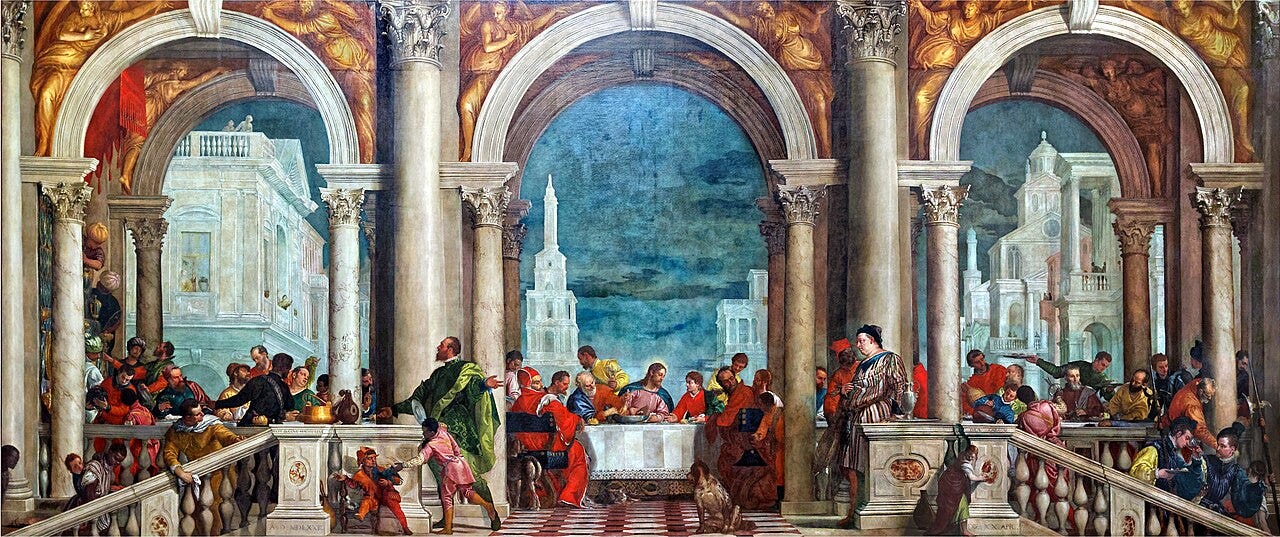
In 1573 the Roman Inquisition summoned Paolo Veronese to explain why his Last Supper included dogs, dwarfs, and drunks. He did not repaint a single figure. He renamed the picture The Feast in the House of Levi and walked out free.
Food and drink in painting work as a coded language. Bread stands for the body of Christ, wine for his blood, rotting fruit for death. Learn the code and a table scene stops being decoration and starts reading like a document.
That is why the Inquisition cared what was on Veronese's table. This page maps the whole territory in seven guides, each one built around a dozen paintings. Here is how they fit together.
The Table Itself
Start with the full meal, because everything else on this page is a piece broken off from it. A painted feast records who sits where, who eats first, and who does not eat at all.
Leonardo's Last Supper, painted in Milan between 1495 and 1498, freezes the exact second after Christ announces that one of the twelve will betray him. The food is almost incidental. The seating chart is the drama.
At the other end of the social ladder, Bruegel's Peasant Wedding of around 1567 shows bowls carried into a barn on a door lifted off its hinges, while the bride sits motionless under a paper crown. All twelve meals, from Milan to that barn in Vienna, are gathered in Food and Feasts in Painting.
One Ingredient, Two Thousand Years of Meaning
No food carries more weight in Western art than bread. Through the Eucharist, a loaf on a painted table can mean the body of Christ, which is why it appears in scenes where nobody is eating.
Painters also treated it as a pure object. Around 1618 the young Velazquez gave a loaf, a jug, a knife, and a cloth the same attention he later gave kings. Dali painted his Basket of Bread twice, in 1926 and again in 1945, the second time working with a magnifying glass for two months, and he called that 1945 version the most rigorous work of his life.
Bread never travels alone for long. On the table Leonardo painted, it sits next to wine, body next to blood, and this cluster splits that one scene into two ingredients: Bread in Painting takes the loaf, and Wine in Art takes the cup.
What the Glass Says About the Drinker
Wine gets a stranger treatment than bread. It comes with a god attached, and painters used Bacchus to say things they could not say directly.
Caravaggio's Bacchus, painted around 1596 and now in the Uffizi, gives the god dirty fingernails and a bowl of rotting fruit, then sat unrecognized in storage until 1913. Vermeer went subtler: in The Glass of Wine, painted about 1659 to 1661 and now in Berlin's Gemaldegalerie, a stained glass figure of Temperance holds a bridle in the window behind the drinkers, a warning built into the room itself.
By 1882 the sacred cup had become a commercial product. Manet's A Bar at the Folies Bergere, his last major work, includes a bottle of Bass Pale Ale with its red triangle label, a beer you can still buy today. The full story of the grape, from god to bar counter, runs through our guide to wine in art.
Before the Food Reaches the Table
Every feast has a back room, and some painters found the back room more honest than the banquet. The kitchen is where food is still labor.
Velazquez was about nineteen when he painted Old Woman Frying Eggs around 1618, with an egg visibly setting in hot oil. An X ray of Vermeer's Milkmaid revealed a wall map and a basket painted over, which means Vermeer stripped the room bare on purpose so nothing would compete with the stream of milk.
Pieter Aertsen went further in 1551. His Meat Stall fills the entire foreground with butchered meat and shrinks the Holy Family to a tiny detail in the background, flipping the hierarchy of subjects a century early.
The kitchen and the fruit bowl are the two ends of still life. Kitchens and Cooks in Painting covers the work and the process, Fruit in Art covers the object once it sits alone on a table, and painters in the line of Chardin and Zurbaran worked both sides.
Rooms Where People Ruin Themselves
Take the drink out of the home and you get the tavern, painting's favorite moral stage. Jan Steen knew the setting from the inside, since he ran a brewery and a tavern himself, and his Beware of Luxury of 1663 spells its warning out on a slate lying on the floor.
Van Gogh pushed the room to its limit in 1888. After three sleepless nights he painted The Night Cafe and wrote to Theo that the clashing red and green showed a place where a man could ruin himself or go mad.
The tavern's most theatrical corner is the card table, and Caravaggio's Cardsharps proves the two subjects were never really separate: a con game over cards, painted around 1595, that bought him a cardinal's patronage. The rooms themselves are in Tavern Paintings, and what happens at the table is in Card Games and Gamblers in Painting.
Where the Stakes Are on the Table
Card scenes deserve their own guide because the money around them became part of the story. Cezanne painted The Card Players five times, and in 2011 the royal family of Qatar reportedly paid over 250 million dollars for one version, then a record for any painting.
Otto Dix, who had served as a machine gunner in the war, painted three German veterans playing skat in 1920, holding their cards with prosthetics, jaw plates, and glass eyes.
Even the joke version has a price tag. A Friend in Need, the famous dogs playing poker painting, was one of sixteen paintings Cassius Marcellus Coolidge made to advertise cigars, and two from the series sold for 658,000 dollars in 2015. All of it, from Cezanne to the cigar ads, is in our guide to card games and gamblers in painting.
Fruit, the Smallest Subject with the Biggest Claims
A single piece of fruit can carry the heaviest symbolism in this whole cluster. The forbidden fruit became an apple through a Latin pun, since malum means both apple and evil, and the Bible itself never names the fruit.
Caravaggio's Basket of Fruit, painted around 1599 and kept in Milan, is usually called the first modern still life, and its subject is decay: a bruised apple, a curling brown leaf, a visible wormhole.
Frida Kahlo closed the tradition with a still life of cut watermelons, painted eight days before her death in 1954, with VIVA LA VIDA written across the flesh of one melon. It was the last thing she signed. Twelve of these loaded objects are decoded in Fruit in Art.
Questions About This Cluster
Which painter appears in the most of these guides? Caravaggio, in three: his Bacchus anchors the wine guide, The Cardsharps opens the tavern and card game story, and his Basket of Fruit starts the fruit guide.
What separates a feast painting from a food still life? People. A feast scene is about who eats and in what order, while a still life removes the eaters and lets the food carry the whole meaning alone.
Is there a most expensive painting across these seven guides? Yes. One version of Cezanne's The Card Players, reportedly bought by the royal family of Qatar in 2011 for over 250 million dollars, then a record for any painting.
Why do bread and wine get separate guides when they share one scene? Because each built its own tradition after the Last Supper. Bread went toward the bodegon and Dali's baskets, wine went toward Bacchus, taverns, and Manet's bar.
What are the oldest and newest paintings in the cluster? Aertsen's A Meat Stall with the Holy Family Giving Alms from 1551 and Kahlo's watermelon still life from 1954, so the seven guides span about four centuries.
Where could you see the most of these paintings in one trip? Vienna's Kunsthistorisches Museum holds both Bruegel's Peasant Wedding and Steen's Beware of Luxury, and Milan has Leonardo's Last Supper and Caravaggio's Basket of Fruit.
One Painting to Rule Them All
If you only follow one painting through this cluster, make it Bruegel's Peasant Wedding. Painted once, around 1567, and hanging in the Kunsthistorisches Museum in Vienna, it is the only work that appears in three of these seven guides. One barn wedding contains a full feast, a basket of bread, and a room of drinking guests, which is why it shows up in the meals guide, the bread guide, and the tavern guide at once.