
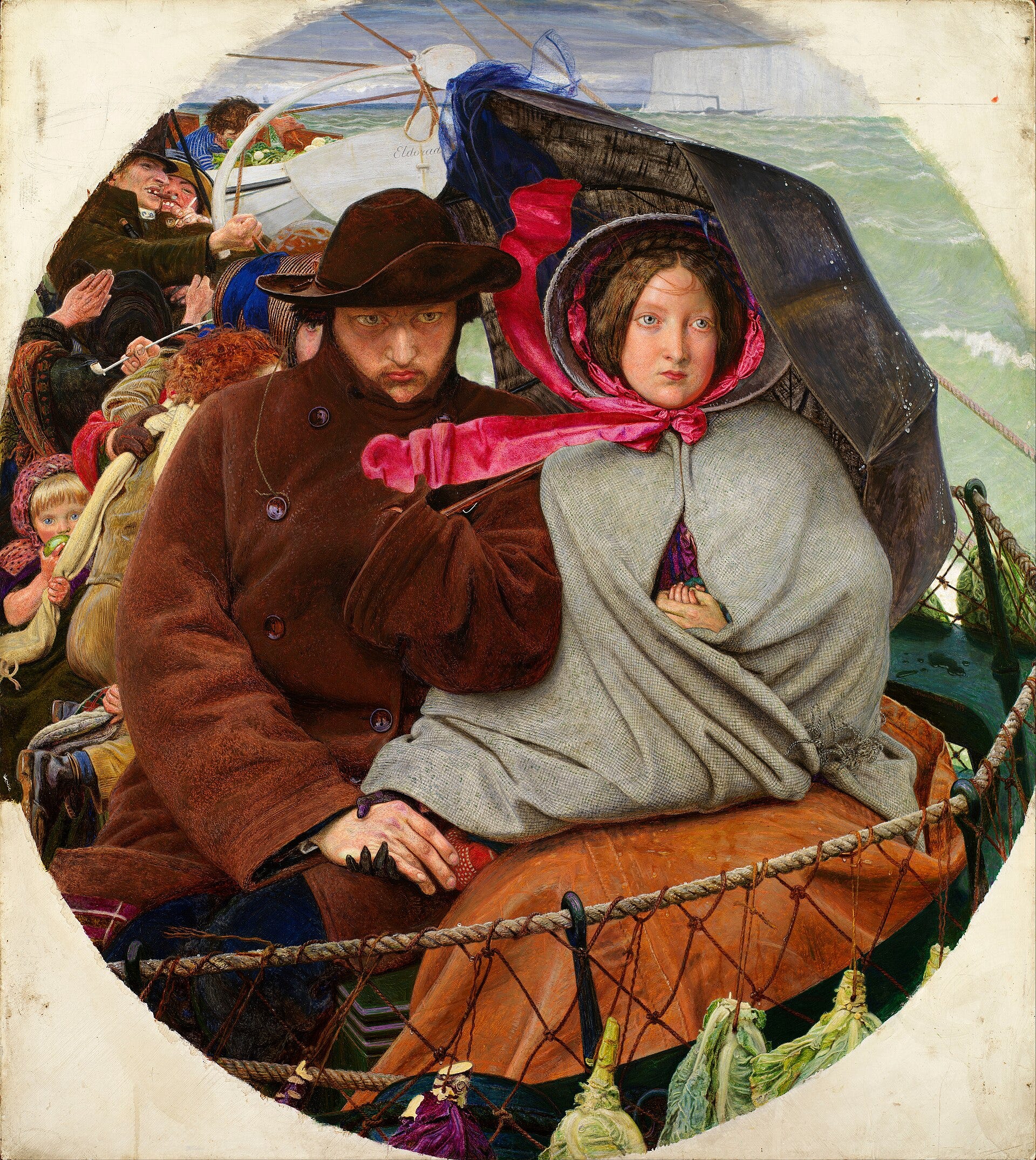
Ford Madox Brown (1821 to 1893) was an English painter of the age of Queen Victoria. He is known for The Last of England, a picture of a couple leaving their country by ship, and for Work, a scene of laborers digging up a road.
Cool Stories About Art is a newsletter to learn art the fun way.
Join 200,000+ readers and get:
10 new art stories / month
The entire archive of content (140+ articles)
Comment, ask questions, and chat with other readers
Ford Madox Brown spent most of his life on the edge of the London art world. He never became a member of the Royal Academy, the society of artists whose yearly exhibition drew the buyers, and in 1852, short of money, he thought of leaving England for India.
Twenty-six years later, Manchester, a great factory city in the north of England, chose the same man to paint the walls of its new town hall.
Ford Madox Brown was born on April 16, 1821, in Calais, a French port across the Channel. His father, who had served in the Royal Navy, had settled the family there because life cost less there.
Brown learned to paint in the art schools of Belgium. In 1843, a competition was held in London to choose the painters who would decorate the walls of the new palace of Parliament. He sent in a large drawing of a scene from English history, and it did not win.
Three years later, in 1846, his first wife, Elizabeth, died of tuberculosis, a disease of the lungs. In 1848, a bricklayer's daughter named Emma Hill began to pose for the widowed painter. Emma became his companion, and in 1850 their daughter Catherine was born.
By 1852, Brown was working in Hampstead, a village north of London, and his pictures found few buyers. That July, his friend Thomas Woolner, a sculptor, emigrated to Australia. Brown thought of leaving too, with Emma and the children, but for India.
That year, he began The Last of England and gave the two travelers on the deck his own face and Emma's.
Brown never sailed. In 1878, Manchester asked him to work in the great hall of its town hall, where the city council sits. The city wanted its story told in twelve large pictures on the two long walls, from a Roman fort to a chemist gathering gas in a marsh. It asked Brown first for six of them, then for the rest.
What happened when the painter who lost the 1843 competition for Parliament's walls was finally given twelve walls of his own?
In the rest of the story
Which small part of The Last of England took Brown four weeks to paint.
Who posed for the baby in Work and died before the picture was finished.
Which scene of its own past Manchester refused to let him paint.
Which famous writer agreed to be photographed so Brown could paint his face.