
Every fortune teller works with two things at once, the client's hand and the client's attention, and painters noticed early that the second was the more valuable. From a Roman tavern and a Venetian arcade to the most famous card reader in Paris, these twelve pictures show the trade at work, and what went missing while the client listened.
Cool Stories About Art is a newsletter to learn art the fun way.
Join 200,000+ readers and get:
10 new art stories / month
The entire archive of content (140+ articles)
Comment, ask questions, and chat with other readers
What the Client Never Sees
A fortune-telling scene gathers three or four people around a small table and gives the painter two plots at once: the future the client is promised, and what happens to his purse while he hears it. Both plots are carried by hands, and that is where painters kept looking.
The routine itself hardly moved in four centuries. The coin came first, then the palm, the cards or the mirror, and a few questions that sounded harmless. Europeans long believed that the Romani people had come from Egypt, which is how the word gypsy was formed, and many old titles still use it.
Each picture chosen here shows the trade through a gesture, a tool or a sign of it, on the street, in a tavern or in a private room. Most of the painters took the client's side and showed what he could not see.
12. François Dumont, Portrait of Mademoiselle Le Normand (about 1793)
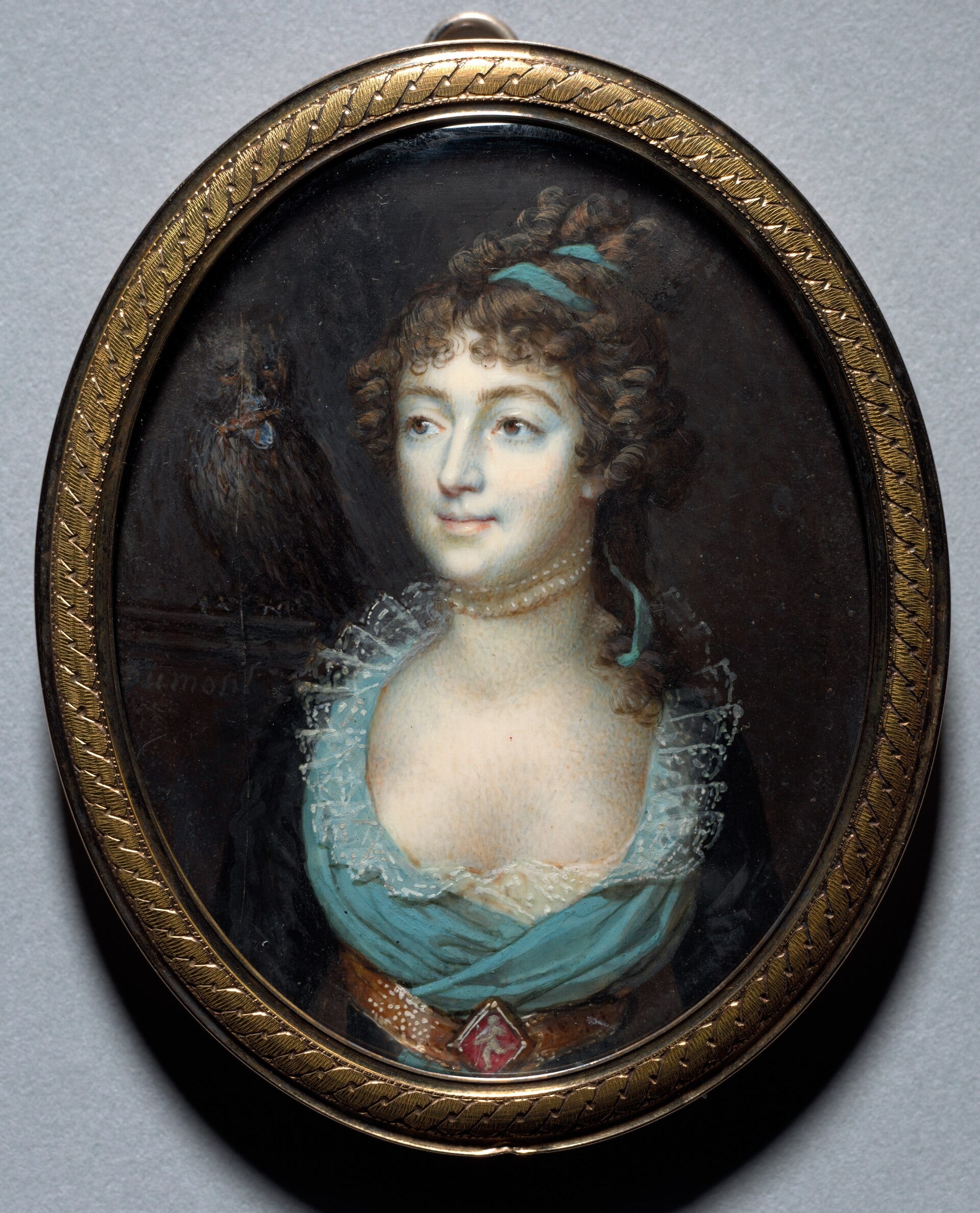
An owl perches beside the young woman in this oval miniature, a moth in its beak. The rest belongs to Paris fashion: powdered curls, a white dress, the soft finish of watercolor on ivory. Only the owl hints at her trade. Since Roman times it had been a bird of ill omen, and Shakespeare calls it the fatal bellman in Macbeth.
The young woman is Marie-Anne Le Normand, born around 1772 in Alençon, in Normandy, who became the most famous card reader in Paris. François Dumont painted her around 1793. A miniaturist, he had portrayed Marie-Antoinette the year before, and the dress and hairstyle he gave his new sitter recall that royal portrait.
The miniature shows nothing of her working day, but her clients described it closely. Captain Rees Howell Gronow, a British officer who wrote memoirs of Paris society, remembered a waiting room like a dentist's, then a consulting room lit from above, with secret panels in the walls. The secrecy had a reason, since under the restored monarchy the police banned fortune-telling.
Inside, the client chose between the grand jeu and the petit jeu, the large spread or the small. Le Normand asked his age, his favorite color and his favorite animal, then said "Coupez," cut, again and again, until she held the number of cards she wanted, and laid them out in rows.
The English diarist Lady Frances Shelley went through the same ritual on July 4, 1816. She was made to cut with her left hand and was asked for the first letter of her name and of her birthplace. Any professional card reader will recognize those innocent questions, because each one gives the reader something to work with before a single card is turned.
Some clients went further and fed her the answers on purpose. The American writer Washington Irving noted in his journal a story told at a dinner by a Count Walewski, who had called on her ahead of a lady he was courting. He described the lady, her life and what she ought to hear, and left six louis. The lady came out amazed.
Nobody who visited her met the young woman of the miniature. Gronow compared her to a bloated, venomous toad, with a squint and a fur cap, in a room with bats nailed to the ceiling and stuffed owls on the walls. In her own memoirs she claimed to have foretold violent deaths to Robespierre, Saint-Just and Marat, and a rise and a fall to Josephine, who summoned her to the Tuileries. Those stories belong to legend.
She retired to Alençon after 1830 and died in 1843. Two years later, the Paris publisher Grimaud printed a Grand Jeu de Mlle Lenormand designed by a woman who said she had been her pupil, and the same year a German deck of 36 cards took her name. The Petit Lenormand that card readers still lay out today never passed through her hands.
At a Glance
Artist: François Dumont (1751 to 1831)
Painted: About 1793
Medium: Watercolor on ivory, in a silver-gilt mount
Size: 7.3 × 5.8 cm (2 7/8 × 2 5/16 in)
Where to see it: Cleveland Museum of Art, Cleveland, Ohio
About This Painting
Who are some famous fortune tellers in history?
In modern Europe, the best known is Marie-Anne Le Normand, who read cards in Paris for about forty years, from the Revolution until around 1830.
11. Karl Bryullov, Svetlana Telling Her Fortune (1836)
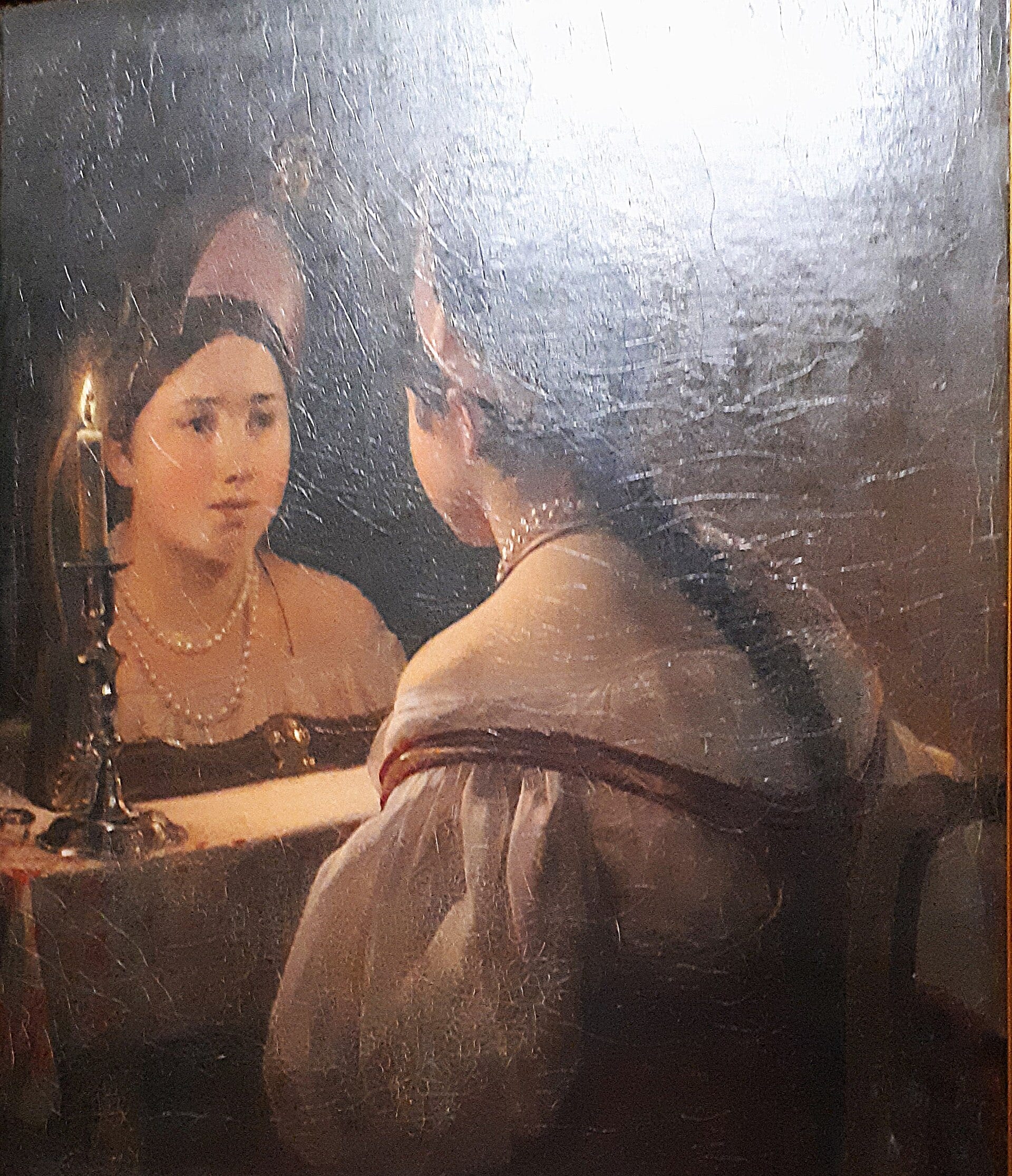
At night, in a dark room, a girl in a Russian sarafan and a tall headdress sits at a table with her back to us. A tall candle standing beside a small mirror gives the only light. She is waiting for a face other than her own to appear in the glass.