Francis Bacon the Painter: The Complete Story

Francis Bacon never took a painting lesson, painted about 45 screaming popes without ever looking at the Velazquez original, and lost the love of his life to an overdose two nights before his own triumph at the Grand Palais. His studio was moved to Dublin brick by brick, chaos included.

He called what he wanted the brutality of fact. The facts of his own life supplied most of the brutality.

Francis Bacon at a glance:

  • 1909: born in Dublin to English parents; his horse-trainer father throws him out at 16.

  • 1927: sees a Picasso show in Paris and decides, with no training at all, that painting is the job.

  • 1945: Three Studies for Figures at the Base of a Crucifixion stuns wartime London; he later destroys most of what came before.

  • 1971: George Dyer dies in their Paris hotel two days before the Grand Palais retrospective opens; the black triptychs follow.

  • 1992: dies in Madrid at 82, in the care of nuns, mid-trip to see a lover; the studio is later moved to Dublin bolt by bolt.

Reconstruction of Francis Bacon's 7 Reece Mews studio
The studio as he left it: rebuilt in Dublin with every tin and slashed canvas mapped.

Dublin, exile, and a Picasso show

Bacon was born in Dublin on October 28, 1909, to English parents, an asthmatic boy in a horse-training household run by a father who despised him.

Thrown out at 16, he drifted through Berlin and Paris, where a 1927 Picasso exhibition decided him: he would paint, untrained.

Through the 1930s he worked as a furniture and rug designer, painting on the side and destroying nearly everything.

April 1945: the Crucifixion triptych

When Three Studies for Figures at the Base of a Crucifixion went up at the Lefevre Gallery in London in April 1945, alongside the news photographs from the liberated camps, visitors recoiled and his name was made in a week.

The snarling, eyeless creatures on orange announced a postwar art with no consolation in it. Bacon later destroyed or disowned most of what he had painted before that month.


Hooked on Bacon? Get more art secrets and stories in your inbox, free.


More incredible painter stories

If Francis Bacon the Painter pulled you in, you will love these too:


The popes, and the man he would not meet

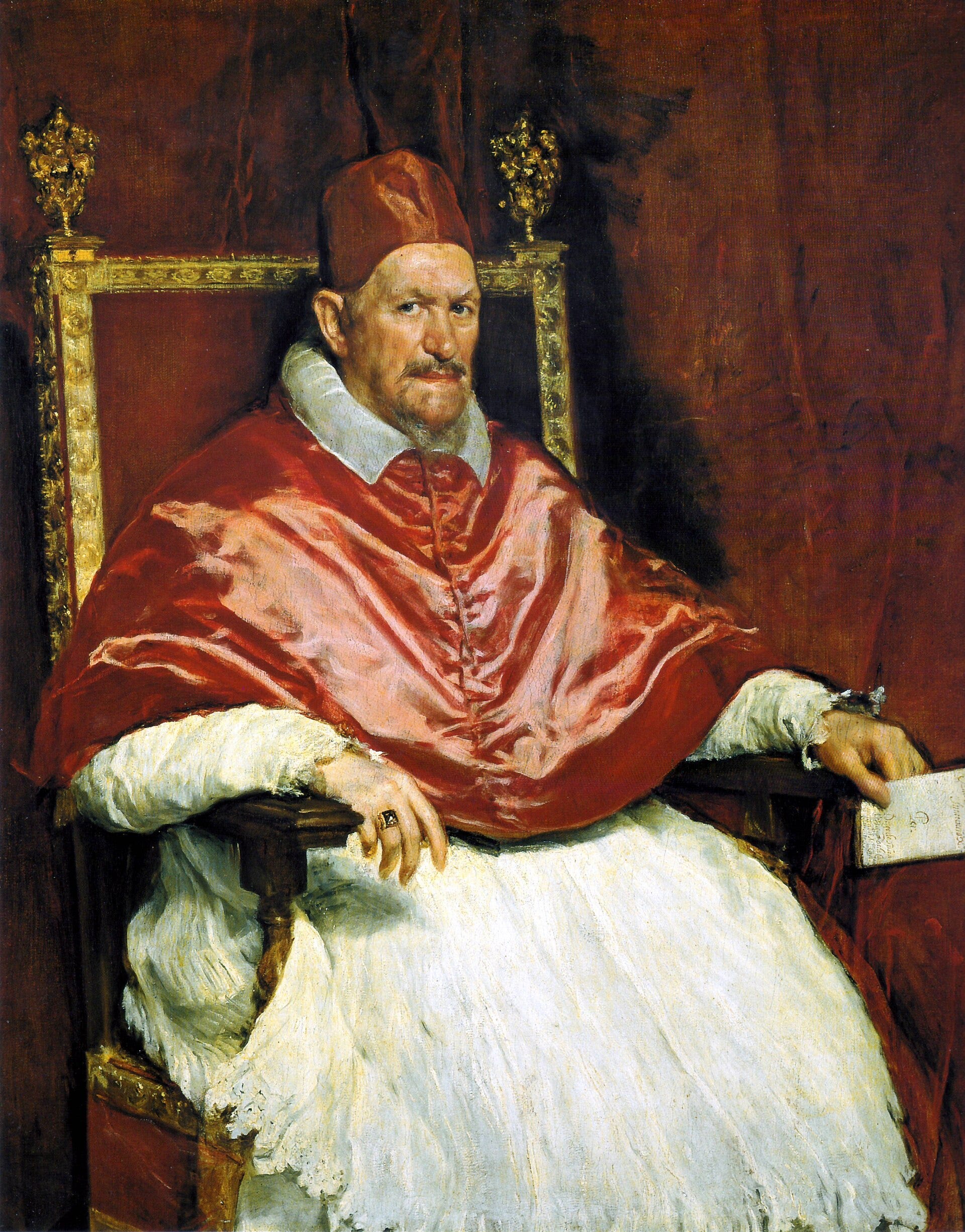
From 1949 into the 1960s Bacon painted around 45 variations on Velazquez's Portrait of Innocent X, caged in glass boxes, mouths open.

He kept the Velazquez in reproduction all over his studio and, on visits to Rome, refused to see the original, saying he had no wish to confront what he had done to it.

The scream he studied from a nurse's face in Eisenstein's Battleship Potemkin, frame by frame.

George Dyer, Paris, 1971

Bacon met George Dyer, an East End petty thief, in 1963, by his own telling when Dyer fell through his skylight mid-burglary.

Dyer became his model and companion, and on October 24, 1971, two days before Bacon's retrospective opened at the Grand Palais, the second living painter so honored, Dyer died of an overdose in their Paris hotel room.

Bacon attended his own apotheosis in mourning and spent the next years painting the Black Triptychs, the most naked grief in postwar art.

The myth of the painter of horror

Bacon rejected the horror label every time it was offered.

He insisted he was a realist about the body, that meat and mortality were simply the situation, and friends knew him as the most generous host in Soho, buying champagne for the room at the Colony Club between sessions of ruthless work at 7 Reece Mews.

The pictures are not nightmares to him; they are portraits with the politeness removed.


130,000 readers learn art the fun way here. Join them, free.


Madrid, the record, and the studio that moved

Bacon died in Madrid on April 28, 1992, of a heart attack, asthma dogging him to the end. 4 million dollars, briefly the most expensive artwork ever auctioned.

His studio at 7 Reece Mews, with its 7,000 books, slashed canvases, and paint-crusted walls, was catalogued like an archaeological site and rebuilt intact at the Hugh Lane Gallery in Dublin, the city he left at 16.

Roulette money and the Colony Room

Before painting paid, gambling sometimes did: he ran an illegal roulette table out of his studio and took the bank's percentage.

Afternoons belonged to the Colony Room, the green-walled Soho drinking club where Muriel Belcher paid him ten pounds a week to bring rich friends.

The discipline hid inside the chaos: whatever the night had been, mornings were for work, alone, hungover and exact.

Interviews as a second oeuvre

With the critic David Sylvester he recorded, over 25 years, the most quoted artist interviews of the century: brutality of fact, the accident that suggests, paint that comes across directly onto the nervous system.

The interviews built the frame every Bacon show still uses, which was partly the idea: he was his own best explainer and his own tightest editor.

He gave the performance in the same suit, over champagne, and never changed the answers. Consistency was the last thing anyone expected from him, so he supplied it.

What he destroyed

He slashed and binned canvases all his life: the Dublin studio inventory counts about a hundred destroyed works, and dealers tell of more rescued from skips.

Nearly everything before 1944 went; he wanted the record to start at the Crucifixion, and largely got his way.

The editing was the point: a small, ferocious surviving corpus with no juvenilia to soften it.

The Francis Bacon questions that keep coming up

  • Why did Bacon paint screaming popes? He was obsessed with Velazquez's Innocent X and with a screaming nurse from Battleship Potemkin, and fused them roughly 45 times, while refusing ever to see the Velazquez in person.

  • Who was George Dyer? Bacon's model and companion from 1963, who died of an overdose in Paris in October 1971, two days before Bacon's Grand Palais opening. The Black Triptychs are his memorial.

  • How much is a Bacon worth? Three Studies of Lucian Freud brought 142.4 million dollars in 2013, then a world auction record, and major triptychs remain in that region.

  • Where is Francis Bacon's studio? Rebuilt exactly, dust and all, at the Hugh Lane Gallery in Dublin, moved from 7 Reece Mews, London, in 1998 with every one of its 7,000 items mapped.

  • Did Bacon draw? He claimed never; sketches surfaced after his death anyway, thin and private. The denial was part of the performance of instinct.

  • What was his palette like? The Dublin reconstruction shows he mixed on the door, the walls and dinner plates, with cashmere sweaters and corduroy used to texture wet paint.


More secrets to unlock


The chaos, played daily in Dublin

The archaeologists who moved Bacon's studio catalogued 7,500 objects, including 1,500 photographs, 100 slashed canvases, and the door he wiped his brushes on. The chaos turned out to be an instrument, and Dublin plays it daily.


Learn art the fun way. Get the next story in your inbox, free.


7 Reece Mews, South Kensington, London, with its plaque
7 Reece Mews, London. Thirty years of paintings came down that narrow staircase.