Frederic Edwin Church: The Complete Story
Frederic Edwin Church charged 25 cents to see a single painting, and thousands lined up with opera glasses. One canvas later vanished for a century into an English boys' home stairwell, resurfaced in 1979, and broke the American auction record.
Thomas Cole's only real pupil turned landscape into mass spectacle, then built a Persian castle above the Hudson when his hands gave out.
Frederic Edwin Church at a glance:
1826: born in Hartford to a wealthy family that can afford to apprentice him to Thomas Cole, who takes exactly one student.
1853: first expedition to South America, following the route Alexander von Humboldt prescribed for artists.
1859: Heart of the Andes shows in New York to paying crowds with opera glasses; 12,000 people file past in three weeks.
1870: begins building Olana, the Persian-styled hilltop house he calls the center of the world.
1900: dies with his fame long faded; the resurrection takes most of the next century.
Cole's one student
Church was born in Hartford, Connecticut, on May 4, 1826, to a wealthy family that could afford the best teacher in America: from 1844 to 1846 he studied in Catskill with Thomas Cole, founder of the Hudson River School, who took no other pupils of consequence. The student soon out-detailed the master, painting rock, bark, and cloud with near-scientific precision.
The one-painting blockbuster
In 1857 Church put Niagara, more than two meters wide, alone in a New York gallery at 25 cents a head, and the crowds came, then came again in London.
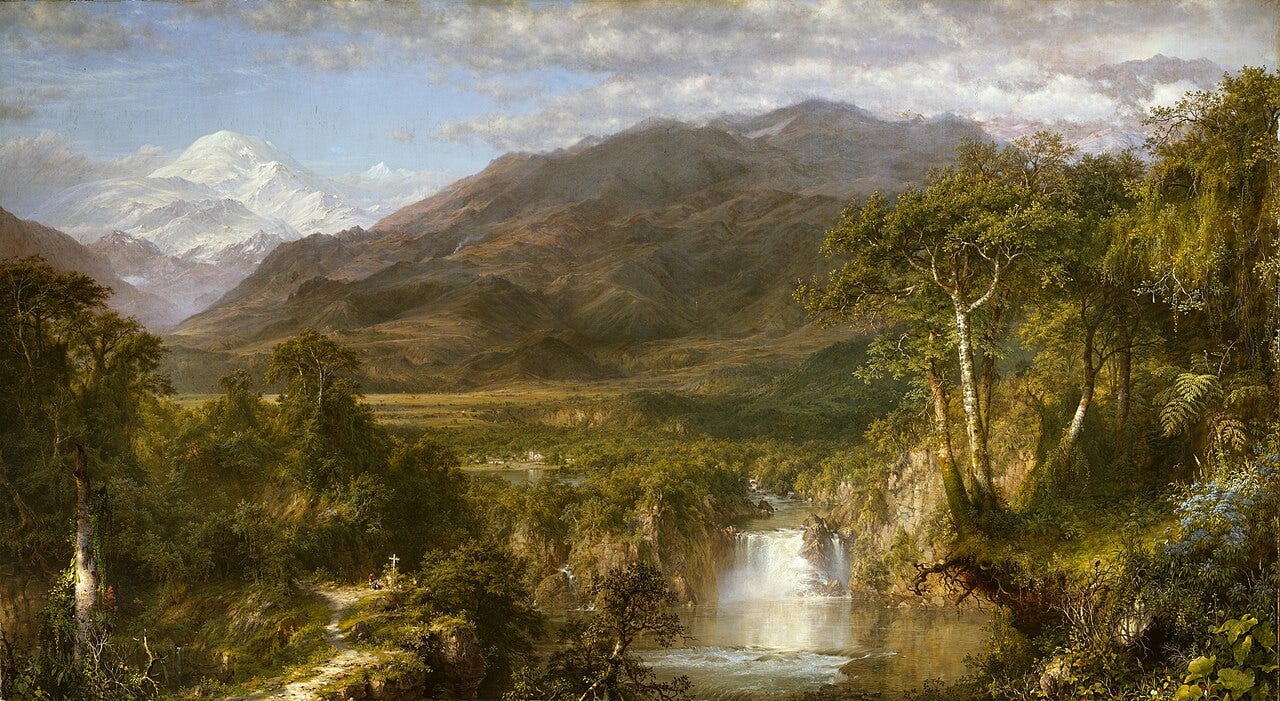
Heart of the Andes followed in 1859, framed like a window, shown in a darkened room with gaslight and opera glasses for the foliage: roughly 13,000 visitors in three weeks, and a sale at 10,000 dollars, the highest price yet paid for a work by a living American artist.
He was following Alexander von Humboldt's call to unite science and art, retracing the naturalist's South American routes in 1853 and 1857.
More incredible painter stories
If Frederic Edwin Church pulled you in, you will love these too:
Icebergs, Petra, and the lost painting
The Icebergs of 1861, painted after a chartered voyage off Newfoundland, toured for the Union cause, sold to an English railway magnate, and disappeared.
5 million dollars, the record for an American painting at the time, and donated anonymously to the Dallas Museum of Art. Church meanwhile had pushed on to the Arctic, Jamaica, and the ruins of Petra and Jerusalem.
The myth of the showman
Modernists dismissed Church as Barnum with a paintbrush, all special effects and ticket lines.
The reappraisal stands on his fieldwork: hundreds of oil sketches made on location, accurate botany Humboldt himself would have recognized, and a public that learned its geography from his canvases decades before photography could deliver color.
The spectacle was science communication, priced for everyone.
Olana: the last composition
Rheumatoid arthritis crippled Church's painting arm from the late 1870s, and he answered with architecture: Olana, the Persian-inspired house he designed with Calvert Vaux above the Hudson from 1870, its windows framing the valley like canvases.
He called the estate his last great landscape and worked on it until his death in New York on April 7, 1900.
Niagara hangs in the National Gallery in Washington, Heart of the Andes at the Met, The Icebergs in Dallas, and Olana is a New York State Historic Site, view intact.
Humboldt's homework
Church went to South America because a book told him to: Humboldt's Cosmos, which called for an artist capable of uniting science and landscape.
He retraced Humboldt's Andean routes in 1853 and 1857, sketching volcanos with a naturalist's discipline: botany legible in the foreground, geology in the cliffs.
He meant to ship Heart of the Andes to Humboldt himself. The old scientist died in 1859, weeks before the painting could cross.
The sky that enlisted
Twilight in the Wilderness, finished in 1860, hangs a blood-red sky over an empty America; within a year viewers decided it had been prophecy.
When war came he answered in paint: Our Banner in the Sky, a sunset torn into the Stars and Stripes, sold as a patriotic print.
For a painter who avoided figures, it was as political as he ever got: the landscape itself enlisting.
Outliving his own fame
By the 1880s, French-trained tonalism made the great machines look theatrical, and his prices collapsed along with his rheumatic painting arm.
He died in 1900 barely mentioned. Olana survived on family stubbornness until a 1966 campaign saved the house from dispersal by months.
Revival came by staircase and archive: the house opened, the oil sketches surfaced, and history rehired the showman as America's painter-scientist.
The Frederic Edwin Church questions that keep coming up
Who taught Frederic Church? Thomas Cole, founder of the Hudson River School, who accepted the 18-year-old as his only real pupil in 1844.
What is Heart of the Andes? His three meter Andean panorama of 1859, exhibited as a one-painting show with opera glasses and 25 cent tickets, now at the Metropolitan Museum.
What is Olana? The Persian-styled house and landscape Church designed above the Hudson when arthritis ended his painting, preserved today exactly as he composed it.
What happened to The Icebergs? Sold to England in 1863, it vanished into a Manchester boys' home for about a century, resurfaced in 1979, made 2.5 million dollars at auction, and went to Dallas.
How much does a Church cost? The Icebergs brought 2.5 million dollars in 1979, then an American record; the rare majors that move now do so privately, for far more.
What about his oil sketches? Thousands survive, quick and free, painted for himself. Many hang at Olana and Cooper Hewitt, and modern taste often prefers them to the machines.
More secrets to unlock
The staircase painting that broke the record
The 1979 rediscovery of The Icebergs multiplied the American auction record several times over in one evening, for a painting that schoolboys had walked past on a staircase for generations without a second look.